


The SaaS Margin Collapse: Why AI Startups Face an "Inference COGS" Crisis (And How to Architect Around It)
For two decades, software startups raised capital on the back of 75% to 85% gross margins: once code was deployed, serving an additional user cost fractions of a cent.
In AI-first software, every user action triggers an inference compute cycle. AI startup gross margins hover closer to 50% to 60%, with some high-growth wrappers dipping as low as 25% to 30%. When your pricing is fixed per seat ($30/seat/month) but your heavy users consume $70 in token passes, scale doesn't create operating leverage—it accelerates cash burn.
Founders must shift from naive API proxy wrappers to a tiered model-routing architecture.
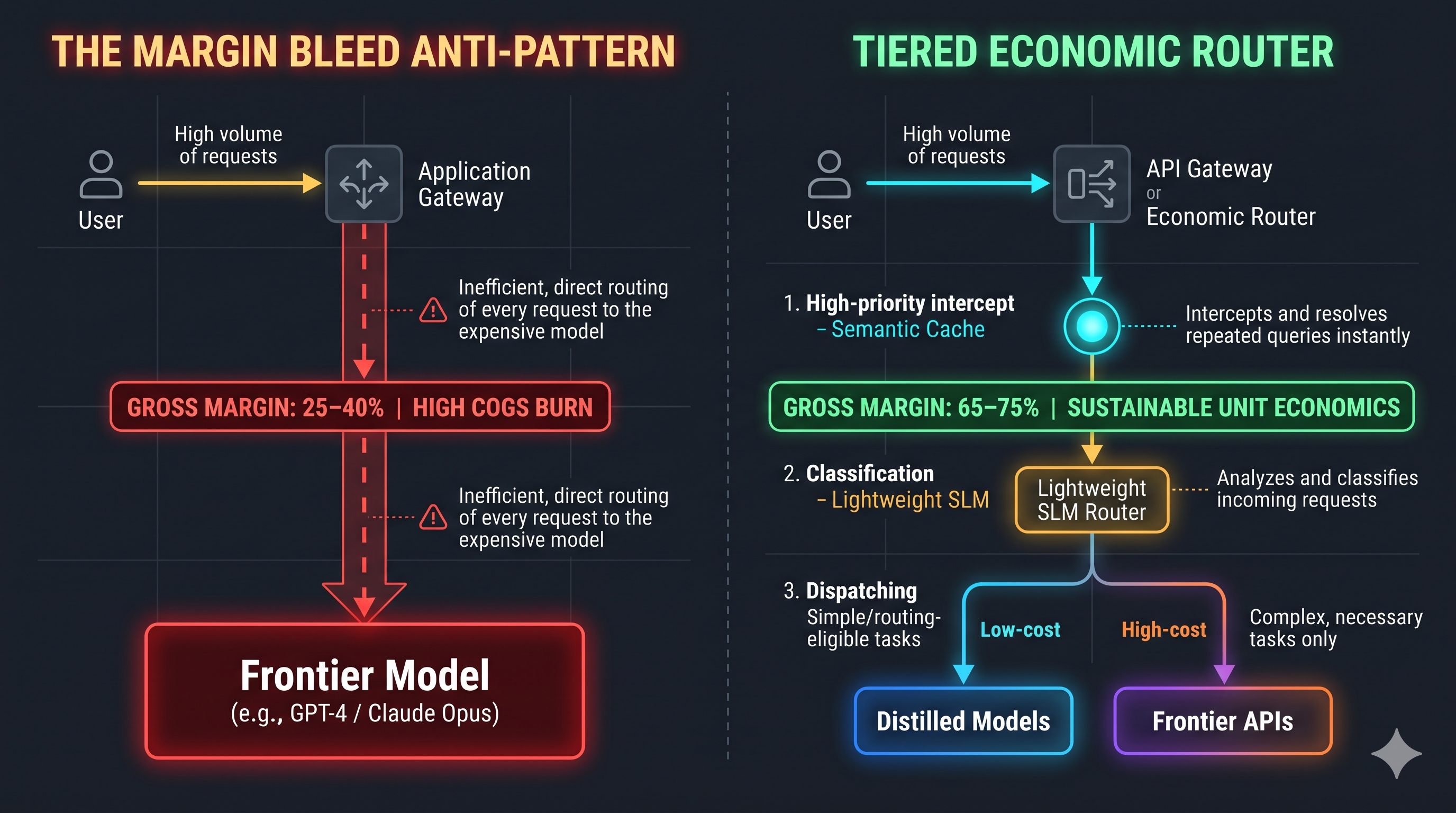
The Margin-Killing Anti-Pattern vs. Tiered Inference
Margin Trap (Naive Proxy):
[User Request] ➔ Universal Frontier Model ($$$$) ➔ Static Output
Margin: ~25-45% (Every token hits the most expensive provider)
Sustainable Margin Architecture:
[User Request]
│
├──> [Semantic Cache (Redis)] ──────────────> Fast Return ($0)
│
├──> [Rule / Complexity Classifier (1B/3B)]
│
├── Simple/Structured ──> [Self-Hosted SLM / Distilled Model] ($)
└── Deep Multi-Step ───> [Frontier Reasoning API] ($$$$)
Margin: 65-75% (Targeted compute allocation)
3 Architectural Rules to Protect Startup Gross Margins
Implement Aggressive Semantic Caching at the Gateway
Between 20% and 40% of queries within specific verticals (e.g., customer support, document parsing, boilerplate drafting) share semantic intent. Serving cached vector similarity matches from an in-memory cache directly eliminates 100% of LLM compute costs on repeated workflows.
Decouple "Thinking" from "Synthesizing" (Cascade Routing)
Use compact, distilled models (1B to 8B parameter models running on cost-effective cloud or edge instances) for classification, extraction, and JSON schema formatting. Route tasks to flagship foundation models only when deep synthetic reasoning or multi-hop evaluation is strictly required.
Align Pricing with Compute Units (Kill Naive Flat-Rate Tiers)
If your product involves agentic workflows or open-ended code generation, pure per-seat flat pricing exposes you to tail-risk power users. Move to hybrid pricing: a base platform fee combined with credit allowances or outcome-based micro-metering that protects your floor gross margin.
Discussion Question
For founders building AI products: What is your current blended gross margin, and at what monthly query volume did you find it economically viable to switch from closed frontier APIs to self-hosted open-weight SLMs?
CTA (Join Startup Founders & Entrepreneurs)
Build defensible products, fix your unit economics, and scale capital-efficient startups alongside venture-backed founders.
👉 Join Startup Founders & Entrepreneurs: [techawks.io/founders-community]
For two decades, software startups raised capital on the back of 75% to 85% gross margins: once code was deployed, serving an additional user cost fractions of a cent.
In AI-first software, every user action triggers an inference compute cycle. AI startup gross margins hover closer to 50% to 60%, with some high-growth wrappers dipping as low as 25% to 30%. When your pricing is fixed per seat ($30/seat/month) but your heavy users consume $70 in token passes, scale doesn't create operating leverage—it accelerates cash burn.
Founders must shift from naive API proxy wrappers to a tiered model-routing architecture.
The Margin-Killing Anti-Pattern vs. Tiered Inference
Margin Trap (Naive Proxy):
[User Request] ➔ Universal Frontier Model ($$$$) ➔ Static Output
Margin: ~25-45% (Every token hits the most expensive provider)
Sustainable Margin Architecture:
[User Request]
│
├──> [Semantic Cache (Redis)] ──────────────> Fast Return ($0)
│
├──> [Rule / Complexity Classifier (1B/3B)]
│
├── Simple/Structured ──> [Self-Hosted SLM / Distilled Model] ($)
└── Deep Multi-Step ───> [Frontier Reasoning API] ($$$$)
Margin: 65-75% (Targeted compute allocation)
3 Architectural Rules to Protect Startup Gross Margins
Implement Aggressive Semantic Caching at the Gateway
Between 20% and 40% of queries within specific verticals (e.g., customer support, document parsing, boilerplate drafting) share semantic intent. Serving cached vector similarity matches from an in-memory cache directly eliminates 100% of LLM compute costs on repeated workflows.
Decouple "Thinking" from "Synthesizing" (Cascade Routing)
Use compact, distilled models (1B to 8B parameter models running on cost-effective cloud or edge instances) for classification, extraction, and JSON schema formatting. Route tasks to flagship foundation models only when deep synthetic reasoning or multi-hop evaluation is strictly required.
Align Pricing with Compute Units (Kill Naive Flat-Rate Tiers)
If your product involves agentic workflows or open-ended code generation, pure per-seat flat pricing exposes you to tail-risk power users. Move to hybrid pricing: a base platform fee combined with credit allowances or outcome-based micro-metering that protects your floor gross margin.
Discussion Question
For founders building AI products: What is your current blended gross margin, and at what monthly query volume did you find it economically viable to switch from closed frontier APIs to self-hosted open-weight SLMs?
CTA (Join Startup Founders & Entrepreneurs)
Build defensible products, fix your unit economics, and scale capital-efficient startups alongside venture-backed founders.
👉 Join Startup Founders & Entrepreneurs: [techawks.io/founders-community]
The SaaS Margin Collapse: Why AI Startups Face an "Inference COGS" Crisis (And How to Architect Around It)
For two decades, software startups raised capital on the back of 75% to 85% gross margins: once code was deployed, serving an additional user cost fractions of a cent.
In AI-first software, every user action triggers an inference compute cycle. AI startup gross margins hover closer to 50% to 60%, with some high-growth wrappers dipping as low as 25% to 30%. When your pricing is fixed per seat ($30/seat/month) but your heavy users consume $70 in token passes, scale doesn't create operating leverage—it accelerates cash burn.
Founders must shift from naive API proxy wrappers to a tiered model-routing architecture.
The Margin-Killing Anti-Pattern vs. Tiered Inference
Margin Trap (Naive Proxy):
[User Request] ➔ Universal Frontier Model ($$$$) ➔ Static Output
Margin: ~25-45% (Every token hits the most expensive provider)
Sustainable Margin Architecture:
[User Request]
│
├──> [Semantic Cache (Redis)] ──────────────> Fast Return ($0)
│
├──> [Rule / Complexity Classifier (1B/3B)]
│
├── Simple/Structured ──> [Self-Hosted SLM / Distilled Model] ($)
└── Deep Multi-Step ───> [Frontier Reasoning API] ($$$$)
Margin: 65-75% (Targeted compute allocation)
3 Architectural Rules to Protect Startup Gross Margins
Implement Aggressive Semantic Caching at the Gateway
Between 20% and 40% of queries within specific verticals (e.g., customer support, document parsing, boilerplate drafting) share semantic intent. Serving cached vector similarity matches from an in-memory cache directly eliminates 100% of LLM compute costs on repeated workflows.
Decouple "Thinking" from "Synthesizing" (Cascade Routing)
Use compact, distilled models (1B to 8B parameter models running on cost-effective cloud or edge instances) for classification, extraction, and JSON schema formatting. Route tasks to flagship foundation models only when deep synthetic reasoning or multi-hop evaluation is strictly required.
Align Pricing with Compute Units (Kill Naive Flat-Rate Tiers)
If your product involves agentic workflows or open-ended code generation, pure per-seat flat pricing exposes you to tail-risk power users. Move to hybrid pricing: a base platform fee combined with credit allowances or outcome-based micro-metering that protects your floor gross margin.
Discussion Question
For founders building AI products: What is your current blended gross margin, and at what monthly query volume did you find it economically viable to switch from closed frontier APIs to self-hosted open-weight SLMs?
CTA (Join Startup Founders & Entrepreneurs)
Build defensible products, fix your unit economics, and scale capital-efficient startups alongside venture-backed founders.
👉 Join Startup Founders & Entrepreneurs: [techawks.io/founders-community]

 Arabic
 French
 Spanish
 Portuguese
 Deutsch
 Turkish
 Dutch
 Italiano
 Russian
 Romaian
 Portuguese (Brazil)
 Greek