


The Two-Copy Trap: Why Modern Data Stacks Are Killing Standalone Vector Databases in Favor of Lakehouse Vector Columns
When generative AI and semantic retrieval exploded into enterprise architectures, the instinctive solution was adding another siloed database: dump raw data into the object lake, transform it in Snowflake or Databricks, generate embeddings via batch jobs, and mirror those vectors into a dedicated vector store.
The real price tag isn't just the secondary storage or GPU RAM bill. It’s the operational blast radius:
Governance Drift: Row-level security, tenant masking, and catalog access policies applied in your lakehouse must be manually reimplemented as metadata filters in the vector store.
Silent Sync Lag: Updates, soft deletes, and GDPR/CCPA purge requests applied in your primary tables fail to propagate instantly, causing LLM retrieval systems to surface deleted or unauthorized data.
Zero Snapshot Time-Travel: While open lakehouse table formats (like Apache Iceberg or Delta Lake) allow deterministic historical queries via immutable snapshot trees, standalone vector databases rarely support unified temporal rollbacks.
Enterprise data architecture is fundamentally consolidating toward In-Place Lakehouse Vector Search and unified columnar formats.
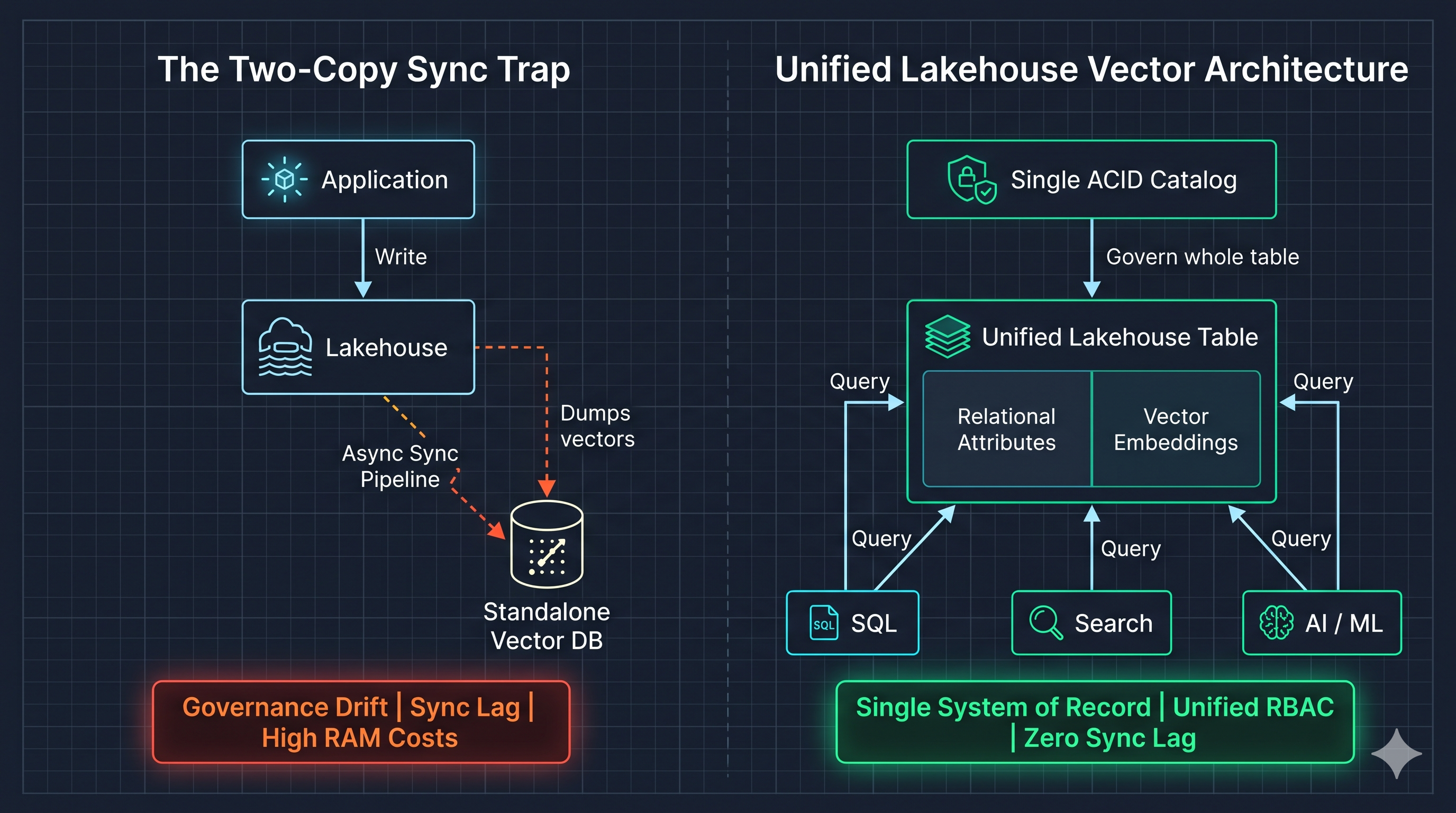
The Siloed Sync Anti-Pattern vs. Unified Lakehouse Storage
Siloed Vector DB Architecture (The Two-Copy Trap):
[Lakehouse Table (Iceberg)]
│
└──> [Brittle Sync Pipeline] ➔ [Standalone Vector DB] ➔ [Disjointed Access Control]
(Prone to lag, sync failures, & GDPR audit leakage)
Unified Lakehouse Architecture (In-Place Vector Search):
[Client / Query Engine (Trino, DuckDB, LanceDB, Spark)]
│
▼
[Unified Open Table Format: Vector Embeddings Stored In-Place]
├── Relational Columns: (user_id, tenant_id, timestamp)
├── Vector Column: embedding: array<float>
└── Governed Catalog (ACID Transactions, Time Travel, Single RBAC Policy)
3 Rules for Designing Resilient Vector Data Architectures
Treat Embeddings as First-Class Column Types
Modern columnar formats (Parquet, Lance, and Iceberg) allow embedding vectors to be stored directly alongside transactional and analytical metadata. Colocating embeddings with structured business attributes enables engines to perform pre-filtered vector pruning (e.g., filtering tenant_id = 'org_42' before computing cosine distance) without cross-system network hops.
Anchor ACID Transactions to a Single System of Record
If your application requires approximate nearest neighbor (ANN) indexing at scale, ensure your open lakehouse format remains the authoritative master. Any specialized external index must be treated as an ephemeral, derived projection that can be rebuilt deterministically from Iceberg snapshot metadata rather than an independent source of truth.
Eliminate RAM-Bound Infrastructure Taxes
First-generation vector stores require keeping entire vector indices in memory to deliver low latencies. Newer disk-backed and object-storage-native indexing algorithms (such as IVF-PQ and DiskANN over cloud object storage) allow petabyte-scale semantic search at standard cloud object storage rates ($0.02/GB/month) rather than dedicated high-RAM cluster pricing.
Discussion Question
Is your data team querying vector embeddings directly within your primary data lakehouse/warehouse engines (via Iceberg, Lance, or warehouse-native vector functions), or are you still maintaining a separate vector database cluster? What has been your biggest pain point with metadata synchronization?
CTA (Join Data Science & Analytics)
Ditch outdated pipeline patterns, optimize lakehouse architectures, and build enterprise-grade data infrastructure with top engineers.
👉 Join Data Science & Analytics: [techawks.io/data-community]
When generative AI and semantic retrieval exploded into enterprise architectures, the instinctive solution was adding another siloed database: dump raw data into the object lake, transform it in Snowflake or Databricks, generate embeddings via batch jobs, and mirror those vectors into a dedicated vector store.
The real price tag isn't just the secondary storage or GPU RAM bill. It’s the operational blast radius:
Governance Drift: Row-level security, tenant masking, and catalog access policies applied in your lakehouse must be manually reimplemented as metadata filters in the vector store.
Silent Sync Lag: Updates, soft deletes, and GDPR/CCPA purge requests applied in your primary tables fail to propagate instantly, causing LLM retrieval systems to surface deleted or unauthorized data.
Zero Snapshot Time-Travel: While open lakehouse table formats (like Apache Iceberg or Delta Lake) allow deterministic historical queries via immutable snapshot trees, standalone vector databases rarely support unified temporal rollbacks.
Enterprise data architecture is fundamentally consolidating toward In-Place Lakehouse Vector Search and unified columnar formats.
The Siloed Sync Anti-Pattern vs. Unified Lakehouse Storage
Siloed Vector DB Architecture (The Two-Copy Trap):
[Lakehouse Table (Iceberg)]
│
└──> [Brittle Sync Pipeline] ➔ [Standalone Vector DB] ➔ [Disjointed Access Control]
(Prone to lag, sync failures, & GDPR audit leakage)
Unified Lakehouse Architecture (In-Place Vector Search):
[Client / Query Engine (Trino, DuckDB, LanceDB, Spark)]
│
▼
[Unified Open Table Format: Vector Embeddings Stored In-Place]
├── Relational Columns: (user_id, tenant_id, timestamp)
├── Vector Column: embedding: array<float>
└── Governed Catalog (ACID Transactions, Time Travel, Single RBAC Policy)
3 Rules for Designing Resilient Vector Data Architectures
Treat Embeddings as First-Class Column Types
Modern columnar formats (Parquet, Lance, and Iceberg) allow embedding vectors to be stored directly alongside transactional and analytical metadata. Colocating embeddings with structured business attributes enables engines to perform pre-filtered vector pruning (e.g., filtering tenant_id = 'org_42' before computing cosine distance) without cross-system network hops.
Anchor ACID Transactions to a Single System of Record
If your application requires approximate nearest neighbor (ANN) indexing at scale, ensure your open lakehouse format remains the authoritative master. Any specialized external index must be treated as an ephemeral, derived projection that can be rebuilt deterministically from Iceberg snapshot metadata rather than an independent source of truth.
Eliminate RAM-Bound Infrastructure Taxes
First-generation vector stores require keeping entire vector indices in memory to deliver low latencies. Newer disk-backed and object-storage-native indexing algorithms (such as IVF-PQ and DiskANN over cloud object storage) allow petabyte-scale semantic search at standard cloud object storage rates ($0.02/GB/month) rather than dedicated high-RAM cluster pricing.
Discussion Question
Is your data team querying vector embeddings directly within your primary data lakehouse/warehouse engines (via Iceberg, Lance, or warehouse-native vector functions), or are you still maintaining a separate vector database cluster? What has been your biggest pain point with metadata synchronization?
CTA (Join Data Science & Analytics)
Ditch outdated pipeline patterns, optimize lakehouse architectures, and build enterprise-grade data infrastructure with top engineers.
👉 Join Data Science & Analytics: [techawks.io/data-community]
The Two-Copy Trap: Why Modern Data Stacks Are Killing Standalone Vector Databases in Favor of Lakehouse Vector Columns
When generative AI and semantic retrieval exploded into enterprise architectures, the instinctive solution was adding another siloed database: dump raw data into the object lake, transform it in Snowflake or Databricks, generate embeddings via batch jobs, and mirror those vectors into a dedicated vector store.
The real price tag isn't just the secondary storage or GPU RAM bill. It’s the operational blast radius:
Governance Drift: Row-level security, tenant masking, and catalog access policies applied in your lakehouse must be manually reimplemented as metadata filters in the vector store.
Silent Sync Lag: Updates, soft deletes, and GDPR/CCPA purge requests applied in your primary tables fail to propagate instantly, causing LLM retrieval systems to surface deleted or unauthorized data.
Zero Snapshot Time-Travel: While open lakehouse table formats (like Apache Iceberg or Delta Lake) allow deterministic historical queries via immutable snapshot trees, standalone vector databases rarely support unified temporal rollbacks.
Enterprise data architecture is fundamentally consolidating toward In-Place Lakehouse Vector Search and unified columnar formats.
The Siloed Sync Anti-Pattern vs. Unified Lakehouse Storage
Siloed Vector DB Architecture (The Two-Copy Trap):
[Lakehouse Table (Iceberg)]
│
└──> [Brittle Sync Pipeline] ➔ [Standalone Vector DB] ➔ [Disjointed Access Control]
(Prone to lag, sync failures, & GDPR audit leakage)
Unified Lakehouse Architecture (In-Place Vector Search):
[Client / Query Engine (Trino, DuckDB, LanceDB, Spark)]
│
▼
[Unified Open Table Format: Vector Embeddings Stored In-Place]
├── Relational Columns: (user_id, tenant_id, timestamp)
├── Vector Column: embedding: array<float>
└── Governed Catalog (ACID Transactions, Time Travel, Single RBAC Policy)
3 Rules for Designing Resilient Vector Data Architectures
Treat Embeddings as First-Class Column Types
Modern columnar formats (Parquet, Lance, and Iceberg) allow embedding vectors to be stored directly alongside transactional and analytical metadata. Colocating embeddings with structured business attributes enables engines to perform pre-filtered vector pruning (e.g., filtering tenant_id = 'org_42' before computing cosine distance) without cross-system network hops.
Anchor ACID Transactions to a Single System of Record
If your application requires approximate nearest neighbor (ANN) indexing at scale, ensure your open lakehouse format remains the authoritative master. Any specialized external index must be treated as an ephemeral, derived projection that can be rebuilt deterministically from Iceberg snapshot metadata rather than an independent source of truth.
Eliminate RAM-Bound Infrastructure Taxes
First-generation vector stores require keeping entire vector indices in memory to deliver low latencies. Newer disk-backed and object-storage-native indexing algorithms (such as IVF-PQ and DiskANN over cloud object storage) allow petabyte-scale semantic search at standard cloud object storage rates ($0.02/GB/month) rather than dedicated high-RAM cluster pricing.
Discussion Question
Is your data team querying vector embeddings directly within your primary data lakehouse/warehouse engines (via Iceberg, Lance, or warehouse-native vector functions), or are you still maintaining a separate vector database cluster? What has been your biggest pain point with metadata synchronization?
CTA (Join Data Science & Analytics)
Ditch outdated pipeline patterns, optimize lakehouse architectures, and build enterprise-grade data infrastructure with top engineers.
👉 Join Data Science & Analytics: [techawks.io/data-community]

 Arabic
 French
 Spanish
 Portuguese
 Deutsch
 Turkish
 Dutch
 Italiano
 Russian
 Romaian
 Portuguese (Brazil)
 Greek