


The Production-Ready Deployment Checklist: 10 Essentials Before You Push to Main
Deploying software shouldn't feel like a high-stakes gamble. Whether you are shipping a minor patch or a core infrastructure update, taking a systematic approach prevents fires before they start.
Bookmark this checklist for your team's next pull request review:
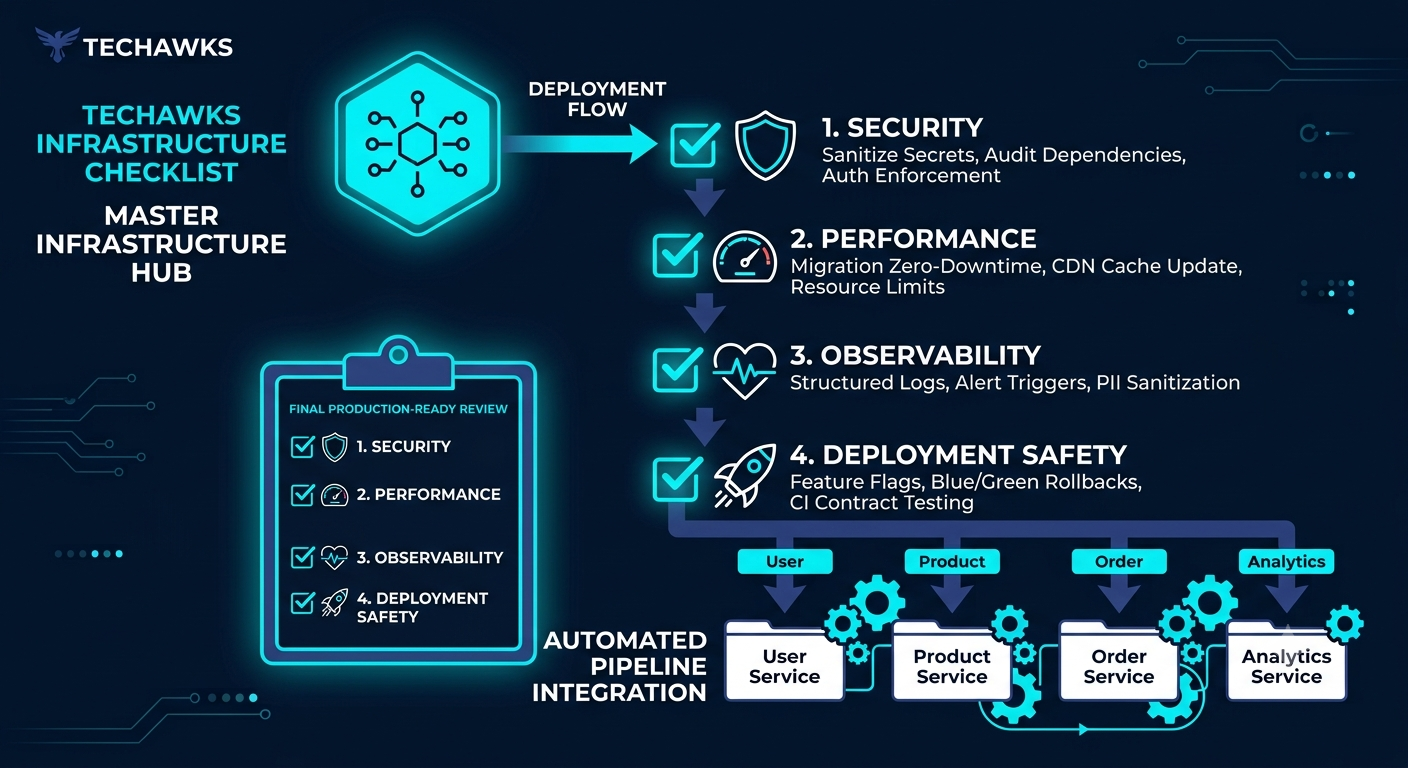
🔒 1. Security & Compliance
Secrets Sanitized: Confirm no API keys, private credentials, or environment variables are hardcoded in the repository.
Dependency Audit: Run npm audit, pip-audit, or your tool of choice to catch known vulnerable packages before going live.
Auth Check: Verify that all new endpoints enforce proper authentication and role-based access control (RBAC).
⚡ 2. Performance & Reliability
Database Migration Plan: Test database migrations against a staging environment with realistic data volumes; ensure a zero-downtime rollback strategy exists.
Caching Layer Updated: Invalidate or update relevant Redis/CDN cache keys to avoid serving stale or mismatched data post-deploy.
Resource Limits: Confirm container CPU/Memory limits and auto-scaling rules are adjusted for expected load changes.
📊 3. Observability & Monitoring
Structured Logging: Ensure error logs include necessary context (trace IDs, user IDs, request paths) without leaking sensitive PII data.
Alert Triggers: Set up or verify alerting thresholds (CPU spikes, 5xx error rate spikes, latency changes) in your monitoring platform.
🔄 4. Deployment Safety
Feature Flags: Wrap major new functionality in feature flags so you can toggle features instantly without requiring a re-deploy.
Rollback Strategy verified: Ensure the CI/CD pipeline can perform an automated blue/green or canary rollback in under two minutes if health checks fail.
Key Takeaways
Shift Security Left: Audit dependencies and secrets before code ever hits the staging branch.
Plan for Failure: Always have a zero-downtime database migration plan and an automated rollback strategy ready.
Observe Everything: Contextual, structured logging makes post-deployment debugging painless.
Decouple Release from Deploy: Use feature flags to safely control feature availability in production.
CTA
Want to level up your engineering workflow? Join thousands of developers, architects, and tech enthusiasts sharing actionable frameworks and industry best practices. Join the Techawks General Community today!
Deploying software shouldn't feel like a high-stakes gamble. Whether you are shipping a minor patch or a core infrastructure update, taking a systematic approach prevents fires before they start.
Bookmark this checklist for your team's next pull request review:
🔒 1. Security & Compliance
Secrets Sanitized: Confirm no API keys, private credentials, or environment variables are hardcoded in the repository.
Dependency Audit: Run npm audit, pip-audit, or your tool of choice to catch known vulnerable packages before going live.
Auth Check: Verify that all new endpoints enforce proper authentication and role-based access control (RBAC).
⚡ 2. Performance & Reliability
Database Migration Plan: Test database migrations against a staging environment with realistic data volumes; ensure a zero-downtime rollback strategy exists.
Caching Layer Updated: Invalidate or update relevant Redis/CDN cache keys to avoid serving stale or mismatched data post-deploy.
Resource Limits: Confirm container CPU/Memory limits and auto-scaling rules are adjusted for expected load changes.
📊 3. Observability & Monitoring
Structured Logging: Ensure error logs include necessary context (trace IDs, user IDs, request paths) without leaking sensitive PII data.
Alert Triggers: Set up or verify alerting thresholds (CPU spikes, 5xx error rate spikes, latency changes) in your monitoring platform.
🔄 4. Deployment Safety
Feature Flags: Wrap major new functionality in feature flags so you can toggle features instantly without requiring a re-deploy.
Rollback Strategy verified: Ensure the CI/CD pipeline can perform an automated blue/green or canary rollback in under two minutes if health checks fail.
Key Takeaways
Shift Security Left: Audit dependencies and secrets before code ever hits the staging branch.
Plan for Failure: Always have a zero-downtime database migration plan and an automated rollback strategy ready.
Observe Everything: Contextual, structured logging makes post-deployment debugging painless.
Decouple Release from Deploy: Use feature flags to safely control feature availability in production.
CTA
Want to level up your engineering workflow? Join thousands of developers, architects, and tech enthusiasts sharing actionable frameworks and industry best practices. Join the Techawks General Community today!
The Production-Ready Deployment Checklist: 10 Essentials Before You Push to Main
Deploying software shouldn't feel like a high-stakes gamble. Whether you are shipping a minor patch or a core infrastructure update, taking a systematic approach prevents fires before they start.
Bookmark this checklist for your team's next pull request review:
🔒 1. Security & Compliance
Secrets Sanitized: Confirm no API keys, private credentials, or environment variables are hardcoded in the repository.
Dependency Audit: Run npm audit, pip-audit, or your tool of choice to catch known vulnerable packages before going live.
Auth Check: Verify that all new endpoints enforce proper authentication and role-based access control (RBAC).
⚡ 2. Performance & Reliability
Database Migration Plan: Test database migrations against a staging environment with realistic data volumes; ensure a zero-downtime rollback strategy exists.
Caching Layer Updated: Invalidate or update relevant Redis/CDN cache keys to avoid serving stale or mismatched data post-deploy.
Resource Limits: Confirm container CPU/Memory limits and auto-scaling rules are adjusted for expected load changes.
📊 3. Observability & Monitoring
Structured Logging: Ensure error logs include necessary context (trace IDs, user IDs, request paths) without leaking sensitive PII data.
Alert Triggers: Set up or verify alerting thresholds (CPU spikes, 5xx error rate spikes, latency changes) in your monitoring platform.
🔄 4. Deployment Safety
Feature Flags: Wrap major new functionality in feature flags so you can toggle features instantly without requiring a re-deploy.
Rollback Strategy verified: Ensure the CI/CD pipeline can perform an automated blue/green or canary rollback in under two minutes if health checks fail.
Key Takeaways
Shift Security Left: Audit dependencies and secrets before code ever hits the staging branch.
Plan for Failure: Always have a zero-downtime database migration plan and an automated rollback strategy ready.
Observe Everything: Contextual, structured logging makes post-deployment debugging painless.
Decouple Release from Deploy: Use feature flags to safely control feature availability in production.
CTA
Want to level up your engineering workflow? Join thousands of developers, architects, and tech enthusiasts sharing actionable frameworks and industry best practices. Join the Techawks General Community today!

 English
 Arabic
 French
 Portuguese
 Deutsch
 Turkish
 Dutch
Dutch
 Italiano
 Russian
 Romaian
 Portuguese (Brazil)
 Greek
Greek