


The Death of the 80% Gross Margin: Rethinking SaaS Unit Economics
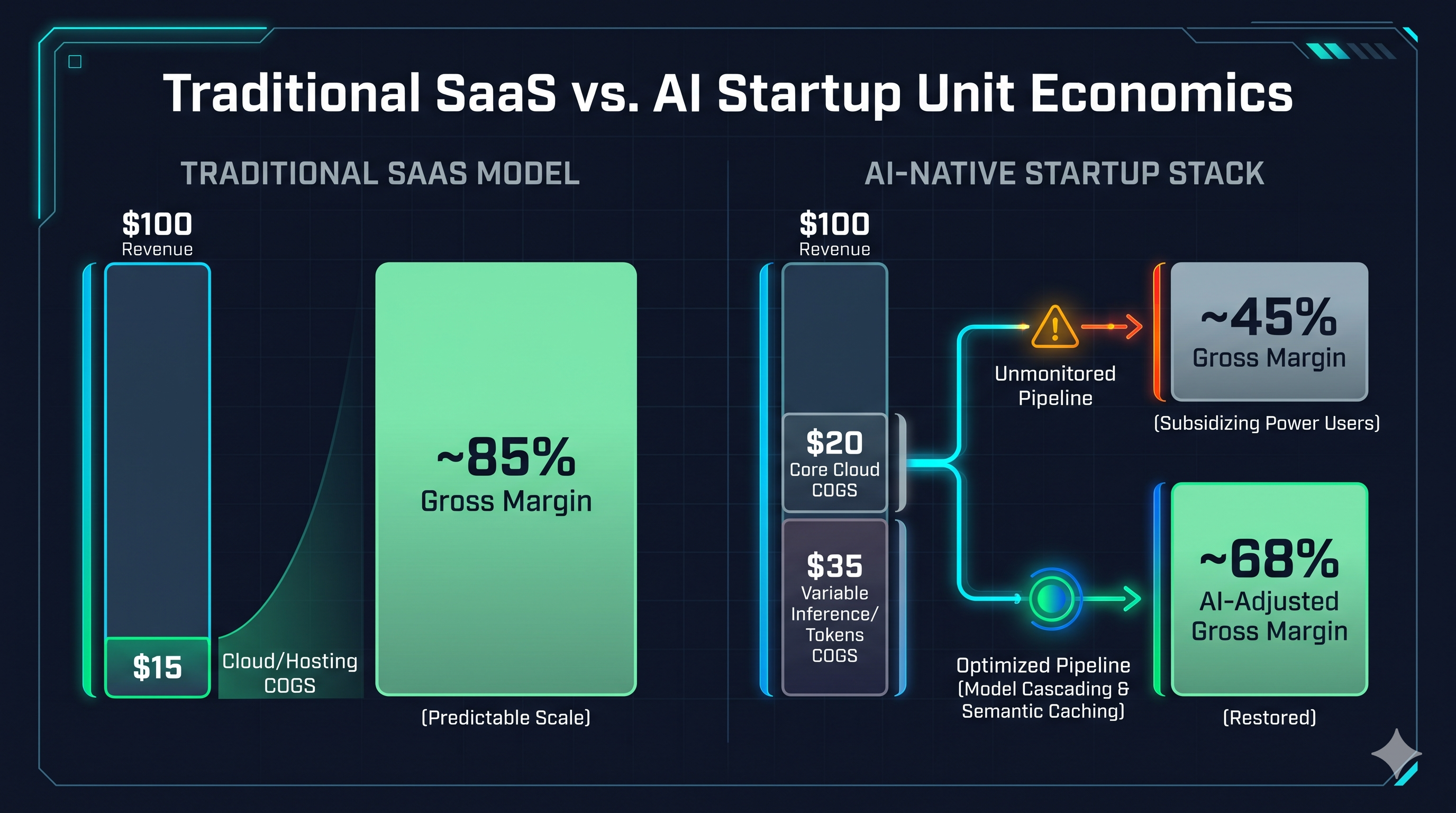
For two decades, venture-backed B2B software relied on a golden benchmark: 75% to 80%+ gross margins. You wrote code once, cloud hosting cost pennies per tenant, and every incremental revenue dollar flowed almost straight to gross profit.
In software startups running autonomous workflows and multi-step inference, that assumption is broken. Industry benchmark data reveals average gross margins on AI products hover near 50–53%, with heavy inference workloads behaving as variable Cost of Goods Sold (COGS) rather than fixed overhead.
When a single power customer runs agentic multi-step task loops, their token consumption can easily exceed their flat monthly seat fee. Founders who ignore this scale themselves into negative-margin cohorts.
Plaintext
[ ANTI-PATTERN: The Flat-Rate AI Margin Bleed ]
Flat $49/mo User ──> Uncapped Agent Loops ──> Dynamic Frontier Calls ──> $65 Compute COGS
│
▼
Net Unit Margin: -32% (Loss)
[ RESILIENT PATTERN: The Defensible AI Unit Economics Stack ]
Hybrid Billing ──> Semantic Prompt Cache ──> Cascading Router ──> Fixed + Metered Profit
($29 Base + Overage) (Zero Cost / Instant) (SLM First -> Frontier) (Guaranteed 65%+ Margin)
Here is how early-stage founders are defending unit economics and gross margins:
Calculate "AI-Adjusted Gross Margin" Per Cohort
Stop analyzing blended gross margins. Blend masks toxic customers. Attribute token egress and cloud GPU cost directly to individual customer accounts to identify the top 5% of users responsible for 50%+ of inference spend.
Deploy Model Routing & Tiered Fallbacks
Directing 100% of tasks to frontier reasoning models is an architectural leak. Implement intent classifiers to route routine classification, formatting, and vector queries to smaller, distilled models or local SLMs at 1/10th the cost. Reserve frontier calls exclusively for complex synthesis.
Transition from Pure Flat-Rate to Hybrid Value-Metric Pricing
Pure per-seat pricing fails when value scales with automated output. Shift to platform base fee + consumption credits (or outcome-based billing tied to resolved tickets, processed docs, or completed runs) to ensure revenue scales parallel to underlying compute.
Discussion Question (Poll)
As a founder or tech lead, how is your startup pricing its AI-heavy features to protect gross margins?
Option A: Traditional flat subscription (absorbing variable compute costs)
Option B: Hybrid pricing (base subscription fee + metered usage/credits)
Option C: Pure consumption-based or outcome-based billing
Option D: Strict usage quotas & rate-limiting per billing tier
CTA
Navigating early-stage monetization, customer acquisition costs, and defensible tech unit economics?
👉 Join the Techawks Startup Founders & Entrepreneurs Community to share pricing frameworks, investor pitch decks, and architectural benchmarks with fellow founders.
The Death of the 80% Gross Margin: Rethinking SaaS Unit Economics
For two decades, venture-backed B2B software relied on a golden benchmark: 75% to 80%+ gross margins. You wrote code once, cloud hosting cost pennies per tenant, and every incremental revenue dollar flowed almost straight to gross profit.
In software startups running autonomous workflows and multi-step inference, that assumption is broken. Industry benchmark data reveals average gross margins on AI products hover near 50–53%, with heavy inference workloads behaving as variable Cost of Goods Sold (COGS) rather than fixed overhead.
When a single power customer runs agentic multi-step task loops, their token consumption can easily exceed their flat monthly seat fee. Founders who ignore this scale themselves into negative-margin cohorts.
Plaintext
[ ANTI-PATTERN: The Flat-Rate AI Margin Bleed ]
Flat $49/mo User ──> Uncapped Agent Loops ──> Dynamic Frontier Calls ──> $65 Compute COGS
│
▼
Net Unit Margin: -32% (Loss)
[ RESILIENT PATTERN: The Defensible AI Unit Economics Stack ]
Hybrid Billing ──> Semantic Prompt Cache ──> Cascading Router ──> Fixed + Metered Profit
($29 Base + Overage) (Zero Cost / Instant) (SLM First -> Frontier) (Guaranteed 65%+ Margin)
Here is how early-stage founders are defending unit economics and gross margins:
Calculate "AI-Adjusted Gross Margin" Per Cohort
Stop analyzing blended gross margins. Blend masks toxic customers. Attribute token egress and cloud GPU cost directly to individual customer accounts to identify the top 5% of users responsible for 50%+ of inference spend.
Deploy Model Routing & Tiered Fallbacks
Directing 100% of tasks to frontier reasoning models is an architectural leak. Implement intent classifiers to route routine classification, formatting, and vector queries to smaller, distilled models or local SLMs at 1/10th the cost. Reserve frontier calls exclusively for complex synthesis.
Transition from Pure Flat-Rate to Hybrid Value-Metric Pricing
Pure per-seat pricing fails when value scales with automated output. Shift to platform base fee + consumption credits (or outcome-based billing tied to resolved tickets, processed docs, or completed runs) to ensure revenue scales parallel to underlying compute.
Discussion Question (Poll)
As a founder or tech lead, how is your startup pricing its AI-heavy features to protect gross margins?
Option A: Traditional flat subscription (absorbing variable compute costs)
Option B: Hybrid pricing (base subscription fee + metered usage/credits)
Option C: Pure consumption-based or outcome-based billing
Option D: Strict usage quotas & rate-limiting per billing tier
CTA
Navigating early-stage monetization, customer acquisition costs, and defensible tech unit economics?
👉 Join the Techawks Startup Founders & Entrepreneurs Community to share pricing frameworks, investor pitch decks, and architectural benchmarks with fellow founders.

 English
 Arabic
 French
 Spanish
 Portuguese
 Deutsch
 Turkish
 Italiano
 Russian
 Romaian
 Portuguese (Brazil)
 Greek