


The Metadata Bottleneck: Why Open Table Formats Are Replacing Hive-Style Partitions in Modern Lakehouses
For years, the standard approach to structuring a cloud data lake relied on Hive-style directory partitioning (e.g., s3://bucket/table/year=2026/month=11/day=05/data.parquet).
At petabyte scale, this approach creates serious operational issues:
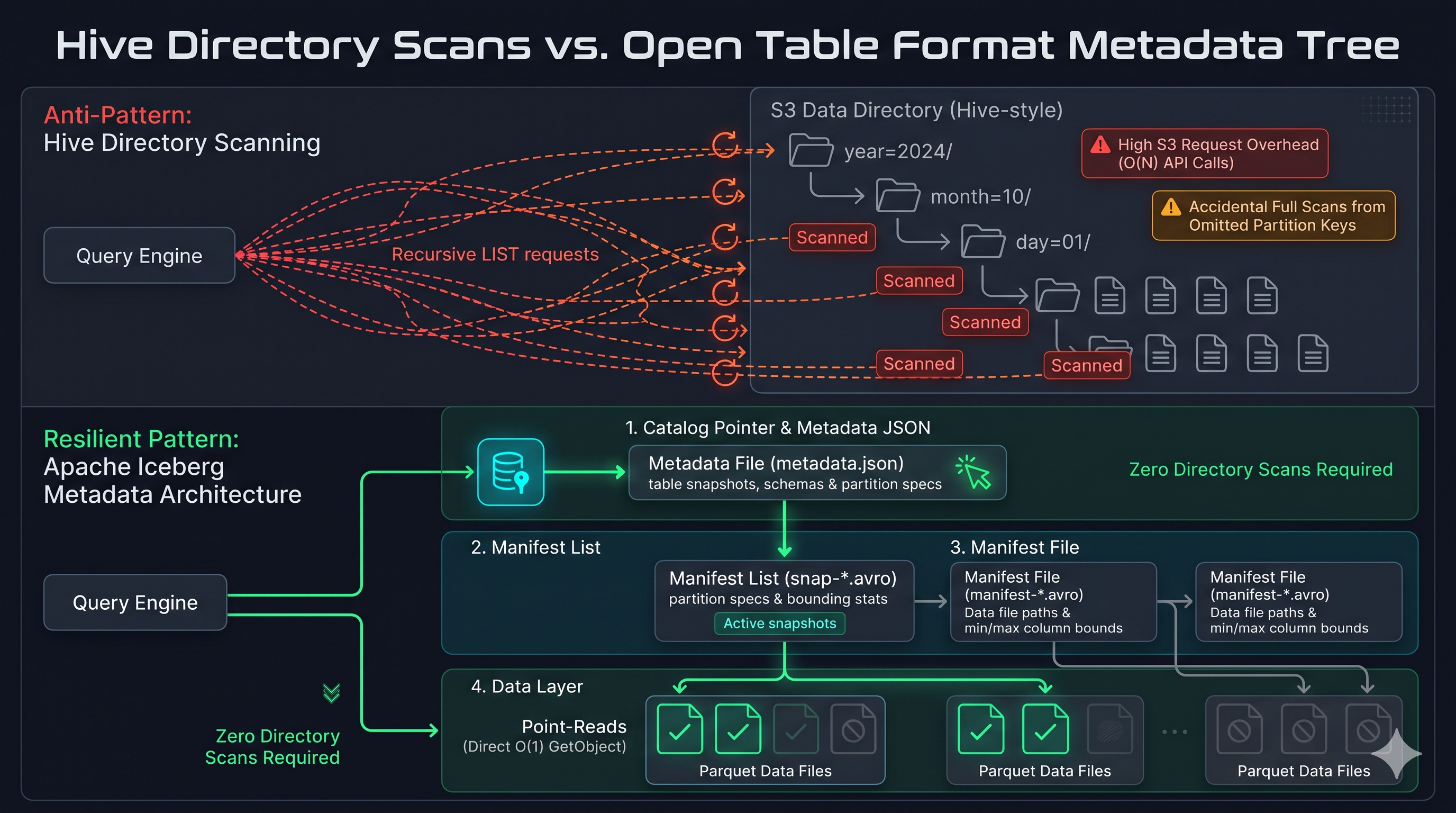
O(N) Directory Scans: Cloud object stores (like S3 or GCS) do not have native directory hierarchies; they are key-value stores. Query planners must issue thousands of recursive LIST requests before returning a single byte of data.
Partition Drift & Accidental Full Scans: If an analyst writes WHERE event_timestamp >= '2026-11-01' without explicitly filtering on the physical string partition year and month, the query engine misses partition pruning and scans the entire lake.
Schema Evolution Breakages: Renaming a column or altering partition schemes often required complete, expensive data rewrites.
Modern enterprise architectures are replacing Hive-style folder listings with Open Table Formats with Hierarchical Metadata Trees (such as Apache Iceberg).
Plaintext
[ ANTI-PATTERN: Hive-Style Directory Traversal ]
Query: SELECT * ... WHERE ts > T ──> Recursive Object Store LIST Calls (Thousands of HTTP GETs)
│
▼
High Query Planning Latency + Failed Scans
[ RESILIENT PATTERN: Open Table Format (Hierarchical Metadata Tree) ]
Query Engine ──> [Catalog Pointer] ──> [Metadata File: Snapshot]
│
▼
[Manifest List] ──(Prunes Partitions via Bounds)
│
▼
[Manifest File] ──(Pushes down Column Min/Max Metrics)
│
▼
Target Parquet Files Only (Direct S3 Range GETs)
Here is how modern open table formats improve the query path:
Decoupling File Organization from Partitioning (Hidden Partitioning)
In formats like Apache Iceberg, partitioning is expressed as metadata transform functions (such as days(event_timestamp)) rather than rigid physical folder paths. Analysts query natural timestamps, and the query planner automatically prunes non-matching files using the metadata tree without needing partition columns.
O(1) Planning via Manifest Lists & File-Level Column Metrics
Instead of scanning object store buckets, query planners read immutable manifest lists containing lower and upper bounds (min/max stats) for every column in every data file. Non-matching files are eliminated during planning, reducing planning latency from minutes to milliseconds.
In-Place Schema Evolution via Unique Column IDs
Traditional formats match Parquet columns by name or ordinal position, which breaks when columns are dropped, reordered, or renamed. Modern table formats track schema changes through stable integer IDs mapped in metadata, allowing instant column renaming without touching existing data files.
Discussion Question (Poll)
As your lakehouse and warehouse datasets expand, where is your team standardizing its core analytical storage layer?
Option A: Apache Iceberg (engine-agnostic flexibility across Trino, Spark, Snowflake)
Option B: Delta Lake / Delta UniForm (Databricks-centered ecosystems)
Option C: Native cloud data warehouse proprietary storage (Snowflake, BigQuery, Redshift)
Option D: Traditional Parquet/ORC with Hive Metastore catalogs
CTA
Want to dive deeper into modern lakehouse design, distributed query optimization, and open data architectures?
👉 Join the Techawks Data Science & Analytics Community to exchange production benchmarks, query tuning strategies, and table format implementation guides with fellow data leaders.
For years, the standard approach to structuring a cloud data lake relied on Hive-style directory partitioning (e.g., s3://bucket/table/year=2026/month=11/day=05/data.parquet).
At petabyte scale, this approach creates serious operational issues:
O(N) Directory Scans: Cloud object stores (like S3 or GCS) do not have native directory hierarchies; they are key-value stores. Query planners must issue thousands of recursive LIST requests before returning a single byte of data.
Partition Drift & Accidental Full Scans: If an analyst writes WHERE event_timestamp >= '2026-11-01' without explicitly filtering on the physical string partition year and month, the query engine misses partition pruning and scans the entire lake.
Schema Evolution Breakages: Renaming a column or altering partition schemes often required complete, expensive data rewrites.
Modern enterprise architectures are replacing Hive-style folder listings with Open Table Formats with Hierarchical Metadata Trees (such as Apache Iceberg).
Plaintext
[ ANTI-PATTERN: Hive-Style Directory Traversal ]
Query: SELECT * ... WHERE ts > T ──> Recursive Object Store LIST Calls (Thousands of HTTP GETs)
│
▼
High Query Planning Latency + Failed Scans
[ RESILIENT PATTERN: Open Table Format (Hierarchical Metadata Tree) ]
Query Engine ──> [Catalog Pointer] ──> [Metadata File: Snapshot]
│
▼
[Manifest List] ──(Prunes Partitions via Bounds)
│
▼
[Manifest File] ──(Pushes down Column Min/Max Metrics)
│
▼
Target Parquet Files Only (Direct S3 Range GETs)
Here is how modern open table formats improve the query path:
Decoupling File Organization from Partitioning (Hidden Partitioning)
In formats like Apache Iceberg, partitioning is expressed as metadata transform functions (such as days(event_timestamp)) rather than rigid physical folder paths. Analysts query natural timestamps, and the query planner automatically prunes non-matching files using the metadata tree without needing partition columns.
O(1) Planning via Manifest Lists & File-Level Column Metrics
Instead of scanning object store buckets, query planners read immutable manifest lists containing lower and upper bounds (min/max stats) for every column in every data file. Non-matching files are eliminated during planning, reducing planning latency from minutes to milliseconds.
In-Place Schema Evolution via Unique Column IDs
Traditional formats match Parquet columns by name or ordinal position, which breaks when columns are dropped, reordered, or renamed. Modern table formats track schema changes through stable integer IDs mapped in metadata, allowing instant column renaming without touching existing data files.
Discussion Question (Poll)
As your lakehouse and warehouse datasets expand, where is your team standardizing its core analytical storage layer?
Option A: Apache Iceberg (engine-agnostic flexibility across Trino, Spark, Snowflake)
Option B: Delta Lake / Delta UniForm (Databricks-centered ecosystems)
Option C: Native cloud data warehouse proprietary storage (Snowflake, BigQuery, Redshift)
Option D: Traditional Parquet/ORC with Hive Metastore catalogs
CTA
Want to dive deeper into modern lakehouse design, distributed query optimization, and open data architectures?
👉 Join the Techawks Data Science & Analytics Community to exchange production benchmarks, query tuning strategies, and table format implementation guides with fellow data leaders.
The Metadata Bottleneck: Why Open Table Formats Are Replacing Hive-Style Partitions in Modern Lakehouses
For years, the standard approach to structuring a cloud data lake relied on Hive-style directory partitioning (e.g., s3://bucket/table/year=2026/month=11/day=05/data.parquet).
At petabyte scale, this approach creates serious operational issues:
O(N) Directory Scans: Cloud object stores (like S3 or GCS) do not have native directory hierarchies; they are key-value stores. Query planners must issue thousands of recursive LIST requests before returning a single byte of data.
Partition Drift & Accidental Full Scans: If an analyst writes WHERE event_timestamp >= '2026-11-01' without explicitly filtering on the physical string partition year and month, the query engine misses partition pruning and scans the entire lake.
Schema Evolution Breakages: Renaming a column or altering partition schemes often required complete, expensive data rewrites.
Modern enterprise architectures are replacing Hive-style folder listings with Open Table Formats with Hierarchical Metadata Trees (such as Apache Iceberg).
Plaintext
[ ANTI-PATTERN: Hive-Style Directory Traversal ]
Query: SELECT * ... WHERE ts > T ──> Recursive Object Store LIST Calls (Thousands of HTTP GETs)
│
▼
High Query Planning Latency + Failed Scans
[ RESILIENT PATTERN: Open Table Format (Hierarchical Metadata Tree) ]
Query Engine ──> [Catalog Pointer] ──> [Metadata File: Snapshot]
│
▼
[Manifest List] ──(Prunes Partitions via Bounds)
│
▼
[Manifest File] ──(Pushes down Column Min/Max Metrics)
│
▼
Target Parquet Files Only (Direct S3 Range GETs)
Here is how modern open table formats improve the query path:
Decoupling File Organization from Partitioning (Hidden Partitioning)
In formats like Apache Iceberg, partitioning is expressed as metadata transform functions (such as days(event_timestamp)) rather than rigid physical folder paths. Analysts query natural timestamps, and the query planner automatically prunes non-matching files using the metadata tree without needing partition columns.
O(1) Planning via Manifest Lists & File-Level Column Metrics
Instead of scanning object store buckets, query planners read immutable manifest lists containing lower and upper bounds (min/max stats) for every column in every data file. Non-matching files are eliminated during planning, reducing planning latency from minutes to milliseconds.
In-Place Schema Evolution via Unique Column IDs
Traditional formats match Parquet columns by name or ordinal position, which breaks when columns are dropped, reordered, or renamed. Modern table formats track schema changes through stable integer IDs mapped in metadata, allowing instant column renaming without touching existing data files.
Discussion Question (Poll)
As your lakehouse and warehouse datasets expand, where is your team standardizing its core analytical storage layer?
Option A: Apache Iceberg (engine-agnostic flexibility across Trino, Spark, Snowflake)
Option B: Delta Lake / Delta UniForm (Databricks-centered ecosystems)
Option C: Native cloud data warehouse proprietary storage (Snowflake, BigQuery, Redshift)
Option D: Traditional Parquet/ORC with Hive Metastore catalogs
CTA
Want to dive deeper into modern lakehouse design, distributed query optimization, and open data architectures?
👉 Join the Techawks Data Science & Analytics Community to exchange production benchmarks, query tuning strategies, and table format implementation guides with fellow data leaders.

 Arabic
 French
 Spanish
 Portuguese
 Deutsch
 Turkish
 Dutch
 Italiano
 Russian
 Romaian
 Portuguese (Brazil)
 Greek