


How to Conduct Customer Discovery Interviews That Reveal Real Market Demand
Most early-stage startups fail not because they couldn't build the product, but because they built something nobody actually needed. To validate genuine demand, you must talk to users about their past behaviors rather than their future promises.
Follow this practical framework to conduct high-signal founder interviews:
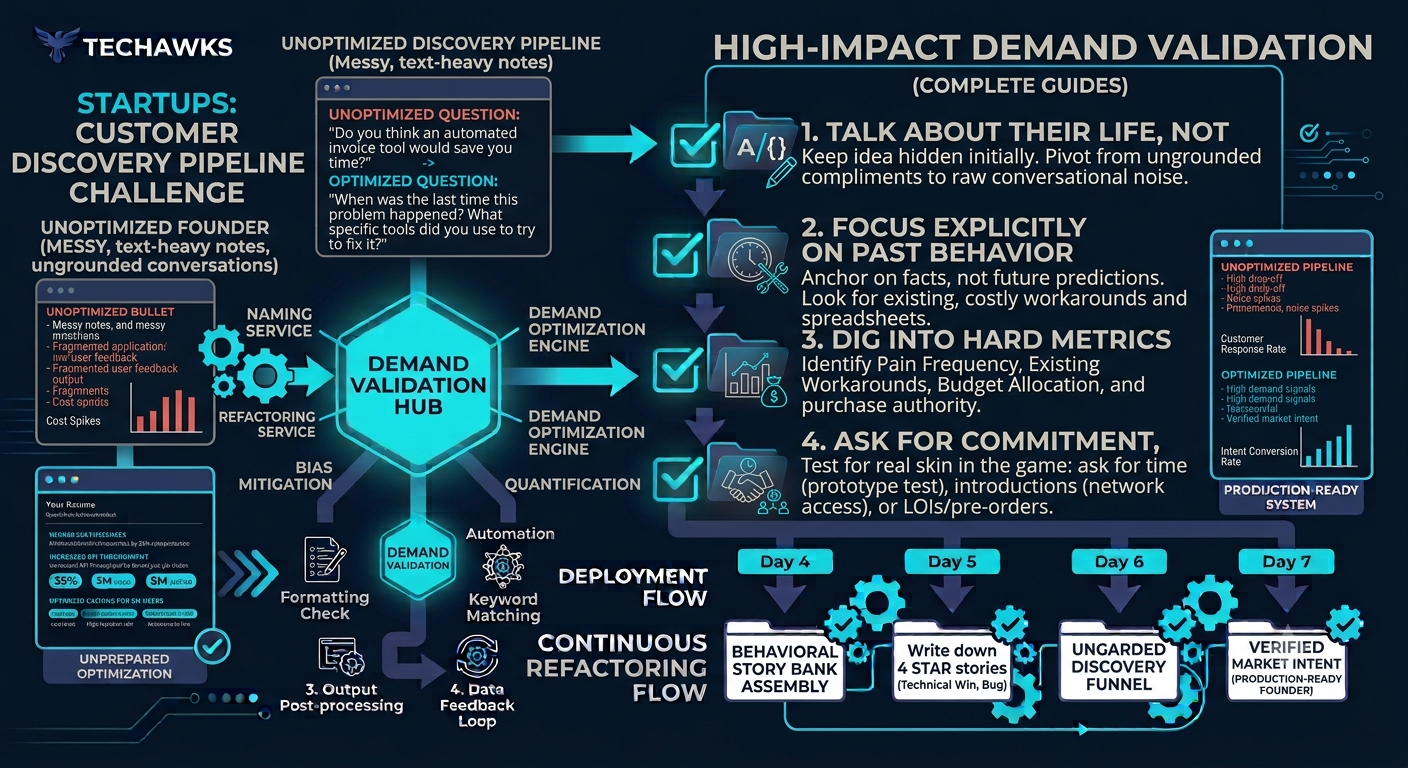
Step 1: Talk About Their Life, Not Your Solution
Keep your startup idea completely hidden during the first half of the conversation. If you reveal your solution early, interviewees will bias their answers to make you feel good.
Bad Question: "Do you think an automated invoice tool would save you time?"
Good Question: "How do you currently handle invoicing at the end of the month?"
Step 2: Focus Explicitly on Past Behavior
Future predictions are cheap; past actions are facts. Look for evidence of existing workarounds, because if a problem is painful enough, users are already trying to solve it with cobbled-together tools.
Ask: "When was the last time this problem happened?"
Ask: "What specific tools or spreadsheets did you use to try to fix it?"
Ask: "How much time or money did that workaround cost you?"
Step 3: Dig Into Hard Metrics and Constraints
Quantify the pain point to ensure it's a "hair-on-fire" priority rather than a minor inconvenience.
Identify Frequency: Is this a daily frustration or an annual minor annoyance?
Identify Budget: Who in the organization holds the purchasing power for this type of issue?
Identify Friction: What was the hardest part about trying to solve this issue in the past?
Step 4: Ask for Commitment, Not Compliments
At the end of the interview, test for real skin in the game. True validation requires a clear trade-off of time, access, or money.
Ask for Time: "Can we schedule a 20-minute call next week to test our early prototype?"
Ask for Introductions: "Who else in your network experiences this exact operational bottleneck?"
Ask for Pre-Orders / LOIs: "If we solve this issue within 30 days, would you be open to signing a letter of intent?"
Key Takeaways
Hide Your Idea Initially: Anchor conversations on the customer's current workflows rather than pitching your product.
Anchor on the Past: Evaluate real past behavior and spent budgets instead of asking hypothetical questions.
Look for Workarounds: If a prospect hasn't actively tried to solve the problem yet, the pain isn't acute enough.
Seek Clear Commitments: Validate interest using tangible skin in the game—time, introductions, or pre-orders.
CTA
Building or validating your next venture? Connect with active founders, angel investors, and startup operators sharing pitch decks, fundraising strategies, and go-to-market playbooks. Join Startup Founders & Entrepreneurs to build faster together!
Most early-stage startups fail not because they couldn't build the product, but because they built something nobody actually needed. To validate genuine demand, you must talk to users about their past behaviors rather than their future promises.
Follow this practical framework to conduct high-signal founder interviews:
Step 1: Talk About Their Life, Not Your Solution
Keep your startup idea completely hidden during the first half of the conversation. If you reveal your solution early, interviewees will bias their answers to make you feel good.
Bad Question: "Do you think an automated invoice tool would save you time?"
Good Question: "How do you currently handle invoicing at the end of the month?"
Step 2: Focus Explicitly on Past Behavior
Future predictions are cheap; past actions are facts. Look for evidence of existing workarounds, because if a problem is painful enough, users are already trying to solve it with cobbled-together tools.
Ask: "When was the last time this problem happened?"
Ask: "What specific tools or spreadsheets did you use to try to fix it?"
Ask: "How much time or money did that workaround cost you?"
Step 3: Dig Into Hard Metrics and Constraints
Quantify the pain point to ensure it's a "hair-on-fire" priority rather than a minor inconvenience.
Identify Frequency: Is this a daily frustration or an annual minor annoyance?
Identify Budget: Who in the organization holds the purchasing power for this type of issue?
Identify Friction: What was the hardest part about trying to solve this issue in the past?
Step 4: Ask for Commitment, Not Compliments
At the end of the interview, test for real skin in the game. True validation requires a clear trade-off of time, access, or money.
Ask for Time: "Can we schedule a 20-minute call next week to test our early prototype?"
Ask for Introductions: "Who else in your network experiences this exact operational bottleneck?"
Ask for Pre-Orders / LOIs: "If we solve this issue within 30 days, would you be open to signing a letter of intent?"
Key Takeaways
Hide Your Idea Initially: Anchor conversations on the customer's current workflows rather than pitching your product.
Anchor on the Past: Evaluate real past behavior and spent budgets instead of asking hypothetical questions.
Look for Workarounds: If a prospect hasn't actively tried to solve the problem yet, the pain isn't acute enough.
Seek Clear Commitments: Validate interest using tangible skin in the game—time, introductions, or pre-orders.
CTA
Building or validating your next venture? Connect with active founders, angel investors, and startup operators sharing pitch decks, fundraising strategies, and go-to-market playbooks. Join Startup Founders & Entrepreneurs to build faster together!
How to Conduct Customer Discovery Interviews That Reveal Real Market Demand
Most early-stage startups fail not because they couldn't build the product, but because they built something nobody actually needed. To validate genuine demand, you must talk to users about their past behaviors rather than their future promises.
Follow this practical framework to conduct high-signal founder interviews:
Step 1: Talk About Their Life, Not Your Solution
Keep your startup idea completely hidden during the first half of the conversation. If you reveal your solution early, interviewees will bias their answers to make you feel good.
Bad Question: "Do you think an automated invoice tool would save you time?"
Good Question: "How do you currently handle invoicing at the end of the month?"
Step 2: Focus Explicitly on Past Behavior
Future predictions are cheap; past actions are facts. Look for evidence of existing workarounds, because if a problem is painful enough, users are already trying to solve it with cobbled-together tools.
Ask: "When was the last time this problem happened?"
Ask: "What specific tools or spreadsheets did you use to try to fix it?"
Ask: "How much time or money did that workaround cost you?"
Step 3: Dig Into Hard Metrics and Constraints
Quantify the pain point to ensure it's a "hair-on-fire" priority rather than a minor inconvenience.
Identify Frequency: Is this a daily frustration or an annual minor annoyance?
Identify Budget: Who in the organization holds the purchasing power for this type of issue?
Identify Friction: What was the hardest part about trying to solve this issue in the past?
Step 4: Ask for Commitment, Not Compliments
At the end of the interview, test for real skin in the game. True validation requires a clear trade-off of time, access, or money.
Ask for Time: "Can we schedule a 20-minute call next week to test our early prototype?"
Ask for Introductions: "Who else in your network experiences this exact operational bottleneck?"
Ask for Pre-Orders / LOIs: "If we solve this issue within 30 days, would you be open to signing a letter of intent?"
Key Takeaways
Hide Your Idea Initially: Anchor conversations on the customer's current workflows rather than pitching your product.
Anchor on the Past: Evaluate real past behavior and spent budgets instead of asking hypothetical questions.
Look for Workarounds: If a prospect hasn't actively tried to solve the problem yet, the pain isn't acute enough.
Seek Clear Commitments: Validate interest using tangible skin in the game—time, introductions, or pre-orders.
CTA
Building or validating your next venture? Connect with active founders, angel investors, and startup operators sharing pitch decks, fundraising strategies, and go-to-market playbooks. Join Startup Founders & Entrepreneurs to build faster together!

 English
 Arabic
 French
 Spanish
 Deutsch
 Turkish
 Dutch
Dutch
 Italiano
 Russian
 Romaian
 Portuguese (Brazil)
 Greek
Greek