


The Ultimate Tech Student's Blueprint: How to Build Projects That Actually Get You Hired
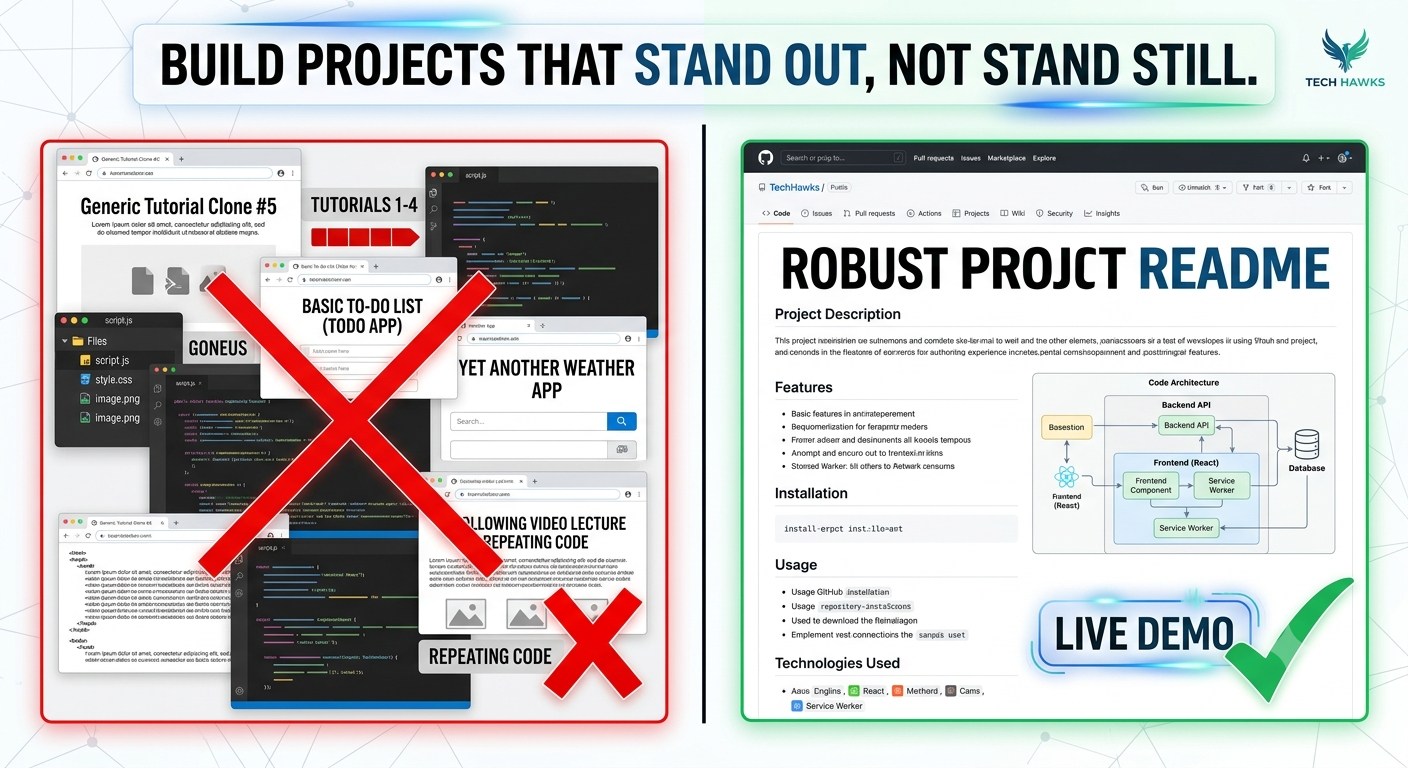
Most tech students fall into the same trap: they follow a tutorial line-by-line, build a basic weather app or a simple to-do list, and add it to their portfolio. The problem? Thousands of other candidates have done the exact same thing.
To land internships and tech roles, you need to showcase problem-solving, not just code-copying.
Here is a step-by-step framework to create high-impact, evergreen portfolio projects:
1 Solve a Hyper-Specific Problem
Instead of: A generic e-commerce store.
Build: A micro-inventory tracker for a local bookstore or a study-habit scheduler for your class. Real-world constraints force real problem-solving.
2 Focus on Quality Over Quantity
Two fully polished, well-documented projects beat ten half-baked tutorial clones every single time. Make sure your application has zero dead links, proper error handling, and clean code structure.
3 Treat Your Readme Like a Landing Page
Recruiters often scan your GitHub before looking at your code. Include:
A clear summary of why you built it.
The tech stack used and why you chose it.
Screenshots or a live demo link.
Setup instructions so anyone can run it locally.
4 Document Your Failures & Learnings
Write a short dev log or blog post explaining the biggest bug you encountered and how you fixed it. Showing your thought process proves you are a true engineer.
Key Takeaways
Originality > Tutorials: Custom-built tools always beat unedited tutorial code.
Polish Matters: Dead links and missing README files kill great projects.
Documentation is Key: Explain why you made engineering decisions, not just what you built.
CTA (Join Students in Tech)
Looking to collaborate on real-world projects, get code reviews, and level up your portfolio with peers?
🚀 Join the Students in Tech community today and start building things that matter!
Most tech students fall into the same trap: they follow a tutorial line-by-line, build a basic weather app or a simple to-do list, and add it to their portfolio. The problem? Thousands of other candidates have done the exact same thing.
To land internships and tech roles, you need to showcase problem-solving, not just code-copying.
Here is a step-by-step framework to create high-impact, evergreen portfolio projects:
1 Solve a Hyper-Specific Problem
Instead of: A generic e-commerce store.
Build: A micro-inventory tracker for a local bookstore or a study-habit scheduler for your class. Real-world constraints force real problem-solving.
2 Focus on Quality Over Quantity
Two fully polished, well-documented projects beat ten half-baked tutorial clones every single time. Make sure your application has zero dead links, proper error handling, and clean code structure.
3 Treat Your Readme Like a Landing Page
Recruiters often scan your GitHub before looking at your code. Include:
A clear summary of why you built it.
The tech stack used and why you chose it.
Screenshots or a live demo link.
Setup instructions so anyone can run it locally.
4 Document Your Failures & Learnings
Write a short dev log or blog post explaining the biggest bug you encountered and how you fixed it. Showing your thought process proves you are a true engineer.
Key Takeaways
Originality > Tutorials: Custom-built tools always beat unedited tutorial code.
Polish Matters: Dead links and missing README files kill great projects.
Documentation is Key: Explain why you made engineering decisions, not just what you built.
CTA (Join Students in Tech)
Looking to collaborate on real-world projects, get code reviews, and level up your portfolio with peers?
🚀 Join the Students in Tech community today and start building things that matter!
The Ultimate Tech Student's Blueprint: How to Build Projects That Actually Get You Hired
Most tech students fall into the same trap: they follow a tutorial line-by-line, build a basic weather app or a simple to-do list, and add it to their portfolio. The problem? Thousands of other candidates have done the exact same thing.
To land internships and tech roles, you need to showcase problem-solving, not just code-copying.
Here is a step-by-step framework to create high-impact, evergreen portfolio projects:
1 Solve a Hyper-Specific Problem
Instead of: A generic e-commerce store.
Build: A micro-inventory tracker for a local bookstore or a study-habit scheduler for your class. Real-world constraints force real problem-solving.
2 Focus on Quality Over Quantity
Two fully polished, well-documented projects beat ten half-baked tutorial clones every single time. Make sure your application has zero dead links, proper error handling, and clean code structure.
3 Treat Your Readme Like a Landing Page
Recruiters often scan your GitHub before looking at your code. Include:
A clear summary of why you built it.
The tech stack used and why you chose it.
Screenshots or a live demo link.
Setup instructions so anyone can run it locally.
4 Document Your Failures & Learnings
Write a short dev log or blog post explaining the biggest bug you encountered and how you fixed it. Showing your thought process proves you are a true engineer.
Key Takeaways
Originality > Tutorials: Custom-built tools always beat unedited tutorial code.
Polish Matters: Dead links and missing README files kill great projects.
Documentation is Key: Explain why you made engineering decisions, not just what you built.
CTA (Join Students in Tech)
Looking to collaborate on real-world projects, get code reviews, and level up your portfolio with peers?
🚀 Join the Students in Tech community today and start building things that matter!

 Arabic
 French
 Spanish
 Portuguese
 Deutsch
 Turkish
 Dutch
Dutch
 Italiano
 Russian
 Romaian
 Portuguese (Brazil)
 Greek
Greek