


Tool Review: OWASP ZAP & Nuclei — Automated Vulnerability Scanning for Web Applications & APIs
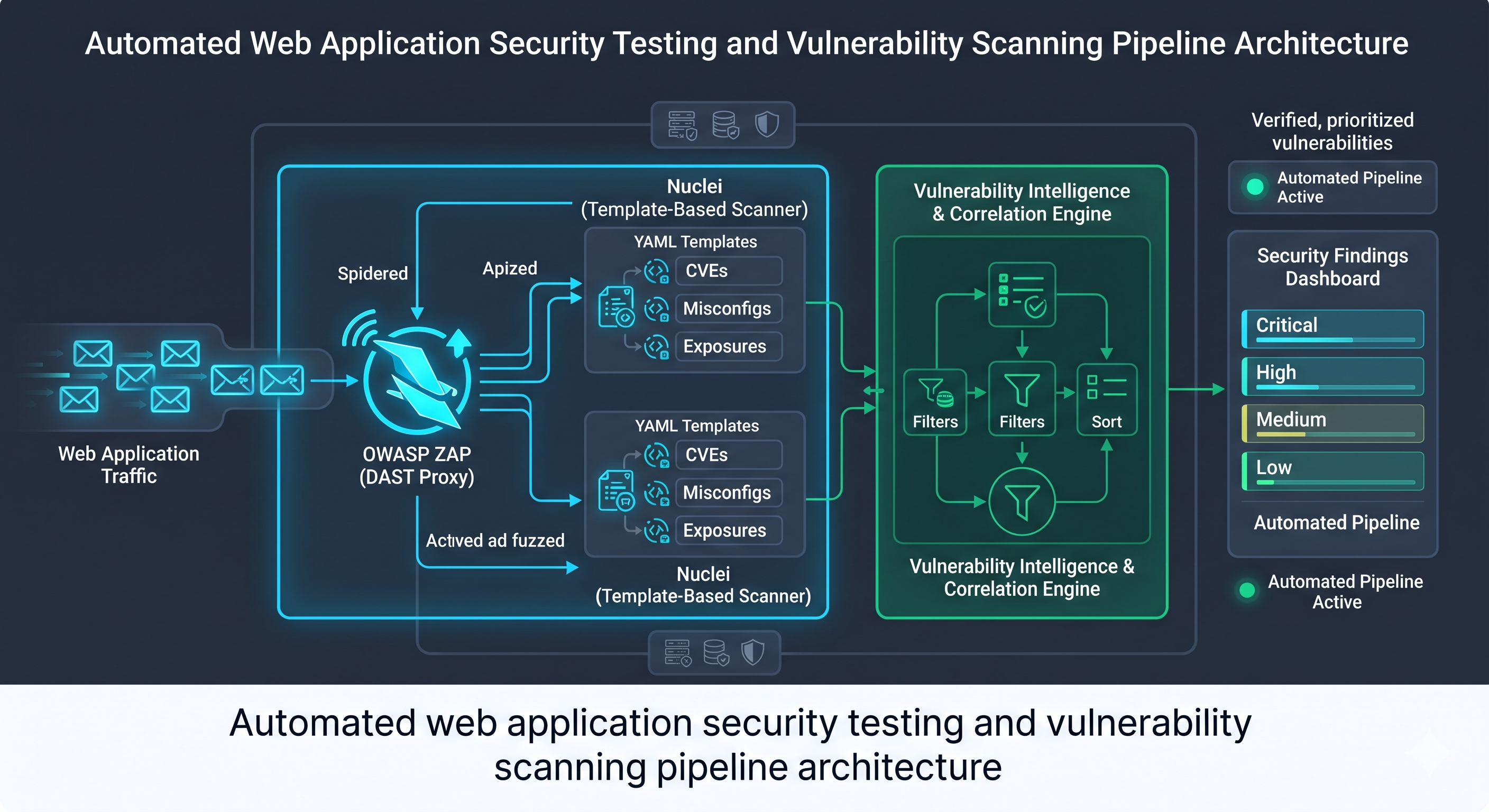
Moving from theoretical cybersecurity concepts to practical defense requires mastering automated scanning tools that simulate real-world threat actors. Modern application security relies heavily on robust open-source engines like OWASP ZAP (Zed Attack Proxy) for dynamic application security testing (DAST) and Nuclei for template-based vulnerability scanning.
Architectural & Functional ComparisonDimensionOWASP ZAP (DAST Proxy)Nuclei (Template-Based Scanners)Core MechanismIntercepting proxy and active/passive crawlerYAML-based targeted template executionPrimary TargetWeb applications, forms, and session flowsKnown CVEs, exposed panels, and misconfigured APIsIntegration LevelExcellent for interactive staging and CI/CD baselinesHighly scalable for continuous automated asset discovery
Practical Integration Pattern: Running Targeted Template Scans
When evaluating an application infrastructure, combining a proxy-based crawler with custom vulnerability checks allows you to isolate logical flaws quickly. For rapid assessment using Nuclei, structuring a clean command workflow ensures minimal noise:
Bash
# Scan a target URL against community-driven vulnerability templates
nuclei -u https://target-staging.techawks.internal -t cves/ -severity critical,high
By automating baseline vulnerability discovery, security analysts can shift focus away from manual enumeration and concentrate on threat modeling, exploit verification, and remediation patching.
Discussion Question
What is your go-to open-source tool for catching logic flaws and injection vulnerabilities during a security audit? Drop your workflow below.
CTA (Join Cybersecurity & Ethical Hacking)
Want to master penetration testing, threat hunting, and defensive security frameworks alongside global learners? Join Cybersecurity & Ethical Hacking today.
Moving from theoretical cybersecurity concepts to practical defense requires mastering automated scanning tools that simulate real-world threat actors. Modern application security relies heavily on robust open-source engines like OWASP ZAP (Zed Attack Proxy) for dynamic application security testing (DAST) and Nuclei for template-based vulnerability scanning.
Architectural & Functional ComparisonDimensionOWASP ZAP (DAST Proxy)Nuclei (Template-Based Scanners)Core MechanismIntercepting proxy and active/passive crawlerYAML-based targeted template executionPrimary TargetWeb applications, forms, and session flowsKnown CVEs, exposed panels, and misconfigured APIsIntegration LevelExcellent for interactive staging and CI/CD baselinesHighly scalable for continuous automated asset discovery
Practical Integration Pattern: Running Targeted Template Scans
When evaluating an application infrastructure, combining a proxy-based crawler with custom vulnerability checks allows you to isolate logical flaws quickly. For rapid assessment using Nuclei, structuring a clean command workflow ensures minimal noise:
Bash
# Scan a target URL against community-driven vulnerability templates
nuclei -u https://target-staging.techawks.internal -t cves/ -severity critical,high
By automating baseline vulnerability discovery, security analysts can shift focus away from manual enumeration and concentrate on threat modeling, exploit verification, and remediation patching.
Discussion Question
What is your go-to open-source tool for catching logic flaws and injection vulnerabilities during a security audit? Drop your workflow below.
CTA (Join Cybersecurity & Ethical Hacking)
Want to master penetration testing, threat hunting, and defensive security frameworks alongside global learners? Join Cybersecurity & Ethical Hacking today.
Tool Review: OWASP ZAP & Nuclei — Automated Vulnerability Scanning for Web Applications & APIs
Moving from theoretical cybersecurity concepts to practical defense requires mastering automated scanning tools that simulate real-world threat actors. Modern application security relies heavily on robust open-source engines like OWASP ZAP (Zed Attack Proxy) for dynamic application security testing (DAST) and Nuclei for template-based vulnerability scanning.
Architectural & Functional ComparisonDimensionOWASP ZAP (DAST Proxy)Nuclei (Template-Based Scanners)Core MechanismIntercepting proxy and active/passive crawlerYAML-based targeted template executionPrimary TargetWeb applications, forms, and session flowsKnown CVEs, exposed panels, and misconfigured APIsIntegration LevelExcellent for interactive staging and CI/CD baselinesHighly scalable for continuous automated asset discovery
Practical Integration Pattern: Running Targeted Template Scans
When evaluating an application infrastructure, combining a proxy-based crawler with custom vulnerability checks allows you to isolate logical flaws quickly. For rapid assessment using Nuclei, structuring a clean command workflow ensures minimal noise:
Bash
# Scan a target URL against community-driven vulnerability templates
nuclei -u https://target-staging.techawks.internal -t cves/ -severity critical,high
By automating baseline vulnerability discovery, security analysts can shift focus away from manual enumeration and concentrate on threat modeling, exploit verification, and remediation patching.
Discussion Question
What is your go-to open-source tool for catching logic flaws and injection vulnerabilities during a security audit? Drop your workflow below.
CTA (Join Cybersecurity & Ethical Hacking)
Want to master penetration testing, threat hunting, and defensive security frameworks alongside global learners? Join Cybersecurity & Ethical Hacking today.

 Arabic
 French
 Spanish
 Portuguese
 Deutsch
 Turkish
 Dutch
 Italiano
 Russian
 Romaian
 Portuguese (Brazil)
 Greek