


The Essential Data Pipeline Health & Governance Checklist
Maintaining production data pipelines requires proactive monitoring, strict governance, and robust error handling. Without systematic auditing, data teams risk pipeline failures, schema breaking changes, and compromised business metrics.
Use this operational checklist to evaluate and harden your data pipelines before deploying to production:
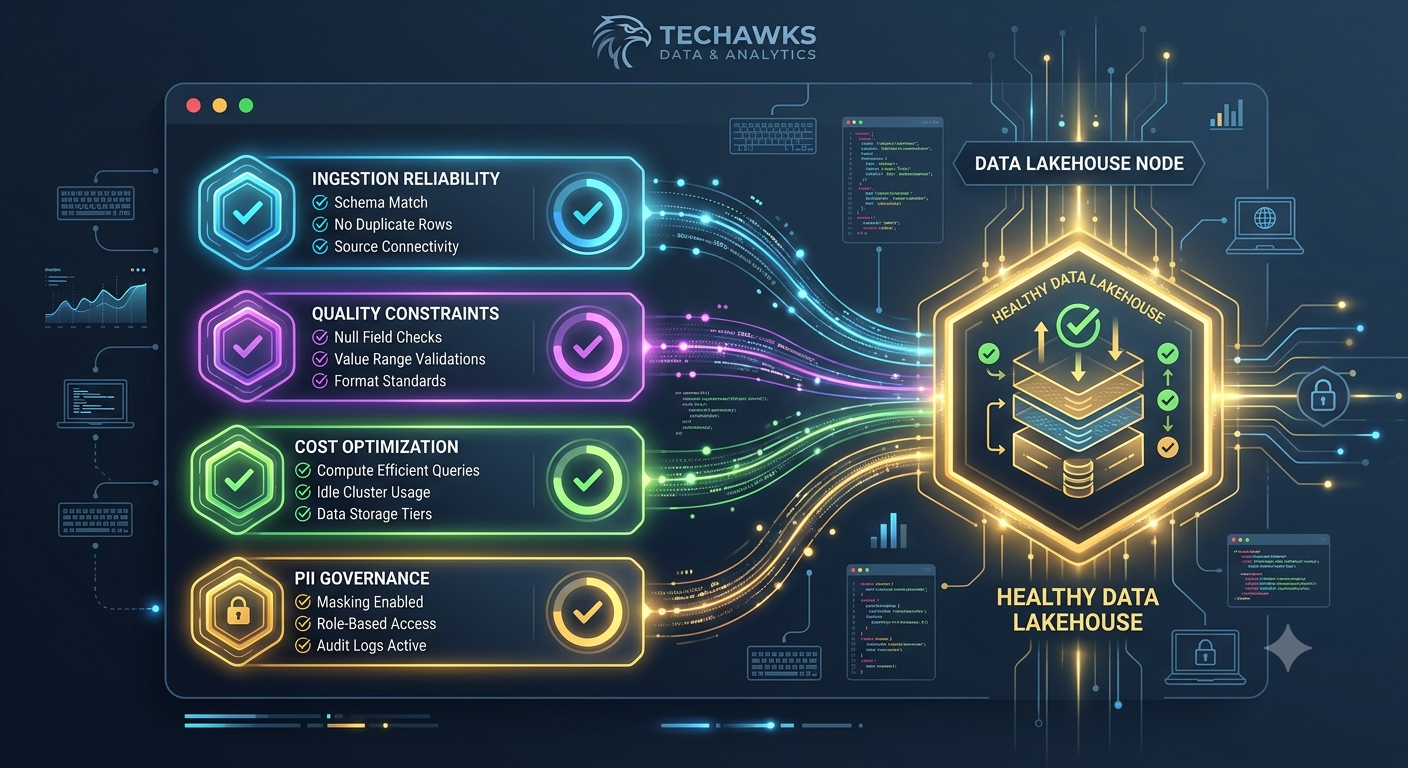
1. Ingestion & Extraction Reliability
Schema Evolution Rules: Are explicit schema validation checks enabled to handle missing, renamed, or new source columns automatically?
Idempotent Executions: Is pipeline logic designed so re-running a failed job produces identical results without duplicating rows or corrupting data?
Source Rate Limiting & Retries: Are exponential backoff and automatic retry policies configured for API and source database connections?
Incremental Loading: Are watermark or log-based CDC (Change Data Capture) mechanisms used to process delta changes rather than full table scans?
2. Data Quality & Integrity Constraints
Primary Key & Null Checks: Are strict unique and not_null assertions enforced on primary surrogate keys?
Referential Integrity: Are cross-table relationship and foreign key validations defined between fact and dimension tables?
Domain & Range Controls: Are numeric ranges and categorical value constraints configured to flag impossible business data (e.g., negative order values)?
Circuit Breakers: Are automated pipeline triggers set to halt downstream execution if critical quality tests fail?
3. Pipeline Performance & Resource Optimization
Query Execution Tuning: Are large warehouse queries optimized using appropriate partitioning, clustering, or indexing strategies?
Resource Allocation: Are compute clusters configured to scale down automatically during idle periods to manage cloud infrastructure costs?
SLA & Latency Alarms: Are real-time alerts set up for jobs that exceed expected execution time windows?
4. Governance & Observability
Data Lineage Tracking: Is column-level data lineage documented or automatically generated from source ingestion to downstream BI tools?
Access Control & PII Masking: Are personally identifiable information (PII) fields encrypted or masked using role-based access controls (RBAC)?
Alert Routing: Are pipeline failure notifications routed directly to on-call engineering channels with actionable error logs?
Key Takeaways
Build for Idempotency: Ensure any pipeline can be safely re-run without causing duplicate data or requiring manual cleanup.
Catch Errors Early: Implement automated schema checks and quality constraints at the ingestion tier to protect downstream data marts.
Observe and Optimize: Track column-level lineage and compute costs continuously to maintain system transparency and control spend.
CTA
Looking to build resilient data pipelines and master modern data engineering? Connect with data engineers, analytics leads, and data architects sharing production architecture patterns, dbt frameworks, and orchestration best practices. Join the Data Science & Analytics Community today!
Maintaining production data pipelines requires proactive monitoring, strict governance, and robust error handling. Without systematic auditing, data teams risk pipeline failures, schema breaking changes, and compromised business metrics.
Use this operational checklist to evaluate and harden your data pipelines before deploying to production:
1. Ingestion & Extraction Reliability
Schema Evolution Rules: Are explicit schema validation checks enabled to handle missing, renamed, or new source columns automatically?
Idempotent Executions: Is pipeline logic designed so re-running a failed job produces identical results without duplicating rows or corrupting data?
Source Rate Limiting & Retries: Are exponential backoff and automatic retry policies configured for API and source database connections?
Incremental Loading: Are watermark or log-based CDC (Change Data Capture) mechanisms used to process delta changes rather than full table scans?
2. Data Quality & Integrity Constraints
Primary Key & Null Checks: Are strict unique and not_null assertions enforced on primary surrogate keys?
Referential Integrity: Are cross-table relationship and foreign key validations defined between fact and dimension tables?
Domain & Range Controls: Are numeric ranges and categorical value constraints configured to flag impossible business data (e.g., negative order values)?
Circuit Breakers: Are automated pipeline triggers set to halt downstream execution if critical quality tests fail?
3. Pipeline Performance & Resource Optimization
Query Execution Tuning: Are large warehouse queries optimized using appropriate partitioning, clustering, or indexing strategies?
Resource Allocation: Are compute clusters configured to scale down automatically during idle periods to manage cloud infrastructure costs?
SLA & Latency Alarms: Are real-time alerts set up for jobs that exceed expected execution time windows?
4. Governance & Observability
Data Lineage Tracking: Is column-level data lineage documented or automatically generated from source ingestion to downstream BI tools?
Access Control & PII Masking: Are personally identifiable information (PII) fields encrypted or masked using role-based access controls (RBAC)?
Alert Routing: Are pipeline failure notifications routed directly to on-call engineering channels with actionable error logs?
Key Takeaways
Build for Idempotency: Ensure any pipeline can be safely re-run without causing duplicate data or requiring manual cleanup.
Catch Errors Early: Implement automated schema checks and quality constraints at the ingestion tier to protect downstream data marts.
Observe and Optimize: Track column-level lineage and compute costs continuously to maintain system transparency and control spend.
CTA
Looking to build resilient data pipelines and master modern data engineering? Connect with data engineers, analytics leads, and data architects sharing production architecture patterns, dbt frameworks, and orchestration best practices. Join the Data Science & Analytics Community today!
The Essential Data Pipeline Health & Governance Checklist
Maintaining production data pipelines requires proactive monitoring, strict governance, and robust error handling. Without systematic auditing, data teams risk pipeline failures, schema breaking changes, and compromised business metrics.
Use this operational checklist to evaluate and harden your data pipelines before deploying to production:
1. Ingestion & Extraction Reliability
Schema Evolution Rules: Are explicit schema validation checks enabled to handle missing, renamed, or new source columns automatically?
Idempotent Executions: Is pipeline logic designed so re-running a failed job produces identical results without duplicating rows or corrupting data?
Source Rate Limiting & Retries: Are exponential backoff and automatic retry policies configured for API and source database connections?
Incremental Loading: Are watermark or log-based CDC (Change Data Capture) mechanisms used to process delta changes rather than full table scans?
2. Data Quality & Integrity Constraints
Primary Key & Null Checks: Are strict unique and not_null assertions enforced on primary surrogate keys?
Referential Integrity: Are cross-table relationship and foreign key validations defined between fact and dimension tables?
Domain & Range Controls: Are numeric ranges and categorical value constraints configured to flag impossible business data (e.g., negative order values)?
Circuit Breakers: Are automated pipeline triggers set to halt downstream execution if critical quality tests fail?
3. Pipeline Performance & Resource Optimization
Query Execution Tuning: Are large warehouse queries optimized using appropriate partitioning, clustering, or indexing strategies?
Resource Allocation: Are compute clusters configured to scale down automatically during idle periods to manage cloud infrastructure costs?
SLA & Latency Alarms: Are real-time alerts set up for jobs that exceed expected execution time windows?
4. Governance & Observability
Data Lineage Tracking: Is column-level data lineage documented or automatically generated from source ingestion to downstream BI tools?
Access Control & PII Masking: Are personally identifiable information (PII) fields encrypted or masked using role-based access controls (RBAC)?
Alert Routing: Are pipeline failure notifications routed directly to on-call engineering channels with actionable error logs?
Key Takeaways
Build for Idempotency: Ensure any pipeline can be safely re-run without causing duplicate data or requiring manual cleanup.
Catch Errors Early: Implement automated schema checks and quality constraints at the ingestion tier to protect downstream data marts.
Observe and Optimize: Track column-level lineage and compute costs continuously to maintain system transparency and control spend.
CTA
Looking to build resilient data pipelines and master modern data engineering? Connect with data engineers, analytics leads, and data architects sharing production architecture patterns, dbt frameworks, and orchestration best practices. Join the Data Science & Analytics Community today!

 English
 Arabic
 French
 Spanish
 Deutsch
 Turkish
 Dutch
Dutch
 Italiano
 Russian
 Romaian
 Portuguese (Brazil)
 Greek
Greek