


Waiting for a dedicated "tech debt sprint" to clean up your code is a trap—it almost never happens. Here is how senior engineers maintain high code quality daily without slowing down delivery.
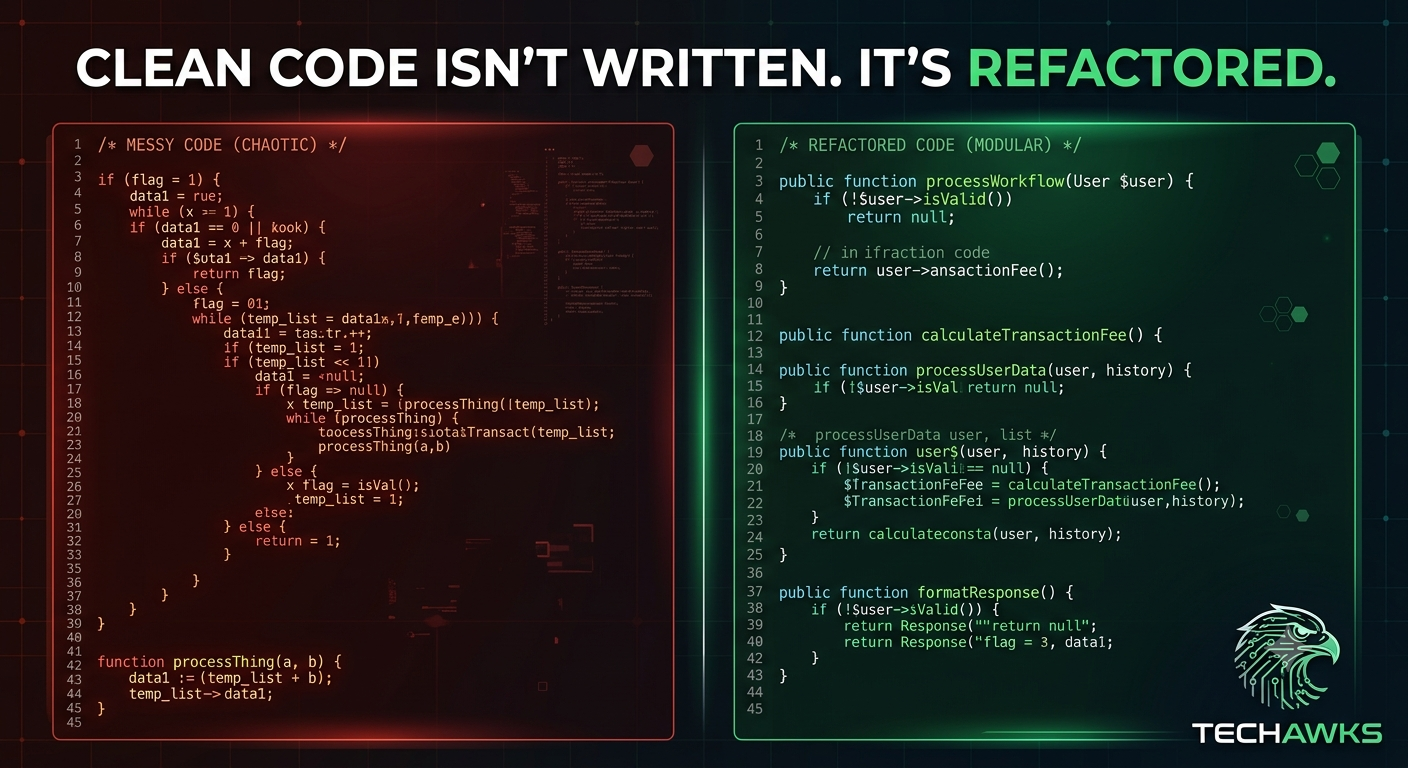
Technical debt accumulates silently. A quick hack here, an unoptimized function there, and within six months, a once-agile project becomes a fragile nightmare to maintain. The solution isn’t halting feature development for two weeks to rewrite modules; it is practicing Micro-Refactoring.
Micro-refactoring is the practice of leaving any file you touch slightly better than you found it, adhering to the Boy Scout Rule. By spending just 5 to 10 minutes refactoring during your standard task workflow, you continuously reduce debt without impacting your sprint velocity.
Here is the 4-step framework to apply micro-refactoring today:
Extract Complex Conditionals
Before: if (user.age > 18 && user.hasPaid && !user.isSuspended)
After: if (user.isEligibleForService())
Why: Reading intent is vastly faster than evaluating logic.
Flatten Deep Nesting
Avoid deeply nested if/else blocks by using early returns (guard clauses). If conditions aren't met, exit the function immediately. This eliminates cognitive overload for the next developer.
Rename for Intent, Not Mechanism
Replace vague variable names like data or temp with descriptive domain terms like pendingInvoices or authenticatedUserSession. Code should read like documentation.
Isolate Pure Functions
Move side-effect-free logic (like calculations or data transformations) into standalone, pure functions. Pure functions are easier to reason about, reuse, and unit test.
Technical debt accumulates silently. A quick hack here, an unoptimized function there, and within six months, a once-agile project becomes a fragile nightmare to maintain. The solution isn’t halting feature development for two weeks to rewrite modules; it is practicing Micro-Refactoring.
Micro-refactoring is the practice of leaving any file you touch slightly better than you found it, adhering to the Boy Scout Rule. By spending just 5 to 10 minutes refactoring during your standard task workflow, you continuously reduce debt without impacting your sprint velocity.
Here is the 4-step framework to apply micro-refactoring today:
Extract Complex Conditionals
Before: if (user.age > 18 && user.hasPaid && !user.isSuspended)
After: if (user.isEligibleForService())
Why: Reading intent is vastly faster than evaluating logic.
Flatten Deep Nesting
Avoid deeply nested if/else blocks by using early returns (guard clauses). If conditions aren't met, exit the function immediately. This eliminates cognitive overload for the next developer.
Rename for Intent, Not Mechanism
Replace vague variable names like data or temp with descriptive domain terms like pendingInvoices or authenticatedUserSession. Code should read like documentation.
Isolate Pure Functions
Move side-effect-free logic (like calculations or data transformations) into standalone, pure functions. Pure functions are easier to reason about, reuse, and unit test.
Waiting for a dedicated "tech debt sprint" to clean up your code is a trap—it almost never happens. Here is how senior engineers maintain high code quality daily without slowing down delivery.
Technical debt accumulates silently. A quick hack here, an unoptimized function there, and within six months, a once-agile project becomes a fragile nightmare to maintain. The solution isn’t halting feature development for two weeks to rewrite modules; it is practicing Micro-Refactoring.
Micro-refactoring is the practice of leaving any file you touch slightly better than you found it, adhering to the Boy Scout Rule. By spending just 5 to 10 minutes refactoring during your standard task workflow, you continuously reduce debt without impacting your sprint velocity.
Here is the 4-step framework to apply micro-refactoring today:
Extract Complex Conditionals
Before: if (user.age > 18 && user.hasPaid && !user.isSuspended)
After: if (user.isEligibleForService())
Why: Reading intent is vastly faster than evaluating logic.
Flatten Deep Nesting
Avoid deeply nested if/else blocks by using early returns (guard clauses). If conditions aren't met, exit the function immediately. This eliminates cognitive overload for the next developer.
Rename for Intent, Not Mechanism
Replace vague variable names like data or temp with descriptive domain terms like pendingInvoices or authenticatedUserSession. Code should read like documentation.
Isolate Pure Functions
Move side-effect-free logic (like calculations or data transformations) into standalone, pure functions. Pure functions are easier to reason about, reuse, and unit test.

 Arabic
 French
 Spanish
 Portuguese
 Deutsch
 Turkish
 Dutch
Dutch
 Italiano
 Russian
 Romaian
 Portuguese (Brazil)
 Greek
Greek