


Tool Review: How Anki Uses Spaced Repetition to Lock Tech Concepts into Long-Term Memory
When studying technical topics—like data structures, algorithm complexities (O(n), O/ n)), network protocols, or programming syntax—simple passive reading won't make the knowledge stick.
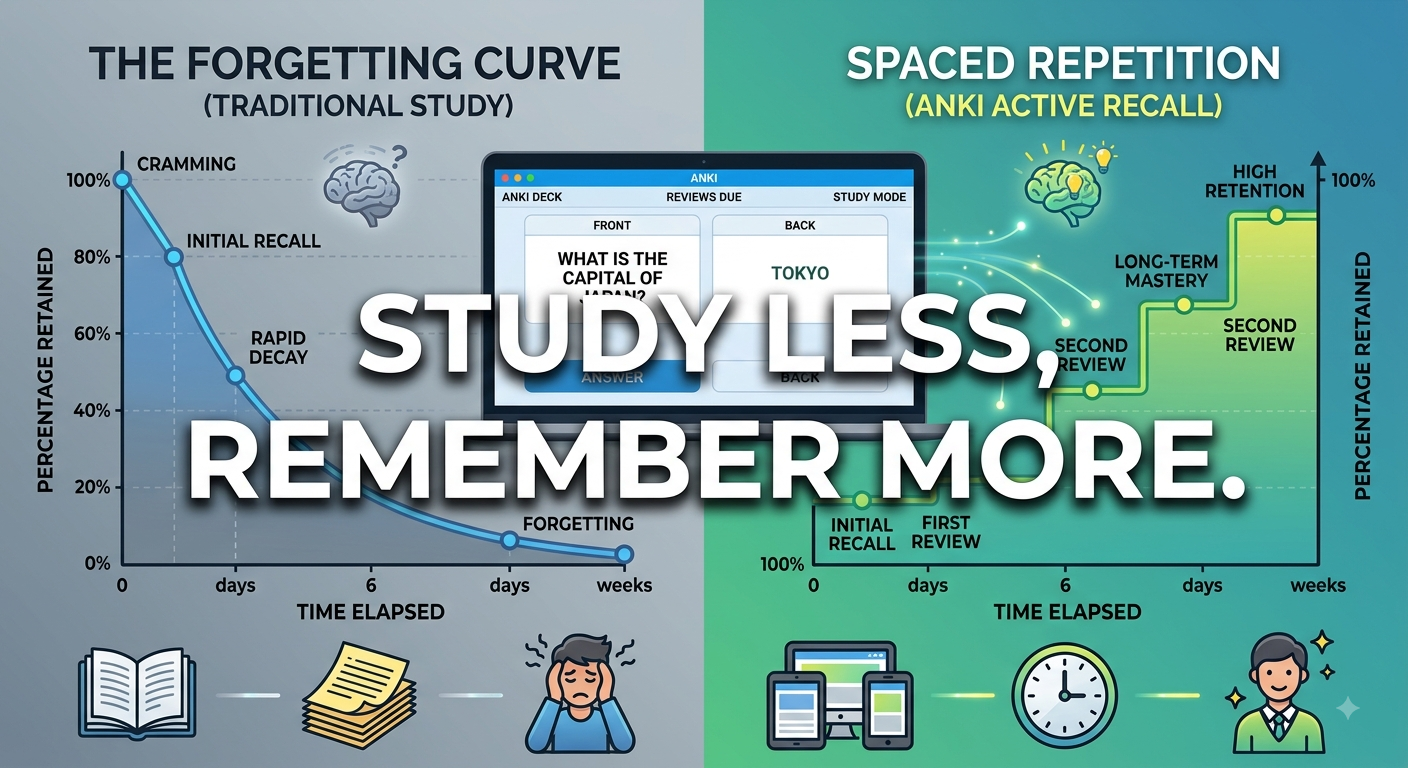
Anki is a free, open-source flashcard application powered by a custom Spaced Repetition System (SRS) algorithm. Instead of reviewing every card every day, Anki calculates the exact moment you are about to forget a piece of information and presents it to you right then, maximizing long-term retention with minimal study time.
🌟 Key Features for Tech Students
1. Custom Cloze Deletions & Code Highlighting
What it does: Hide specific parts of a code snippet or formula (Cloze Overlaps) to test active recall in context.
Student Advantage: Learn syntax pattern recognition quickly (e.g., test yourself on function syntax, parameters, or edge-case handling without looking at full code solutions).
2. Algorithmically Scheduled Reviews
What it does: Based on how easily you recall an answer (Rated: Again, Hard, Good, or Easy), Anki schedules the next review for 1 day, 4 days, or even 3 months out.
Student Advantage: You spend zero time reviewing concepts you already know well, freeing up time for hands-on project building.
3. Cross-Platform Syncing & Community Decks
What it does: Sync your cards seamlessly between desktop and mobile devices, or import pre-made community decks for core subjects like CS fundamentals, Git commands, or AWS certifications.
⚠️ Where It Falls Short
Dull Interface: Anki prioritizes functional algorithms over sleek UI design. It looks like a legacy program out of the box (though customizable with themes).
Card Creation Hygiene: Anki only works well if you write atomic cards. If you try to paste whole code files or multi-paragraph notes onto one flashcard, the system breaks down.
💡 Student Action Plan (Getting Started)Follow the Minimum Information Principle: Keep cards short. Ask one specific question per card (e.g., "What is the time complexity of looking up a key in a Hash Table? > O(1)).
Make Your Own Cards: While community decks exist, the act of converting your study notes into flashcards accounts for 50% of the learning process.
Commit to 10 Minutes Daily: Spaced repetition relies on consistency. Reviewing 15–20 cards a day over a semester guarantees higher retention than pulling a 12-hour cram session before finals.
Key Takeaways
Beat the Forgetting Curve: Spaced repetition forces active recall right at the point of forgetting to lock knowledge into long-term memory.
Efficiency First: Smart algorithms stop you from wasting time reviewing material you already master.
Consistency > Intensity: Just 10 minutes of daily flashcard review beats hours of last-minute cramming.
CTA
Studying tech doesn't have to be a solo struggle.
Swap study strategies, get recommendations on pre-built study decks, and collaborate with ambitious student developers. [Join Students in Tech] to supercharge your learning journey today.
When studying technical topics—like data structures, algorithm complexities (O(n), O/ n)), network protocols, or programming syntax—simple passive reading won't make the knowledge stick.
Anki is a free, open-source flashcard application powered by a custom Spaced Repetition System (SRS) algorithm. Instead of reviewing every card every day, Anki calculates the exact moment you are about to forget a piece of information and presents it to you right then, maximizing long-term retention with minimal study time.
🌟 Key Features for Tech Students
1. Custom Cloze Deletions & Code Highlighting
What it does: Hide specific parts of a code snippet or formula (Cloze Overlaps) to test active recall in context.
Student Advantage: Learn syntax pattern recognition quickly (e.g., test yourself on function syntax, parameters, or edge-case handling without looking at full code solutions).
2. Algorithmically Scheduled Reviews
What it does: Based on how easily you recall an answer (Rated: Again, Hard, Good, or Easy), Anki schedules the next review for 1 day, 4 days, or even 3 months out.
Student Advantage: You spend zero time reviewing concepts you already know well, freeing up time for hands-on project building.
3. Cross-Platform Syncing & Community Decks
What it does: Sync your cards seamlessly between desktop and mobile devices, or import pre-made community decks for core subjects like CS fundamentals, Git commands, or AWS certifications.
⚠️ Where It Falls Short
Dull Interface: Anki prioritizes functional algorithms over sleek UI design. It looks like a legacy program out of the box (though customizable with themes).
Card Creation Hygiene: Anki only works well if you write atomic cards. If you try to paste whole code files or multi-paragraph notes onto one flashcard, the system breaks down.
💡 Student Action Plan (Getting Started)Follow the Minimum Information Principle: Keep cards short. Ask one specific question per card (e.g., "What is the time complexity of looking up a key in a Hash Table? > O(1)).
Make Your Own Cards: While community decks exist, the act of converting your study notes into flashcards accounts for 50% of the learning process.
Commit to 10 Minutes Daily: Spaced repetition relies on consistency. Reviewing 15–20 cards a day over a semester guarantees higher retention than pulling a 12-hour cram session before finals.
Key Takeaways
Beat the Forgetting Curve: Spaced repetition forces active recall right at the point of forgetting to lock knowledge into long-term memory.
Efficiency First: Smart algorithms stop you from wasting time reviewing material you already master.
Consistency > Intensity: Just 10 minutes of daily flashcard review beats hours of last-minute cramming.
CTA
Studying tech doesn't have to be a solo struggle.
Swap study strategies, get recommendations on pre-built study decks, and collaborate with ambitious student developers. [Join Students in Tech] to supercharge your learning journey today.
Tool Review: How Anki Uses Spaced Repetition to Lock Tech Concepts into Long-Term Memory
When studying technical topics—like data structures, algorithm complexities (O(n), O/ n)), network protocols, or programming syntax—simple passive reading won't make the knowledge stick.
Anki is a free, open-source flashcard application powered by a custom Spaced Repetition System (SRS) algorithm. Instead of reviewing every card every day, Anki calculates the exact moment you are about to forget a piece of information and presents it to you right then, maximizing long-term retention with minimal study time.
🌟 Key Features for Tech Students
1. Custom Cloze Deletions & Code Highlighting
What it does: Hide specific parts of a code snippet or formula (Cloze Overlaps) to test active recall in context.
Student Advantage: Learn syntax pattern recognition quickly (e.g., test yourself on function syntax, parameters, or edge-case handling without looking at full code solutions).
2. Algorithmically Scheduled Reviews
What it does: Based on how easily you recall an answer (Rated: Again, Hard, Good, or Easy), Anki schedules the next review for 1 day, 4 days, or even 3 months out.
Student Advantage: You spend zero time reviewing concepts you already know well, freeing up time for hands-on project building.
3. Cross-Platform Syncing & Community Decks
What it does: Sync your cards seamlessly between desktop and mobile devices, or import pre-made community decks for core subjects like CS fundamentals, Git commands, or AWS certifications.
⚠️ Where It Falls Short
Dull Interface: Anki prioritizes functional algorithms over sleek UI design. It looks like a legacy program out of the box (though customizable with themes).
Card Creation Hygiene: Anki only works well if you write atomic cards. If you try to paste whole code files or multi-paragraph notes onto one flashcard, the system breaks down.
💡 Student Action Plan (Getting Started)Follow the Minimum Information Principle: Keep cards short. Ask one specific question per card (e.g., "What is the time complexity of looking up a key in a Hash Table? > O(1)).
Make Your Own Cards: While community decks exist, the act of converting your study notes into flashcards accounts for 50% of the learning process.
Commit to 10 Minutes Daily: Spaced repetition relies on consistency. Reviewing 15–20 cards a day over a semester guarantees higher retention than pulling a 12-hour cram session before finals.
Key Takeaways
Beat the Forgetting Curve: Spaced repetition forces active recall right at the point of forgetting to lock knowledge into long-term memory.
Efficiency First: Smart algorithms stop you from wasting time reviewing material you already master.
Consistency > Intensity: Just 10 minutes of daily flashcard review beats hours of last-minute cramming.
CTA
Studying tech doesn't have to be a solo struggle.
Swap study strategies, get recommendations on pre-built study decks, and collaborate with ambitious student developers. [Join Students in Tech] to supercharge your learning journey today.

 English
 Arabic
 French
 Spanish
 Portuguese
 Turkish
 Dutch
Dutch
 Italiano
 Russian
 Romaian
 Portuguese (Brazil)
 Greek
Greek