


Myth vs. Fact: 4 System Performance Traps That Fooled Senior Engineers
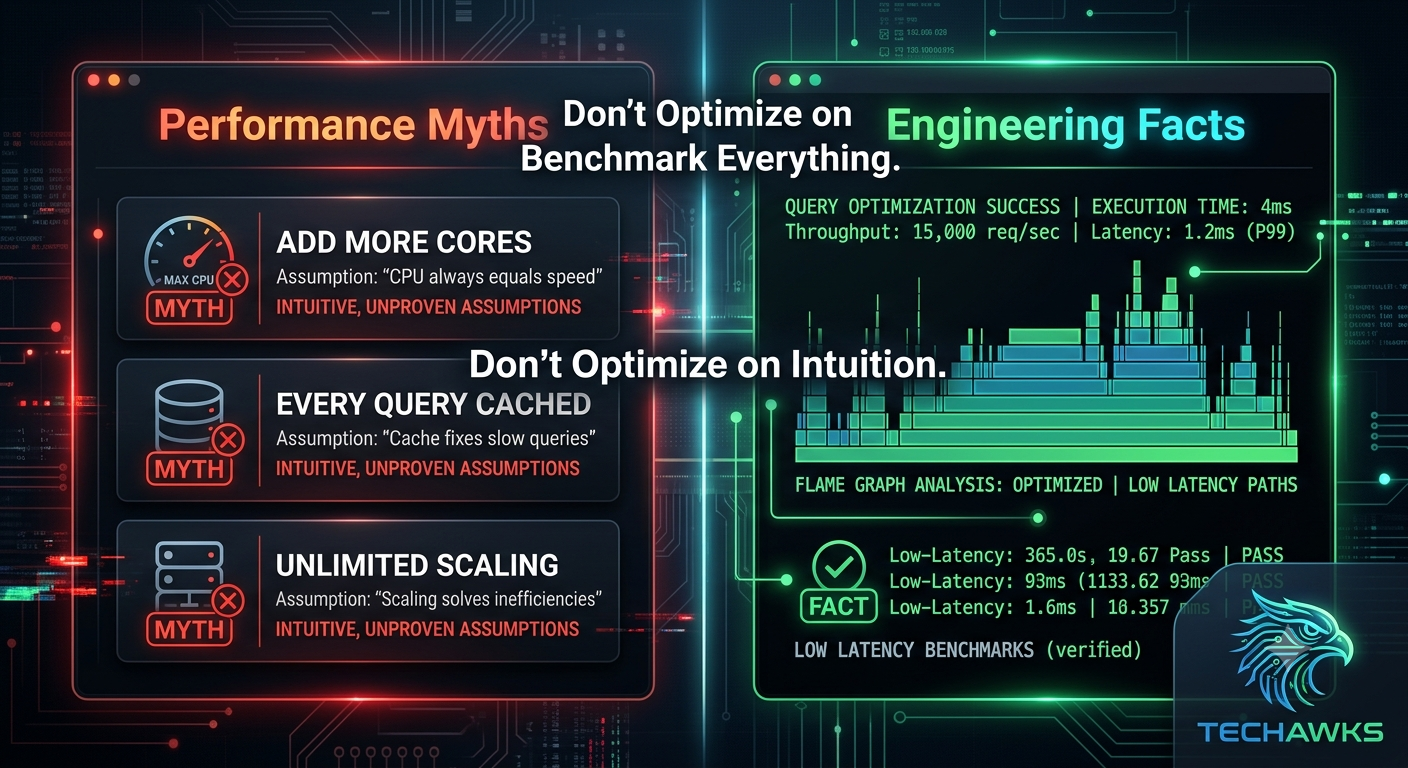
Optimizing software performance requires diagnosing actual bottlenecks rather than relying on common assumptions. Relying on intuition instead of profiling tools often introduces unnecessary system complexity while leaving performance issues untouched.
Here are four widespread performance myths debunked with practical engineering realities:
Myth 1: "Adding more server nodes will fix slow API endpoints."
Fact: Scale-out horizontal scaling only helps when your bottleneck is CPU or memory consumption on the application server. If your database queries lack proper indexes, adding ten extra server instances will only multiply concurrent connections and degrade database performance faster.
Action: Profile your requests using APM tools. Fix underlying slow database queries and locking issues before adding infrastructure nodes.
Myth 2: "Caching everything in Redis guarantees low latency."
Fact: Inefficient cache usage can degrade performance. Unindexed cache keys, massive payload sizes, and high serialization/deserialization overhead can make Redis lookups slower than optimized local database reads.
Action: Cache selectively. Store pre-parsed, minimal data structures rather than full raw objects, and always enforce TTLs (Time-To-Live) to avoid memory bloat.
Myth 3: "Asynchronous code is always faster than synchronous code."
Fact: Asynchronous processing improves throughput and resource utilization by preventing thread blocking, but it does not reduce single-request execution latency. In fact, task scheduling and event loop context switching add small overheads.
Action: Use async/non-blocking I/O to handle high concurrency, but do not rely on it to make heavy computational tasks process faster.
Myth 4: "Microservices are faster than monolithic applications."
Fact: Microservices trade single-process memory calls for network HTTP/gRPC calls. Network latency, serialization overhead, and retries mean microservices are inherently slower on a single-request level than a clean monolith.
Action: Adopt microservices for team autonomy and isolated deployment scale, not for raw execution speed.
Key Takeaways
Measure First, Optimize Second: Never guess where latency originates; use profiling, flame graphs, and APM tools to isolate bottlenecks.
Fix the Root Cause: Infrastructure scaling cannot compensate for inefficient algorithms or missing database indexes.
Factor in Network Overhead: Moving logic across network boundaries always introduces latency—design interfaces to minimize round trips.
CTA
Tired of engineering myths wasting your team's sprint cycles? Join the Techawks General Community to discuss system design trade-offs, share real-world profiling benchmarks, and sharpen your architectural skills with peers worldwide.
Optimizing software performance requires diagnosing actual bottlenecks rather than relying on common assumptions. Relying on intuition instead of profiling tools often introduces unnecessary system complexity while leaving performance issues untouched.
Here are four widespread performance myths debunked with practical engineering realities:
Myth 1: "Adding more server nodes will fix slow API endpoints."
Fact: Scale-out horizontal scaling only helps when your bottleneck is CPU or memory consumption on the application server. If your database queries lack proper indexes, adding ten extra server instances will only multiply concurrent connections and degrade database performance faster.
Action: Profile your requests using APM tools. Fix underlying slow database queries and locking issues before adding infrastructure nodes.
Myth 2: "Caching everything in Redis guarantees low latency."
Fact: Inefficient cache usage can degrade performance. Unindexed cache keys, massive payload sizes, and high serialization/deserialization overhead can make Redis lookups slower than optimized local database reads.
Action: Cache selectively. Store pre-parsed, minimal data structures rather than full raw objects, and always enforce TTLs (Time-To-Live) to avoid memory bloat.
Myth 3: "Asynchronous code is always faster than synchronous code."
Fact: Asynchronous processing improves throughput and resource utilization by preventing thread blocking, but it does not reduce single-request execution latency. In fact, task scheduling and event loop context switching add small overheads.
Action: Use async/non-blocking I/O to handle high concurrency, but do not rely on it to make heavy computational tasks process faster.
Myth 4: "Microservices are faster than monolithic applications."
Fact: Microservices trade single-process memory calls for network HTTP/gRPC calls. Network latency, serialization overhead, and retries mean microservices are inherently slower on a single-request level than a clean monolith.
Action: Adopt microservices for team autonomy and isolated deployment scale, not for raw execution speed.
Key Takeaways
Measure First, Optimize Second: Never guess where latency originates; use profiling, flame graphs, and APM tools to isolate bottlenecks.
Fix the Root Cause: Infrastructure scaling cannot compensate for inefficient algorithms or missing database indexes.
Factor in Network Overhead: Moving logic across network boundaries always introduces latency—design interfaces to minimize round trips.
CTA
Tired of engineering myths wasting your team's sprint cycles? Join the Techawks General Community to discuss system design trade-offs, share real-world profiling benchmarks, and sharpen your architectural skills with peers worldwide.
Myth vs. Fact: 4 System Performance Traps That Fooled Senior Engineers
Optimizing software performance requires diagnosing actual bottlenecks rather than relying on common assumptions. Relying on intuition instead of profiling tools often introduces unnecessary system complexity while leaving performance issues untouched.
Here are four widespread performance myths debunked with practical engineering realities:
Myth 1: "Adding more server nodes will fix slow API endpoints."
Fact: Scale-out horizontal scaling only helps when your bottleneck is CPU or memory consumption on the application server. If your database queries lack proper indexes, adding ten extra server instances will only multiply concurrent connections and degrade database performance faster.
Action: Profile your requests using APM tools. Fix underlying slow database queries and locking issues before adding infrastructure nodes.
Myth 2: "Caching everything in Redis guarantees low latency."
Fact: Inefficient cache usage can degrade performance. Unindexed cache keys, massive payload sizes, and high serialization/deserialization overhead can make Redis lookups slower than optimized local database reads.
Action: Cache selectively. Store pre-parsed, minimal data structures rather than full raw objects, and always enforce TTLs (Time-To-Live) to avoid memory bloat.
Myth 3: "Asynchronous code is always faster than synchronous code."
Fact: Asynchronous processing improves throughput and resource utilization by preventing thread blocking, but it does not reduce single-request execution latency. In fact, task scheduling and event loop context switching add small overheads.
Action: Use async/non-blocking I/O to handle high concurrency, but do not rely on it to make heavy computational tasks process faster.
Myth 4: "Microservices are faster than monolithic applications."
Fact: Microservices trade single-process memory calls for network HTTP/gRPC calls. Network latency, serialization overhead, and retries mean microservices are inherently slower on a single-request level than a clean monolith.
Action: Adopt microservices for team autonomy and isolated deployment scale, not for raw execution speed.
Key Takeaways
Measure First, Optimize Second: Never guess where latency originates; use profiling, flame graphs, and APM tools to isolate bottlenecks.
Fix the Root Cause: Infrastructure scaling cannot compensate for inefficient algorithms or missing database indexes.
Factor in Network Overhead: Moving logic across network boundaries always introduces latency—design interfaces to minimize round trips.
CTA
Tired of engineering myths wasting your team's sprint cycles? Join the Techawks General Community to discuss system design trade-offs, share real-world profiling benchmarks, and sharpen your architectural skills with peers worldwide.

 English
 Arabic
 French
 Spanish
 Deutsch
 Turkish
 Dutch
Dutch
 Italiano
 Russian
 Romaian
 Portuguese (Brazil)
 Greek
Greek