


Tool Breakdown: SQL vs. Python for Data Analytics—Which Belongs in Your Stack?
Every data professional uses both SQL and Python, but knowing where each tool shines in a modern analytics workflow is what separates junior analysts from senior data strategists.
Here is an objective, practical review of how SQL and Python stack up for core analytics tasks—and how to combine them effectively.
1. Structured Data Transformation
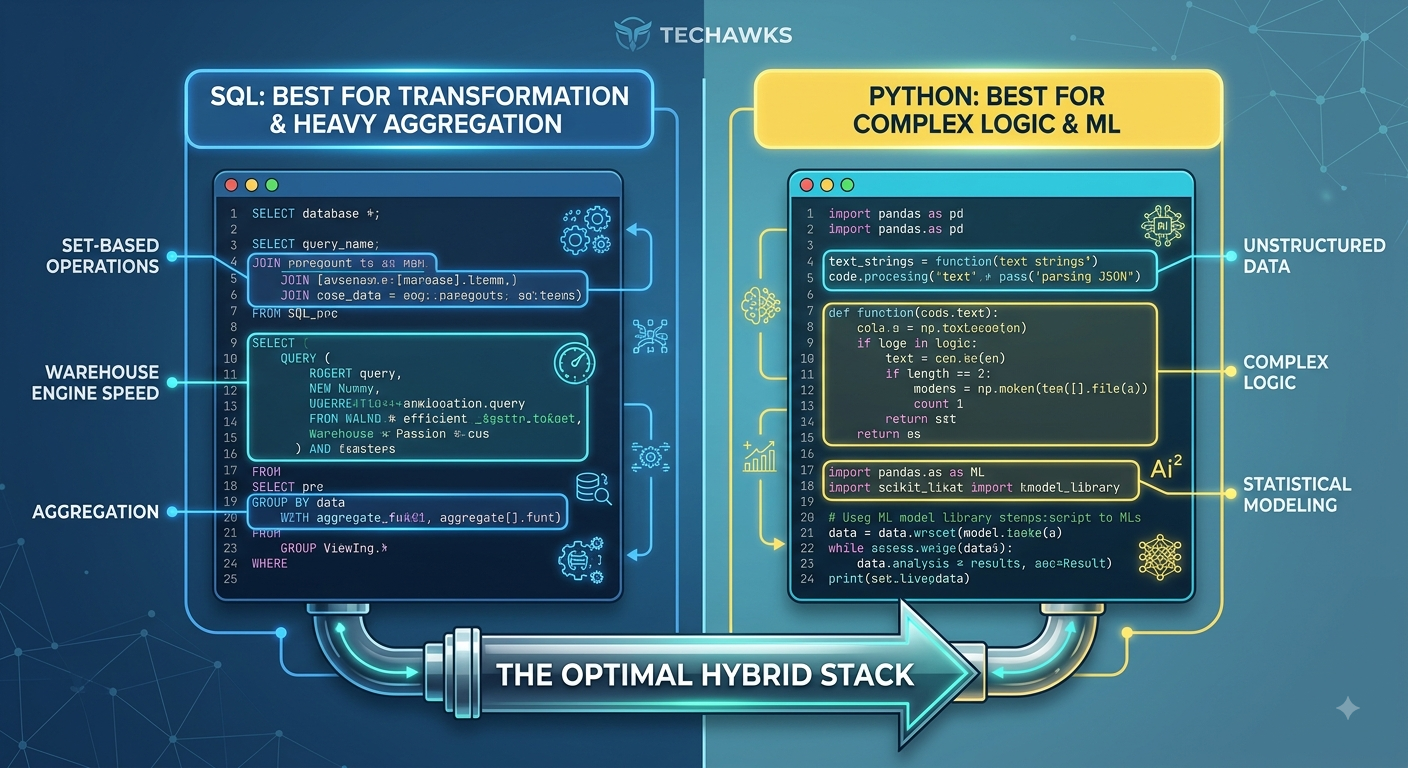
SQL: Winner. SQL is engine-optimized for set-based operations. Pushing joins, aggregations, and window functions directly to your cloud data warehouse (e.g., Snowflake, BigQuery) maximizes performance and minimizes cost via query optimization engines.
Python (Pandas/Polars): Great for small-to-medium in-memory datasets, but pulling millions of rows out of a warehouse into a local Python runtime creates massive bandwidth bottlenecks and memory errors.
Rule of Thumb: If the data is already structured inside a relational database or warehouse, do 100% of your initial filtering, joining, and aggregation in SQL.
2. Complex Business Logic & Data Wrangling
SQL: Can quickly become unreadable. Nested subqueries, dynamic looping, and procedural logic require complex Common Table Expressions (CTEs) or vendor-specific stored procedures that are difficult to unit-test and version-control.
Python: Winner. Python shines when handling unstructured data (JSON, text parsing), statistical modeling, regex manipulation, and iterative loops. Libraries like Polars or Pandas make custom string parsing and complex logic clean and testable.
Rule of Thumb: If your transformation requires looping, complex conditional logic, API calls, or machine learning pipelines, hand the clean data off to Python.
3. Workflow Maintainability & Ecosystem
SQL: Combined with modern modeling tools (like dbt), SQL enables modular transformations, automated documentation, and easy lineage tracking.
Python: Offers robust software engineering standards—unit testing (pytest), object-oriented design, and seamless integration with orchestration tools like Airflow or Prefect.
The Strategy: The Hybrid Analytics Stack
To get the highest performance at the lowest cost, follow this two-stage pipeline pattern:
Heavy Lifting in SQL: Perform heavy aggregations, joins, and filtering inside the warehouse using SQL. Reduce 10 million rows down to the key 50,000 summarized records.
Advanced Analytics in Python: Export the aggregated subset to a Python environment for predictive modeling, statistical testing, or custom visualizations.
Key Takeaways
Leverage Engine Optimization: Use SQL for in-warehouse data transformations to take advantage of MPP (Massively Parallel Processing) engines.
Use Python for Custom Logic: Reserve Python for complex data manipulation, unstructured text parsing, and statistical modeling.
Build Hybrid Pipelines: Don't pick one over the other—aggregate down with SQL, then model up with Python.
CTA
Want to master modern analytics workflows, cloud data architecture, and advanced modeling strategies? Join Data Science & Analytics at Techawks today and elevate your technical edge.
Every data professional uses both SQL and Python, but knowing where each tool shines in a modern analytics workflow is what separates junior analysts from senior data strategists.
Here is an objective, practical review of how SQL and Python stack up for core analytics tasks—and how to combine them effectively.
1. Structured Data Transformation
SQL: Winner. SQL is engine-optimized for set-based operations. Pushing joins, aggregations, and window functions directly to your cloud data warehouse (e.g., Snowflake, BigQuery) maximizes performance and minimizes cost via query optimization engines.
Python (Pandas/Polars): Great for small-to-medium in-memory datasets, but pulling millions of rows out of a warehouse into a local Python runtime creates massive bandwidth bottlenecks and memory errors.
Rule of Thumb: If the data is already structured inside a relational database or warehouse, do 100% of your initial filtering, joining, and aggregation in SQL.
2. Complex Business Logic & Data Wrangling
SQL: Can quickly become unreadable. Nested subqueries, dynamic looping, and procedural logic require complex Common Table Expressions (CTEs) or vendor-specific stored procedures that are difficult to unit-test and version-control.
Python: Winner. Python shines when handling unstructured data (JSON, text parsing), statistical modeling, regex manipulation, and iterative loops. Libraries like Polars or Pandas make custom string parsing and complex logic clean and testable.
Rule of Thumb: If your transformation requires looping, complex conditional logic, API calls, or machine learning pipelines, hand the clean data off to Python.
3. Workflow Maintainability & Ecosystem
SQL: Combined with modern modeling tools (like dbt), SQL enables modular transformations, automated documentation, and easy lineage tracking.
Python: Offers robust software engineering standards—unit testing (pytest), object-oriented design, and seamless integration with orchestration tools like Airflow or Prefect.
The Strategy: The Hybrid Analytics Stack
To get the highest performance at the lowest cost, follow this two-stage pipeline pattern:
Heavy Lifting in SQL: Perform heavy aggregations, joins, and filtering inside the warehouse using SQL. Reduce 10 million rows down to the key 50,000 summarized records.
Advanced Analytics in Python: Export the aggregated subset to a Python environment for predictive modeling, statistical testing, or custom visualizations.
Key Takeaways
Leverage Engine Optimization: Use SQL for in-warehouse data transformations to take advantage of MPP (Massively Parallel Processing) engines.
Use Python for Custom Logic: Reserve Python for complex data manipulation, unstructured text parsing, and statistical modeling.
Build Hybrid Pipelines: Don't pick one over the other—aggregate down with SQL, then model up with Python.
CTA
Want to master modern analytics workflows, cloud data architecture, and advanced modeling strategies? Join Data Science & Analytics at Techawks today and elevate your technical edge.
Tool Breakdown: SQL vs. Python for Data Analytics—Which Belongs in Your Stack?
Every data professional uses both SQL and Python, but knowing where each tool shines in a modern analytics workflow is what separates junior analysts from senior data strategists.
Here is an objective, practical review of how SQL and Python stack up for core analytics tasks—and how to combine them effectively.
1. Structured Data Transformation
SQL: Winner. SQL is engine-optimized for set-based operations. Pushing joins, aggregations, and window functions directly to your cloud data warehouse (e.g., Snowflake, BigQuery) maximizes performance and minimizes cost via query optimization engines.
Python (Pandas/Polars): Great for small-to-medium in-memory datasets, but pulling millions of rows out of a warehouse into a local Python runtime creates massive bandwidth bottlenecks and memory errors.
Rule of Thumb: If the data is already structured inside a relational database or warehouse, do 100% of your initial filtering, joining, and aggregation in SQL.
2. Complex Business Logic & Data Wrangling
SQL: Can quickly become unreadable. Nested subqueries, dynamic looping, and procedural logic require complex Common Table Expressions (CTEs) or vendor-specific stored procedures that are difficult to unit-test and version-control.
Python: Winner. Python shines when handling unstructured data (JSON, text parsing), statistical modeling, regex manipulation, and iterative loops. Libraries like Polars or Pandas make custom string parsing and complex logic clean and testable.
Rule of Thumb: If your transformation requires looping, complex conditional logic, API calls, or machine learning pipelines, hand the clean data off to Python.
3. Workflow Maintainability & Ecosystem
SQL: Combined with modern modeling tools (like dbt), SQL enables modular transformations, automated documentation, and easy lineage tracking.
Python: Offers robust software engineering standards—unit testing (pytest), object-oriented design, and seamless integration with orchestration tools like Airflow or Prefect.
The Strategy: The Hybrid Analytics Stack
To get the highest performance at the lowest cost, follow this two-stage pipeline pattern:
Heavy Lifting in SQL: Perform heavy aggregations, joins, and filtering inside the warehouse using SQL. Reduce 10 million rows down to the key 50,000 summarized records.
Advanced Analytics in Python: Export the aggregated subset to a Python environment for predictive modeling, statistical testing, or custom visualizations.
Key Takeaways
Leverage Engine Optimization: Use SQL for in-warehouse data transformations to take advantage of MPP (Massively Parallel Processing) engines.
Use Python for Custom Logic: Reserve Python for complex data manipulation, unstructured text parsing, and statistical modeling.
Build Hybrid Pipelines: Don't pick one over the other—aggregate down with SQL, then model up with Python.
CTA
Want to master modern analytics workflows, cloud data architecture, and advanced modeling strategies? Join Data Science & Analytics at Techawks today and elevate your technical edge.

 English
 French
 Spanish
 Portuguese
 Deutsch
 Turkish
 Dutch
Dutch
 Italiano
 Russian
 Romaian
 Portuguese (Brazil)
 Greek
Greek