


Stop Over-Engineering K8s: The Single-Node Challenge
Here is an uncomfortable truth in modern cloud engineering: Resilience doesn't come from infrastructure complexity; it comes from system simplicity.
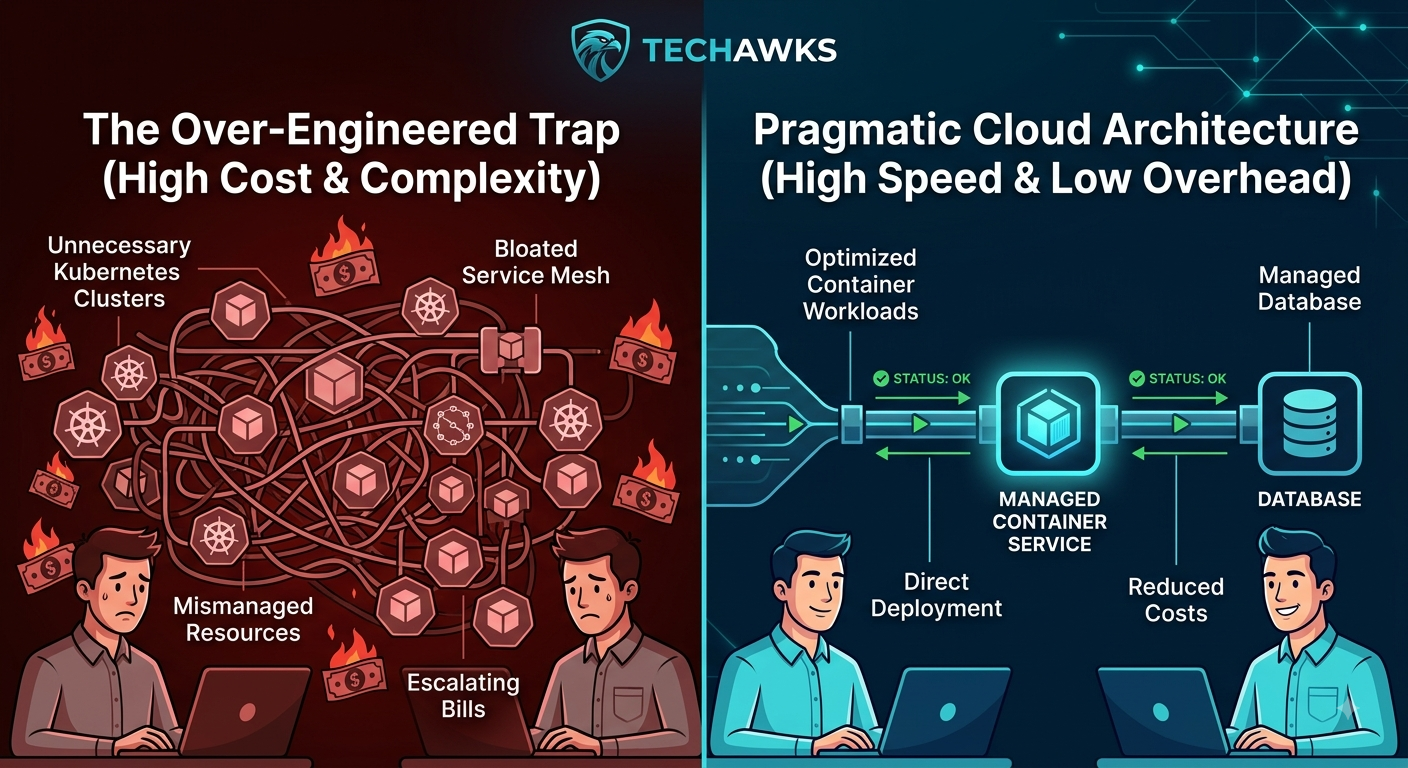
Somewhere along the line, "cloud native" became synonymous with deploy-everything-on-Kubernetes. Engineers spin up control planes, ingress controllers, service meshes, and custom CRDs for workloads that could easily run on a managed container service or a couple of well-configured virtual instances. The result? Skyrocketing cloud costs, painful upgrades, and hours spent debugging control plane anomalies instead of shipping product.
It’s time to challenge the default assumption that every application needs a distributed microservice cluster.
The Challenge: Audit Your Workload Against the "Single Node Test"
Take your primary application architecture today and run it through this brutal simplification filter:
The Traffic Realism Test: Does your app handle more than 10,000 requests per second continuously? If the answer is no, a single well-resourced instance (or a managed service like AWS Fargate/GCP Cloud Run) can easily handle your load with zero cluster management overhead.
The Stateful Reality Test: Are you running stateful databases inside Kubernetes pods just because you can? If yes, move them to a managed cloud database (RDS, Cloud SQL). Let cloud providers handle automated backups, failover, and multi-AZ replication.
The Deployment Velocity Test: Does your deployment pipeline take longer to configure Helm charts, ingress routes, and service mesh policies than it does to compile your application code? If your infrastructure config outgrows your business logic, you've over-engineered.
How to Execute This Today:
Adopt Serverless / Managed Containers First: Before spinning up EKS or GKE, ask: "Can this run on Cloud Run, ECS Fargate, or App Runner?" If yes, deploy there first. You eliminate control plane costs and node group maintenance instantly.
Treat Infrastructure as Stateless: If you do need VMs or bare nodes, make them entirely ephemeral. If an instance dies, your load balancer should seamlessly route to a fresh clone configured via simple cloud-init scripts or lightweight container runtimes.
Measure Maintenance Overhead: Track how many engineering hours per month are spent updating Kubernetes control planes, patching CNI plugins, and fixing ingress controllers versus writing customer-facing code.
True cloud mastery isn't about how many distributed systems you can stitch together—it's about building the simplest architecture that reliably meets your SLA.
Key Takeaways
Simplicity Equals Reliability: Fewer moving parts mean fewer failure domains, easier debugging, and lower operational costs.
Prefer Managed Services Over DIY Clusters: Outsource cluster management, load balancing, and database replication to managed cloud providers whenever possible.
Match Architecture to Scale: Don't build for Netflix-level traffic if your system handles moderate, predictable workloads.
CTA
Ready to build pragmatic, resilient, and cost-effective cloud platforms without unnecessary complexity? Join Cloud, DevOps & Open Source at Techawks today to master high-impact cloud architecture and infrastructure engineering.
Here is an uncomfortable truth in modern cloud engineering: Resilience doesn't come from infrastructure complexity; it comes from system simplicity.
Somewhere along the line, "cloud native" became synonymous with deploy-everything-on-Kubernetes. Engineers spin up control planes, ingress controllers, service meshes, and custom CRDs for workloads that could easily run on a managed container service or a couple of well-configured virtual instances. The result? Skyrocketing cloud costs, painful upgrades, and hours spent debugging control plane anomalies instead of shipping product.
It’s time to challenge the default assumption that every application needs a distributed microservice cluster.
The Challenge: Audit Your Workload Against the "Single Node Test"
Take your primary application architecture today and run it through this brutal simplification filter:
The Traffic Realism Test: Does your app handle more than 10,000 requests per second continuously? If the answer is no, a single well-resourced instance (or a managed service like AWS Fargate/GCP Cloud Run) can easily handle your load with zero cluster management overhead.
The Stateful Reality Test: Are you running stateful databases inside Kubernetes pods just because you can? If yes, move them to a managed cloud database (RDS, Cloud SQL). Let cloud providers handle automated backups, failover, and multi-AZ replication.
The Deployment Velocity Test: Does your deployment pipeline take longer to configure Helm charts, ingress routes, and service mesh policies than it does to compile your application code? If your infrastructure config outgrows your business logic, you've over-engineered.
How to Execute This Today:
Adopt Serverless / Managed Containers First: Before spinning up EKS or GKE, ask: "Can this run on Cloud Run, ECS Fargate, or App Runner?" If yes, deploy there first. You eliminate control plane costs and node group maintenance instantly.
Treat Infrastructure as Stateless: If you do need VMs or bare nodes, make them entirely ephemeral. If an instance dies, your load balancer should seamlessly route to a fresh clone configured via simple cloud-init scripts or lightweight container runtimes.
Measure Maintenance Overhead: Track how many engineering hours per month are spent updating Kubernetes control planes, patching CNI plugins, and fixing ingress controllers versus writing customer-facing code.
True cloud mastery isn't about how many distributed systems you can stitch together—it's about building the simplest architecture that reliably meets your SLA.
Key Takeaways
Simplicity Equals Reliability: Fewer moving parts mean fewer failure domains, easier debugging, and lower operational costs.
Prefer Managed Services Over DIY Clusters: Outsource cluster management, load balancing, and database replication to managed cloud providers whenever possible.
Match Architecture to Scale: Don't build for Netflix-level traffic if your system handles moderate, predictable workloads.
CTA
Ready to build pragmatic, resilient, and cost-effective cloud platforms without unnecessary complexity? Join Cloud, DevOps & Open Source at Techawks today to master high-impact cloud architecture and infrastructure engineering.
Stop Over-Engineering K8s: The Single-Node Challenge
Here is an uncomfortable truth in modern cloud engineering: Resilience doesn't come from infrastructure complexity; it comes from system simplicity.
Somewhere along the line, "cloud native" became synonymous with deploy-everything-on-Kubernetes. Engineers spin up control planes, ingress controllers, service meshes, and custom CRDs for workloads that could easily run on a managed container service or a couple of well-configured virtual instances. The result? Skyrocketing cloud costs, painful upgrades, and hours spent debugging control plane anomalies instead of shipping product.
It’s time to challenge the default assumption that every application needs a distributed microservice cluster.
The Challenge: Audit Your Workload Against the "Single Node Test"
Take your primary application architecture today and run it through this brutal simplification filter:
The Traffic Realism Test: Does your app handle more than 10,000 requests per second continuously? If the answer is no, a single well-resourced instance (or a managed service like AWS Fargate/GCP Cloud Run) can easily handle your load with zero cluster management overhead.
The Stateful Reality Test: Are you running stateful databases inside Kubernetes pods just because you can? If yes, move them to a managed cloud database (RDS, Cloud SQL). Let cloud providers handle automated backups, failover, and multi-AZ replication.
The Deployment Velocity Test: Does your deployment pipeline take longer to configure Helm charts, ingress routes, and service mesh policies than it does to compile your application code? If your infrastructure config outgrows your business logic, you've over-engineered.
How to Execute This Today:
Adopt Serverless / Managed Containers First: Before spinning up EKS or GKE, ask: "Can this run on Cloud Run, ECS Fargate, or App Runner?" If yes, deploy there first. You eliminate control plane costs and node group maintenance instantly.
Treat Infrastructure as Stateless: If you do need VMs or bare nodes, make them entirely ephemeral. If an instance dies, your load balancer should seamlessly route to a fresh clone configured via simple cloud-init scripts or lightweight container runtimes.
Measure Maintenance Overhead: Track how many engineering hours per month are spent updating Kubernetes control planes, patching CNI plugins, and fixing ingress controllers versus writing customer-facing code.
True cloud mastery isn't about how many distributed systems you can stitch together—it's about building the simplest architecture that reliably meets your SLA.
Key Takeaways
Simplicity Equals Reliability: Fewer moving parts mean fewer failure domains, easier debugging, and lower operational costs.
Prefer Managed Services Over DIY Clusters: Outsource cluster management, load balancing, and database replication to managed cloud providers whenever possible.
Match Architecture to Scale: Don't build for Netflix-level traffic if your system handles moderate, predictable workloads.
CTA
Ready to build pragmatic, resilient, and cost-effective cloud platforms without unnecessary complexity? Join Cloud, DevOps & Open Source at Techawks today to master high-impact cloud architecture and infrastructure engineering.

 English
 Arabic
 French
 Spanish
 Portuguese
 Deutsch
 Turkish
 Dutch
Dutch
 Russian
 Romaian
 Portuguese (Brazil)
 Greek
Greek