


Tool Breakdown: Terraform vs. Pulumi—Which Infrastructure as Code Tool Belongs in Your Pipeline?
Infrastructure as Code is the backbone of modern cloud engineering, but the debate between domain-specific declarative languages and general-purpose code runtimes is sharper than ever.
Here is an objective, practical review of Terraform (HCL) vs. Pulumi—and how to choose the right fit for your engineering organization.
1. Declarative Domain-Specific Language (Terraform / OpenTofu)
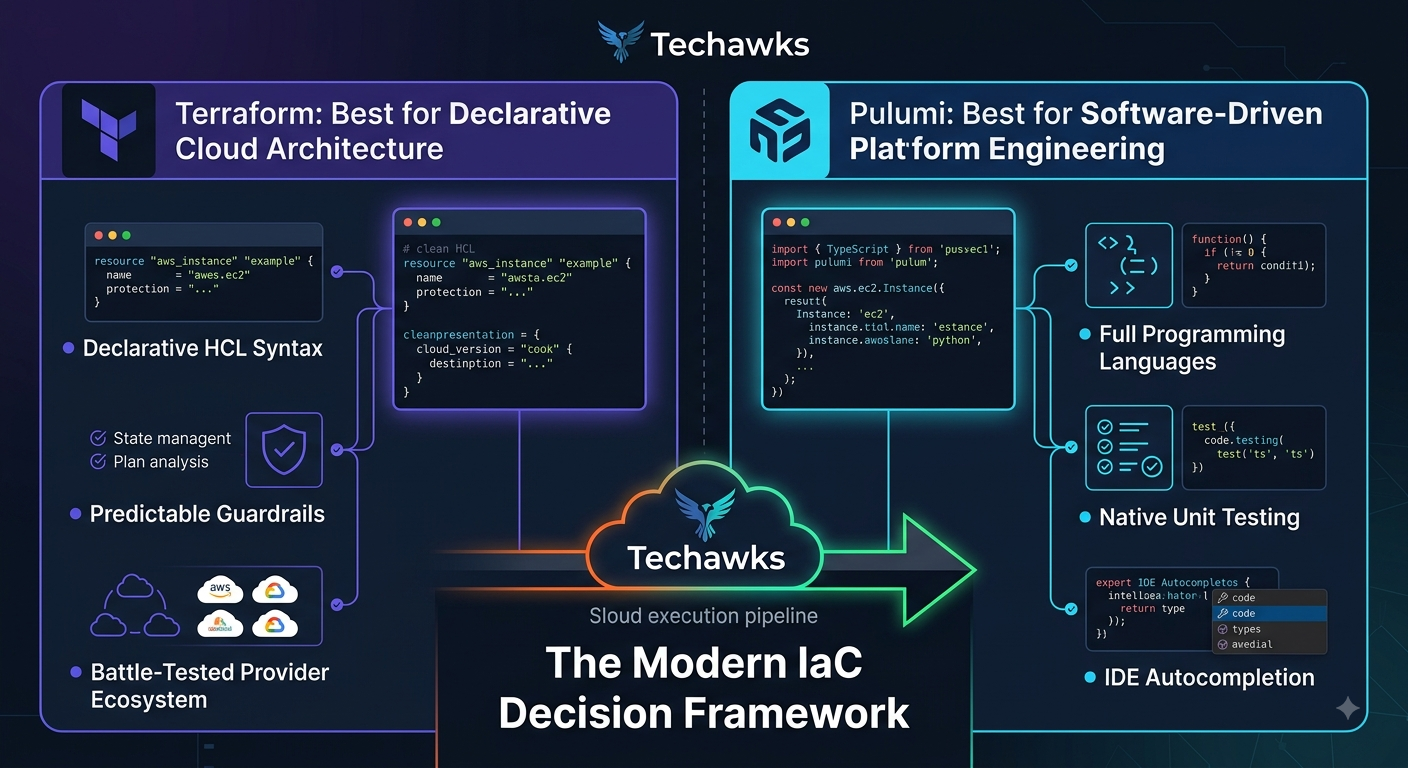
Terraform (HCL): Winner for Pure Infrastructure Teams. HashiCorp Configuration Language (HCL) is designed specifically for infrastructure declaration. Its structured, declarative nature prevents engineers from introducing overly complex programmatic logic (like arbitrary loops, network requests, or side effects) into infrastructure definitions.
Pulumi: Supports declarative paradigms, but using general-purpose languages makes it easy for developers to write anti-patterns—such as embedding dynamic API calls or non-deterministic loops directly inside resource definitions.
Rule of Thumb: If your primary platform operators are traditional sysadmins, cloud architects, or dedicated DevOps engineers, Terraform/HCL enforces clean, predictable guardrails.
2. General-Purpose Language Flexibility & Expressiveness (Pulumi)
Terraform: Can become clunky when handling complex dynamic infrastructure (e.g., iterating over multi-tenant configurations or complex JSON objects). You end up writing convoluted for_each expressions, dynamic blocks, and external local-exec scripts.
Pulumi: Winner for Application Developers & Platform Engineers. Pulumi lets you define infrastructure using real programming languages (TypeScript, Python, Go, C#). This unlocks native IDE autocompletion, robust unit testing frameworks (e.g., jest, pytest), object-oriented abstraction, and package manager ecosystem reuse (npm, pip).
Rule of Thumb: If your product engineers build their own cloud resources or you are constructing custom Internal Developer Platforms (IDPs), Pulumi bridges the gap between software development and infrastructure.
3. State Management & Ecosystem
Terraform: The undisputed market leader with thousands of battle-tested community providers. State file management via remote backends (S3, GCS) is widely understood across the industry.
Pulumi: Uses the same provider ecosystem under the hood (via bridge adapters) and offers seamless managed backend state storage out of the box, though self-hosting state requires slightly more configuration.
The Strategy: How to Make Your Decision Today
Assess Your Team's Skillset: If your team thinks in code (functions, classes, unit tests), choose Pulumi. If your team thinks in architecture diagrams and configuration files, choose Terraform.
Standardize Modular Abstractions: Regardless of tool choice, package your cloud patterns (e.g., secure VPC defaults, compliant S3 buckets) into reusable modules or npm/python packages before handing them to feature teams.
Enforce Automated Policy as Code: Use tools like OPA (Open Policy Agent) or Pulumi CrossGuard in your CI/CD pipelines to validate security compliance before state drift occurs.
Key Takeaways
Terraform Equals Guardrails: Best for standardizing cloud resources with declarative simplicity and minimal logic sprawl.
Pulumi Equals Expressiveness: Best for developer-centric teams needing real programming language abstractions, native unit testing, and dynamic resource loops.
Focus on Architecture over Hype: The strength of your IaC stack depends on modular design, state security, and automated CI/CD validation—not just syntax.
CTA
Want to master modern cloud provisioning, automated CI/CD pipelines, and enterprise infrastructure architecture? Join Cloud, DevOps & Open Source at Techawks today and build software that scales reliably.
Infrastructure as Code is the backbone of modern cloud engineering, but the debate between domain-specific declarative languages and general-purpose code runtimes is sharper than ever.
Here is an objective, practical review of Terraform (HCL) vs. Pulumi—and how to choose the right fit for your engineering organization.
1. Declarative Domain-Specific Language (Terraform / OpenTofu)
Terraform (HCL): Winner for Pure Infrastructure Teams. HashiCorp Configuration Language (HCL) is designed specifically for infrastructure declaration. Its structured, declarative nature prevents engineers from introducing overly complex programmatic logic (like arbitrary loops, network requests, or side effects) into infrastructure definitions.
Pulumi: Supports declarative paradigms, but using general-purpose languages makes it easy for developers to write anti-patterns—such as embedding dynamic API calls or non-deterministic loops directly inside resource definitions.
Rule of Thumb: If your primary platform operators are traditional sysadmins, cloud architects, or dedicated DevOps engineers, Terraform/HCL enforces clean, predictable guardrails.
2. General-Purpose Language Flexibility & Expressiveness (Pulumi)
Terraform: Can become clunky when handling complex dynamic infrastructure (e.g., iterating over multi-tenant configurations or complex JSON objects). You end up writing convoluted for_each expressions, dynamic blocks, and external local-exec scripts.
Pulumi: Winner for Application Developers & Platform Engineers. Pulumi lets you define infrastructure using real programming languages (TypeScript, Python, Go, C#). This unlocks native IDE autocompletion, robust unit testing frameworks (e.g., jest, pytest), object-oriented abstraction, and package manager ecosystem reuse (npm, pip).
Rule of Thumb: If your product engineers build their own cloud resources or you are constructing custom Internal Developer Platforms (IDPs), Pulumi bridges the gap between software development and infrastructure.
3. State Management & Ecosystem
Terraform: The undisputed market leader with thousands of battle-tested community providers. State file management via remote backends (S3, GCS) is widely understood across the industry.
Pulumi: Uses the same provider ecosystem under the hood (via bridge adapters) and offers seamless managed backend state storage out of the box, though self-hosting state requires slightly more configuration.
The Strategy: How to Make Your Decision Today
Assess Your Team's Skillset: If your team thinks in code (functions, classes, unit tests), choose Pulumi. If your team thinks in architecture diagrams and configuration files, choose Terraform.
Standardize Modular Abstractions: Regardless of tool choice, package your cloud patterns (e.g., secure VPC defaults, compliant S3 buckets) into reusable modules or npm/python packages before handing them to feature teams.
Enforce Automated Policy as Code: Use tools like OPA (Open Policy Agent) or Pulumi CrossGuard in your CI/CD pipelines to validate security compliance before state drift occurs.
Key Takeaways
Terraform Equals Guardrails: Best for standardizing cloud resources with declarative simplicity and minimal logic sprawl.
Pulumi Equals Expressiveness: Best for developer-centric teams needing real programming language abstractions, native unit testing, and dynamic resource loops.
Focus on Architecture over Hype: The strength of your IaC stack depends on modular design, state security, and automated CI/CD validation—not just syntax.
CTA
Want to master modern cloud provisioning, automated CI/CD pipelines, and enterprise infrastructure architecture? Join Cloud, DevOps & Open Source at Techawks today and build software that scales reliably.
Tool Breakdown: Terraform vs. Pulumi—Which Infrastructure as Code Tool Belongs in Your Pipeline?
Infrastructure as Code is the backbone of modern cloud engineering, but the debate between domain-specific declarative languages and general-purpose code runtimes is sharper than ever.
Here is an objective, practical review of Terraform (HCL) vs. Pulumi—and how to choose the right fit for your engineering organization.
1. Declarative Domain-Specific Language (Terraform / OpenTofu)
Terraform (HCL): Winner for Pure Infrastructure Teams. HashiCorp Configuration Language (HCL) is designed specifically for infrastructure declaration. Its structured, declarative nature prevents engineers from introducing overly complex programmatic logic (like arbitrary loops, network requests, or side effects) into infrastructure definitions.
Pulumi: Supports declarative paradigms, but using general-purpose languages makes it easy for developers to write anti-patterns—such as embedding dynamic API calls or non-deterministic loops directly inside resource definitions.
Rule of Thumb: If your primary platform operators are traditional sysadmins, cloud architects, or dedicated DevOps engineers, Terraform/HCL enforces clean, predictable guardrails.
2. General-Purpose Language Flexibility & Expressiveness (Pulumi)
Terraform: Can become clunky when handling complex dynamic infrastructure (e.g., iterating over multi-tenant configurations or complex JSON objects). You end up writing convoluted for_each expressions, dynamic blocks, and external local-exec scripts.
Pulumi: Winner for Application Developers & Platform Engineers. Pulumi lets you define infrastructure using real programming languages (TypeScript, Python, Go, C#). This unlocks native IDE autocompletion, robust unit testing frameworks (e.g., jest, pytest), object-oriented abstraction, and package manager ecosystem reuse (npm, pip).
Rule of Thumb: If your product engineers build their own cloud resources or you are constructing custom Internal Developer Platforms (IDPs), Pulumi bridges the gap between software development and infrastructure.
3. State Management & Ecosystem
Terraform: The undisputed market leader with thousands of battle-tested community providers. State file management via remote backends (S3, GCS) is widely understood across the industry.
Pulumi: Uses the same provider ecosystem under the hood (via bridge adapters) and offers seamless managed backend state storage out of the box, though self-hosting state requires slightly more configuration.
The Strategy: How to Make Your Decision Today
Assess Your Team's Skillset: If your team thinks in code (functions, classes, unit tests), choose Pulumi. If your team thinks in architecture diagrams and configuration files, choose Terraform.
Standardize Modular Abstractions: Regardless of tool choice, package your cloud patterns (e.g., secure VPC defaults, compliant S3 buckets) into reusable modules or npm/python packages before handing them to feature teams.
Enforce Automated Policy as Code: Use tools like OPA (Open Policy Agent) or Pulumi CrossGuard in your CI/CD pipelines to validate security compliance before state drift occurs.
Key Takeaways
Terraform Equals Guardrails: Best for standardizing cloud resources with declarative simplicity and minimal logic sprawl.
Pulumi Equals Expressiveness: Best for developer-centric teams needing real programming language abstractions, native unit testing, and dynamic resource loops.
Focus on Architecture over Hype: The strength of your IaC stack depends on modular design, state security, and automated CI/CD validation—not just syntax.
CTA
Want to master modern cloud provisioning, automated CI/CD pipelines, and enterprise infrastructure architecture? Join Cloud, DevOps & Open Source at Techawks today and build software that scales reliably.

 English
 Arabic
 French
 Spanish
 Deutsch
 Turkish
 Dutch
Dutch
 Italiano
 Russian
 Romaian
 Portuguese (Brazil)
 Greek
Greek