


Beyond CI/CD Pipelines: How DevOps Engineers Level Up into Cloud Architects
In many engineering teams, DevOps specialists get trapped in the loop of constant maintenance: fixing broken build steps, managing Kubernetes clusters, and responding to deployment alerts. To elevate your career, you need to transition from an operational script-writer to a strategic cloud systems designer.
Here is a 3-step actionable roadmap to accelerate your career trajectory toward cloud architecture:
1. Master Infrastructure as Code (IaC) Governance, Not Just Syntax
Knowing how to write basic Terraform or CloudFormation templates is no longer enough. Senior engineers focus on cloud governance, modularity, and drift detection.
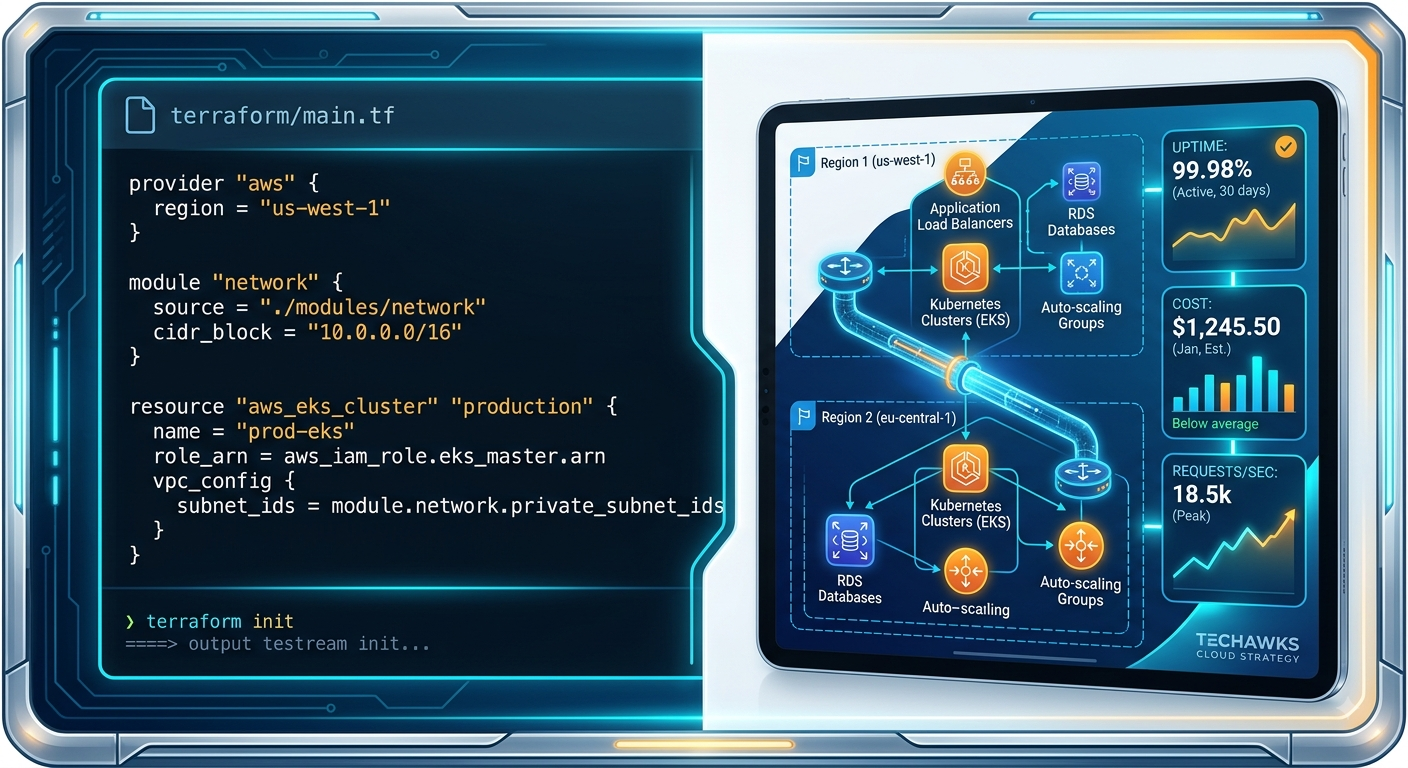
Action: Stop writing monolithic IaC files. Practice building reusable, version-controlled infrastructure modules (e.g., standardized VPCs or hardened EKS/GKE clusters) with automated linting (tflint) and security scanning (checkov) integrated directly into your pull request pipelines.
2. Learn the Economics of Cloud Architecture (FinOps)
Designing a system that scales to zero is just as impressive as designing one that handles millions of requests.
Action: Treat cost optimization as a core engineering metric. Before provisioning resources, calculate their total cost of ownership (TCO). Familiarize yourself with spot/preemptible instances, auto-scaling thresholds, and multi-tier storage lifecycle policies. Presenting cost-saving architectural refactors to leadership is one of the fastest ways to demonstrate executive business impact.
3. Shift Left on Reliability & Chaos Engineering
Instead of waiting for an outage to test your infrastructure's fault tolerance, proactively simulate system failures.
Action: Implement basic chaos engineering principles using open-source tools like Chaos Mesh or Gremlin in your staging environment. Test how your application behaves when a database primary node fails, or when cross-region network latency spikes. Architectural expertise is built on understanding failure modes, not just success paths.
Key Takeaways
Modularize Your Infrastructure: Move beyond basic IaC syntax by building secure, compliant, and reusable infrastructure modules.
Embrace FinOps: Design for cost efficiency alongside performance and availability; business leaders value engineers who protect cloud budgets.
Design for Resilience: Proactively test and document failure scenarios using fault-injection techniques to ensure high availability.
CTA
Ready to level up your cloud architecture, automation pipelines, and infrastructure skills?
Join Cloud, DevOps & Open Source today to access production-ready deployment guides, architectural blueprints, and connect with experienced cloud engineers!
In many engineering teams, DevOps specialists get trapped in the loop of constant maintenance: fixing broken build steps, managing Kubernetes clusters, and responding to deployment alerts. To elevate your career, you need to transition from an operational script-writer to a strategic cloud systems designer.
Here is a 3-step actionable roadmap to accelerate your career trajectory toward cloud architecture:
1. Master Infrastructure as Code (IaC) Governance, Not Just Syntax
Knowing how to write basic Terraform or CloudFormation templates is no longer enough. Senior engineers focus on cloud governance, modularity, and drift detection.
Action: Stop writing monolithic IaC files. Practice building reusable, version-controlled infrastructure modules (e.g., standardized VPCs or hardened EKS/GKE clusters) with automated linting (tflint) and security scanning (checkov) integrated directly into your pull request pipelines.
2. Learn the Economics of Cloud Architecture (FinOps)
Designing a system that scales to zero is just as impressive as designing one that handles millions of requests.
Action: Treat cost optimization as a core engineering metric. Before provisioning resources, calculate their total cost of ownership (TCO). Familiarize yourself with spot/preemptible instances, auto-scaling thresholds, and multi-tier storage lifecycle policies. Presenting cost-saving architectural refactors to leadership is one of the fastest ways to demonstrate executive business impact.
3. Shift Left on Reliability & Chaos Engineering
Instead of waiting for an outage to test your infrastructure's fault tolerance, proactively simulate system failures.
Action: Implement basic chaos engineering principles using open-source tools like Chaos Mesh or Gremlin in your staging environment. Test how your application behaves when a database primary node fails, or when cross-region network latency spikes. Architectural expertise is built on understanding failure modes, not just success paths.
Key Takeaways
Modularize Your Infrastructure: Move beyond basic IaC syntax by building secure, compliant, and reusable infrastructure modules.
Embrace FinOps: Design for cost efficiency alongside performance and availability; business leaders value engineers who protect cloud budgets.
Design for Resilience: Proactively test and document failure scenarios using fault-injection techniques to ensure high availability.
CTA
Ready to level up your cloud architecture, automation pipelines, and infrastructure skills?
Join Cloud, DevOps & Open Source today to access production-ready deployment guides, architectural blueprints, and connect with experienced cloud engineers!
Beyond CI/CD Pipelines: How DevOps Engineers Level Up into Cloud Architects
In many engineering teams, DevOps specialists get trapped in the loop of constant maintenance: fixing broken build steps, managing Kubernetes clusters, and responding to deployment alerts. To elevate your career, you need to transition from an operational script-writer to a strategic cloud systems designer.
Here is a 3-step actionable roadmap to accelerate your career trajectory toward cloud architecture:
1. Master Infrastructure as Code (IaC) Governance, Not Just Syntax
Knowing how to write basic Terraform or CloudFormation templates is no longer enough. Senior engineers focus on cloud governance, modularity, and drift detection.
Action: Stop writing monolithic IaC files. Practice building reusable, version-controlled infrastructure modules (e.g., standardized VPCs or hardened EKS/GKE clusters) with automated linting (tflint) and security scanning (checkov) integrated directly into your pull request pipelines.
2. Learn the Economics of Cloud Architecture (FinOps)
Designing a system that scales to zero is just as impressive as designing one that handles millions of requests.
Action: Treat cost optimization as a core engineering metric. Before provisioning resources, calculate their total cost of ownership (TCO). Familiarize yourself with spot/preemptible instances, auto-scaling thresholds, and multi-tier storage lifecycle policies. Presenting cost-saving architectural refactors to leadership is one of the fastest ways to demonstrate executive business impact.
3. Shift Left on Reliability & Chaos Engineering
Instead of waiting for an outage to test your infrastructure's fault tolerance, proactively simulate system failures.
Action: Implement basic chaos engineering principles using open-source tools like Chaos Mesh or Gremlin in your staging environment. Test how your application behaves when a database primary node fails, or when cross-region network latency spikes. Architectural expertise is built on understanding failure modes, not just success paths.
Key Takeaways
Modularize Your Infrastructure: Move beyond basic IaC syntax by building secure, compliant, and reusable infrastructure modules.
Embrace FinOps: Design for cost efficiency alongside performance and availability; business leaders value engineers who protect cloud budgets.
Design for Resilience: Proactively test and document failure scenarios using fault-injection techniques to ensure high availability.
CTA
Ready to level up your cloud architecture, automation pipelines, and infrastructure skills?
Join Cloud, DevOps & Open Source today to access production-ready deployment guides, architectural blueprints, and connect with experienced cloud engineers!

 English
 Arabic
 French
 Spanish
 Portuguese
 Deutsch
 Turkish
 Italiano
 Russian
 Romaian
 Portuguese (Brazil)
 Greek
Greek