


Specialist vs. Generalist: Which Path Sets CS Students Up for Greater Early-Career Success?
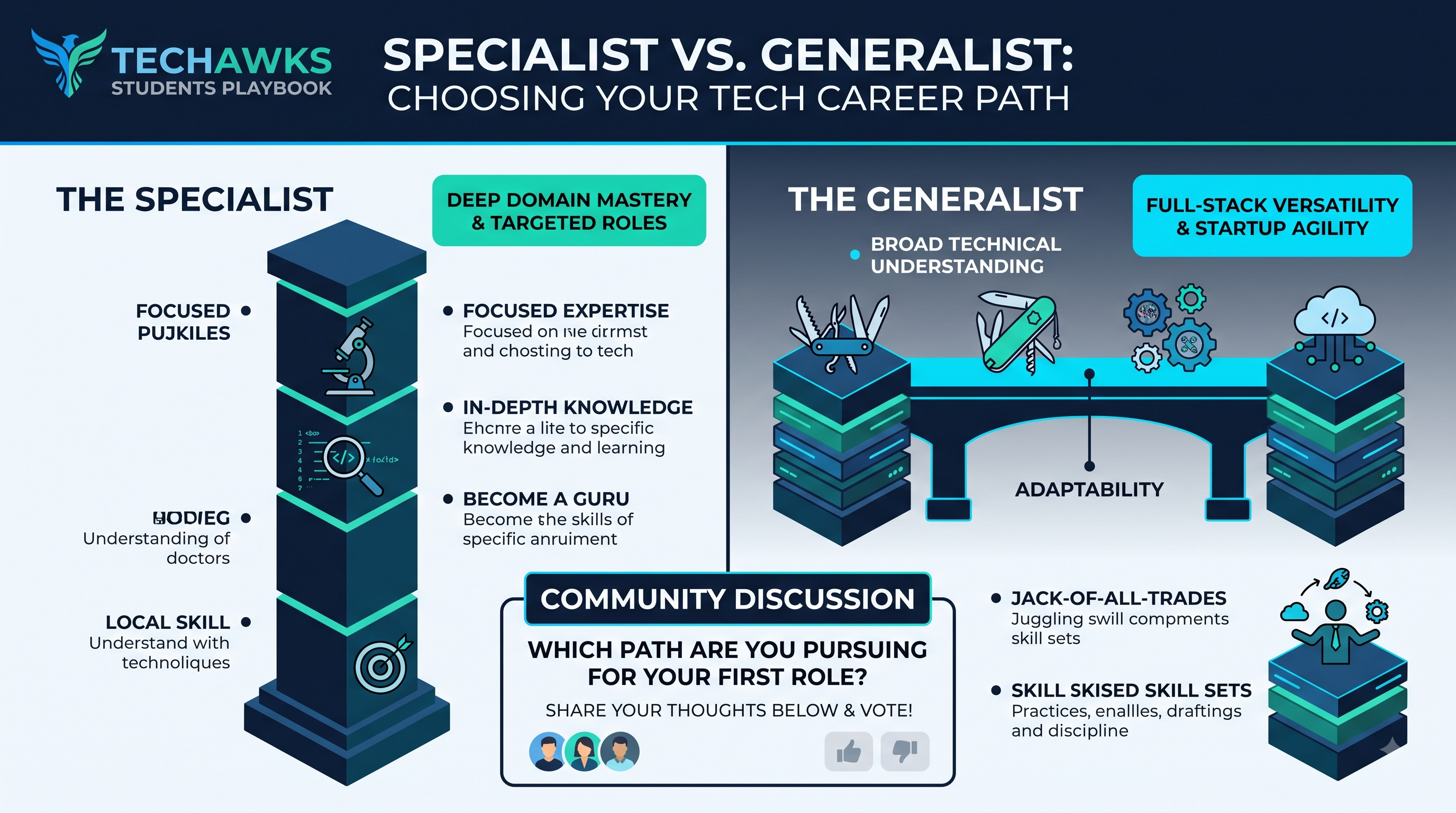
Choosing your technical learning trajectory shapes your early project portfolio, internship applications, and daily study habits. Both paths offer distinct advantages and trade-offs:
The Specialist Path (Deep Mastery): Focusing intensively on one domain (e.g., backend systems, machine learning pipelines, or cybersecurity).
Advantage: Highly competitive for targeted entry-level roles requiring immediate deep domain skills.
Trade-off: Narrower initial job pool and slower adaptation if market demand shifts.
The Generalist Path (T-Shaped Versatility): Building working knowledge across frontend, backend, databases, and DevOps.
Advantage: High adaptability, ideal for early-stage startups and cross-functional engineering teams.
Trade-off: Harder to stand out in interviews with specialized technical screens that drill into low-level systems.
Students: Are you focusing your portfolio on mastering a single specialized stack, or are you prioritizing end-to-end full-stack versatility? What influenced your decision?
Key Takeaways
Deep specialists stand out faster in large enterprise technical screens with domain-specific requirements.
Generalists thrive in high-velocity startup environments where engineers own features from database to UI.
Building a "T-shaped" skill set (broad foundation + one deep core competency) offers a resilient middle ground.
CTA
Want to connect with fellow student engineers, get feedback on your learning roadmap, and prepare for tech interviews? Join the Students in Tech community today to collaborate, share projects, and learn together.
Choosing your technical learning trajectory shapes your early project portfolio, internship applications, and daily study habits. Both paths offer distinct advantages and trade-offs:
The Specialist Path (Deep Mastery): Focusing intensively on one domain (e.g., backend systems, machine learning pipelines, or cybersecurity).
Advantage: Highly competitive for targeted entry-level roles requiring immediate deep domain skills.
Trade-off: Narrower initial job pool and slower adaptation if market demand shifts.
The Generalist Path (T-Shaped Versatility): Building working knowledge across frontend, backend, databases, and DevOps.
Advantage: High adaptability, ideal for early-stage startups and cross-functional engineering teams.
Trade-off: Harder to stand out in interviews with specialized technical screens that drill into low-level systems.
Students: Are you focusing your portfolio on mastering a single specialized stack, or are you prioritizing end-to-end full-stack versatility? What influenced your decision?
Key Takeaways
Deep specialists stand out faster in large enterprise technical screens with domain-specific requirements.
Generalists thrive in high-velocity startup environments where engineers own features from database to UI.
Building a "T-shaped" skill set (broad foundation + one deep core competency) offers a resilient middle ground.
CTA
Want to connect with fellow student engineers, get feedback on your learning roadmap, and prepare for tech interviews? Join the Students in Tech community today to collaborate, share projects, and learn together.
Specialist vs. Generalist: Which Path Sets CS Students Up for Greater Early-Career Success?
Choosing your technical learning trajectory shapes your early project portfolio, internship applications, and daily study habits. Both paths offer distinct advantages and trade-offs:
The Specialist Path (Deep Mastery): Focusing intensively on one domain (e.g., backend systems, machine learning pipelines, or cybersecurity).
Advantage: Highly competitive for targeted entry-level roles requiring immediate deep domain skills.
Trade-off: Narrower initial job pool and slower adaptation if market demand shifts.
The Generalist Path (T-Shaped Versatility): Building working knowledge across frontend, backend, databases, and DevOps.
Advantage: High adaptability, ideal for early-stage startups and cross-functional engineering teams.
Trade-off: Harder to stand out in interviews with specialized technical screens that drill into low-level systems.
Students: Are you focusing your portfolio on mastering a single specialized stack, or are you prioritizing end-to-end full-stack versatility? What influenced your decision?
Key Takeaways
Deep specialists stand out faster in large enterprise technical screens with domain-specific requirements.
Generalists thrive in high-velocity startup environments where engineers own features from database to UI.
Building a "T-shaped" skill set (broad foundation + one deep core competency) offers a resilient middle ground.
CTA
Want to connect with fellow student engineers, get feedback on your learning roadmap, and prepare for tech interviews? Join the Students in Tech community today to collaborate, share projects, and learn together.

 English
 French
 Spanish
 Portuguese
 Deutsch
 Turkish
 Dutch
Dutch
 Italiano
 Russian
 Romaian
 Portuguese (Brazil)
 Greek
Greek