


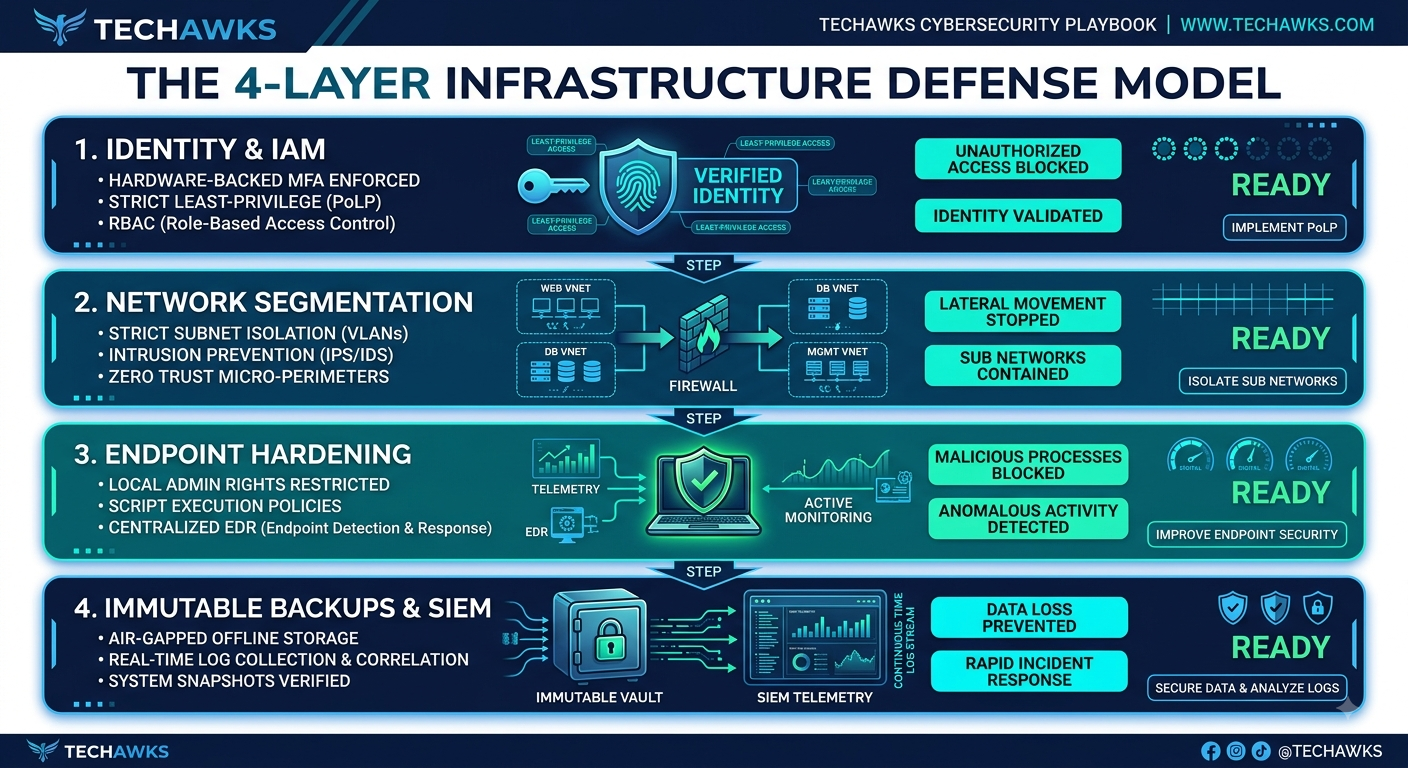
The 4-Layer Defense Model: How Modern Infrastructure Stops Lateral Movement
Relying solely on edge firewalls leaves internal assets exposed. Implementing an intentional defense-in-depth model prevents attackers from moving laterally across your systems:
Layer 1: Identity & Access Hygiene (IAM)
Enforce hardware-backed multi-factor authentication (MFA) across all administration portals.
Implement the Principle of Least Privilege (PoLP)—users and service accounts should access only the specific resources required for their active role.
Layer 2: Network Segmentation & Micro-Perimeters
Separate internal subnets using Virtual Local Area Networks (VLANs) and strict firewall rules.
Isolate production workloads from staging, development, and general corporate traffic to contain compromised nodes.
Layer 3: Endpoint Hardening & EDR
Deploy centralized Endpoint Detection and Response (EDR) agents to detect anomalous execution patterns in real time.
Restrict local administrator rights and enforce script-execution policies to block unauthorized binaries.
Layer 4: Continuous Telemetry & Immutable Backups
Ship structured logs to a centralized Security Information and Event Management (SIEM) system with automated alerting.
Store system snapshots and critical databases in air-gapped or immutable cloud storage to guarantee rapid recovery.
Key Takeaways
Perimeter security alone is insufficient; internal lateral movement must be actively restricted.
Strict identity policies and least privilege prevent initial credentials from granting broad access.
Immutable, isolated backups provide the ultimate safeguard against data loss and extortion.
CTA
Want to dive deeper into practical defensive architectures, penetration testing methodologies, and SOC workflows? Join the Cybersecurity & Ethical Hacking community to build hands-on skills alongside security professionals.
Relying solely on edge firewalls leaves internal assets exposed. Implementing an intentional defense-in-depth model prevents attackers from moving laterally across your systems:
Layer 1: Identity & Access Hygiene (IAM)
Enforce hardware-backed multi-factor authentication (MFA) across all administration portals.
Implement the Principle of Least Privilege (PoLP)—users and service accounts should access only the specific resources required for their active role.
Layer 2: Network Segmentation & Micro-Perimeters
Separate internal subnets using Virtual Local Area Networks (VLANs) and strict firewall rules.
Isolate production workloads from staging, development, and general corporate traffic to contain compromised nodes.
Layer 3: Endpoint Hardening & EDR
Deploy centralized Endpoint Detection and Response (EDR) agents to detect anomalous execution patterns in real time.
Restrict local administrator rights and enforce script-execution policies to block unauthorized binaries.
Layer 4: Continuous Telemetry & Immutable Backups
Ship structured logs to a centralized Security Information and Event Management (SIEM) system with automated alerting.
Store system snapshots and critical databases in air-gapped or immutable cloud storage to guarantee rapid recovery.
Key Takeaways
Perimeter security alone is insufficient; internal lateral movement must be actively restricted.
Strict identity policies and least privilege prevent initial credentials from granting broad access.
Immutable, isolated backups provide the ultimate safeguard against data loss and extortion.
CTA
Want to dive deeper into practical defensive architectures, penetration testing methodologies, and SOC workflows? Join the Cybersecurity & Ethical Hacking community to build hands-on skills alongside security professionals.
The 4-Layer Defense Model: How Modern Infrastructure Stops Lateral Movement
Relying solely on edge firewalls leaves internal assets exposed. Implementing an intentional defense-in-depth model prevents attackers from moving laterally across your systems:
Layer 1: Identity & Access Hygiene (IAM)
Enforce hardware-backed multi-factor authentication (MFA) across all administration portals.
Implement the Principle of Least Privilege (PoLP)—users and service accounts should access only the specific resources required for their active role.
Layer 2: Network Segmentation & Micro-Perimeters
Separate internal subnets using Virtual Local Area Networks (VLANs) and strict firewall rules.
Isolate production workloads from staging, development, and general corporate traffic to contain compromised nodes.
Layer 3: Endpoint Hardening & EDR
Deploy centralized Endpoint Detection and Response (EDR) agents to detect anomalous execution patterns in real time.
Restrict local administrator rights and enforce script-execution policies to block unauthorized binaries.
Layer 4: Continuous Telemetry & Immutable Backups
Ship structured logs to a centralized Security Information and Event Management (SIEM) system with automated alerting.
Store system snapshots and critical databases in air-gapped or immutable cloud storage to guarantee rapid recovery.
Key Takeaways
Perimeter security alone is insufficient; internal lateral movement must be actively restricted.
Strict identity policies and least privilege prevent initial credentials from granting broad access.
Immutable, isolated backups provide the ultimate safeguard against data loss and extortion.
CTA
Want to dive deeper into practical defensive architectures, penetration testing methodologies, and SOC workflows? Join the Cybersecurity & Ethical Hacking community to build hands-on skills alongside security professionals.

 English
 French
 Spanish
 Portuguese
 Deutsch
 Turkish
 Dutch
Dutch
 Italiano
 Russian
 Romaian
 Portuguese (Brazil)
 Greek
Greek