


The Production Data Pipeline Pre-Deployment Checklist
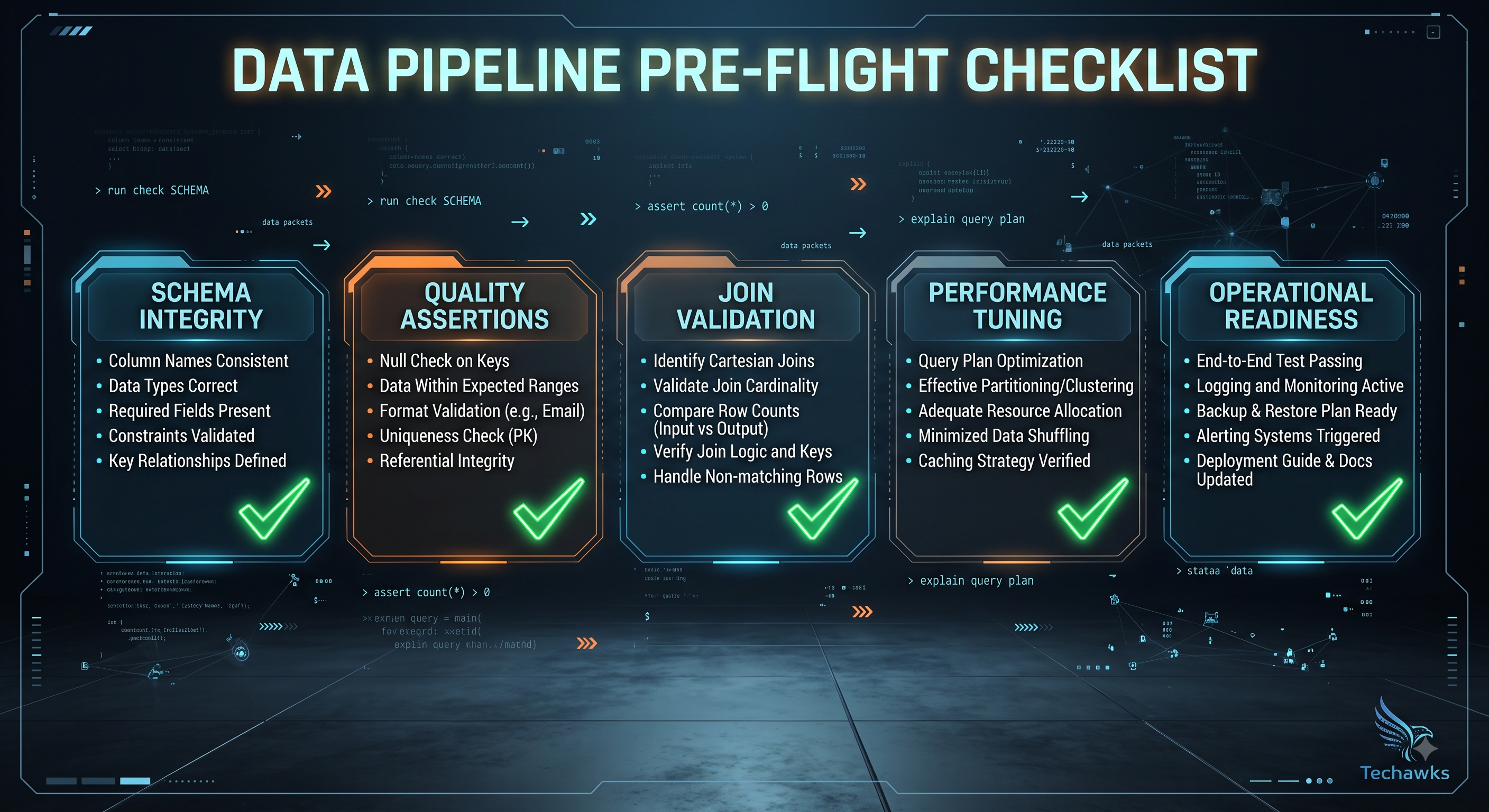
Before merging any transformation model, analytics table, or scheduled DAG to production, run through this 5-stage verification checklist to prevent downstream pipeline outages:
1. Schema & Column Integrity
[ ] Column naming follows standard snake_case conventions and contains no reserved SQL keywords.
[ ] Primary keys are explicitly defined and asserted with uniqueness tests.
[ ] Data types match downstream consumption requirements (e.g., TIMESTAMP_NTZ vs. TIMESTAMPTZ, explicit casting on numeric decimals).
2. Data Quality & Boundary Assertions
[ ] Zero non-null violations on essential dimension keys.
[ ] Numeric metrics have defined range bounds (e.g., revenue >= 0, percentage BETWEEN 0 AND 1).
[ ] Categorical columns conform to accepted value enums or referential integrity checks against dimension seed tables.
3. Join & Granularity Verification
[ ] Grain of the output table is explicitly documented (e.g., one row per user_id per day).
[ ] Row counts pre- and post-join match expected cardinality to ensure no Cartesian products or silent row drops.
[ ] Foreign keys resolve cleanly with zero orphan records in analytical marts.
4. Performance & Resource Optimization
[ ] Partitioning and clustering keys align with frequent downstream BI query filter patterns.
[ ] Full-table scans are minimized using incremental materialization logic for high-volume event logs.
[ ] Intermediate CTE memory consumption is optimized (avoiding redundant Window functions over unpartitioned frames).
5. Operational Readiness & Documentation
[ ] Table and column descriptions are updated in the data catalog / metadata layer.
[ ] Pipeline failure alerts route directly to the designated on-call Slack/Pager channel.
[ ] Idempotency confirmed: backfilling the pipeline for an existing date window yields identical results without duplicate rows.
Key Takeaways
Enforce primary key uniqueness and non-null constraints before merging code.
Verify join cardinality to eliminate silent metric inflation from fan-outs.
Ensure all pipeline jobs are fully idempotent to support reliable backfills.
Align table partitioning schemes with actual BI query consumption patterns.
CTA
Want to build resilient data architecture and elevate your data engineering workflows?
Join Techawks Data Science & Analytics to access industry-standard templates, deployment checklists, and connect with experienced data engineers and analysts.
Before merging any transformation model, analytics table, or scheduled DAG to production, run through this 5-stage verification checklist to prevent downstream pipeline outages:
1. Schema & Column Integrity
[ ] Column naming follows standard snake_case conventions and contains no reserved SQL keywords.
[ ] Primary keys are explicitly defined and asserted with uniqueness tests.
[ ] Data types match downstream consumption requirements (e.g., TIMESTAMP_NTZ vs. TIMESTAMPTZ, explicit casting on numeric decimals).
2. Data Quality & Boundary Assertions
[ ] Zero non-null violations on essential dimension keys.
[ ] Numeric metrics have defined range bounds (e.g., revenue >= 0, percentage BETWEEN 0 AND 1).
[ ] Categorical columns conform to accepted value enums or referential integrity checks against dimension seed tables.
3. Join & Granularity Verification
[ ] Grain of the output table is explicitly documented (e.g., one row per user_id per day).
[ ] Row counts pre- and post-join match expected cardinality to ensure no Cartesian products or silent row drops.
[ ] Foreign keys resolve cleanly with zero orphan records in analytical marts.
4. Performance & Resource Optimization
[ ] Partitioning and clustering keys align with frequent downstream BI query filter patterns.
[ ] Full-table scans are minimized using incremental materialization logic for high-volume event logs.
[ ] Intermediate CTE memory consumption is optimized (avoiding redundant Window functions over unpartitioned frames).
5. Operational Readiness & Documentation
[ ] Table and column descriptions are updated in the data catalog / metadata layer.
[ ] Pipeline failure alerts route directly to the designated on-call Slack/Pager channel.
[ ] Idempotency confirmed: backfilling the pipeline for an existing date window yields identical results without duplicate rows.
Key Takeaways
Enforce primary key uniqueness and non-null constraints before merging code.
Verify join cardinality to eliminate silent metric inflation from fan-outs.
Ensure all pipeline jobs are fully idempotent to support reliable backfills.
Align table partitioning schemes with actual BI query consumption patterns.
CTA
Want to build resilient data architecture and elevate your data engineering workflows?
Join Techawks Data Science & Analytics to access industry-standard templates, deployment checklists, and connect with experienced data engineers and analysts.
The Production Data Pipeline Pre-Deployment Checklist
Before merging any transformation model, analytics table, or scheduled DAG to production, run through this 5-stage verification checklist to prevent downstream pipeline outages:
1. Schema & Column Integrity
[ ] Column naming follows standard snake_case conventions and contains no reserved SQL keywords.
[ ] Primary keys are explicitly defined and asserted with uniqueness tests.
[ ] Data types match downstream consumption requirements (e.g., TIMESTAMP_NTZ vs. TIMESTAMPTZ, explicit casting on numeric decimals).
2. Data Quality & Boundary Assertions
[ ] Zero non-null violations on essential dimension keys.
[ ] Numeric metrics have defined range bounds (e.g., revenue >= 0, percentage BETWEEN 0 AND 1).
[ ] Categorical columns conform to accepted value enums or referential integrity checks against dimension seed tables.
3. Join & Granularity Verification
[ ] Grain of the output table is explicitly documented (e.g., one row per user_id per day).
[ ] Row counts pre- and post-join match expected cardinality to ensure no Cartesian products or silent row drops.
[ ] Foreign keys resolve cleanly with zero orphan records in analytical marts.
4. Performance & Resource Optimization
[ ] Partitioning and clustering keys align with frequent downstream BI query filter patterns.
[ ] Full-table scans are minimized using incremental materialization logic for high-volume event logs.
[ ] Intermediate CTE memory consumption is optimized (avoiding redundant Window functions over unpartitioned frames).
5. Operational Readiness & Documentation
[ ] Table and column descriptions are updated in the data catalog / metadata layer.
[ ] Pipeline failure alerts route directly to the designated on-call Slack/Pager channel.
[ ] Idempotency confirmed: backfilling the pipeline for an existing date window yields identical results without duplicate rows.
Key Takeaways
Enforce primary key uniqueness and non-null constraints before merging code.
Verify join cardinality to eliminate silent metric inflation from fan-outs.
Ensure all pipeline jobs are fully idempotent to support reliable backfills.
Align table partitioning schemes with actual BI query consumption patterns.
CTA
Want to build resilient data architecture and elevate your data engineering workflows?
Join Techawks Data Science & Analytics to access industry-standard templates, deployment checklists, and connect with experienced data engineers and analysts.

 English
 Arabic
 French
 Spanish
 Portuguese
 Deutsch
 Dutch
Dutch
 Italiano
 Russian
 Romaian
 Portuguese (Brazil)
 Greek
Greek