


The 4-Pillar Architectural Framework for Hardening Production Kubernetes Workloads
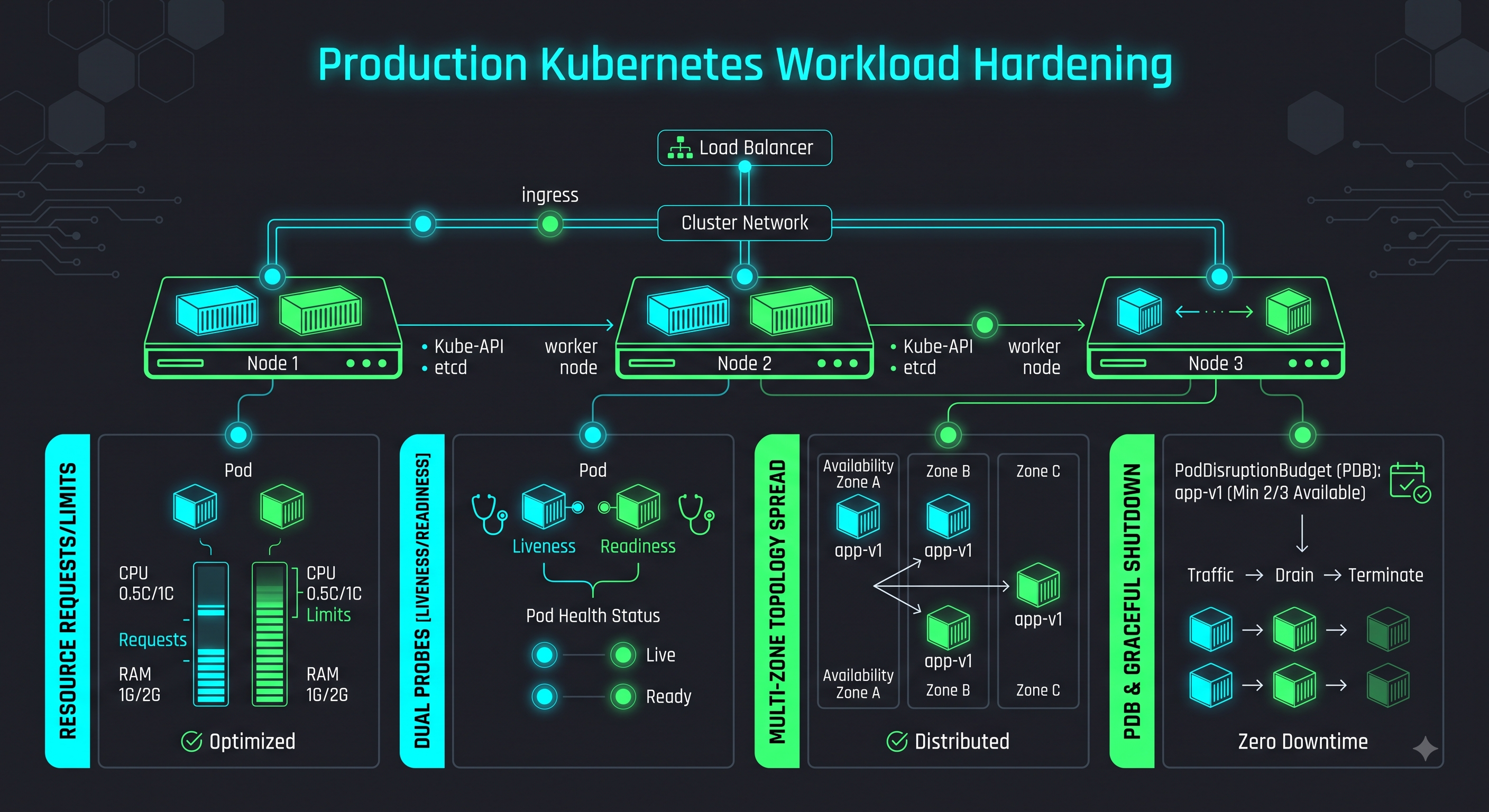
Building resilience into containerized infrastructure requires shifting from default configurations to intentional workload isolation. When deploying services to Kubernetes, implement these 4 foundational operational patterns:
1. Define Strict Resource Requests & Limits
Set explicit requests to allow the scheduler to place pods accurately on nodes with adequate headroom.
Set proportional limits to prevent rogue memory leaks from triggering node-wide Out-Of-Memory (OOM) kernel panics.
Keep CPU requests close to realistic baseline usage while avoiding hard CPU limits that induce unnecessary throttling.
2. Decouple Liveness from Readiness Probes
Configure readinessProbe to control traffic ingress, routing requests only when internal caches and database connections are established.
Use livenessProbe strictly to catch deadlocks and unrecoverable runtime states—never point a liveness probe at external dependencies.
3. Enforce Pod Anti-Affinity and Topology Spread
Avoid co-locating critical pod replicas on the same underlying virtual machine or availability zone:
YAML
topologySpreadConstraints:
- maxSkew: 1
topologyKey: topology.kubernetes.io/zone
whenUnsatisfiable: DoNotSchedule
labelSelector:
matchLabels:
app: core-api
Distributing workloads evenly across zones prevents single-zone cloud outages from taking down your entire service.
4. Configure Graceful Termination & Disruption Budgets
Set PodDisruptionBudgets (PDB) to guarantee minimum available replicas during rolling node upgrades.
Implement handling for SIGTERM in your application runtime, pairing it with a preStop lifecycle sleep hook to allow load balancers to deregister endpoints cleanly before container termination.
Key Takeaways
Sizing resource requests correctly is essential for cluster scheduling stability.
Never point liveness probes at downstream dependencies like databases or external APIs.
Enforce multi-zone topology spread constraints to survive cloud infrastructure failures.
Combine Pod Disruption Budgets with SIGTERM graceful shutdown handling for zero-downtime rolling deploys.
CTA
Ready to master cloud-native architecture, infrastructure as code, and production reliability engineering?
Join Techawks Cloud, DevOps & Open Source to collaborate with experienced cloud engineers, share production architectures, and sharpen your DevOps toolchain.
Building resilience into containerized infrastructure requires shifting from default configurations to intentional workload isolation. When deploying services to Kubernetes, implement these 4 foundational operational patterns:
1. Define Strict Resource Requests & Limits
Set explicit requests to allow the scheduler to place pods accurately on nodes with adequate headroom.
Set proportional limits to prevent rogue memory leaks from triggering node-wide Out-Of-Memory (OOM) kernel panics.
Keep CPU requests close to realistic baseline usage while avoiding hard CPU limits that induce unnecessary throttling.
2. Decouple Liveness from Readiness Probes
Configure readinessProbe to control traffic ingress, routing requests only when internal caches and database connections are established.
Use livenessProbe strictly to catch deadlocks and unrecoverable runtime states—never point a liveness probe at external dependencies.
3. Enforce Pod Anti-Affinity and Topology Spread
Avoid co-locating critical pod replicas on the same underlying virtual machine or availability zone:
YAML
topologySpreadConstraints:
- maxSkew: 1
topologyKey: topology.kubernetes.io/zone
whenUnsatisfiable: DoNotSchedule
labelSelector:
matchLabels:
app: core-api
Distributing workloads evenly across zones prevents single-zone cloud outages from taking down your entire service.
4. Configure Graceful Termination & Disruption Budgets
Set PodDisruptionBudgets (PDB) to guarantee minimum available replicas during rolling node upgrades.
Implement handling for SIGTERM in your application runtime, pairing it with a preStop lifecycle sleep hook to allow load balancers to deregister endpoints cleanly before container termination.
Key Takeaways
Sizing resource requests correctly is essential for cluster scheduling stability.
Never point liveness probes at downstream dependencies like databases or external APIs.
Enforce multi-zone topology spread constraints to survive cloud infrastructure failures.
Combine Pod Disruption Budgets with SIGTERM graceful shutdown handling for zero-downtime rolling deploys.
CTA
Ready to master cloud-native architecture, infrastructure as code, and production reliability engineering?
Join Techawks Cloud, DevOps & Open Source to collaborate with experienced cloud engineers, share production architectures, and sharpen your DevOps toolchain.
The 4-Pillar Architectural Framework for Hardening Production Kubernetes Workloads
Building resilience into containerized infrastructure requires shifting from default configurations to intentional workload isolation. When deploying services to Kubernetes, implement these 4 foundational operational patterns:
1. Define Strict Resource Requests & Limits
Set explicit requests to allow the scheduler to place pods accurately on nodes with adequate headroom.
Set proportional limits to prevent rogue memory leaks from triggering node-wide Out-Of-Memory (OOM) kernel panics.
Keep CPU requests close to realistic baseline usage while avoiding hard CPU limits that induce unnecessary throttling.
2. Decouple Liveness from Readiness Probes
Configure readinessProbe to control traffic ingress, routing requests only when internal caches and database connections are established.
Use livenessProbe strictly to catch deadlocks and unrecoverable runtime states—never point a liveness probe at external dependencies.
3. Enforce Pod Anti-Affinity and Topology Spread
Avoid co-locating critical pod replicas on the same underlying virtual machine or availability zone:
YAML
topologySpreadConstraints:
- maxSkew: 1
topologyKey: topology.kubernetes.io/zone
whenUnsatisfiable: DoNotSchedule
labelSelector:
matchLabels:
app: core-api
Distributing workloads evenly across zones prevents single-zone cloud outages from taking down your entire service.
4. Configure Graceful Termination & Disruption Budgets
Set PodDisruptionBudgets (PDB) to guarantee minimum available replicas during rolling node upgrades.
Implement handling for SIGTERM in your application runtime, pairing it with a preStop lifecycle sleep hook to allow load balancers to deregister endpoints cleanly before container termination.
Key Takeaways
Sizing resource requests correctly is essential for cluster scheduling stability.
Never point liveness probes at downstream dependencies like databases or external APIs.
Enforce multi-zone topology spread constraints to survive cloud infrastructure failures.
Combine Pod Disruption Budgets with SIGTERM graceful shutdown handling for zero-downtime rolling deploys.
CTA
Ready to master cloud-native architecture, infrastructure as code, and production reliability engineering?
Join Techawks Cloud, DevOps & Open Source to collaborate with experienced cloud engineers, share production architectures, and sharpen your DevOps toolchain.

 English
 Arabic
 French
 Spanish
 Portuguese
 Deutsch
 Turkish
 Dutch
Dutch
 Italiano
 Russian
 Romaian
 Greek
Greek