


The Production Cloud Infrastructure Pre-Flight Checklist: 5 Gates Before Deployment
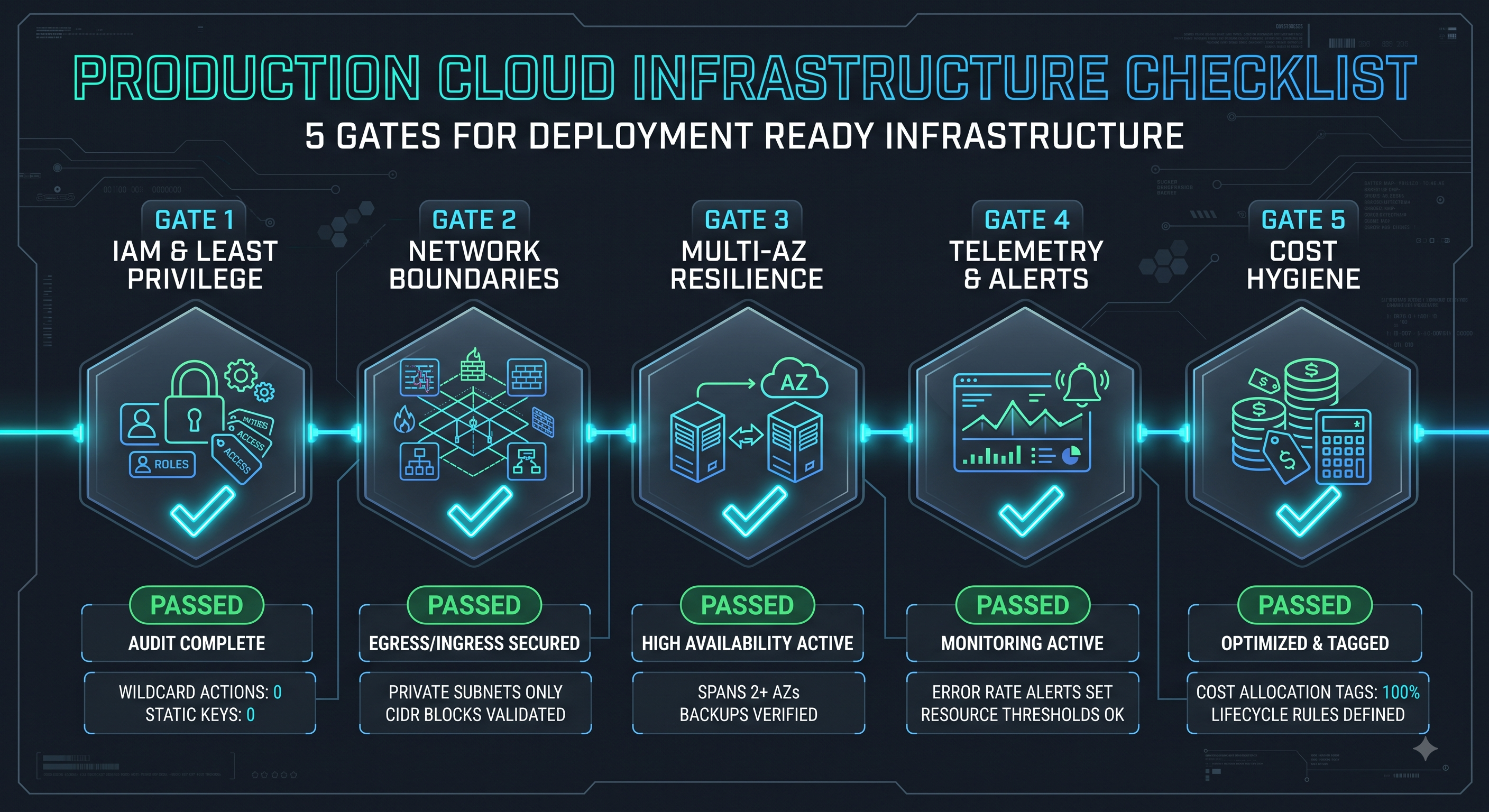
Before applying Terraform changes, deploying cluster updates, or promoting infrastructure code to production, run through this 5-stage operational readiness checklist:
1. Identity & Access Management (IAM)
[ ] Principle of least privilege enforced (zero wildcard * actions on production resources).
[ ] Service accounts use short-lived STS tokens or OIDC federation instead of static access keys.
[ ] Multi-Factor Authentication (MFA) and conditional IP/context access enforced for administrative roles.
2. Network Architecture & Security Boundaries
[ ] Database instances and private microservices reside strictly in isolated private subnets with no public IPs.
[ ] Security group ingress rules explicitly define CIDR blocks and specific ports (no 0.0.0.0/0 on management ports like 22, 3389, or 5432).
[ ] Egress traffic routes through monitored NAT Gateways or VPC Endpoints for cloud services.
3. High Availability & Resilience
[ ] Workloads and data stores span at least two distinct Availability Zones (Multi-AZ).
[ ] Auto-scaling policies and Pod Disruption Budgets (PDBs) are configured to handle node-level failures.
[ ] Automated backups with point-in-time recovery (PITR) are active and verified with cross-region replication where required.
4. Telemetry, Observability & Guardrails
[ ] Centralized structured logging enabled (e.g., VPC Flow Logs, audit logs, container stdout).
[ ] Standard alert thresholds set for error rates (5xx), resource saturation (CPU/Memory>80%), and synthetic health probes
[ ] An automated rollback strategy or blue/green switch mechanism is verified.
5. Cost & Lifecycle Hygiene
[ ] Mandatory cost allocation tags applied (Environment, Service, Owner, CostCenter).
[ ] Cloud storage lifecycle rules defined to transition old build artifacts and logs to cold storage.
Key Takeaways
Eliminate static IAM access keys in favor of short-lived OIDC federated credentials.
Never expose database or internal service endpoints to public CIDR blocks.
Validate Multi-AZ redundancy and automated point-in-time recovery before pushing live.
Enforce cost-allocation tags and automated lifecycle rules across all provisioned resources.
CTA
Want to access production-grade IaC templates, cloud architecture patterns, and reliability engineering workflows?
Join Techawks Cloud, DevOps & Open Source to collaborate with experienced cloud engineers, share architectural blueprints, and sharpen your platform engineering toolkit..
Before applying Terraform changes, deploying cluster updates, or promoting infrastructure code to production, run through this 5-stage operational readiness checklist:
1. Identity & Access Management (IAM)
[ ] Principle of least privilege enforced (zero wildcard * actions on production resources).
[ ] Service accounts use short-lived STS tokens or OIDC federation instead of static access keys.
[ ] Multi-Factor Authentication (MFA) and conditional IP/context access enforced for administrative roles.
2. Network Architecture & Security Boundaries
[ ] Database instances and private microservices reside strictly in isolated private subnets with no public IPs.
[ ] Security group ingress rules explicitly define CIDR blocks and specific ports (no 0.0.0.0/0 on management ports like 22, 3389, or 5432).
[ ] Egress traffic routes through monitored NAT Gateways or VPC Endpoints for cloud services.
3. High Availability & Resilience
[ ] Workloads and data stores span at least two distinct Availability Zones (Multi-AZ).
[ ] Auto-scaling policies and Pod Disruption Budgets (PDBs) are configured to handle node-level failures.
[ ] Automated backups with point-in-time recovery (PITR) are active and verified with cross-region replication where required.
4. Telemetry, Observability & Guardrails
[ ] Centralized structured logging enabled (e.g., VPC Flow Logs, audit logs, container stdout).
[ ] Standard alert thresholds set for error rates (5xx), resource saturation (CPU/Memory>80%), and synthetic health probes
[ ] An automated rollback strategy or blue/green switch mechanism is verified.
5. Cost & Lifecycle Hygiene
[ ] Mandatory cost allocation tags applied (Environment, Service, Owner, CostCenter).
[ ] Cloud storage lifecycle rules defined to transition old build artifacts and logs to cold storage.
Key Takeaways
Eliminate static IAM access keys in favor of short-lived OIDC federated credentials.
Never expose database or internal service endpoints to public CIDR blocks.
Validate Multi-AZ redundancy and automated point-in-time recovery before pushing live.
Enforce cost-allocation tags and automated lifecycle rules across all provisioned resources.
CTA
Want to access production-grade IaC templates, cloud architecture patterns, and reliability engineering workflows?
Join Techawks Cloud, DevOps & Open Source to collaborate with experienced cloud engineers, share architectural blueprints, and sharpen your platform engineering toolkit..
The Production Cloud Infrastructure Pre-Flight Checklist: 5 Gates Before Deployment
Before applying Terraform changes, deploying cluster updates, or promoting infrastructure code to production, run through this 5-stage operational readiness checklist:
1. Identity & Access Management (IAM)
[ ] Principle of least privilege enforced (zero wildcard * actions on production resources).
[ ] Service accounts use short-lived STS tokens or OIDC federation instead of static access keys.
[ ] Multi-Factor Authentication (MFA) and conditional IP/context access enforced for administrative roles.
2. Network Architecture & Security Boundaries
[ ] Database instances and private microservices reside strictly in isolated private subnets with no public IPs.
[ ] Security group ingress rules explicitly define CIDR blocks and specific ports (no 0.0.0.0/0 on management ports like 22, 3389, or 5432).
[ ] Egress traffic routes through monitored NAT Gateways or VPC Endpoints for cloud services.
3. High Availability & Resilience
[ ] Workloads and data stores span at least two distinct Availability Zones (Multi-AZ).
[ ] Auto-scaling policies and Pod Disruption Budgets (PDBs) are configured to handle node-level failures.
[ ] Automated backups with point-in-time recovery (PITR) are active and verified with cross-region replication where required.
4. Telemetry, Observability & Guardrails
[ ] Centralized structured logging enabled (e.g., VPC Flow Logs, audit logs, container stdout).
[ ] Standard alert thresholds set for error rates (5xx), resource saturation (CPU/Memory>80%), and synthetic health probes
[ ] An automated rollback strategy or blue/green switch mechanism is verified.
5. Cost & Lifecycle Hygiene
[ ] Mandatory cost allocation tags applied (Environment, Service, Owner, CostCenter).
[ ] Cloud storage lifecycle rules defined to transition old build artifacts and logs to cold storage.
Key Takeaways
Eliminate static IAM access keys in favor of short-lived OIDC federated credentials.
Never expose database or internal service endpoints to public CIDR blocks.
Validate Multi-AZ redundancy and automated point-in-time recovery before pushing live.
Enforce cost-allocation tags and automated lifecycle rules across all provisioned resources.
CTA
Want to access production-grade IaC templates, cloud architecture patterns, and reliability engineering workflows?
Join Techawks Cloud, DevOps & Open Source to collaborate with experienced cloud engineers, share architectural blueprints, and sharpen your platform engineering toolkit..

 Arabic
 French
 Spanish
 Portuguese
 Deutsch
 Turkish
 Dutch
Dutch
 Italiano
 Russian
 Romaian
 Portuguese (Brazil)
 Greek
Greek