


Why Multi-Factor Authentication is not enough: The mechanics of Adversary-in-the-Middle (AiTM) and Session Token Theft.
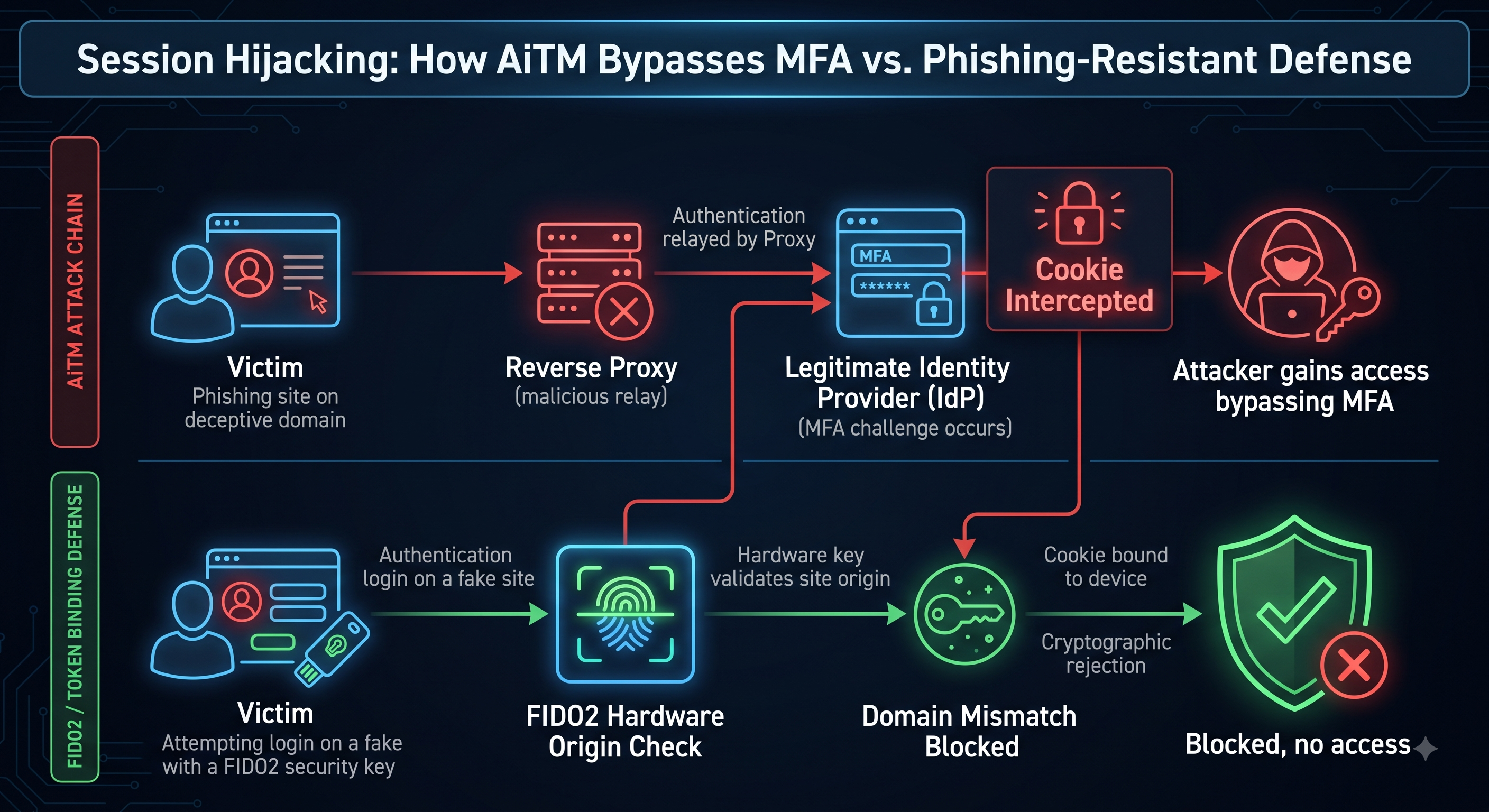
Traditional credential harvesting targeted usernames and passwords. Today, adversaries bypass standard MFA entirely by targeting the authenticated session cookie generated after a successful login.
The 3-Stage Attack Chain (AiTM & Pass-the-Cookie):
The Reverse Proxy Interception:
Instead of hosting a static clone of a login page, the attacker deploys a reverse-proxy engine (e.g., Evilginx). When the victim clicks a phishing link, the proxy transparently relays HTTP requests between the victim and the legitimate Identity Provider (IdP).
The Post-MFA Handshake:
The victim enters their password and successfully approves the push notification or TOTP code. The legitimate IdP validates the login and emits an authentication session cookie / OAuth refresh token.
Session Replay (Pass-the-Cookie):
The proxy intercepts and saves that session cookie before passing it to the victim. The adversary injects this stolen token into their own browser. Because the session is already authenticated, the cloud service accepts the connection immediately—no MFA challenge triggered, no password needed.
Plaintext
Victim Browser ──► [ Adversary Proxy (AiTM) ] ──► [ Legitimate Identity Provider ]
│ ▲
│ (Relays Credentials & MFA Prompt) │
▼ │
Steals Session Cookie ◄───────────────────────┘
How Security Engineers Defend Against Token Theft:
Deploy Phishing-Resistant MFA (FIDO2 / WebAuthn / Passkeys):
Unlike SMS, TOTP apps, or push notifications, FIDO2 authentication cryptographically binds the authentication credential to the browser’s origin URL. If the user is on attacker-login.com, the hardware key refuses to sign the challenge for login.microsoftonline.com, terminating the attack at step 1.
Continuous Access Evaluation (CAE) & Device Binding:
Implement token protection policies that cryptographically bind session tokens to the physical device's Trusted Platform Module (TPM). If an attacker replays the cookie from an untrusted hardware fingerprint or non-compliant IP, the IdP revokes the token instantly.
Identity Threat Detection and Response (ITDR):
Monitor sign-in telemetry for impossible travel, unusual user-agent shifts on active sessions, and immediate anomalous persistence actions (e.g., automated mailbox forwarding rules created seconds after authentication).
Discussion Question
For SOC analysts, security engineers, and learners: How is your team handling post-authentication risk—are you migrating to FIDO2 passkeys, or relying on identity behavioral telemetry and CAE to revoke hijacked sessions? Let’s share notes below.
CTA
Build real-world defensive and offensive security skills with Techawks Cybersecurity.
Join our Cybersecurity & Ethical Hacking community to break down attack chains, analyze detection engineering rules, and practice hands-on lab scenarios with security professionals worldwide: [Join Techawks Cybersecurity Community]
Traditional credential harvesting targeted usernames and passwords. Today, adversaries bypass standard MFA entirely by targeting the authenticated session cookie generated after a successful login.
The 3-Stage Attack Chain (AiTM & Pass-the-Cookie):
The Reverse Proxy Interception:
Instead of hosting a static clone of a login page, the attacker deploys a reverse-proxy engine (e.g., Evilginx). When the victim clicks a phishing link, the proxy transparently relays HTTP requests between the victim and the legitimate Identity Provider (IdP).
The Post-MFA Handshake:
The victim enters their password and successfully approves the push notification or TOTP code. The legitimate IdP validates the login and emits an authentication session cookie / OAuth refresh token.
Session Replay (Pass-the-Cookie):
The proxy intercepts and saves that session cookie before passing it to the victim. The adversary injects this stolen token into their own browser. Because the session is already authenticated, the cloud service accepts the connection immediately—no MFA challenge triggered, no password needed.
Plaintext
Victim Browser ──► [ Adversary Proxy (AiTM) ] ──► [ Legitimate Identity Provider ]
│ ▲
│ (Relays Credentials & MFA Prompt) │
▼ │
Steals Session Cookie ◄───────────────────────┘
How Security Engineers Defend Against Token Theft:
Deploy Phishing-Resistant MFA (FIDO2 / WebAuthn / Passkeys):
Unlike SMS, TOTP apps, or push notifications, FIDO2 authentication cryptographically binds the authentication credential to the browser’s origin URL. If the user is on attacker-login.com, the hardware key refuses to sign the challenge for login.microsoftonline.com, terminating the attack at step 1.
Continuous Access Evaluation (CAE) & Device Binding:
Implement token protection policies that cryptographically bind session tokens to the physical device's Trusted Platform Module (TPM). If an attacker replays the cookie from an untrusted hardware fingerprint or non-compliant IP, the IdP revokes the token instantly.
Identity Threat Detection and Response (ITDR):
Monitor sign-in telemetry for impossible travel, unusual user-agent shifts on active sessions, and immediate anomalous persistence actions (e.g., automated mailbox forwarding rules created seconds after authentication).
Discussion Question
For SOC analysts, security engineers, and learners: How is your team handling post-authentication risk—are you migrating to FIDO2 passkeys, or relying on identity behavioral telemetry and CAE to revoke hijacked sessions? Let’s share notes below.
CTA
Build real-world defensive and offensive security skills with Techawks Cybersecurity.
Join our Cybersecurity & Ethical Hacking community to break down attack chains, analyze detection engineering rules, and practice hands-on lab scenarios with security professionals worldwide: [Join Techawks Cybersecurity Community]
Why Multi-Factor Authentication is not enough: The mechanics of Adversary-in-the-Middle (AiTM) and Session Token Theft.
Traditional credential harvesting targeted usernames and passwords. Today, adversaries bypass standard MFA entirely by targeting the authenticated session cookie generated after a successful login.
The 3-Stage Attack Chain (AiTM & Pass-the-Cookie):
The Reverse Proxy Interception:
Instead of hosting a static clone of a login page, the attacker deploys a reverse-proxy engine (e.g., Evilginx). When the victim clicks a phishing link, the proxy transparently relays HTTP requests between the victim and the legitimate Identity Provider (IdP).
The Post-MFA Handshake:
The victim enters their password and successfully approves the push notification or TOTP code. The legitimate IdP validates the login and emits an authentication session cookie / OAuth refresh token.
Session Replay (Pass-the-Cookie):
The proxy intercepts and saves that session cookie before passing it to the victim. The adversary injects this stolen token into their own browser. Because the session is already authenticated, the cloud service accepts the connection immediately—no MFA challenge triggered, no password needed.
Plaintext
Victim Browser ──► [ Adversary Proxy (AiTM) ] ──► [ Legitimate Identity Provider ]
│ ▲
│ (Relays Credentials & MFA Prompt) │
▼ │
Steals Session Cookie ◄───────────────────────┘
How Security Engineers Defend Against Token Theft:
Deploy Phishing-Resistant MFA (FIDO2 / WebAuthn / Passkeys):
Unlike SMS, TOTP apps, or push notifications, FIDO2 authentication cryptographically binds the authentication credential to the browser’s origin URL. If the user is on attacker-login.com, the hardware key refuses to sign the challenge for login.microsoftonline.com, terminating the attack at step 1.
Continuous Access Evaluation (CAE) & Device Binding:
Implement token protection policies that cryptographically bind session tokens to the physical device's Trusted Platform Module (TPM). If an attacker replays the cookie from an untrusted hardware fingerprint or non-compliant IP, the IdP revokes the token instantly.
Identity Threat Detection and Response (ITDR):
Monitor sign-in telemetry for impossible travel, unusual user-agent shifts on active sessions, and immediate anomalous persistence actions (e.g., automated mailbox forwarding rules created seconds after authentication).
Discussion Question
For SOC analysts, security engineers, and learners: How is your team handling post-authentication risk—are you migrating to FIDO2 passkeys, or relying on identity behavioral telemetry and CAE to revoke hijacked sessions? Let’s share notes below.
CTA
Build real-world defensive and offensive security skills with Techawks Cybersecurity.
Join our Cybersecurity & Ethical Hacking community to break down attack chains, analyze detection engineering rules, and practice hands-on lab scenarios with security professionals worldwide: [Join Techawks Cybersecurity Community]

 English
 Arabic
 French
 Portuguese
 Deutsch
 Turkish
 Dutch
Dutch
 Italiano
 Russian
 Romaian
 Portuguese (Brazil)
 Greek
Greek