


Stop partition hell in your Data Lake: How Apache Iceberg metadata trees eliminate O(N) directory scan bottlenecks.
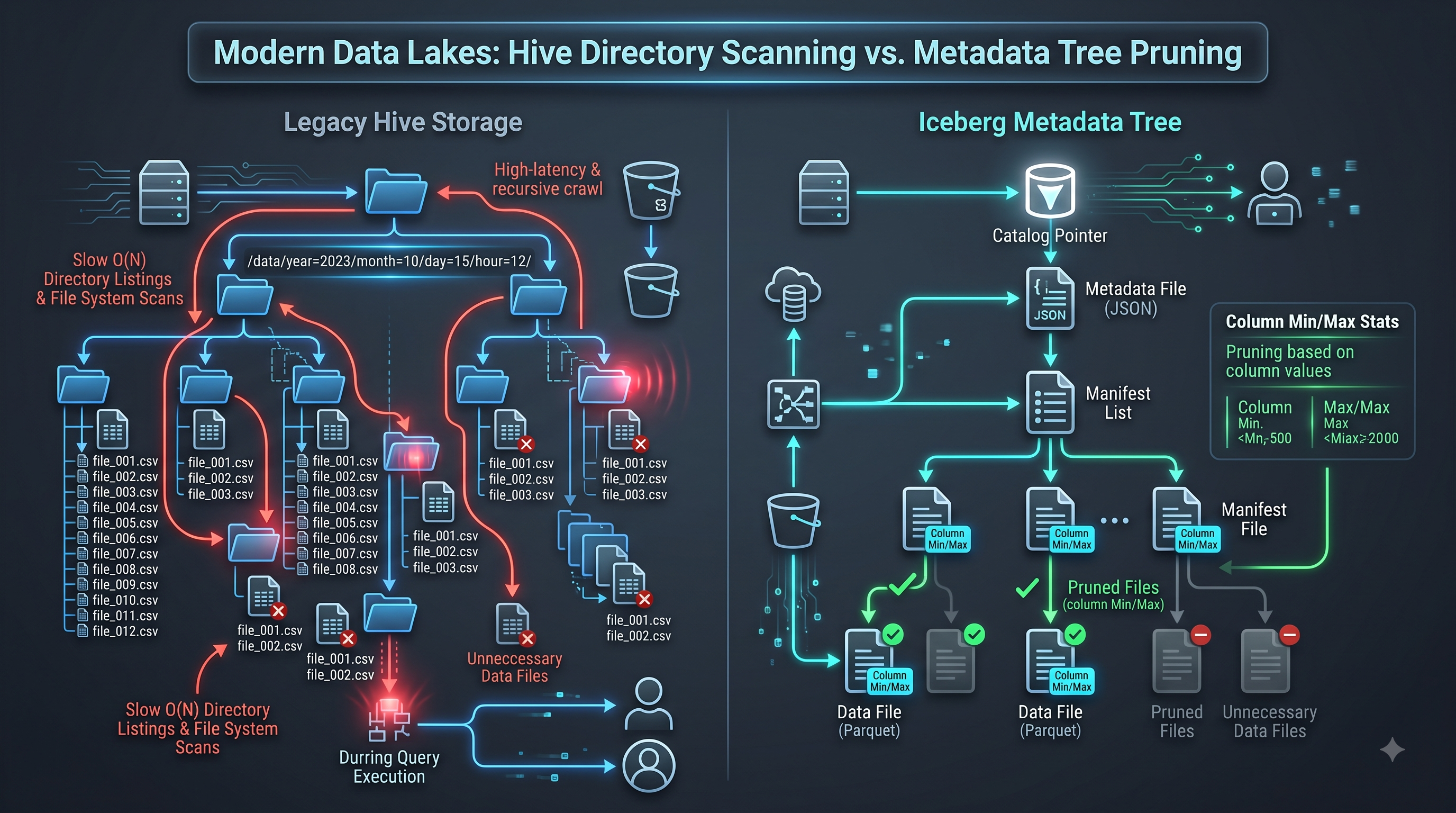
Traditional data lakes organize files by directory paths (e.g., s3://lake/table/year=2026/month=08/day=17/file.parquet). This design forces the query engine to recursively crawl directory trees to figure out which files to read, causing object storage rate-limiting and high query latency.
The Solution: Hierarchical Metadata Architecture
Instead of using the file system layout as the source of truth, open table formats maintain an explicit, multi-layered metadata tree:
Plaintext
[ Catalog Pointer ] (Polaris, Nessie, Glue, REST)
│
▼
[ Metadata File (JSON) ] ── (Snapshot history, schema, partition spec)
│
▼
[ Manifest List (Avro) ] ── (List of manifest files + partition summary stats)
│
▼
[ Manifest Files (Avro) ] ── (Direct data file paths + column min/max stats)
│
▼
[ Data Files (Parquet/ORC) ] (Actual columnar data on S3/GCS/ADLS)
The 3 Core Mechanics Every Data Professional Should Know:
Two-Level Pruning (File-Level Skipping):
Manifest List Level: The engine reads the manifest list to eliminate entire manifest files based on partition summary bounds.
Manifest Level: The engine evaluates column-level min/max statistics to prune individual Parquet data files before touching object storage. Scan planning becomes O(1) in metadata lookups rather than O(N) in directory file crawls.
Atomic Commits & Snapshot Isolation:
Writes generate a new metadata tree without modifying existing files. Commits perform an atomic swap of the metadata file pointer at the catalog level. Readers always query a frozen, consistent snapshot—eliminating "partial read" anomalies during active pipeline writes.
Hidden Partitioning & Partition Evolution:
Users query raw columns (WHERE event_timestamp >= '2026-08-17') instead of artificial partition keys (event_date=...). The metadata handles timestamp-to-day transforms automatically. You can change your partitioning strategy (e.g., from monthly to daily) without rewriting historical data files.
Takeaway for Data Architects:
Decoupling table state from physical storage paths allows multiple disparate engines (Spark, Trino, Flink, DuckDB, Snowflake) to safely read and write to the same single source of truth on cloud object storage without vendor lock-in.
Discussion Question
For data engineers and analytics teams: Are you migrating legacy Hive/data lake tables to open table formats (Iceberg, Delta, or Hudi)? What has been your biggest hurdle—catalog standardization (REST/Polaris), compaction management, or real-time streaming commit tuning? Let's discuss below.
CTA
Master modern lakehouse architectures and data engineering with Techawks.
Join our Data Science & Analytics community to access technical guides, query optimization deep-dives, and lakehouse benchmarks with data professionals worldwide: [Join Techawks Data & Analytics Community]
Traditional data lakes organize files by directory paths (e.g., s3://lake/table/year=2026/month=08/day=17/file.parquet). This design forces the query engine to recursively crawl directory trees to figure out which files to read, causing object storage rate-limiting and high query latency.
The Solution: Hierarchical Metadata Architecture
Instead of using the file system layout as the source of truth, open table formats maintain an explicit, multi-layered metadata tree:
Plaintext
[ Catalog Pointer ] (Polaris, Nessie, Glue, REST)
│
▼
[ Metadata File (JSON) ] ── (Snapshot history, schema, partition spec)
│
▼
[ Manifest List (Avro) ] ── (List of manifest files + partition summary stats)
│
▼
[ Manifest Files (Avro) ] ── (Direct data file paths + column min/max stats)
│
▼
[ Data Files (Parquet/ORC) ] (Actual columnar data on S3/GCS/ADLS)
The 3 Core Mechanics Every Data Professional Should Know:
Two-Level Pruning (File-Level Skipping):
Manifest List Level: The engine reads the manifest list to eliminate entire manifest files based on partition summary bounds.
Manifest Level: The engine evaluates column-level min/max statistics to prune individual Parquet data files before touching object storage. Scan planning becomes O(1) in metadata lookups rather than O(N) in directory file crawls.
Atomic Commits & Snapshot Isolation:
Writes generate a new metadata tree without modifying existing files. Commits perform an atomic swap of the metadata file pointer at the catalog level. Readers always query a frozen, consistent snapshot—eliminating "partial read" anomalies during active pipeline writes.
Hidden Partitioning & Partition Evolution:
Users query raw columns (WHERE event_timestamp >= '2026-08-17') instead of artificial partition keys (event_date=...). The metadata handles timestamp-to-day transforms automatically. You can change your partitioning strategy (e.g., from monthly to daily) without rewriting historical data files.
Takeaway for Data Architects:
Decoupling table state from physical storage paths allows multiple disparate engines (Spark, Trino, Flink, DuckDB, Snowflake) to safely read and write to the same single source of truth on cloud object storage without vendor lock-in.
Discussion Question
For data engineers and analytics teams: Are you migrating legacy Hive/data lake tables to open table formats (Iceberg, Delta, or Hudi)? What has been your biggest hurdle—catalog standardization (REST/Polaris), compaction management, or real-time streaming commit tuning? Let's discuss below.
CTA
Master modern lakehouse architectures and data engineering with Techawks.
Join our Data Science & Analytics community to access technical guides, query optimization deep-dives, and lakehouse benchmarks with data professionals worldwide: [Join Techawks Data & Analytics Community]
Stop partition hell in your Data Lake: How Apache Iceberg metadata trees eliminate O(N) directory scan bottlenecks.
Traditional data lakes organize files by directory paths (e.g., s3://lake/table/year=2026/month=08/day=17/file.parquet). This design forces the query engine to recursively crawl directory trees to figure out which files to read, causing object storage rate-limiting and high query latency.
The Solution: Hierarchical Metadata Architecture
Instead of using the file system layout as the source of truth, open table formats maintain an explicit, multi-layered metadata tree:
Plaintext
[ Catalog Pointer ] (Polaris, Nessie, Glue, REST)
│
▼
[ Metadata File (JSON) ] ── (Snapshot history, schema, partition spec)
│
▼
[ Manifest List (Avro) ] ── (List of manifest files + partition summary stats)
│
▼
[ Manifest Files (Avro) ] ── (Direct data file paths + column min/max stats)
│
▼
[ Data Files (Parquet/ORC) ] (Actual columnar data on S3/GCS/ADLS)
The 3 Core Mechanics Every Data Professional Should Know:
Two-Level Pruning (File-Level Skipping):
Manifest List Level: The engine reads the manifest list to eliminate entire manifest files based on partition summary bounds.
Manifest Level: The engine evaluates column-level min/max statistics to prune individual Parquet data files before touching object storage. Scan planning becomes O(1) in metadata lookups rather than O(N) in directory file crawls.
Atomic Commits & Snapshot Isolation:
Writes generate a new metadata tree without modifying existing files. Commits perform an atomic swap of the metadata file pointer at the catalog level. Readers always query a frozen, consistent snapshot—eliminating "partial read" anomalies during active pipeline writes.
Hidden Partitioning & Partition Evolution:
Users query raw columns (WHERE event_timestamp >= '2026-08-17') instead of artificial partition keys (event_date=...). The metadata handles timestamp-to-day transforms automatically. You can change your partitioning strategy (e.g., from monthly to daily) without rewriting historical data files.
Takeaway for Data Architects:
Decoupling table state from physical storage paths allows multiple disparate engines (Spark, Trino, Flink, DuckDB, Snowflake) to safely read and write to the same single source of truth on cloud object storage without vendor lock-in.
Discussion Question
For data engineers and analytics teams: Are you migrating legacy Hive/data lake tables to open table formats (Iceberg, Delta, or Hudi)? What has been your biggest hurdle—catalog standardization (REST/Polaris), compaction management, or real-time streaming commit tuning? Let's discuss below.
CTA
Master modern lakehouse architectures and data engineering with Techawks.
Join our Data Science & Analytics community to access technical guides, query optimization deep-dives, and lakehouse benchmarks with data professionals worldwide: [Join Techawks Data & Analytics Community]

 Arabic
 French
 Spanish
 Portuguese
 Deutsch
 Turkish
 Dutch
Dutch
 Italiano
 Russian
 Romaian
 Portuguese (Brazil)
 Greek
Greek