


Stop using sidecar proxies for basic routing: The operational shift to eBPF-powered Ambient Service Mesh.
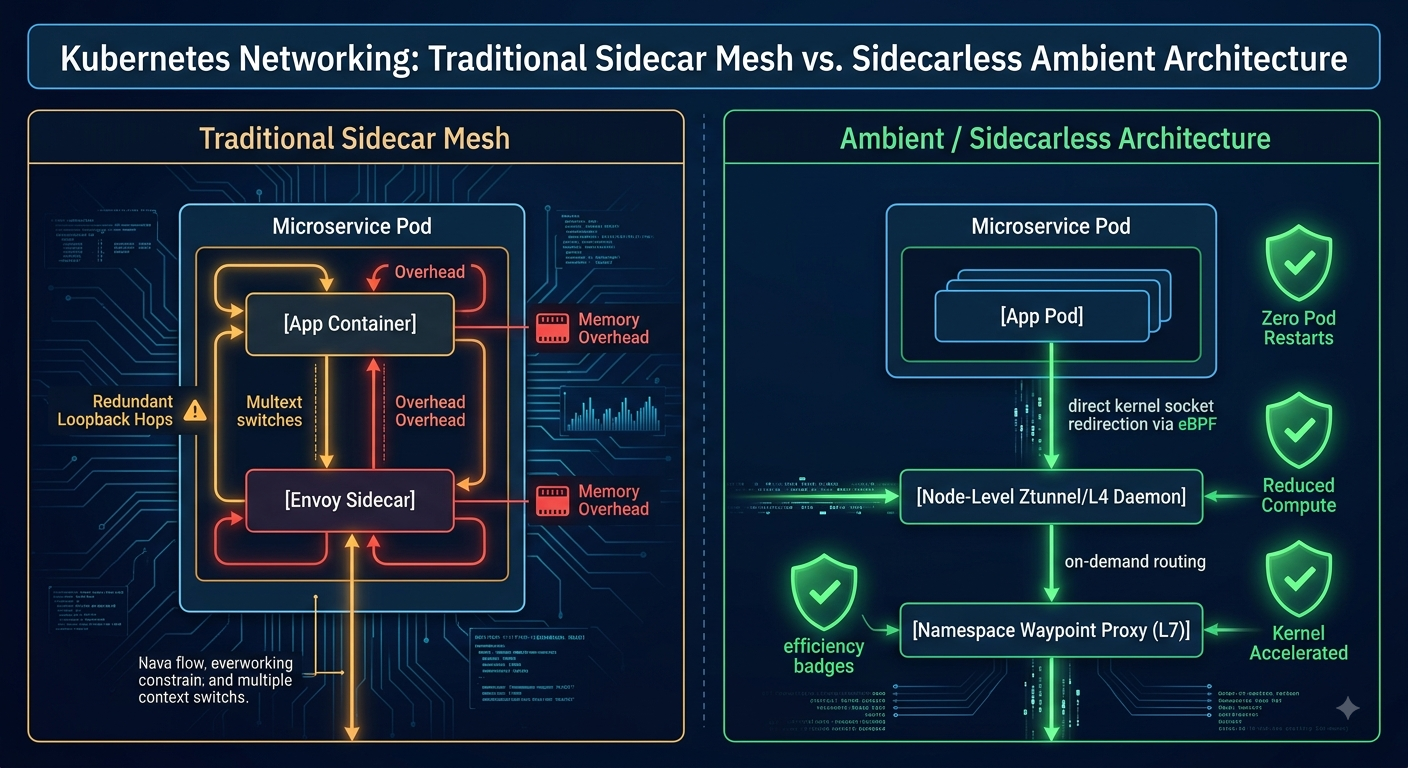
Traditional service mesh architectures inject an Envoy proxy alongside every application container. Every inbound and outbound network request must traverse multiple context switches:
[ App Container ] ── (Localhost TCP) ──► [ Sidecar Envoy ] ──► [ Node Eth0 ] ──► Network
At scale, this pattern introduces significant operational drag:
Memory & CPU Bloat: Even an idle Envoy proxy consumes 30MB–70MB of RAM; across 3,000 microservices, that is hundreds of gigabytes wasted on proxy boilerplate.
Upgrade Disruption: Patching or upgrading proxy versions requires restarting the entire application pod.
TCP Loopback Overhead: Every packet traverses the kernel network stack multiple times.
The Modern Alternative: Ambient Architecture + eBPF
Sidecarless mesh decouples service mesh capabilities into two purpose-built layers:
The Secure Transport Layer (Node-Level / L4):
A lightweight, per-node daemon (e.g., Istio's ztunnel or Cilium's eBPF datapath) handles basic Layer 4 identity, mutual TLS (mTLS) encapsulation, and authentication.
By using eBPF (Extended Berkeley Packet Filter), socket-to-socket traffic is routed directly in kernel space (via sockmap), bypassing the physical loopback stack entirely.
The Layer 7 Processing Layer (Waypoint Proxies):
Heavy L7 features (header-based routing, retries, rate limiting, distributed tracing) are offloaded to dedicated Waypoint Proxies deployed per-namespace or per-service identity.
If a workload only requires encrypted zero-trust transit (L4 mTLS), it never touches an L7 proxy, avoiding unnecessary latency overhead.
Why This Matters for DevOps & Cloud Engineers:
Zero Pod Restarts: Upgrading mesh versions or rotating proxy configs happens independently of application life cycles.
Resource Optimization: Reduces mesh-related compute and memory utilization by up to 60%–70%.
Simplified Operations: Developers deploy standard, clean container images without mutating webhook injections breaking their deployment manifests.
Discussion Question
For Platform and DevOps engineers running production clusters: Have you started transitioning to sidecarless architectures (Ambient Mesh / Cilium Service Mesh), or are traditional sidecars still your default standard? What is your biggest hurdle in migrating? Let's discuss below.
CTA
Master modern cloud-native architecture and infrastructure engineering with Techawks.
Join our Cloud, DevOps & Open Source community to access hands-on Kubernetes teardowns, eBPF deep-dives, and production architecture guides with engineers worldwide: [Join Techawks Cloud & DevOps Community]
Traditional service mesh architectures inject an Envoy proxy alongside every application container. Every inbound and outbound network request must traverse multiple context switches:
[ App Container ] ── (Localhost TCP) ──► [ Sidecar Envoy ] ──► [ Node Eth0 ] ──► Network
At scale, this pattern introduces significant operational drag:
Memory & CPU Bloat: Even an idle Envoy proxy consumes 30MB–70MB of RAM; across 3,000 microservices, that is hundreds of gigabytes wasted on proxy boilerplate.
Upgrade Disruption: Patching or upgrading proxy versions requires restarting the entire application pod.
TCP Loopback Overhead: Every packet traverses the kernel network stack multiple times.
The Modern Alternative: Ambient Architecture + eBPF
Sidecarless mesh decouples service mesh capabilities into two purpose-built layers:
The Secure Transport Layer (Node-Level / L4):
A lightweight, per-node daemon (e.g., Istio's ztunnel or Cilium's eBPF datapath) handles basic Layer 4 identity, mutual TLS (mTLS) encapsulation, and authentication.
By using eBPF (Extended Berkeley Packet Filter), socket-to-socket traffic is routed directly in kernel space (via sockmap), bypassing the physical loopback stack entirely.
The Layer 7 Processing Layer (Waypoint Proxies):
Heavy L7 features (header-based routing, retries, rate limiting, distributed tracing) are offloaded to dedicated Waypoint Proxies deployed per-namespace or per-service identity.
If a workload only requires encrypted zero-trust transit (L4 mTLS), it never touches an L7 proxy, avoiding unnecessary latency overhead.
Why This Matters for DevOps & Cloud Engineers:
Zero Pod Restarts: Upgrading mesh versions or rotating proxy configs happens independently of application life cycles.
Resource Optimization: Reduces mesh-related compute and memory utilization by up to 60%–70%.
Simplified Operations: Developers deploy standard, clean container images without mutating webhook injections breaking their deployment manifests.
Discussion Question
For Platform and DevOps engineers running production clusters: Have you started transitioning to sidecarless architectures (Ambient Mesh / Cilium Service Mesh), or are traditional sidecars still your default standard? What is your biggest hurdle in migrating? Let's discuss below.
CTA
Master modern cloud-native architecture and infrastructure engineering with Techawks.
Join our Cloud, DevOps & Open Source community to access hands-on Kubernetes teardowns, eBPF deep-dives, and production architecture guides with engineers worldwide: [Join Techawks Cloud & DevOps Community]
Stop using sidecar proxies for basic routing: The operational shift to eBPF-powered Ambient Service Mesh.
Traditional service mesh architectures inject an Envoy proxy alongside every application container. Every inbound and outbound network request must traverse multiple context switches:
[ App Container ] ── (Localhost TCP) ──► [ Sidecar Envoy ] ──► [ Node Eth0 ] ──► Network
At scale, this pattern introduces significant operational drag:
Memory & CPU Bloat: Even an idle Envoy proxy consumes 30MB–70MB of RAM; across 3,000 microservices, that is hundreds of gigabytes wasted on proxy boilerplate.
Upgrade Disruption: Patching or upgrading proxy versions requires restarting the entire application pod.
TCP Loopback Overhead: Every packet traverses the kernel network stack multiple times.
The Modern Alternative: Ambient Architecture + eBPF
Sidecarless mesh decouples service mesh capabilities into two purpose-built layers:
The Secure Transport Layer (Node-Level / L4):
A lightweight, per-node daemon (e.g., Istio's ztunnel or Cilium's eBPF datapath) handles basic Layer 4 identity, mutual TLS (mTLS) encapsulation, and authentication.
By using eBPF (Extended Berkeley Packet Filter), socket-to-socket traffic is routed directly in kernel space (via sockmap), bypassing the physical loopback stack entirely.
The Layer 7 Processing Layer (Waypoint Proxies):
Heavy L7 features (header-based routing, retries, rate limiting, distributed tracing) are offloaded to dedicated Waypoint Proxies deployed per-namespace or per-service identity.
If a workload only requires encrypted zero-trust transit (L4 mTLS), it never touches an L7 proxy, avoiding unnecessary latency overhead.
Why This Matters for DevOps & Cloud Engineers:
Zero Pod Restarts: Upgrading mesh versions or rotating proxy configs happens independently of application life cycles.
Resource Optimization: Reduces mesh-related compute and memory utilization by up to 60%–70%.
Simplified Operations: Developers deploy standard, clean container images without mutating webhook injections breaking their deployment manifests.
Discussion Question
For Platform and DevOps engineers running production clusters: Have you started transitioning to sidecarless architectures (Ambient Mesh / Cilium Service Mesh), or are traditional sidecars still your default standard? What is your biggest hurdle in migrating? Let's discuss below.
CTA
Master modern cloud-native architecture and infrastructure engineering with Techawks.
Join our Cloud, DevOps & Open Source community to access hands-on Kubernetes teardowns, eBPF deep-dives, and production architecture guides with engineers worldwide: [Join Techawks Cloud & DevOps Community]

 English
 Arabic
 French
 Portuguese
 Deutsch
 Turkish
 Dutch
Dutch
 Italiano
 Russian
 Romaian
 Portuguese (Brazil)
 Greek
Greek