• How to Transition from Junior to Senior Developer: The 4 Core Competencies You Need
    Reaching the senior developer level isn't about mastering every framework—it's about demonstrating architectural foresight, business acumen, and cross-team leadership. If you want to accelerate your career trajectory, focus on building these four non-technical skills alongside your engineering practice:


    1. Shift from Coding Solutions to Defining Problems
    Junior Mindset: Waits for fully detailed ticket specifications and executes tasks as requested.
    Senior Action: Questions assumptions, identifies edge cases early, and clarifies business goals before writing code. Focus on understanding why a feature matters to end-users rather than just completing tickets.


    2. Communicate Architectural Trade-Offs
    Junior Mindset: Chooses technologies based on popularity or technical novelty.
    Senior Action: Evaluates technical choices through the lens of trade-offs: cost, maintainability, execution speed, and system security. When presenting decisions to managers, explain options in terms of business impact and risk rather than syntax preferences.


    3. Elevate Team Productivity Through Mentorship
    Junior Mindset: Focuses exclusively on individual daily ticket output.
    Senior Action: Acts as a force multiplier for the team. Senior engineers write clear documentation, create reusable tooling, conduct constructive code reviews, and unblock junior team members through pair programming.


    4. Practice System Health & Production Ownership
    Junior Mindset: Considers a task finished once code passes local tests and gets merged.
    Senior Action: Takes responsibility for observability, error logging, CI/CD pipeline reliability, and post-release monitoring. Senior engineers design systems that are easy to debug when failures occur in production.


    Key Takeaways


    Solve Business Problems: Focus on delivering measurable product value, not just closing software tickets.
    Multiply Team Output: Your growth to a senior role is measured by how much better you make the engineers around you.
    Master System Ownership: Take responsibility for operational health, monitoring, and long-term code maintainability.


    CTA
    Ready to take the next step in your tech career? Join Tech Jobs & Opportunities to connect with hiring managers, discover curated engineering roles, and access career growth strategies from industry mentors.

    How to Transition from Junior to Senior Developer: The 4 Core Competencies You Need Reaching the senior developer level isn't about mastering every framework—it's about demonstrating architectural foresight, business acumen, and cross-team leadership. If you want to accelerate your career trajectory, focus on building these four non-technical skills alongside your engineering practice: 1. Shift from Coding Solutions to Defining Problems Junior Mindset: Waits for fully detailed ticket specifications and executes tasks as requested. Senior Action: Questions assumptions, identifies edge cases early, and clarifies business goals before writing code. Focus on understanding why a feature matters to end-users rather than just completing tickets. 2. Communicate Architectural Trade-Offs Junior Mindset: Chooses technologies based on popularity or technical novelty. Senior Action: Evaluates technical choices through the lens of trade-offs: cost, maintainability, execution speed, and system security. When presenting decisions to managers, explain options in terms of business impact and risk rather than syntax preferences. 3. Elevate Team Productivity Through Mentorship Junior Mindset: Focuses exclusively on individual daily ticket output. Senior Action: Acts as a force multiplier for the team. Senior engineers write clear documentation, create reusable tooling, conduct constructive code reviews, and unblock junior team members through pair programming. 4. Practice System Health & Production Ownership Junior Mindset: Considers a task finished once code passes local tests and gets merged. Senior Action: Takes responsibility for observability, error logging, CI/CD pipeline reliability, and post-release monitoring. Senior engineers design systems that are easy to debug when failures occur in production. Key Takeaways Solve Business Problems: Focus on delivering measurable product value, not just closing software tickets. Multiply Team Output: Your growth to a senior role is measured by how much better you make the engineers around you. Master System Ownership: Take responsibility for operational health, monitoring, and long-term code maintainability. CTA Ready to take the next step in your tech career? Join Tech Jobs & Opportunities to connect with hiring managers, discover curated engineering roles, and access career growth strategies from industry mentors.

    0 Commentarii 0 Distribuiri 2K Views 0 previzualizare
  • Technical Interviews vs. On-the-Job Reality: Are System Design Frameworks Overrated?
    Standard technical interviews rely heavily on structured frameworks: memorizing estimation formulas, drawing textbook diagrams, and implementing generic algorithms. However, production engineering environments rarely look like pristine interview whiteboards.
    In real engineering teams, you face incomplete requirements, legacy technical debt, tight budgets, and cross-functional friction.
    To stand out in senior-level interviews and build a resilient career, you need to demonstrate practical engineering intuition over memorized scripts:


    1. Challenge Interview Assumptions Respectfully
    The Interview Script: Immediately starts drawing database schemas and load balancer layers for a hypothetical system.
    The Practical Approach: Ask probing questions first. What is the team's existing tech stack? What are the reliability requirements? Is speed to market more critical than high availability for this MVP?


    2. Focus on Operational Cost and Team Bandwidth
    The Interview Script: Recommends complex microservices, dedicated caching layers, and multi-region replication by default.
    The Practical Approach: Evaluate solutions based on total cost of ownership (TCO). A simple, well-monitored monolith hosted on managed infrastructure is often far better for a small engineering team than a high-maintenance distributed system.


    3. Discuss Failure Modes and Incident Recovery
    The Interview Script: Designs a system that assumes every service operates with 100% uptime.
    The Practical Approach: Proactively explain what happens when components fail. How does the system degrade gracefully? How do engineers debug issues during a midnight production outage?


    How to Practice for Practical Technical Interviews:
    Instead of only memorizing system design templates, conduct post-mortems on real open-source architecture decisions. Read engineering blogs from companies detailing their production outages, data migrations, and architectural refactors to understand real-world trade-offs.


    Key Takeaways
    Prioritize Trade-Offs Over Perfection: Perfect architectures don't exist; candidate evaluations center on your ability to weigh costs, complexity, and performance.
    Emphasize Maintainability: Show interviewers that you care about code readability, monitoring, and operational overhead.
    Ask Clarifying Business Questions: Frame technical decisions around business constraints before picking tools or frameworks.


    CTA
    How do you prepare for technical interviews without relying on rigid memorization? Join Tech Jobs & Opportunities to discuss interview experiences, benchmark salary data, and get feedback on your system design approaches from senior engineers.
    Technical Interviews vs. On-the-Job Reality: Are System Design Frameworks Overrated? Standard technical interviews rely heavily on structured frameworks: memorizing estimation formulas, drawing textbook diagrams, and implementing generic algorithms. However, production engineering environments rarely look like pristine interview whiteboards. In real engineering teams, you face incomplete requirements, legacy technical debt, tight budgets, and cross-functional friction. To stand out in senior-level interviews and build a resilient career, you need to demonstrate practical engineering intuition over memorized scripts: 1. Challenge Interview Assumptions Respectfully The Interview Script: Immediately starts drawing database schemas and load balancer layers for a hypothetical system. The Practical Approach: Ask probing questions first. What is the team's existing tech stack? What are the reliability requirements? Is speed to market more critical than high availability for this MVP? 2. Focus on Operational Cost and Team Bandwidth The Interview Script: Recommends complex microservices, dedicated caching layers, and multi-region replication by default. The Practical Approach: Evaluate solutions based on total cost of ownership (TCO). A simple, well-monitored monolith hosted on managed infrastructure is often far better for a small engineering team than a high-maintenance distributed system. 3. Discuss Failure Modes and Incident Recovery The Interview Script: Designs a system that assumes every service operates with 100% uptime. The Practical Approach: Proactively explain what happens when components fail. How does the system degrade gracefully? How do engineers debug issues during a midnight production outage? How to Practice for Practical Technical Interviews: Instead of only memorizing system design templates, conduct post-mortems on real open-source architecture decisions. Read engineering blogs from companies detailing their production outages, data migrations, and architectural refactors to understand real-world trade-offs. Key Takeaways Prioritize Trade-Offs Over Perfection: Perfect architectures don't exist; candidate evaluations center on your ability to weigh costs, complexity, and performance. Emphasize Maintainability: Show interviewers that you care about code readability, monitoring, and operational overhead. Ask Clarifying Business Questions: Frame technical decisions around business constraints before picking tools or frameworks. CTA How do you prepare for technical interviews without relying on rigid memorization? Join Tech Jobs & Opportunities to discuss interview experiences, benchmark salary data, and get feedback on your system design approaches from senior engineers.
    0 Commentarii 0 Distribuiri 2K Views 0 previzualizare
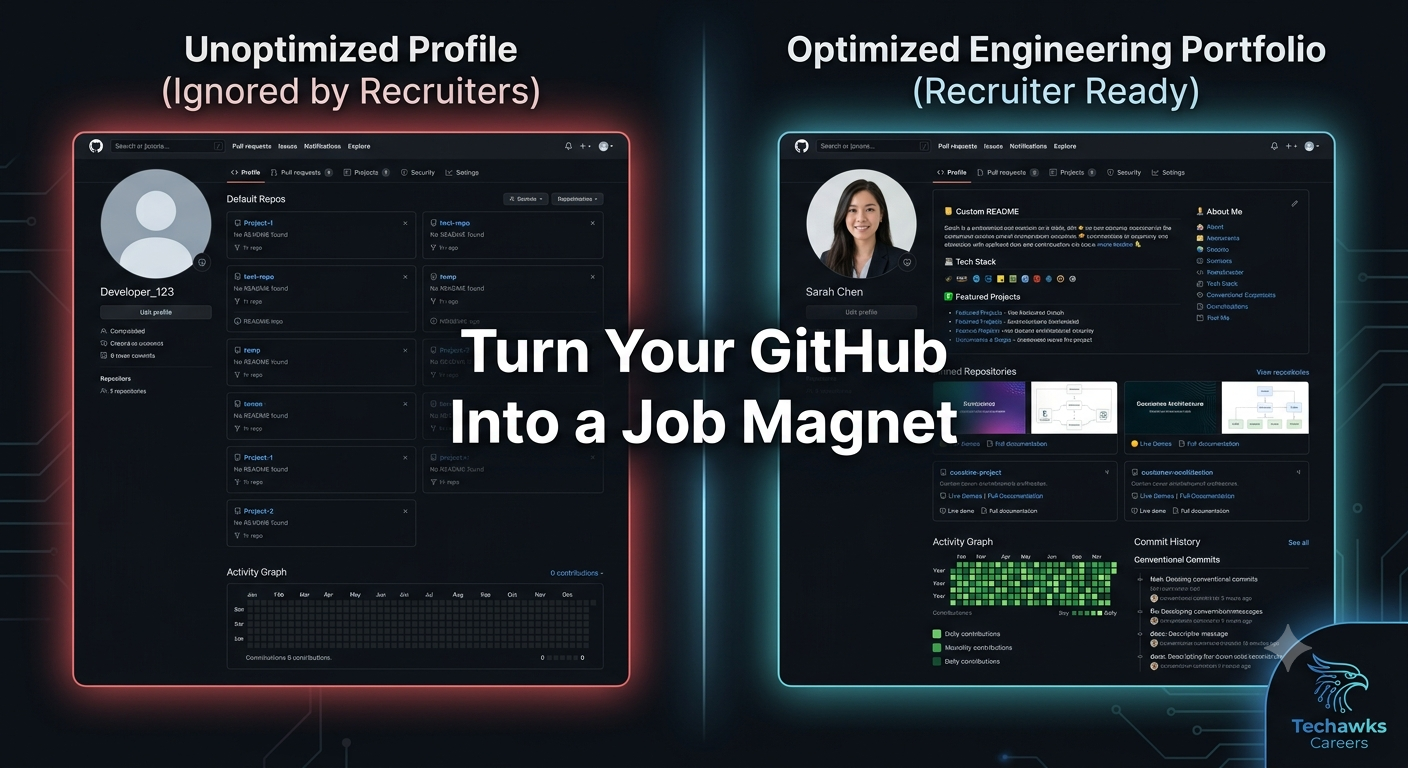
  • How to Optimize Your GitHub Profile for Tech Recruiters: Step-by-Step Guide
    Your GitHub profile is your live engineering portfolio. To stand out to hiring managers and technical recruiters, you need to structure your profile so it immediately communicates code quality, documentation skills, and problem-solving ability.


    Follow this step-by-step tutorial to transform your GitHub into a recruiter magnet:


    Step 1: Build a Custom Profile README
    Create a repository named exactly as your GitHub username to unlock a special profile README that displays at the top of your landing page.
    Keep it Concise: Include a brief 2-sentence bio detailing your core stack (e.g., Node.js, TypeScript, PostgreSQL) and current focus.
    Highlight Key Metrics: Use dynamic badges to display language proficiencies, total contributions, or open-source pull requests merged.
    Add Direct Links: Provide quick access to your LinkedIn, personal portfolio, and contact info.


    Step 2: Curate and Pin Your Top 3–4 Repositories
    Do not leave your pinned repositories blank or let GitHub default to your most recently updated projects. Carefully select 3 to 4 repositories that demonstrate:
    Full-Stack Competency: A complete, deployed application with front-end, API, and database integration.
    Technical Depth: A project featuring non-trivial complexity (e.g., custom rate limiter, cache layer, or data processing pipeline).
    Open-Source Impact: A contributed PR to an established open-source tool or community project.


    Step 3: Write Production-Grade Repository READMEs
    A recruiter or engineering lead will rarely clone your repo to run it locally; they read the README. Every pinned project must include:
    Project Architecture Diagram: A clear flowchart illustrating how data moves through your system.
    Tech Stack & Key Trade-Offs: Explanations of why you chose specific frameworks or databases over alternatives.
    Live Demo & Deployment Links: A working URL (e.g., hosted on Vercel, AWS, or Render) alongside a 10-second GIF demonstrating core functionality.
    Setup Instructions: Precise, copy-pasteable terminal commands to run the project locally.


    Step 4: Practice Clean Commit Hygiene
    Recruiters look at repository commit histories to evaluate how you work within a team.
    Avoid generic commit messages like fix bug or updated code.
    Use Conventional Commits (e.g., feat: add user authentication endpoint or fix: handle null token error in auth middleware).
    Keep feature branches clean and write descriptive Pull Request descriptions.


    Key Takeaways
    First Impressions Matter: A custom profile README immediately establishes professionalism and communicates your core engineering stack.
    Document Like a Senior: Comprehensive repository READMEs with diagrams and live demos matter more to hiring teams than thousands of raw lines of code.
    Demonstrate Workflow Discipline: Clean commit history and conventional messages show that you understand industry team practices.


    CTA
    Want expert feedback on your developer portfolio and GitHub profile? Join Tech Jobs & Opportunities to get profile reviews, benchmark your application materials, and connect directly with hiring managers in tech.
    How to Optimize Your GitHub Profile for Tech Recruiters: Step-by-Step Guide Your GitHub profile is your live engineering portfolio. To stand out to hiring managers and technical recruiters, you need to structure your profile so it immediately communicates code quality, documentation skills, and problem-solving ability. Follow this step-by-step tutorial to transform your GitHub into a recruiter magnet: Step 1: Build a Custom Profile README Create a repository named exactly as your GitHub username to unlock a special profile README that displays at the top of your landing page. Keep it Concise: Include a brief 2-sentence bio detailing your core stack (e.g., Node.js, TypeScript, PostgreSQL) and current focus. Highlight Key Metrics: Use dynamic badges to display language proficiencies, total contributions, or open-source pull requests merged. Add Direct Links: Provide quick access to your LinkedIn, personal portfolio, and contact info. Step 2: Curate and Pin Your Top 3–4 Repositories Do not leave your pinned repositories blank or let GitHub default to your most recently updated projects. Carefully select 3 to 4 repositories that demonstrate: Full-Stack Competency: A complete, deployed application with front-end, API, and database integration. Technical Depth: A project featuring non-trivial complexity (e.g., custom rate limiter, cache layer, or data processing pipeline). Open-Source Impact: A contributed PR to an established open-source tool or community project. Step 3: Write Production-Grade Repository READMEs A recruiter or engineering lead will rarely clone your repo to run it locally; they read the README. Every pinned project must include: Project Architecture Diagram: A clear flowchart illustrating how data moves through your system. Tech Stack & Key Trade-Offs: Explanations of why you chose specific frameworks or databases over alternatives. Live Demo & Deployment Links: A working URL (e.g., hosted on Vercel, AWS, or Render) alongside a 10-second GIF demonstrating core functionality. Setup Instructions: Precise, copy-pasteable terminal commands to run the project locally. Step 4: Practice Clean Commit Hygiene Recruiters look at repository commit histories to evaluate how you work within a team. Avoid generic commit messages like fix bug or updated code. Use Conventional Commits (e.g., feat: add user authentication endpoint or fix: handle null token error in auth middleware). Keep feature branches clean and write descriptive Pull Request descriptions. Key Takeaways First Impressions Matter: A custom profile README immediately establishes professionalism and communicates your core engineering stack. Document Like a Senior: Comprehensive repository READMEs with diagrams and live demos matter more to hiring teams than thousands of raw lines of code. Demonstrate Workflow Discipline: Clean commit history and conventional messages show that you understand industry team practices. CTA Want expert feedback on your developer portfolio and GitHub profile? Join Tech Jobs & Opportunities to get profile reviews, benchmark your application materials, and connect directly with hiring managers in tech.
    0 Commentarii 0 Distribuiri 1K Views 0 previzualizare
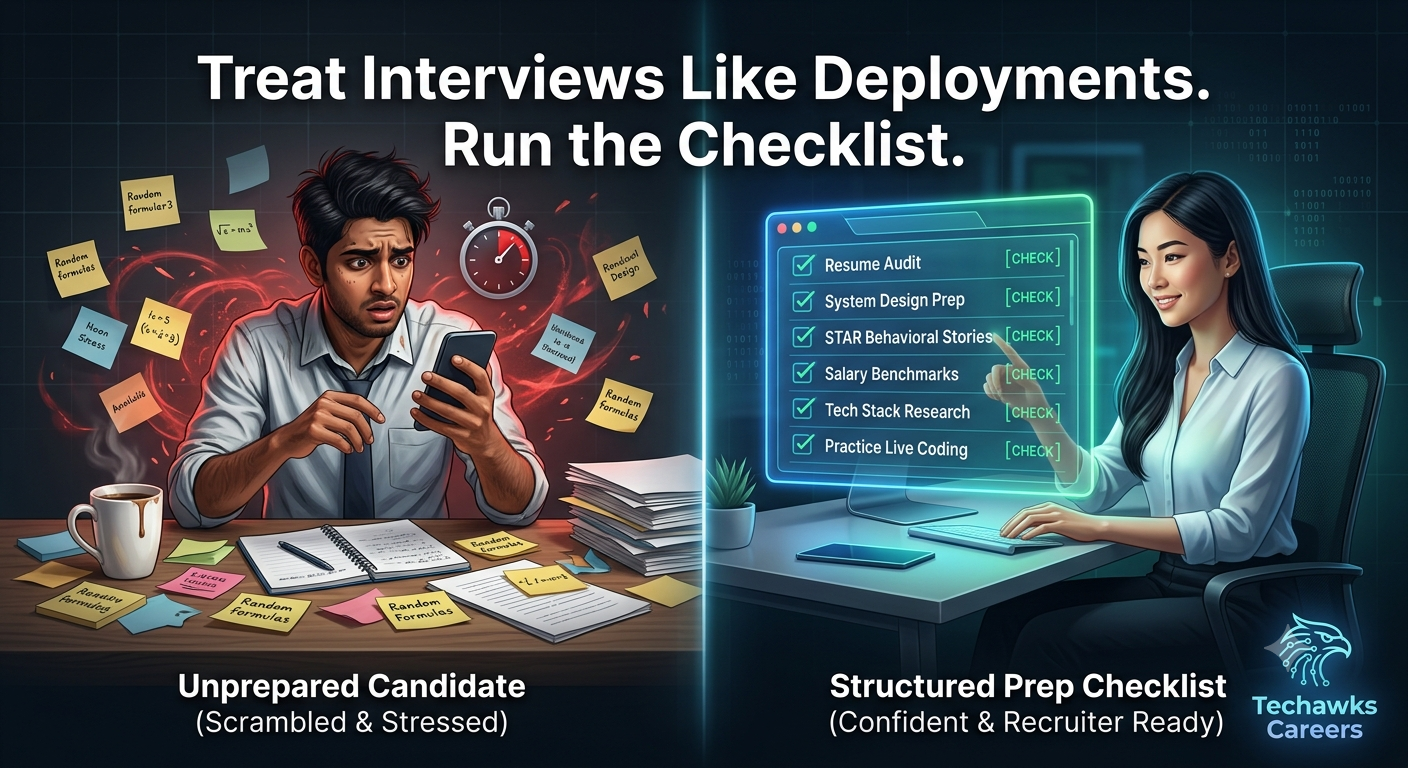
  • The Ultimate Pre-Interview Tech Checklist: 10 Critical Steps Before Every First Round
    Passing first-round technical and recruiter screens requires more than scanning your resume an hour before the call. To project confidence, competence, and clarity, treat your interview preparation like a deployment checklist.


    Work through these 10 actionable steps 24 to 48 hours before every interview:


    Phase 1: Company & Product Reconnaissance
    1. Test the Core Product: Sign up for the company’s product or app, try its main features, and note two areas of smooth UX and two potential technical improvements.
    2. Map the Tech Stack: Review engineering job postings, tech blogs, or GitHub profiles from the company to identify their primary databases, frameworks, and cloud providers.
    3. Research Recent Milestones: Identify recent product launches, major feature releases, or technical blog posts to ask informed questions during the interview.


    Phase 2: Technical & Behavioral Alignment
    4. Audit Your Resume Bullet Points: Be prepared to explain the architectural decisions, trade-offs, and metrics behind every project listed on your resume.
    5. Prepare 3 STAR Stories: Prepare concise Situation-Task-Action-Result (STAR) stories highlighting a complex bug fix, a technical trade-off debate, and a cross-functional disagreement.
    6. Rehearse Your "Tell Me About Yourself" Pitch: Keep your professional background pitch under 90 seconds, focusing on technical growth, recent impact, and why this specific role fits your trajectory.


    Phase 3: System & Live Coding Setup
    7. Verify Your Local Environment: Test your IDE, terminal extensions, node/python runtime versions, and local webcams to prevent technical glitches during live coding screens.
    8. Bookmark Documentation Quick-Links: Keep language syntax docs, standard library references, and key API specs open in separate browser tabs for quick reference.


    Phase 4: Strategic Questions for the Hiring Team
    9. Prepare 3 Reverse-Interview Questions: Draft questions focused on engineering culture, deployment frequency, on-call schedules, or tech debt management.
    10. Define Your Salary Expectation Range: Research benchmark salary data for the position, level, and location so you can answer compensation questions confidently.


    Key Takeaways
    Systematize Preparation: Treat every interview prep like a deployment procedure to eliminate missed details.
    Understand the Business: Candidates who test the actual product and understand company constraints stand out immediately.
    Control the Technical Environment: Eliminate setup friction by auditing your local IDE and testing equipment well ahead of time.


    CTA
    How do you prepare for high-stakes technical interviews? Join Tech Jobs & Opportunities to access downloadable interview checklists, review salary benchmarks, and practice mock interviews with fellow software engineers.
    The Ultimate Pre-Interview Tech Checklist: 10 Critical Steps Before Every First Round Passing first-round technical and recruiter screens requires more than scanning your resume an hour before the call. To project confidence, competence, and clarity, treat your interview preparation like a deployment checklist. Work through these 10 actionable steps 24 to 48 hours before every interview: Phase 1: Company & Product Reconnaissance 1. Test the Core Product: Sign up for the company’s product or app, try its main features, and note two areas of smooth UX and two potential technical improvements. 2. Map the Tech Stack: Review engineering job postings, tech blogs, or GitHub profiles from the company to identify their primary databases, frameworks, and cloud providers. 3. Research Recent Milestones: Identify recent product launches, major feature releases, or technical blog posts to ask informed questions during the interview. Phase 2: Technical & Behavioral Alignment 4. Audit Your Resume Bullet Points: Be prepared to explain the architectural decisions, trade-offs, and metrics behind every project listed on your resume. 5. Prepare 3 STAR Stories: Prepare concise Situation-Task-Action-Result (STAR) stories highlighting a complex bug fix, a technical trade-off debate, and a cross-functional disagreement. 6. Rehearse Your "Tell Me About Yourself" Pitch: Keep your professional background pitch under 90 seconds, focusing on technical growth, recent impact, and why this specific role fits your trajectory. Phase 3: System & Live Coding Setup 7. Verify Your Local Environment: Test your IDE, terminal extensions, node/python runtime versions, and local webcams to prevent technical glitches during live coding screens. 8. Bookmark Documentation Quick-Links: Keep language syntax docs, standard library references, and key API specs open in separate browser tabs for quick reference. Phase 4: Strategic Questions for the Hiring Team 9. Prepare 3 Reverse-Interview Questions: Draft questions focused on engineering culture, deployment frequency, on-call schedules, or tech debt management. 10. Define Your Salary Expectation Range: Research benchmark salary data for the position, level, and location so you can answer compensation questions confidently. Key Takeaways Systematize Preparation: Treat every interview prep like a deployment procedure to eliminate missed details. Understand the Business: Candidates who test the actual product and understand company constraints stand out immediately. Control the Technical Environment: Eliminate setup friction by auditing your local IDE and testing equipment well ahead of time. CTA How do you prepare for high-stakes technical interviews? Join Tech Jobs & Opportunities to access downloadable interview checklists, review salary benchmarks, and practice mock interviews with fellow software engineers.
    0 Commentarii 0 Distribuiri 1K Views 0 previzualizare
  • How to Measure True Product-Market Fit: 4 Quantitative Metrics Every Founder Needs
    Most startups fail not because they couldn't build a product, but because they built something without sustainable market demand. Founders often mistake initial launch buzz for Product-Market Fit, leading to premature scaling that burns through runway.


    To know if you have real PMF before spending heavily on sales and marketing, track these four core quantitative benchmarks:


    1. The "Sean Ellis" 40% Test
    Survey your active users with a single question: "How would you feel if you could no longer use [Product]?"
    The Threshold: If 40% or more of respondents answer "very disappointed," you have reached a baseline for PMF.
    Actionable Insight: If your score is below 40%, stop growing marketing spend and interview the users who did answer "very disappointed" to double down on what makes the core value proposition work for them.


    2. The Cohort Retention Curve (The "Flattening" Line)
    Track user cohorts over 30, 60, and 90 days. Plot retention percentages over time on a graph.
    The Threshold: Look for a curve that drops initially but eventually flattens out parallel to the x-axis.
    Actionable Insight: A curve that trends continuously down to zero indicates a "leaky bucket"—adding more users will not save the business. A flat line proves a baseline of core power users who find recurring value.


    3. Net Revenue Retention (NRR) > 100% (For B2B SaaS)
    NRR measures the percentage of recurring revenue retained from existing customers over a specific period, factoring in upgrades, cross-sells, and churn.
    The Threshold: An NRR above 100% (ideally 110%+ for SMB, 120%+ for Enterprise) means your business grows organically from your existing customer base even if you acquire zero new customers.


    4. LTV to CAC Ratio > 3:1
    Customer Lifetime Value (LTV) must significantly exceed Customer Acquisition Cost (CAC).
    The Threshold: A healthy ratio is 3:1 or higher, with a CAC payback period of less than 12 months.
    Actionable Insight: If your payback period exceeds 18–24 months early on, your acquisition engine is inefficient or your pricing model is undercharging for delivered value.


    Key Takeaways
    Ignore Vanity Metrics: Registrations and downloads mask underlying churn; focus on retention and repeat usage.
    Look for Flat Retention Curves: Sustainable growth requires a stable cohort baseline that never drops to zero.
    Fix Product Before Scaling Growth: Pouring capital into acquisition before achieving 40%+ survey disappointment or >100% NRR accelerates startup failure.


    CTA
    Are you evaluating your startup's retention numbers or preparing for a seed round? Join Startup Founders & Entrepreneurs to share benchmark metrics, refine your go-to-market strategy, and connect with fellow founders and investors.
    How to Measure True Product-Market Fit: 4 Quantitative Metrics Every Founder Needs Most startups fail not because they couldn't build a product, but because they built something without sustainable market demand. Founders often mistake initial launch buzz for Product-Market Fit, leading to premature scaling that burns through runway. To know if you have real PMF before spending heavily on sales and marketing, track these four core quantitative benchmarks: 1. The "Sean Ellis" 40% Test Survey your active users with a single question: "How would you feel if you could no longer use [Product]?" The Threshold: If 40% or more of respondents answer "very disappointed," you have reached a baseline for PMF. Actionable Insight: If your score is below 40%, stop growing marketing spend and interview the users who did answer "very disappointed" to double down on what makes the core value proposition work for them. 2. The Cohort Retention Curve (The "Flattening" Line) Track user cohorts over 30, 60, and 90 days. Plot retention percentages over time on a graph. The Threshold: Look for a curve that drops initially but eventually flattens out parallel to the x-axis. Actionable Insight: A curve that trends continuously down to zero indicates a "leaky bucket"—adding more users will not save the business. A flat line proves a baseline of core power users who find recurring value. 3. Net Revenue Retention (NRR) > 100% (For B2B SaaS) NRR measures the percentage of recurring revenue retained from existing customers over a specific period, factoring in upgrades, cross-sells, and churn. The Threshold: An NRR above 100% (ideally 110%+ for SMB, 120%+ for Enterprise) means your business grows organically from your existing customer base even if you acquire zero new customers. 4. LTV to CAC Ratio > 3:1 Customer Lifetime Value (LTV) must significantly exceed Customer Acquisition Cost (CAC). The Threshold: A healthy ratio is 3:1 or higher, with a CAC payback period of less than 12 months. Actionable Insight: If your payback period exceeds 18–24 months early on, your acquisition engine is inefficient or your pricing model is undercharging for delivered value. Key Takeaways Ignore Vanity Metrics: Registrations and downloads mask underlying churn; focus on retention and repeat usage. Look for Flat Retention Curves: Sustainable growth requires a stable cohort baseline that never drops to zero. Fix Product Before Scaling Growth: Pouring capital into acquisition before achieving 40%+ survey disappointment or >100% NRR accelerates startup failure. CTA Are you evaluating your startup's retention numbers or preparing for a seed round? Join Startup Founders & Entrepreneurs to share benchmark metrics, refine your go-to-market strategy, and connect with fellow founders and investors.
    0 Commentarii 0 Distribuiri 3K Views 0 previzualizare
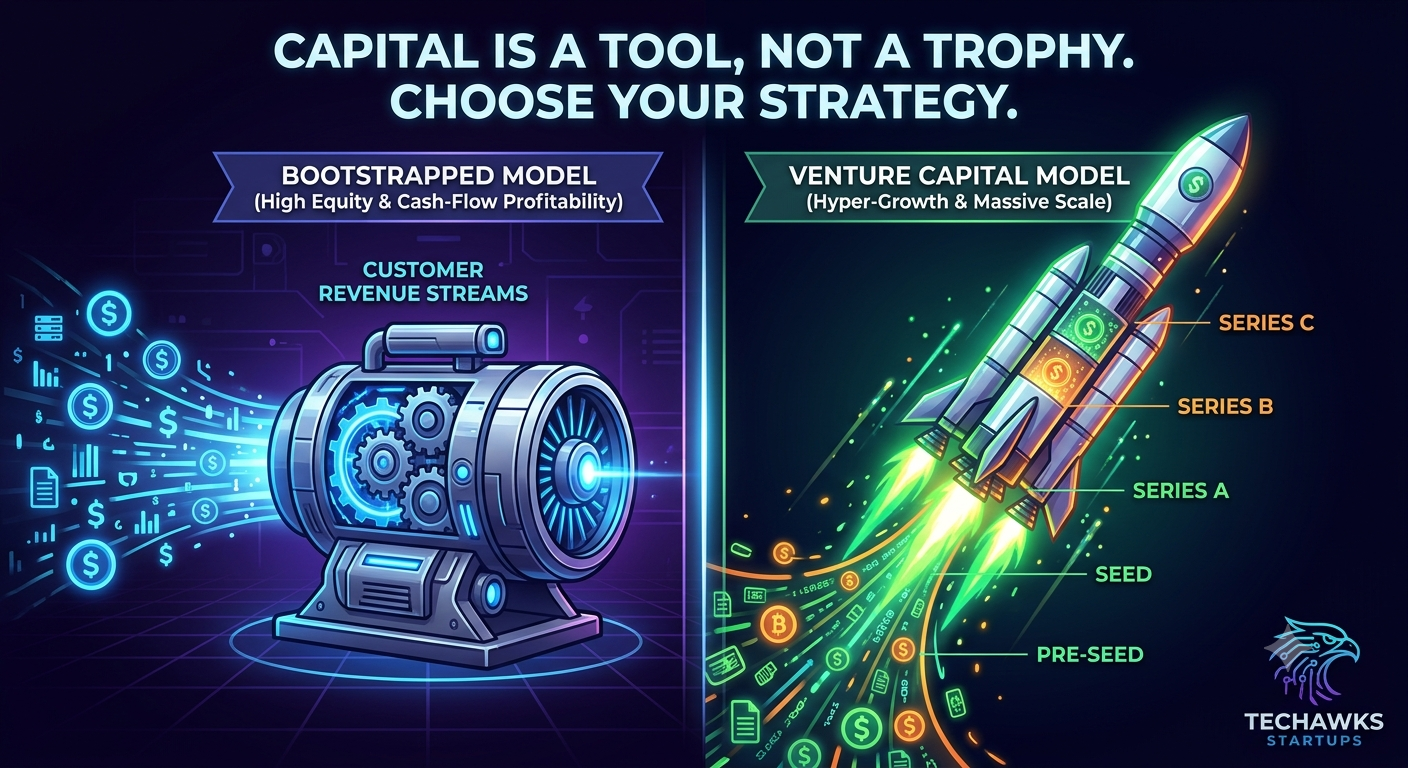
  • Bootstrapping vs. Venture Capital: How to Choose the Right Capital Strategy for Your Startup
    Venture capital is not a badge of honor—it is a specific financial tool designed for high-risk, hyper-growth business models. Choosing between bootstrapping and raising VC fundamentally shapes your company's ownership, growth pace, and ultimate exit options.
    Before signing a term sheet or committing to a pitch deck circuit, run your startup idea through these three strategic filters:


    1. Market Size & Addressable Velocity
    Venture Capital Fit: Your total addressable market (TAM) is in the billions, and winner-take-most network dynamics demand rapid customer acquisition before competitors lock in market share.
    Bootstrapping Fit: Your market is specialized or niche, allowing for profitable cash-flow operations without requiring multi-million-dollar land-grab marketing budgets.


    2. Unit Economics and Margin Structure
    Venture Capital Fit: High upfront engineering and R&D costs require heavy capital injection before reaching operational breakeven (e.g., deep tech, hardware, complex enterprise software).
    Bootstrapping Fit: High gross margins and short sales cycles allow customer revenue to directly fund product development, hiring, and day-to-day operations from month one.


    3. Founder Alignment and Exit Realities
    Venture Capital Fit: You are comfortable trading equity and control for aggressive growth, targeting a large-scale M&A or IPO exit within a 7- to 10-year window.
    Bootstrapping Fit: You value long-term equity control, profit distribution, operational flexibility, and building a sustainable business on your own timeline.


    Actionable Advice for Early-Stage Founders
    Treat fundraising as an deliberate architectural choice, not a default milestone. Build your Minimum Viable Product (MVP) using lean, bootstrapped principles first. Proving customer demand and unit economics with real revenue gives you maximum leverage—whether you choose to remain self-funded or pitch investors from a position of strength.


    Key Takeaways
    VC is a Speed Engine: Raising capital is about accelerating speed-to-market in massive, winner-take-all sectors—not validating whether an idea works.
    Bootstrapping Retains Control: Self-funding aligns growth with real profitability, keeping founders in full command of company direction and equity.
    Prove Leverage First: Focus on achieving cash-flow efficiency and customer acquisition before deciding on capital strategy.


    CTA
    Did you bootstrap your startup or choose the venture capital route? Join Startup Founders & Entrepreneurs to debate funding models, benchmark financial metrics, and trade strategies with fellow founders.
    Bootstrapping vs. Venture Capital: How to Choose the Right Capital Strategy for Your Startup Venture capital is not a badge of honor—it is a specific financial tool designed for high-risk, hyper-growth business models. Choosing between bootstrapping and raising VC fundamentally shapes your company's ownership, growth pace, and ultimate exit options. Before signing a term sheet or committing to a pitch deck circuit, run your startup idea through these three strategic filters: 1. Market Size & Addressable Velocity Venture Capital Fit: Your total addressable market (TAM) is in the billions, and winner-take-most network dynamics demand rapid customer acquisition before competitors lock in market share. Bootstrapping Fit: Your market is specialized or niche, allowing for profitable cash-flow operations without requiring multi-million-dollar land-grab marketing budgets. 2. Unit Economics and Margin Structure Venture Capital Fit: High upfront engineering and R&D costs require heavy capital injection before reaching operational breakeven (e.g., deep tech, hardware, complex enterprise software). Bootstrapping Fit: High gross margins and short sales cycles allow customer revenue to directly fund product development, hiring, and day-to-day operations from month one. 3. Founder Alignment and Exit Realities Venture Capital Fit: You are comfortable trading equity and control for aggressive growth, targeting a large-scale M&A or IPO exit within a 7- to 10-year window. Bootstrapping Fit: You value long-term equity control, profit distribution, operational flexibility, and building a sustainable business on your own timeline. Actionable Advice for Early-Stage Founders Treat fundraising as an deliberate architectural choice, not a default milestone. Build your Minimum Viable Product (MVP) using lean, bootstrapped principles first. Proving customer demand and unit economics with real revenue gives you maximum leverage—whether you choose to remain self-funded or pitch investors from a position of strength. Key Takeaways VC is a Speed Engine: Raising capital is about accelerating speed-to-market in massive, winner-take-all sectors—not validating whether an idea works. Bootstrapping Retains Control: Self-funding aligns growth with real profitability, keeping founders in full command of company direction and equity. Prove Leverage First: Focus on achieving cash-flow efficiency and customer acquisition before deciding on capital strategy. CTA Did you bootstrap your startup or choose the venture capital route? Join Startup Founders & Entrepreneurs to debate funding models, benchmark financial metrics, and trade strategies with fellow founders.
    0 Commentarii 0 Distribuiri 2K Views 0 previzualizare
  • How to Run Customer Discovery Interviews That Reveal True Market Demand: A Step-by-Step Guide
    Customer discovery is the most critical phase of early-stage startup validation. However, most founders fall into the trap of pitching their solution during user interviews, receiving polite encouragement that rarely translates into actual sales.


    Follow this step-by-step tutorial based on practical customer discovery principles to extract honest feedback and validate real market pain points:


    Step 1: Define Your Target Problem Hypothesis
    Before reaching out to interviewees, document the exact pain point you believe exists:
    Target Profile: Who specifically experiences this problem? (e.g., "Engineering Managers at 20-50 person startups")
    Core Problem: What obstacle or inefficiency is costing them time or money?
    Current Workaround: How are they solving it today?


    Step 2: Source Unbiased Interview Candidates
    Avoid asking friends, family, or personal advocates who might give polite responses.
    Reach out via cold LinkedIn messages or niche developer/industry communities.
    Frame your request around learning about their daily workflow, not pitching a product: "I’m researching challenges in CI/CD pipeline bottlenecks for mid-sized tech teams and would love 15 minutes to learn about your current workflow."


    Step 3: Ask Backward-Looking Questions
    Never ask hypothetical questions like "Would you pay $50/month for a tool that solves X?" People are notoriously bad at predicting their future buying behavior. Instead, ask about specific past experiences:
    "Tell me about the last time you ran into [Problem]?" (Verifies if the problem occurs frequently)
    "What made that situation frustrating or expensive?" (Measures pain severity)
    "What tools or workarounds did you use to solve it?" (Proves existing budget or active effort)
    "What didn't you like about those workarounds?" (Identifies product differentiation opportunities)


    Step 4: Quantify the Pain and Financial Impact
    Ask follow-up questions to understand the real cost of the problem:
    How many hours per week does your team spend on this workaround?
    Has this issue ever caused lost revenue, missed deadlines, or security incidents?
    If they haven't actively tried to find a solution, the pain is not severe enough to build a startup around.


    Step 5: Pivot or Validate Based on Signal, Not Compliments
    Log your interview responses in a structured spreadsheet. Look for strong buying signals:
    Strong Signal: The user complains bitterly about past experiences, shows you messy workarounds, or asks when your solution will be ready.
    Weak Signal: The user says "That sounds like a great idea!" but has never spent time or money trying to fix the issue.


    Key Takeaways
    Ask About the Past: Focus questions strictly on historical behavior and past expenditures, not future predictions.
    Search for Active Workarounds: If users aren't already spending time or money trying to fix the problem, they won't buy your product.
    Listen 80%, Talk 20%: Keep your pitch out of customer discovery calls; your only job is to extract raw market reality.


    CTA
    Struggling to validate your startup idea or get real response rates on user interviews? Join Startup Founders & Entrepreneurs to practice mock interviews, refine your customer discovery scripts, and connect with fellow early-stage founders.
    How to Run Customer Discovery Interviews That Reveal True Market Demand: A Step-by-Step Guide Customer discovery is the most critical phase of early-stage startup validation. However, most founders fall into the trap of pitching their solution during user interviews, receiving polite encouragement that rarely translates into actual sales. Follow this step-by-step tutorial based on practical customer discovery principles to extract honest feedback and validate real market pain points: Step 1: Define Your Target Problem Hypothesis Before reaching out to interviewees, document the exact pain point you believe exists: Target Profile: Who specifically experiences this problem? (e.g., "Engineering Managers at 20-50 person startups") Core Problem: What obstacle or inefficiency is costing them time or money? Current Workaround: How are they solving it today? Step 2: Source Unbiased Interview Candidates Avoid asking friends, family, or personal advocates who might give polite responses. Reach out via cold LinkedIn messages or niche developer/industry communities. Frame your request around learning about their daily workflow, not pitching a product: "I’m researching challenges in CI/CD pipeline bottlenecks for mid-sized tech teams and would love 15 minutes to learn about your current workflow." Step 3: Ask Backward-Looking Questions Never ask hypothetical questions like "Would you pay $50/month for a tool that solves X?" People are notoriously bad at predicting their future buying behavior. Instead, ask about specific past experiences: "Tell me about the last time you ran into [Problem]?" (Verifies if the problem occurs frequently) "What made that situation frustrating or expensive?" (Measures pain severity) "What tools or workarounds did you use to solve it?" (Proves existing budget or active effort) "What didn't you like about those workarounds?" (Identifies product differentiation opportunities) Step 4: Quantify the Pain and Financial Impact Ask follow-up questions to understand the real cost of the problem: How many hours per week does your team spend on this workaround? Has this issue ever caused lost revenue, missed deadlines, or security incidents? If they haven't actively tried to find a solution, the pain is not severe enough to build a startup around. Step 5: Pivot or Validate Based on Signal, Not Compliments Log your interview responses in a structured spreadsheet. Look for strong buying signals: Strong Signal: The user complains bitterly about past experiences, shows you messy workarounds, or asks when your solution will be ready. Weak Signal: The user says "That sounds like a great idea!" but has never spent time or money trying to fix the issue. Key Takeaways Ask About the Past: Focus questions strictly on historical behavior and past expenditures, not future predictions. Search for Active Workarounds: If users aren't already spending time or money trying to fix the problem, they won't buy your product. Listen 80%, Talk 20%: Keep your pitch out of customer discovery calls; your only job is to extract raw market reality. CTA Struggling to validate your startup idea or get real response rates on user interviews? Join Startup Founders & Entrepreneurs to practice mock interviews, refine your customer discovery scripts, and connect with fellow early-stage founders.
    0 Commentarii 0 Distribuiri 2K Views 0 previzualizare
  • The Pre-Seed Pitch Deck Checklist: 10 Slides Every Founder Needs Before Meeting VCs
    At the pre-seed stage, investors aren't buying a finished product—they are betting on a compelling market opportunity, an unfair team advantage, and high-velocity execution. To maximize your chances of securing a check, structure your pitch deck using this battle-tested 10-slide framework.


    Work through this checklist to audit your deck before sending it out or scheduling pitch calls:


    Phase 1: Problem & Vision
    1. Title & One-Liner Slide: Clearly state your startup's name and a memorable 10-word value proposition (e.g., "Stripe for cross-border logistics"). Avoid jargon.
    2. The Problem Slide: Detail a severe, recurring pain point experienced by a specific customer segment. Frame it around quantifiable friction: wasted time, high costs, or lost revenue.
    3. The Solution & Value Proposition Slide: Show (don't just tell) how your product solves this problem uniquely. Highlight the core benefit and 2–3 key features max.


    Phase 2: Market & Business Model
    4. Total Addressable Market (TAM) Slide: Use a bottom-up calculation to show your TAM, Serviceable Addressable Market (SAM), and initial Target Market. Prove the market is large enough to support a billion-dollar outcome.
    5. Business Model Slide: Explain clearly how you make money (e.g., SaaS subscription, transaction fee, marketplace take-rate) and your target pricing structure.
    6. Unfair Advantage & Defensability Slide: Identify why established incumbents can't easily copy you (e.g., proprietary algorithms, network effects, strategic partnerships, or deep regulatory moats).


    Phase 3: Execution & Financials
    7. Traction & Velocity Slide: Highlight your most impressive quantitative metrics (e.g., MoM revenue growth, pilot programs, waitlist numbers, retention rates, or key letter of intent agreements).
    8. Go-To-Market (GTM) Strategy Slide: Outline your primary acquisition channels and repeatable strategy for acquiring your first 1,000 paid users or enterprise accounts.
    9. The Team Slide: Showcase why your founding team is uniquely qualified to build this specific startup. Highlight past domain expertise, technical accomplishments, or prior exit experience.
    10. The Ask & Use of Funds Slide: State the exact capital amount you are raising and break down how it will be spent across key milestones over the next 18–24 months (e.g., engineering hires, customer acquisition, regulatory licensing).


    Key Takeaways
    Keep It Concise: Stick to 10–12 slides max; pre-seed decks should take no longer than 3–4 minutes to read through.
    Lead with Bottom-Up TAM: Top-down market calculations look lazy to experienced VCs—always calculate market size based on target customer count multiplied by annual contract value.
    Focus on Milestones, Not Just Runway: Frame your capital ask around reaching specific growth metrics that enable your next valuation milestone.


    CTA
    Preparing to fundraise your pre-seed or seed round? Join Startup Founders & Entrepreneurs to get deck reviews, benchmark term sheets, and practice your pitch with active founders and angel investors.
    The Pre-Seed Pitch Deck Checklist: 10 Slides Every Founder Needs Before Meeting VCs At the pre-seed stage, investors aren't buying a finished product—they are betting on a compelling market opportunity, an unfair team advantage, and high-velocity execution. To maximize your chances of securing a check, structure your pitch deck using this battle-tested 10-slide framework. Work through this checklist to audit your deck before sending it out or scheduling pitch calls: Phase 1: Problem & Vision 1. Title & One-Liner Slide: Clearly state your startup's name and a memorable 10-word value proposition (e.g., "Stripe for cross-border logistics"). Avoid jargon. 2. The Problem Slide: Detail a severe, recurring pain point experienced by a specific customer segment. Frame it around quantifiable friction: wasted time, high costs, or lost revenue. 3. The Solution & Value Proposition Slide: Show (don't just tell) how your product solves this problem uniquely. Highlight the core benefit and 2–3 key features max. Phase 2: Market & Business Model 4. Total Addressable Market (TAM) Slide: Use a bottom-up calculation to show your TAM, Serviceable Addressable Market (SAM), and initial Target Market. Prove the market is large enough to support a billion-dollar outcome. 5. Business Model Slide: Explain clearly how you make money (e.g., SaaS subscription, transaction fee, marketplace take-rate) and your target pricing structure. 6. Unfair Advantage & Defensability Slide: Identify why established incumbents can't easily copy you (e.g., proprietary algorithms, network effects, strategic partnerships, or deep regulatory moats). Phase 3: Execution & Financials 7. Traction & Velocity Slide: Highlight your most impressive quantitative metrics (e.g., MoM revenue growth, pilot programs, waitlist numbers, retention rates, or key letter of intent agreements). 8. Go-To-Market (GTM) Strategy Slide: Outline your primary acquisition channels and repeatable strategy for acquiring your first 1,000 paid users or enterprise accounts. 9. The Team Slide: Showcase why your founding team is uniquely qualified to build this specific startup. Highlight past domain expertise, technical accomplishments, or prior exit experience. 10. The Ask & Use of Funds Slide: State the exact capital amount you are raising and break down how it will be spent across key milestones over the next 18–24 months (e.g., engineering hires, customer acquisition, regulatory licensing). Key Takeaways Keep It Concise: Stick to 10–12 slides max; pre-seed decks should take no longer than 3–4 minutes to read through. Lead with Bottom-Up TAM: Top-down market calculations look lazy to experienced VCs—always calculate market size based on target customer count multiplied by annual contract value. Focus on Milestones, Not Just Runway: Frame your capital ask around reaching specific growth metrics that enable your next valuation milestone. CTA Preparing to fundraise your pre-seed or seed round? Join Startup Founders & Entrepreneurs to get deck reviews, benchmark term sheets, and practice your pitch with active founders and angel investors.
    0 Commentarii 0 Distribuiri 1K Views 0 previzualizare
  • How Data Structures and Algorithms Actually Apply to Real-World Software Engineering
    When you study DSA for class exams or coding challenges, problems feel abstract—reversing linked lists or balancing trees in a controlled environment. However, when software engineers build scalable web apps, mobile services, or data pipelines, these concepts dictate how fast a system runs and how much server memory it consumes.Here is how foundational data structures map directly to real-world engineering challenges


    1. Hash Tables (Objects / Dictionaries) vs. Arrays
    The Academic View: Searching an array takes $O(n)$ time, while a Hash Table offers $O(1)$ constant time lookup on average.
    The Production Reality: Imagine building a user authentication middleware that runs on every API request. If you store session tokens in an Array, every API call requires scanning through every active user—slowing down the app as users grow. Using a Hash Map or Redis key-value store guarantees instant authorization checks regardless of user count.


    2. Queues in Asynchronous Background Processing
    The Academic View: A First-In, First-Out (FIFO) queue buffers data elements for sequential processing.
    The Production Reality: When a user signs up or uploads a video on a platform, processing tasks (like rendering thumbnails or sending welcome emails) shouldn't block the UI. Engineering teams send these tasks to background message queues (e.g., RabbitMQ, Kafka, or AWS SQS). The application responds instantly, while worker processes pull tasks from the queue in order.


    3. Graphs in Recommendation Systems & Social Networks
    The Academic View: Graphs consist of nodes (vertices) connected by edges, traversed using Breadth-First Search (BFS) or Depth-First Search (DFS).
    The Production Reality: Social networks like LinkedIn or Instagram rely on graph databases. Users are nodes, and connections or friendships are edges. Finding "mutual connections" or "people you may know" uses BFS traversal algorithms to discover degree-of-separation paths efficiently across millions of users.


    4. Trees in Database Indexing
    The Academic View: Binary Search Trees and B-Trees keep data sorted for logarithmic search time ($O(\log n)$).
    The Production Reality: Relational databases like PostgreSQL and MySQL use B-Trees to build indexes on columns. Searching through millions of database rows without an index requires a slow full-table scan; an indexed search pinpoints data in milliseconds.How to Shift Your Study ApproachInstead of just memorizing syntax for coding tests, ask yourself: "Where in a modern web application would this data structure save server memory or reduce latency?" Linking abstract theory to system behavior is what separates top CS students from industry-ready software engineers.


    Key Takeaways
    Algorithms Impact Performance: DSA concepts govern system responsiveness, database speed, and hosting costs in real applications.Select for Scalability: Choosing an $O(1)$ lookup or an $O(\log n)$ search structure prevents server slowdowns when user traffic scales.Connect Theory to Architecture: Understanding background queues, indexing trees, and graph traversal makes complex software design intuitive.


    CTA
    Want to bridge the gap between computer science coursework and building real-world software? Join Students in Tech to access project guides, join peer coding sessions, and connect with senior engineers who can mentor your journey.
    How Data Structures and Algorithms Actually Apply to Real-World Software Engineering When you study DSA for class exams or coding challenges, problems feel abstract—reversing linked lists or balancing trees in a controlled environment. However, when software engineers build scalable web apps, mobile services, or data pipelines, these concepts dictate how fast a system runs and how much server memory it consumes.Here is how foundational data structures map directly to real-world engineering challenges 1. Hash Tables (Objects / Dictionaries) vs. Arrays The Academic View: Searching an array takes $O(n)$ time, while a Hash Table offers $O(1)$ constant time lookup on average. The Production Reality: Imagine building a user authentication middleware that runs on every API request. If you store session tokens in an Array, every API call requires scanning through every active user—slowing down the app as users grow. Using a Hash Map or Redis key-value store guarantees instant authorization checks regardless of user count. 2. Queues in Asynchronous Background Processing The Academic View: A First-In, First-Out (FIFO) queue buffers data elements for sequential processing. The Production Reality: When a user signs up or uploads a video on a platform, processing tasks (like rendering thumbnails or sending welcome emails) shouldn't block the UI. Engineering teams send these tasks to background message queues (e.g., RabbitMQ, Kafka, or AWS SQS). The application responds instantly, while worker processes pull tasks from the queue in order. 3. Graphs in Recommendation Systems & Social Networks The Academic View: Graphs consist of nodes (vertices) connected by edges, traversed using Breadth-First Search (BFS) or Depth-First Search (DFS). The Production Reality: Social networks like LinkedIn or Instagram rely on graph databases. Users are nodes, and connections or friendships are edges. Finding "mutual connections" or "people you may know" uses BFS traversal algorithms to discover degree-of-separation paths efficiently across millions of users. 4. Trees in Database Indexing The Academic View: Binary Search Trees and B-Trees keep data sorted for logarithmic search time ($O(\log n)$). The Production Reality: Relational databases like PostgreSQL and MySQL use B-Trees to build indexes on columns. Searching through millions of database rows without an index requires a slow full-table scan; an indexed search pinpoints data in milliseconds.How to Shift Your Study ApproachInstead of just memorizing syntax for coding tests, ask yourself: "Where in a modern web application would this data structure save server memory or reduce latency?" Linking abstract theory to system behavior is what separates top CS students from industry-ready software engineers. Key Takeaways Algorithms Impact Performance: DSA concepts govern system responsiveness, database speed, and hosting costs in real applications.Select for Scalability: Choosing an $O(1)$ lookup or an $O(\log n)$ search structure prevents server slowdowns when user traffic scales.Connect Theory to Architecture: Understanding background queues, indexing trees, and graph traversal makes complex software design intuitive. CTA Want to bridge the gap between computer science coursework and building real-world software? Join Students in Tech to access project guides, join peer coding sessions, and connect with senior engineers who can mentor your journey.
    0 Commentarii 0 Distribuiri 2K Views 0 previzualizare
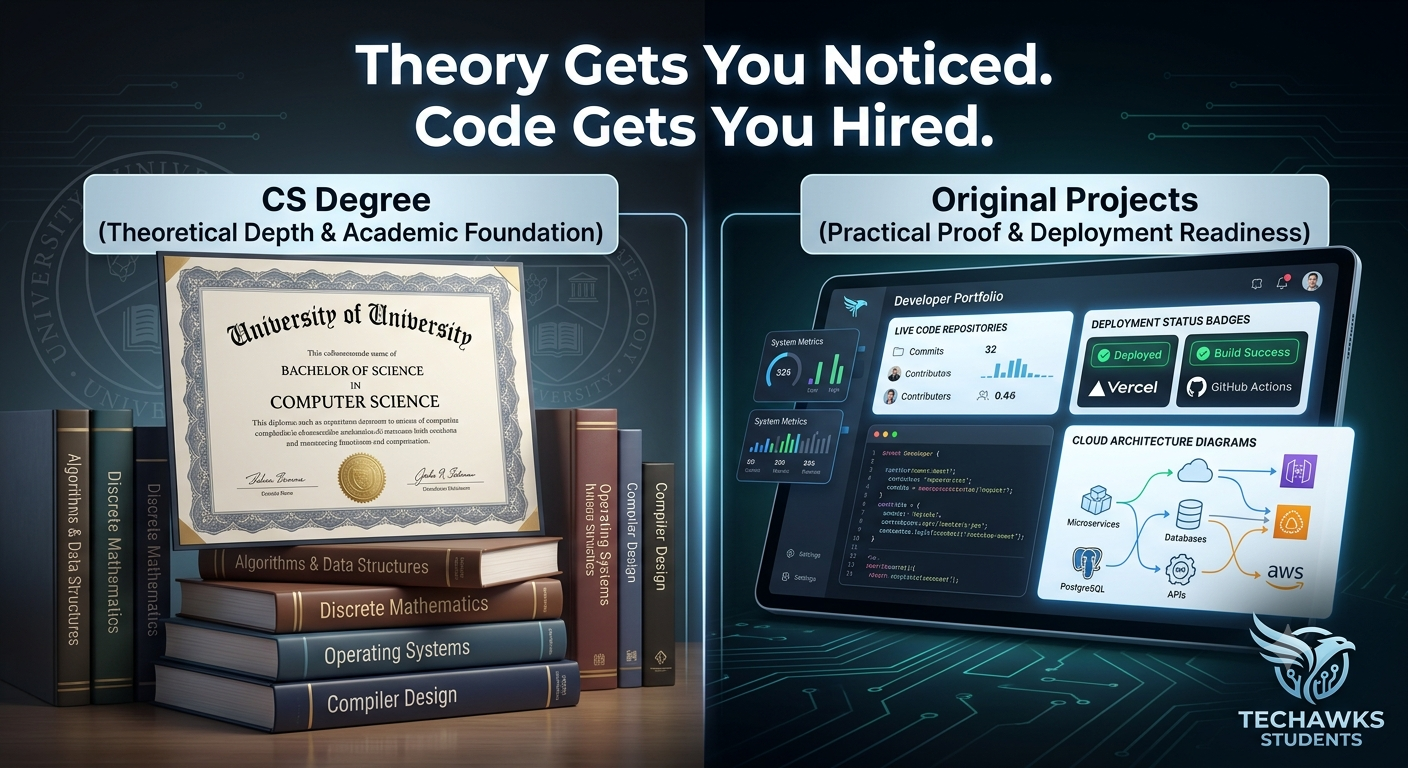
  • Degree vs. Projects: What Actually Lands Your First Tech Role?
    The debate between prioritizing formal academic coursework versus spending time building personal projects is a constant source of anxiety for tech students. To maximize your employability before graduation, you need to understand how recruiters and engineering leads evaluate both assets.


    Here is how degree credentials and real-world projects actually compare when launching your tech career:
    1. The Computer Science Degree: The Foundation & Filtering Mechanism
    A CS degree provides deep, structured exposure to underlying engineering concepts like operating systems, computer architecture, networking, and discrete mathematics.
    Where It Helps: Passing automated applicant tracking systems (ATS), meeting baseline requirements for large enterprise companies, and providing long-term conceptual depth for complex system engineering.
    Where It Falls Short: Academic curricula often lag behind modern industry toolchains, meaning a CS degree alone rarely proves you can ship production code using current frameworks, CI/CD pipelines, or cloud services.


    2. Portfolio Projects: Proof of Execution & Practical Value
    Building original, deployed applications demonstrates immediate capability to hiring managers.
    Where It Helps: Differentiating your resume from thousands of applicants, proving you can write clean, maintainable code, and providing concrete talking points for technical interviews.
    Where It Falls Short: Copying basic tutorial projects (like simple to-do list apps) offers zero competitive advantage. Projects must solve real problems, feature deployment pipelines, and demonstrate code quality.


    Actionable Advice for Balancing Both
    Don't choose one at the expense of the other—use them synergistically:
    Target the Intersection: Use class assignments as opportunities to build non-trivial, deployed projects instead of doing the bare minimum to pass.
    Focus on Depth Over Quantity: Two polished, fully deployed applications with working live demos, architecture diagrams, and comprehensive READMEs matter significantly more than ten incomplete tutorial repositories.
    Highlight Problem-Solving: Frame your portfolio projects around trade-offs you made (e.g., database choices, state management strategies) rather than just listing tech stack keywords.


    Key Takeaways
    Degrees Get You Screened, Projects Get You Hired: A degree validates your theoretical foundation, but real-world projects prove you can deliver value on day one.
    Quality Over Quantity: Recruiters evaluate candidate portfolios based on depth, documentation, and live deployments—not raw repo counts.
    Combine Theory with Modern Tools: Use your academic understanding of algorithms and systems to build well-architected applications with modern frameworks.


    CTA
    How are you balancing class assignments with personal side projects this semester? Join Students in Tech to share your project repositories, get feedback on your portfolio, and engage in technical discussions with fellow students and senior developers.
    Degree vs. Projects: What Actually Lands Your First Tech Role? The debate between prioritizing formal academic coursework versus spending time building personal projects is a constant source of anxiety for tech students. To maximize your employability before graduation, you need to understand how recruiters and engineering leads evaluate both assets. Here is how degree credentials and real-world projects actually compare when launching your tech career: 1. The Computer Science Degree: The Foundation & Filtering Mechanism A CS degree provides deep, structured exposure to underlying engineering concepts like operating systems, computer architecture, networking, and discrete mathematics. Where It Helps: Passing automated applicant tracking systems (ATS), meeting baseline requirements for large enterprise companies, and providing long-term conceptual depth for complex system engineering. Where It Falls Short: Academic curricula often lag behind modern industry toolchains, meaning a CS degree alone rarely proves you can ship production code using current frameworks, CI/CD pipelines, or cloud services. 2. Portfolio Projects: Proof of Execution & Practical Value Building original, deployed applications demonstrates immediate capability to hiring managers. Where It Helps: Differentiating your resume from thousands of applicants, proving you can write clean, maintainable code, and providing concrete talking points for technical interviews. Where It Falls Short: Copying basic tutorial projects (like simple to-do list apps) offers zero competitive advantage. Projects must solve real problems, feature deployment pipelines, and demonstrate code quality. Actionable Advice for Balancing Both Don't choose one at the expense of the other—use them synergistically: Target the Intersection: Use class assignments as opportunities to build non-trivial, deployed projects instead of doing the bare minimum to pass. Focus on Depth Over Quantity: Two polished, fully deployed applications with working live demos, architecture diagrams, and comprehensive READMEs matter significantly more than ten incomplete tutorial repositories. Highlight Problem-Solving: Frame your portfolio projects around trade-offs you made (e.g., database choices, state management strategies) rather than just listing tech stack keywords. Key Takeaways Degrees Get You Screened, Projects Get You Hired: A degree validates your theoretical foundation, but real-world projects prove you can deliver value on day one. Quality Over Quantity: Recruiters evaluate candidate portfolios based on depth, documentation, and live deployments—not raw repo counts. Combine Theory with Modern Tools: Use your academic understanding of algorithms and systems to build well-architected applications with modern frameworks. CTA How are you balancing class assignments with personal side projects this semester? Join Students in Tech to share your project repositories, get feedback on your portfolio, and engage in technical discussions with fellow students and senior developers.
    0 Commentarii 0 Distribuiri 1K Views 0 previzualizare