




Techawks India is the official Techawks community connecting students, developers, founders, professionals, creators, and technology enthusiasts from across India. Stay updated with the latest in artificial intelligence, software development, cybersecurity, cloud computing, data science, startups, and emerging technologies.
Discover practical tutorials, industry news, hackathons, open-source projects, networking opportunities, job updates, events, product launches, and expert discussions. Learn new skills, collaborate on innovative ideas, showcase your work, and grow with one of India's technology-focused communities.
Discover practical tutorials, industry news, hackathons, open-source projects, networking opportunities, job updates, events, product launches, and expert discussions. Learn new skills, collaborate on innovative ideas, showcase your work, and grow with one of India's technology-focused communities.
-
مجموعة عامة
-
99 المنشورات
-
99 الصور
-
0 الفيديوهات
-
معاينة
-
People and Nations
البحث

 English
 French
 Spanish
 Portuguese
 Deutsch
 Turkish
 Dutch
 Italiano
 Russian
 Romaian
 Portuguese (Brazil)
 Greek
التحديثات الأخيرة
-
Beyond Global Models: Why 'Hinglish' RAG is the New Gold Standard for Indian Enterprise AI
Stop trying to force your internal enterprise data into English-only vector databases if your users communicate in Hinglish. When a customer asks, "Order kab deliver hoga? Mera mood kharab ho raha hai," a standard GPT-4 or Llama 3 RAG pipeline might retrieve the correct delivery status, but it completely misses the urgency sentiment because it treats the Hindi and English tokens as noise rather than semantic context.
Why this matters in India:
Semantic Fidelity: In Indian enterprise contexts, critical information (intent, sentiment, entities) is often embedded in the non-English code-switched words.
The User Experience Gap: Customers using voice or chat interfaces expect AI to understand them naturally. If the AI replies only in formal English to a colloquial Hinglish query, trust plummets.
Reducing Hallucination: When models don't understand the query language mix, they are far more likely to hallucinate irrelevant answers from your knowledge base.
How to fix it (Teach Something Useful):
Don't just rely on base models. You must adapt your RAG stack for the Indian linguistic landscape:
Indic-Aware Embedding Models: Use embedding models specifically fine-tuned for Indian languages and code-switching (e.g., models from the AI4Bharat initiative or specific Indic variants on Hugging Face) to build your vector index.
Preprocessing Pipelines: Implement robust normalization that treats Hinglish input not as an error, but as a distinct input profile. This might involve transliteration or specialized tokenization.
Prompt Engineering for Context: Your system prompts must explicitly instruct the model to recognize and respond to the detected language mix, maintaining the tone (e.g., professional Hinglish) of the user query.
Discussion Question
Are your current RAG implementations struggling with Indian language queries or code-mixing? What specific strategies (e.g., custom embeddings, specialized models) have you tested to improve semantic retrieval for Hinglish?
CTA (Join Techawks India)
Want to dive deeper into the practical challenges of building localized AI for India? Connect with fellow senior engineers and architects in the Techawks India group to share real-world benchmarks and solutions. [Link to Techawks India Group]Beyond Global Models: Why 'Hinglish' RAG is the New Gold Standard for Indian Enterprise AI Stop trying to force your internal enterprise data into English-only vector databases if your users communicate in Hinglish. When a customer asks, "Order kab deliver hoga? Mera mood kharab ho raha hai," a standard GPT-4 or Llama 3 RAG pipeline might retrieve the correct delivery status, but it completely misses the urgency sentiment because it treats the Hindi and English tokens as noise rather than semantic context. Why this matters in India: Semantic Fidelity: In Indian enterprise contexts, critical information (intent, sentiment, entities) is often embedded in the non-English code-switched words. The User Experience Gap: Customers using voice or chat interfaces expect AI to understand them naturally. If the AI replies only in formal English to a colloquial Hinglish query, trust plummets. Reducing Hallucination: When models don't understand the query language mix, they are far more likely to hallucinate irrelevant answers from your knowledge base. How to fix it (Teach Something Useful): Don't just rely on base models. You must adapt your RAG stack for the Indian linguistic landscape: Indic-Aware Embedding Models: Use embedding models specifically fine-tuned for Indian languages and code-switching (e.g., models from the AI4Bharat initiative or specific Indic variants on Hugging Face) to build your vector index. Preprocessing Pipelines: Implement robust normalization that treats Hinglish input not as an error, but as a distinct input profile. This might involve transliteration or specialized tokenization. Prompt Engineering for Context: Your system prompts must explicitly instruct the model to recognize and respond to the detected language mix, maintaining the tone (e.g., professional Hinglish) of the user query. Discussion Question Are your current RAG implementations struggling with Indian language queries or code-mixing? What specific strategies (e.g., custom embeddings, specialized models) have you tested to improve semantic retrieval for Hinglish? CTA (Join Techawks India) Want to dive deeper into the practical challenges of building localized AI for India? Connect with fellow senior engineers and architects in the Techawks India group to share real-world benchmarks and solutions. [Link to Techawks India Group] 0 التعليقات 0 المشاركات 2 مشاهدة 0 معاينة
-
Stop Chasing Mass Framework Certifications: Why GCC Platforms in India Are Reshaping the 2026 Tech Hiring Barbell
For over a decade, early-career engineers and career changers across India’s major hubs—including Bengaluru, Hyderabad, Delhi NCR, and Pune—relied on a predictable playbook: collect certifications, complete visual tutorial projects, and apply to mass entry-level service openings (1.2.11).
However, late 2026 industry insights reveal a massive market shift (1.2.12). High-volume, junior boilerplate roles have compressed, while seniors, platform engineers, and specialists with strong systems visibility now command the highest market demand (1.1.12). India’s thriving Global Capability Centers (GCCs) have transitioned from outsourcing cost-effective tasks to driving core product and infrastructure ownership (1.1.10).
When you apply with generic, copy-pasted portfolio code, you're trying to compete with automated tools that can generate error-free code in seconds. Enterprise teams aren’t look for code typists; they need highly capable verification gatekeepers who can troubleshoot, trace failure paths, and run systems (1.1.10, 1.1.12).
Plaintext
[Legacy Pattern: The Mass Saturated Application Funnel]
Applicant Profile ---> Multiple Certifications ---> Generative Boilerplate Portfolio ---> Automated Sifting
|
+---> ❌ Single-commit GitHub projects with no tests.
+---> ❌ Resume packed with disparate keywords.
+---> ❌ Result: Stalled in flooded queues with little feedback.
[Resilient Pattern: Evidence-Based Architectural Ownership]
Applicant Portfolio ---> Scoped Enterprise & Tool Problems Resolved
|
├── GitHub workflows with test suites and CI pipelines
├── Fault Isolation: Post-mortems of connection drops & memory drift
└── Visual ADRs: Design trade-offs (AWS/Kubernetes/OS) documented
|
v
Direct Engineering Referral (Access to Premium GCC Hub Openings)
To set yourself apart in this competitive environment, you need to prove you can keep complex, distributed systems up, optimized, and running.
4 Habits That Signal Real Production Judgment
Move Past "Happ-Path" Code: Don't assume the network is always stable and inputs are always correct. Build robust validation, design exponential backoff with jitter for failures, and deploy circuit breakers (like Envoy or Resilience4j) to prevent cascading outages (1.4.11).
Build Hands-On CI/CD Pipelines: Don't stop at making an application run on localhost. Implement automated linting, security scanning, and unit testing via GitHub Actions or similar CI tools. A project that tests and deploys itself proves you're ready for team collaboration.
Capture Telemetry and Profiling: Investigate how your changes impact downstream resources. Familiarize yourself with memory and CPU profiling (e.g., using native language profilers or browser devtools) and understand distributed tracing with OpenTelemetry (1.4.11).
Document Architectural Decisions (ADRs): When showcasing a portfolio project, describe the "why" in your README. Explain why you chose your specific database, how you manage connection pools, and what resource trade-offs you accepted.
Your ability to analyze, secure, and debug systems is what makes you irreplaceable.
Discussion Question
For engineers and job seekers: In your current applications or interview loops with Indian GCCs and tech firms, are you experiencing a shift away from standard algorithmic screenings toward practical troubleshooting, architecture, or code-review audits?
CTA
Ready to look past surface-level tutorials, understand production-grade system lifecycles, and access exclusive mentors in Bengaluru, Hyderabad, and beyond (1.2.11)? Join the Techawks India community today to access architecture teardowns, live mock drills, and direct peer support!Stop Chasing Mass Framework Certifications: Why GCC Platforms in India Are Reshaping the 2026 Tech Hiring Barbell For over a decade, early-career engineers and career changers across India’s major hubs—including Bengaluru, Hyderabad, Delhi NCR, and Pune—relied on a predictable playbook: collect certifications, complete visual tutorial projects, and apply to mass entry-level service openings (1.2.11). However, late 2026 industry insights reveal a massive market shift (1.2.12). High-volume, junior boilerplate roles have compressed, while seniors, platform engineers, and specialists with strong systems visibility now command the highest market demand (1.1.12). India’s thriving Global Capability Centers (GCCs) have transitioned from outsourcing cost-effective tasks to driving core product and infrastructure ownership (1.1.10). When you apply with generic, copy-pasted portfolio code, you're trying to compete with automated tools that can generate error-free code in seconds. Enterprise teams aren’t look for code typists; they need highly capable verification gatekeepers who can troubleshoot, trace failure paths, and run systems (1.1.10, 1.1.12). Plaintext [Legacy Pattern: The Mass Saturated Application Funnel] Applicant Profile ---> Multiple Certifications ---> Generative Boilerplate Portfolio ---> Automated Sifting | +---> ❌ Single-commit GitHub projects with no tests. +---> ❌ Resume packed with disparate keywords. +---> ❌ Result: Stalled in flooded queues with little feedback. [Resilient Pattern: Evidence-Based Architectural Ownership] Applicant Portfolio ---> Scoped Enterprise & Tool Problems Resolved | ├── GitHub workflows with test suites and CI pipelines ├── Fault Isolation: Post-mortems of connection drops & memory drift └── Visual ADRs: Design trade-offs (AWS/Kubernetes/OS) documented | v Direct Engineering Referral (Access to Premium GCC Hub Openings) To set yourself apart in this competitive environment, you need to prove you can keep complex, distributed systems up, optimized, and running. 4 Habits That Signal Real Production Judgment Move Past "Happ-Path" Code: Don't assume the network is always stable and inputs are always correct. Build robust validation, design exponential backoff with jitter for failures, and deploy circuit breakers (like Envoy or Resilience4j) to prevent cascading outages (1.4.11). Build Hands-On CI/CD Pipelines: Don't stop at making an application run on localhost. Implement automated linting, security scanning, and unit testing via GitHub Actions or similar CI tools. A project that tests and deploys itself proves you're ready for team collaboration. Capture Telemetry and Profiling: Investigate how your changes impact downstream resources. Familiarize yourself with memory and CPU profiling (e.g., using native language profilers or browser devtools) and understand distributed tracing with OpenTelemetry (1.4.11). Document Architectural Decisions (ADRs): When showcasing a portfolio project, describe the "why" in your README. Explain why you chose your specific database, how you manage connection pools, and what resource trade-offs you accepted. Your ability to analyze, secure, and debug systems is what makes you irreplaceable. Discussion Question For engineers and job seekers: In your current applications or interview loops with Indian GCCs and tech firms, are you experiencing a shift away from standard algorithmic screenings toward practical troubleshooting, architecture, or code-review audits? CTA Ready to look past surface-level tutorials, understand production-grade system lifecycles, and access exclusive mentors in Bengaluru, Hyderabad, and beyond (1.2.11)? Join the Techawks India community today to access architecture teardowns, live mock drills, and direct peer support! 0 التعليقات 0 المشاركات 4 مشاهدة 0 معاينة
-
Demystifying India’s DPDP Consent Manager Framework: The New Architectural Pillar of Digital Public Infrastructure
India's data privacy landscape has fundamentally transformed from a general discussion into a strictly enforced compliance milestone. Following the phased implementation of the Digital Personal Data Protection (DPDP) Act and its accompanying Rules, the standard for capturing, storing, and accessing user data has shifted from direct peer-to-peer collection to the mandatory Consent Manager Framework.
Just as UPI decoupled financial transactions from proprietary banking apps, India’s Consent Manager ecosystem decouples data authorization from individual platforms.
Under the Act, "consent managers" operate as interoperable, accessible, and reviewable Digital Public Infrastructure (DPI) platforms. They act as fiduciaries on behalf of the user, offering a single interface to manage, withdraw, and track digital footprints across all consumer apps.
How Indian Engineering Teams Must Refactor Their Data Architectures:
API-First Consent Handshakes (Not Static Form Checkboxes):
Scrap hardcoded, checkbox-driven databases. Develop and expose standardized JSON-RPC or REST APIs that interface with registered third-party Consent Managers. When a user logs in, your platform must query, verify, and document active consent tokens programmatically.
Dynamic Consent Revocation Pipelines:
Under DPDP, citizens have the right to withdraw consent as easily as they gave it. If a user revokes permissions through their independent Consent Manager, that decision triggers a real-time webhook back to your system. You must programmatically cascade this "forget" request across all production databases, search indexes, and caching layers.
Immutably Audit-Ready Trails:
Ensure every consent acquisition, boundary modification, and revocation event is logged in a secure, immutable, and time-stamped ledger. Under India's strict data protection framework, failing to provide verifiable proof of precise consent can lead to substantial penalties (up to ₹250 crore).
Building on India's sovereign tech stack is no longer just about optimizing your feature set—it is about ensuring your systems are modular, compliant, and deeply integrated with our DPI standards.
Discussion Question
Indian Tech Community Poll: Where is your engineering team focusing their compliance and architecture efforts to align with the latest DPDP requirements?
Option A: Integrating API gateways with registered third-party Consent Managers & DPI portals
Option B: Re-architecting backends for dynamic, cascading user-data deletion and consent revocation
Option C: Implementing secure, immutable audit logs and data mapping within the database layer
Option D: Auditing and updating our data ingestion practices and user-facing privacy policies
CTA
Join Techawks India! Keep your engineering workflows ahead of the curve as India's tech landscape and Digital Public Infrastructure continue to rapidly evolve. Tap "Follow" or click "Join" to connect with top Indian developers, architects, and product builders, and share in the comments: How is your team currently refactoring its data pipelines to stay compliant?Demystifying India’s DPDP Consent Manager Framework: The New Architectural Pillar of Digital Public Infrastructure India's data privacy landscape has fundamentally transformed from a general discussion into a strictly enforced compliance milestone. Following the phased implementation of the Digital Personal Data Protection (DPDP) Act and its accompanying Rules, the standard for capturing, storing, and accessing user data has shifted from direct peer-to-peer collection to the mandatory Consent Manager Framework. Just as UPI decoupled financial transactions from proprietary banking apps, India’s Consent Manager ecosystem decouples data authorization from individual platforms. Under the Act, "consent managers" operate as interoperable, accessible, and reviewable Digital Public Infrastructure (DPI) platforms. They act as fiduciaries on behalf of the user, offering a single interface to manage, withdraw, and track digital footprints across all consumer apps. How Indian Engineering Teams Must Refactor Their Data Architectures: API-First Consent Handshakes (Not Static Form Checkboxes): Scrap hardcoded, checkbox-driven databases. Develop and expose standardized JSON-RPC or REST APIs that interface with registered third-party Consent Managers. When a user logs in, your platform must query, verify, and document active consent tokens programmatically. Dynamic Consent Revocation Pipelines: Under DPDP, citizens have the right to withdraw consent as easily as they gave it. If a user revokes permissions through their independent Consent Manager, that decision triggers a real-time webhook back to your system. You must programmatically cascade this "forget" request across all production databases, search indexes, and caching layers. Immutably Audit-Ready Trails: Ensure every consent acquisition, boundary modification, and revocation event is logged in a secure, immutable, and time-stamped ledger. Under India's strict data protection framework, failing to provide verifiable proof of precise consent can lead to substantial penalties (up to ₹250 crore). Building on India's sovereign tech stack is no longer just about optimizing your feature set—it is about ensuring your systems are modular, compliant, and deeply integrated with our DPI standards. Discussion Question Indian Tech Community Poll: Where is your engineering team focusing their compliance and architecture efforts to align with the latest DPDP requirements? Option A: Integrating API gateways with registered third-party Consent Managers & DPI portals Option B: Re-architecting backends for dynamic, cascading user-data deletion and consent revocation Option C: Implementing secure, immutable audit logs and data mapping within the database layer Option D: Auditing and updating our data ingestion practices and user-facing privacy policies CTA Join Techawks India! Keep your engineering workflows ahead of the curve as India's tech landscape and Digital Public Infrastructure continue to rapidly evolve. Tap "Follow" or click "Join" to connect with top Indian developers, architects, and product builders, and share in the comments: How is your team currently refactoring its data pipelines to stay compliant?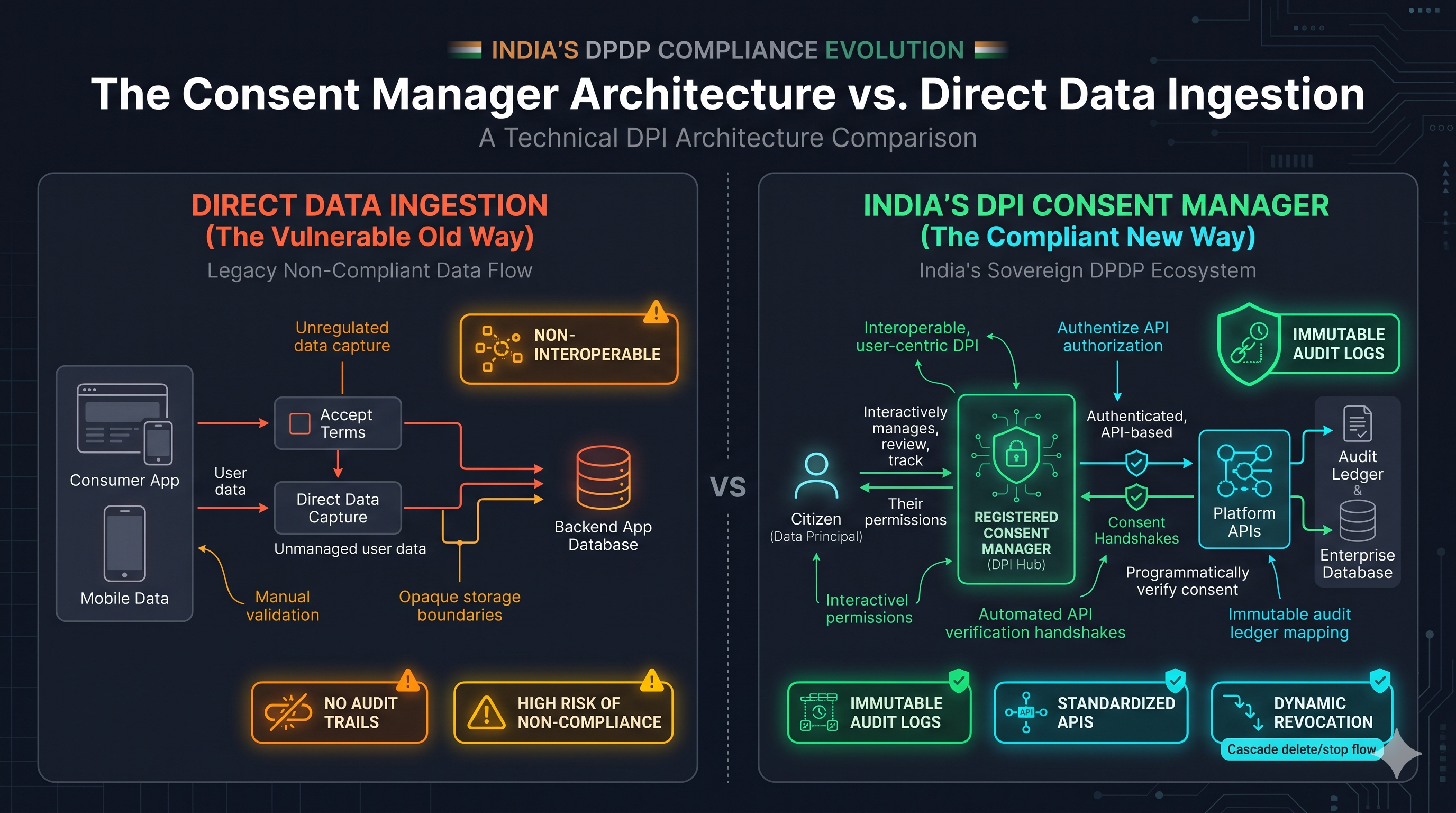 0 التعليقات 0 المشاركات 22 مشاهدة 0 معاينة
-
Architecting for India's DPDP Act: Why Your Consent Layer Can't Just Be an Afterthought in a Modal
As India solidifies its compliance roadmap for the DPDP Act alongside sectoral mandates (RBI payment localization, SEBI frameworks, and UIDAI data vaults), engineering orgs across Bengaluru, Hyderabad, Pune, and NCR are facing a major architectural overhaul.
Consent under DPDP must be free, specific, informed, unconditional, and unambiguously revocable with an easy withdrawal mechanism. For developers building high-throughput consumer tech, fintech, or SaaS platforms, this makes treating user consent as a static boolean flag (is_consented: true) in your SQL users table completely obsolete.
Here is how systems architects are structuring a modern Consent-Aware Data Pipeline:
Decouple Consent into an Event-Driven Audit Ledger:
Treat consent as an immutable time-series event, not mutable user state.
When a user opts in or revokes consent for a specific processing purpose (e.g., promotional profiling vs. transactional telemetry), publish an event (ConsentUpdatedEvent) to an event stream (such as Kafka or Redpanda).
Persist every state change with the exact notice version, scope timestamp, and identity hash into an append-only consent registry.
Downstream Tokenization & Purpose-Based Access Control (PBAC):
Decouple raw PII from application processing layers using internal tokenization services.
Inject purpose context into your data access calls:
Python
# Enforce purpose-scoped retrieval at the data gateway
def get_user_profile(user_id, purpose="order_fulfillment"):
consent_status = consent_service.verify(user_id, purpose)
if not consent_status.is_valid():
raise PermissionError("DPDP: Purpose consent missing or revoked")
return token_vault.resolve_pii(user_id, fields=consent_status.permitted_fields)
Handling the "Right to Erasure" Across Distributed Systems:
When an Indian data principal requests data deletion or withdraws consent, your architecture must reliably propagate that deletion to replica stores, analytics data lakes, and vector indices.
Avoid full table rebuilds by employing cryptographic erasure (crypto-shredding): encrypt individual user records with unique per-user keys. Deleting the specific user's encryption key renders their distributed data unrecoverable, fulfilling compliance without breaking immutable event stores.
Discussion Question
For engineering teams and CTOs building for the Indian ecosystem: How is your team handling consent revocation downstream in your analytics lakes and caching layers? Have you opted for crypto-shredding, modular microservices with dedicated consent tokens, or external consent management platforms?
CTA
Join Techawks India: Connect with our nationwide network of engineering leads, security researchers, and systems architects as we break down deep-dive engineering patterns, compliance blueprints, and tech innovations shaping the Indian ecosystem. Drop your thoughts below and subscribe to the page!Architecting for India's DPDP Act: Why Your Consent Layer Can't Just Be an Afterthought in a Modal As India solidifies its compliance roadmap for the DPDP Act alongside sectoral mandates (RBI payment localization, SEBI frameworks, and UIDAI data vaults), engineering orgs across Bengaluru, Hyderabad, Pune, and NCR are facing a major architectural overhaul. Consent under DPDP must be free, specific, informed, unconditional, and unambiguously revocable with an easy withdrawal mechanism. For developers building high-throughput consumer tech, fintech, or SaaS platforms, this makes treating user consent as a static boolean flag (is_consented: true) in your SQL users table completely obsolete. Here is how systems architects are structuring a modern Consent-Aware Data Pipeline: Decouple Consent into an Event-Driven Audit Ledger: Treat consent as an immutable time-series event, not mutable user state. When a user opts in or revokes consent for a specific processing purpose (e.g., promotional profiling vs. transactional telemetry), publish an event (ConsentUpdatedEvent) to an event stream (such as Kafka or Redpanda). Persist every state change with the exact notice version, scope timestamp, and identity hash into an append-only consent registry. Downstream Tokenization & Purpose-Based Access Control (PBAC): Decouple raw PII from application processing layers using internal tokenization services. Inject purpose context into your data access calls: Python # Enforce purpose-scoped retrieval at the data gateway def get_user_profile(user_id, purpose="order_fulfillment"): consent_status = consent_service.verify(user_id, purpose) if not consent_status.is_valid(): raise PermissionError("DPDP: Purpose consent missing or revoked") return token_vault.resolve_pii(user_id, fields=consent_status.permitted_fields) Handling the "Right to Erasure" Across Distributed Systems: When an Indian data principal requests data deletion or withdraws consent, your architecture must reliably propagate that deletion to replica stores, analytics data lakes, and vector indices. Avoid full table rebuilds by employing cryptographic erasure (crypto-shredding): encrypt individual user records with unique per-user keys. Deleting the specific user's encryption key renders their distributed data unrecoverable, fulfilling compliance without breaking immutable event stores. Discussion Question For engineering teams and CTOs building for the Indian ecosystem: How is your team handling consent revocation downstream in your analytics lakes and caching layers? Have you opted for crypto-shredding, modular microservices with dedicated consent tokens, or external consent management platforms? CTA Join Techawks India: Connect with our nationwide network of engineering leads, security researchers, and systems architects as we break down deep-dive engineering patterns, compliance blueprints, and tech innovations shaping the Indian ecosystem. Drop your thoughts below and subscribe to the page! 0 التعليقات 0 المشاركات 27 مشاهدة 0 معاينة
-
The Consent Boundary Collapse: Why Indian Engineering Stacks Need Cryptographic Consent Artifacts for DPDP Compliance
India's data architecture landscape is experiencing its most radical transformation since the rollout of UPI.
Between the enforcement of the Digital Personal Data Protection Act (DPDP Act) and the nationwide expansion of the Data Empowerment and Protection Architecture (DEPA) (anchored by the RBI Account Aggregator ecosystem), data ownership is shifting from proprietary corporate silos to citizen-centric consent protocols.
Most consumer applications, fintechs, and SaaS backends built in India still rely on The Boolean Consent Anti-Pattern:
A user checks a bundled modal on signup.
The backend stamps is_consented = 1 in the users table.
Telemetry, analytics, and CRM workers read customer PII across microservices with zero purpose validation or scope lifecycle checks.
Under DPDP audit, a boolean flag is indefensible. The law demands unbundled, purpose-limited, itemized, and revocable consent. If a user consents to loan underwriting but revokes marketing outreach, or revokes processing entirely after 90 days, your downstream data pipelines, analytics lakes, and third-party webhooks must execute cryptographic erasure and purpose-fencing automatically.
To build compliant, population-scale Indian tech backends, engineering teams must transition to Cryptographic Consent Artefacts & Purpose-Fenced Ingress.
Plaintext
[ ANTI-PATTERN: THE UNGOVERNED BOOLEAN CONSENT ]
User Signup ──► Bundled "Agree All" Modal ──► users.has_consented = true ──► Unrestricted Downstream Pipeline (Analytics / Marketing / Models) ──► Non-Compliance Audit (Penalties up to ₹250 Cr)
[ PRODUCTION ARCHITECTURE: DEPA-COMPLIANT CONSENT ARTEFACT ENGINE ]
Data Principal ──► Registered Consent Manager / Granular UI
│
▼
Signed Digital Consent Artefact (W3C / MeitY Machine-Readable XML/JSON)
[Scope: Financial / Purpose: CreditUnderwrite / Expiry: 30D / Revocable: Yes]
│
▼
Consent Verification API Gateway
│
┌───────────────────┴───────────────────┐
▼ ▼
Authorized Pipeline Automated Revocation Bus
(Purpose: Underwriting) (Kafka / EventBridge Deletion Hook)
│ │
▼ ▼
Ephemereal Data Vault (Encrypted) Zero-Copy Lakehouse Purge / Shard Erasure
Here are three core architectural shifts Indian software engineers and platform architects must implement today:
1. Adopt Machine-Readable, Signed Consent Artefacts
Replace static database booleans with structured, cryptographic consent artefacts (mirroring the Electronic Consent specifications of MeitY and DEPA):
A consent record must specify:
purpose_code: The exact legal and operational reason for data capture (e.g., IN.GOV.KYC_VERIFICATION).
data_fields: Explicit itemization of fields accessed (e.g., ["pan", "bank_statement_summary"]).
expiry_timestamp: Concrete TTL after which data retention is illegal without affirmative renewal.
digital_signature: Asymmetric cryptographic signature generated by the Data Principal or registered Consent Manager.
2. Implement Purpose-Fenced Ingress at the API Gateway
3. Engineer Automated Consent Revocation Webhooks
The DPDP Act guarantees Data Principals the right to withdraw consent with the same ease it was granted.
Indian tech architecture is no longer just about building high-concurrency systems; it is about building verifiable, privacy-first systems where consent is an immutable, executable contract in code.
Discussion Question
For Indian backend engineers, CTOs, and platform leads: How is your team adapting its data pipelines for DPDP Act compliance—have you decoupled consent into dedicated microservices/artefacts, and how are you handling user consent revocation across your cold storage and analytics data lakes?
CTA
Building the next generation of high-scale, resilient tech systems in India?
👉 Join the Techawks India community to collaborate with top engineers, CTOs, and systems architects shaping India's tech ecosystem!The Consent Boundary Collapse: Why Indian Engineering Stacks Need Cryptographic Consent Artifacts for DPDP Compliance India's data architecture landscape is experiencing its most radical transformation since the rollout of UPI. Between the enforcement of the Digital Personal Data Protection Act (DPDP Act) and the nationwide expansion of the Data Empowerment and Protection Architecture (DEPA) (anchored by the RBI Account Aggregator ecosystem), data ownership is shifting from proprietary corporate silos to citizen-centric consent protocols. Most consumer applications, fintechs, and SaaS backends built in India still rely on The Boolean Consent Anti-Pattern: A user checks a bundled modal on signup. The backend stamps is_consented = 1 in the users table. Telemetry, analytics, and CRM workers read customer PII across microservices with zero purpose validation or scope lifecycle checks. Under DPDP audit, a boolean flag is indefensible. The law demands unbundled, purpose-limited, itemized, and revocable consent. If a user consents to loan underwriting but revokes marketing outreach, or revokes processing entirely after 90 days, your downstream data pipelines, analytics lakes, and third-party webhooks must execute cryptographic erasure and purpose-fencing automatically. To build compliant, population-scale Indian tech backends, engineering teams must transition to Cryptographic Consent Artefacts & Purpose-Fenced Ingress. Plaintext [ ANTI-PATTERN: THE UNGOVERNED BOOLEAN CONSENT ] User Signup ──► Bundled "Agree All" Modal ──► users.has_consented = true ──► Unrestricted Downstream Pipeline (Analytics / Marketing / Models) ──► Non-Compliance Audit (Penalties up to ₹250 Cr) [ PRODUCTION ARCHITECTURE: DEPA-COMPLIANT CONSENT ARTEFACT ENGINE ] Data Principal ──► Registered Consent Manager / Granular UI │ ▼ Signed Digital Consent Artefact (W3C / MeitY Machine-Readable XML/JSON) [Scope: Financial / Purpose: CreditUnderwrite / Expiry: 30D / Revocable: Yes] │ ▼ Consent Verification API Gateway │ ┌───────────────────┴───────────────────┐ ▼ ▼ Authorized Pipeline Automated Revocation Bus (Purpose: Underwriting) (Kafka / EventBridge Deletion Hook) │ │ ▼ ▼ Ephemereal Data Vault (Encrypted) Zero-Copy Lakehouse Purge / Shard Erasure Here are three core architectural shifts Indian software engineers and platform architects must implement today: 1. Adopt Machine-Readable, Signed Consent Artefacts Replace static database booleans with structured, cryptographic consent artefacts (mirroring the Electronic Consent specifications of MeitY and DEPA): A consent record must specify: purpose_code: The exact legal and operational reason for data capture (e.g., IN.GOV.KYC_VERIFICATION). data_fields: Explicit itemization of fields accessed (e.g., ["pan", "bank_statement_summary"]). expiry_timestamp: Concrete TTL after which data retention is illegal without affirmative renewal. digital_signature: Asymmetric cryptographic signature generated by the Data Principal or registered Consent Manager. 2. Implement Purpose-Fenced Ingress at the API Gateway 3. Engineer Automated Consent Revocation Webhooks The DPDP Act guarantees Data Principals the right to withdraw consent with the same ease it was granted. Indian tech architecture is no longer just about building high-concurrency systems; it is about building verifiable, privacy-first systems where consent is an immutable, executable contract in code. Discussion Question For Indian backend engineers, CTOs, and platform leads: How is your team adapting its data pipelines for DPDP Act compliance—have you decoupled consent into dedicated microservices/artefacts, and how are you handling user consent revocation across your cold storage and analytics data lakes? CTA Building the next generation of high-scale, resilient tech systems in India? 👉 Join the Techawks India community to collaborate with top engineers, CTOs, and systems architects shaping India's tech ecosystem! 0 التعليقات 0 المشاركات 41 مشاهدة 0 معاينة
-
Scaling Beyond 16 Billion Transactions: Why Indian Engineering Teams Are Rethinking Asynchronous DPI Integration
India’s Digital Public Infrastructure (DPI) operates at a concurrency scale unseen anywhere else globally—processing over 16 billion monthly UPI transactions alone, with thousands of public and private APIs exchanging real-time payloads.
However, for Indian software engineers building fintech, logistics, and consumer tech platforms, interacting with state-level distributed protocols introduces a harsh reality: you do not control the upstream latency distribution.
When an upstream payment service provider (PSP) or an open network protocol experiences an unexpected 800ms latency jitter during peak sales traffic, synchronous HTTP calls trigger three immediate failure cascades:
Thread Starvation: Inbound connection pools get tied up waiting for upstream TCP socket responses, causing microservices to reject ordinary read queries.
Amplified Retry Storms: Aggressive, naive client-side retries hit already degraded upstream bank switches, escalating a transient slowdown into an outright system outage.
Divergent State Horizons: When an upstream API times out after 10 seconds, your system assumes a network failure while the banking switch actually commits the debit—leading to costly reconciliation mismatches.
The Architectural Pattern: The Outbox-Worker Paradigm with Dynamic BackoffTo build resilient platforms on top of India Stack and open protocols (Beckn/ONDC), senior backend teams decouple client execution from gateway commits:
Transactional Outbox + Idempotency Keys: Never invoke an external DPI API directly within a client-facing web request cycle. Write the transaction intent and payload atomically into an internal outbox table within the same database commit, keyed with an immutable idempotency_key (UUID v7/SHA-256 hash of order metadata).Decoupled Asynchronous Workers: Background queue consumers (Kafka, RabbitMQ) read outbox records and execute gateway network calls. If the gateway lags, downstream workers absorb the backpressure without blocking incoming client requests.
Circuit Breakers with Jittered Exponential Backoff:
Implement circuit breakers (e.g., resilience4j or custom Envoy filters) that trip immediately when upstream error rates cross 5%. When retrying, use full jitter:$$\text{Delay} = \text{random}(0, \min(M, B \times 2^{\text{attempt}}))$$This prevents synchronized "thundering herds" from battering recovery nodes.
Webhook Re-conciliation Webhooks Over Polling: Rely primarily on signed asynchronous webhooks to transition states from PENDING to SUCCESS, backed by a periodic reconciliation cron strictly for abandoned sessions.
Designing for the Indian tech ecosystem means designing for massive transaction volume and uneven network conditions. When you build with asynchronous resilience, your stack scales effortlessly alongside the country's digital rails.
Discussion Question
For engineers building on UPI, Account Aggregator, or ONDC: how does your platform handle upstream gateway timeouts without locking database connection pools or causing user double-debit panic?
CTA
Join Techawks India: Connect with top Indian software architects, backend engineers, and engineering leaders discussing large-scale distributed systems, India Stack architecture, and high-concurrency engineering. Link in bio/comments.Scaling Beyond 16 Billion Transactions: Why Indian Engineering Teams Are Rethinking Asynchronous DPI Integration India’s Digital Public Infrastructure (DPI) operates at a concurrency scale unseen anywhere else globally—processing over 16 billion monthly UPI transactions alone, with thousands of public and private APIs exchanging real-time payloads. However, for Indian software engineers building fintech, logistics, and consumer tech platforms, interacting with state-level distributed protocols introduces a harsh reality: you do not control the upstream latency distribution. When an upstream payment service provider (PSP) or an open network protocol experiences an unexpected 800ms latency jitter during peak sales traffic, synchronous HTTP calls trigger three immediate failure cascades: Thread Starvation: Inbound connection pools get tied up waiting for upstream TCP socket responses, causing microservices to reject ordinary read queries. Amplified Retry Storms: Aggressive, naive client-side retries hit already degraded upstream bank switches, escalating a transient slowdown into an outright system outage. Divergent State Horizons: When an upstream API times out after 10 seconds, your system assumes a network failure while the banking switch actually commits the debit—leading to costly reconciliation mismatches. The Architectural Pattern: The Outbox-Worker Paradigm with Dynamic BackoffTo build resilient platforms on top of India Stack and open protocols (Beckn/ONDC), senior backend teams decouple client execution from gateway commits: Transactional Outbox + Idempotency Keys: Never invoke an external DPI API directly within a client-facing web request cycle. Write the transaction intent and payload atomically into an internal outbox table within the same database commit, keyed with an immutable idempotency_key (UUID v7/SHA-256 hash of order metadata).Decoupled Asynchronous Workers: Background queue consumers (Kafka, RabbitMQ) read outbox records and execute gateway network calls. If the gateway lags, downstream workers absorb the backpressure without blocking incoming client requests. Circuit Breakers with Jittered Exponential Backoff: Implement circuit breakers (e.g., resilience4j or custom Envoy filters) that trip immediately when upstream error rates cross 5%. When retrying, use full jitter:$$\text{Delay} = \text{random}(0, \min(M, B \times 2^{\text{attempt}}))$$This prevents synchronized "thundering herds" from battering recovery nodes. Webhook Re-conciliation Webhooks Over Polling: Rely primarily on signed asynchronous webhooks to transition states from PENDING to SUCCESS, backed by a periodic reconciliation cron strictly for abandoned sessions. Designing for the Indian tech ecosystem means designing for massive transaction volume and uneven network conditions. When you build with asynchronous resilience, your stack scales effortlessly alongside the country's digital rails. Discussion Question For engineers building on UPI, Account Aggregator, or ONDC: how does your platform handle upstream gateway timeouts without locking database connection pools or causing user double-debit panic? CTA Join Techawks India: Connect with top Indian software architects, backend engineers, and engineering leaders discussing large-scale distributed systems, India Stack architecture, and high-concurrency engineering. Link in bio/comments. 0 التعليقات 0 المشاركات 41 مشاهدة 0 معاينة
-
Architecting for India Stack: How to Build Resilient SAGA Choreography for Population-Scale UPI Pipelines
India's Unified Payments Interface (UPI) handles billions of monthly transactions across hundreds of disparate banking partners. At this volume, banking endpoints exhibit unpredictable latency: an issuer debit call might take 80ms during standard hours and suddenly spike to 12 seconds during festive flash sales.Traditional distributed transaction systems attempt Two-Phase Commit (2PC), locking database rows across both the debiting bank and the crediting bank until both confirm.In a distributed, multi-entity ecosystem like the India Stack, holding global locks across independent banking networks is an operational failure mode. Instead, resilient payment architectures implement an Event-Driven SAGA Choreography with Compensating Reversals.[❌ The Synchronous HTTP / 2PC Anti-Pattern]
User App ──(HTTP)──> Gateway ──(Sync)──> Issuer Bank (Debit) ──(Sync)──> Beneficiary Bank (Credit)
│ (Timeout / 10s hang)
▼
Outcome: Connection pools max out; upstream services crash; locks stay held indefinitely.
[✅ The Production SAGA Choreography Architecture]
Client Request ──> API Gateway ──> Orchestrator (Emits: 'PaymentInitiated')
│
┌───────────────────────┴───────────────────────┐
▼ ▼
[Debit Leg Worker] [Credit Leg Worker]
(Calls Issuer via NPCI Switch) (Listens for 'DebitConfirmed' Event)
│ │
(Timeout / Failure?) (Credit Timeout?)
▼ ▼
Emit 'DebitFailed' Event Trigger Auto-Reversal / Re-query
(Immediate User Response) (Zero-Loss Settlement Worker)
To engineer high-throughput payment rails that handle Indian peak load without transaction corruption, implement this 3-tier resilient pattern:
1. Split Debits and Credits into Independent Asynchronous LegsNever bundle the customer debit and merchant/beneficiary credit into a single atomic blocking step.Debit Leg: Deduct funds from the payer’s account and transition state to DEBITED. Emit a signed internal Kafka/event-broker message.Credit Leg: Consume the event and execute credit against the payee’s institution.If the debit succeeds but the credit fails, do not fail the entire transaction synchronously. Instead, route the credit task to an internal dead-letter queue (DLQ) with scheduled polling or initiate an automated refund compensation saga.
2. Implement Client-Side Idempotency and State MachinesBecause Indian networks face transient edge drops, consumers frequently mash retry buttons.Require every incoming payment request to carry a deterministic Transaction Reference ID (generated via UUIDv5 hashing the device binding, merchant order ID, and timestamp window).Enforce a strict Finite State Machine (FSM): INITIATED $\rightarrow$ PENDING_DEBIT $\rightarrow$ DEBITED $\rightarrow$ SETTLED (or REVERSED).Ensure state transitions are strictly monotonic so duplicate network webhooks cannot overwrite a terminal status.
3. Decouple Polling via Bank Status Re-Query QueuesWhen an NPCI or bank switch returns a PENDING or TIMEOUT response code, do not keep the user's mobile screen waiting on a blocking thread.Immediately return a PENDING receipt to the client.Dispatch an out-of-band asynchronous worker with exponential backoff (e.g., polling intervals at $T+5\text{s}$, $T+30\text{s}$, $T+2\text{m}$, $T+15\text{m}$) to query the transaction status API directly.
This frees up application gateway threads to ingest new requests while long-tail bank delays resolve asynchronously in the background.Architecting for population scale in India requires accepting that network delays and banking timeouts are inevitable—and building decoupled, eventually consistent workflows that guarantee zero ledger drift.
Discussion Question
When handling delayed payment states during peak traffic events, how does your engineering team manage the threshold between running automated status re-queries versus triggering immediate user refund sagas?
CTA
Join Techawks India to dissect national-scale software architectures, fintech systems engineering, and distributed design patterns with developers across India.Architecting for India Stack: How to Build Resilient SAGA Choreography for Population-Scale UPI Pipelines India's Unified Payments Interface (UPI) handles billions of monthly transactions across hundreds of disparate banking partners. At this volume, banking endpoints exhibit unpredictable latency: an issuer debit call might take 80ms during standard hours and suddenly spike to 12 seconds during festive flash sales.Traditional distributed transaction systems attempt Two-Phase Commit (2PC), locking database rows across both the debiting bank and the crediting bank until both confirm.In a distributed, multi-entity ecosystem like the India Stack, holding global locks across independent banking networks is an operational failure mode. Instead, resilient payment architectures implement an Event-Driven SAGA Choreography with Compensating Reversals.[❌ The Synchronous HTTP / 2PC Anti-Pattern] User App ──(HTTP)──> Gateway ──(Sync)──> Issuer Bank (Debit) ──(Sync)──> Beneficiary Bank (Credit) │ (Timeout / 10s hang) ▼ Outcome: Connection pools max out; upstream services crash; locks stay held indefinitely. [✅ The Production SAGA Choreography Architecture] Client Request ──> API Gateway ──> Orchestrator (Emits: 'PaymentInitiated') │ ┌───────────────────────┴───────────────────────┐ ▼ ▼ [Debit Leg Worker] [Credit Leg Worker] (Calls Issuer via NPCI Switch) (Listens for 'DebitConfirmed' Event) │ │ (Timeout / Failure?) (Credit Timeout?) ▼ ▼ Emit 'DebitFailed' Event Trigger Auto-Reversal / Re-query (Immediate User Response) (Zero-Loss Settlement Worker) To engineer high-throughput payment rails that handle Indian peak load without transaction corruption, implement this 3-tier resilient pattern: 1. Split Debits and Credits into Independent Asynchronous LegsNever bundle the customer debit and merchant/beneficiary credit into a single atomic blocking step.Debit Leg: Deduct funds from the payer’s account and transition state to DEBITED. Emit a signed internal Kafka/event-broker message.Credit Leg: Consume the event and execute credit against the payee’s institution.If the debit succeeds but the credit fails, do not fail the entire transaction synchronously. Instead, route the credit task to an internal dead-letter queue (DLQ) with scheduled polling or initiate an automated refund compensation saga. 2. Implement Client-Side Idempotency and State MachinesBecause Indian networks face transient edge drops, consumers frequently mash retry buttons.Require every incoming payment request to carry a deterministic Transaction Reference ID (generated via UUIDv5 hashing the device binding, merchant order ID, and timestamp window).Enforce a strict Finite State Machine (FSM): INITIATED $\rightarrow$ PENDING_DEBIT $\rightarrow$ DEBITED $\rightarrow$ SETTLED (or REVERSED).Ensure state transitions are strictly monotonic so duplicate network webhooks cannot overwrite a terminal status. 3. Decouple Polling via Bank Status Re-Query QueuesWhen an NPCI or bank switch returns a PENDING or TIMEOUT response code, do not keep the user's mobile screen waiting on a blocking thread.Immediately return a PENDING receipt to the client.Dispatch an out-of-band asynchronous worker with exponential backoff (e.g., polling intervals at $T+5\text{s}$, $T+30\text{s}$, $T+2\text{m}$, $T+15\text{m}$) to query the transaction status API directly. This frees up application gateway threads to ingest new requests while long-tail bank delays resolve asynchronously in the background.Architecting for population scale in India requires accepting that network delays and banking timeouts are inevitable—and building decoupled, eventually consistent workflows that guarantee zero ledger drift. Discussion Question When handling delayed payment states during peak traffic events, how does your engineering team manage the threshold between running automated status re-queries versus triggering immediate user refund sagas? CTA Join Techawks India to dissect national-scale software architectures, fintech systems engineering, and distributed design patterns with developers across India. 0 التعليقات 0 المشاركات 69 مشاهدة 0 معاينة
-
Unlocking Offline Digital Payments: Inside NPCI's Tap-to-Pay and the Architecture of Non-Internet UPI
In India's hyper-digital economy, UPI is the lifeblood of daily commerce. However, there's a major, invisible bottleneck: network dropouts. Whether a customer is in a underground metro, a remote rural area, or a crowded festival, a 1-bar signal means a failing payment gateway and a frustrated customer.
To bridge this connectivity gap, the National Payments Corporation of India (NPCI) and the Reserve Bank of India (RBI) have introduced native Offline digital payment specifications (utilising UPI Lite X and the latest Tap-to-Pay standards).
Instead of treating internet availability as a mandatory requirement, these frameworks allow on-device wallets and Near Field Communication (NFC) to process transactions directly between devices, deferring bank-server reconciliation for later.
[ Offline Buyer (NFC Device) ]
│
▼ (Tap-to-Pay / Bluetooth)
┌──────────────────┐
│ Merchant POS │ (Receives cryptogram offline)
│ Terminal │
└──────────────────┘
│
(On-device wallet debited)
│
┌──────────────────┐
│ Delayed Batch │ (Sends to bank when
│ Reconciliation │ connectivity returns)
└──────────────────┘
💡 The Developer’s Blueprint for Designing Offline Digital Payments:
Leverage the On-Device Ledger (UPI Lite Model)
You cannot query a remote core banking system (CBS) without network. Instead, the architecture uses an on-device tokenized wallet. The user "pre-loads" up to ₹2,000 into their local UPI Lite pool on their device while online. Small-value transactions (capped up to ₹500 per transaction) are then decremented locally without needing a One-Time Password (OTP) or immediate server authentication—relying on cryptographic device signatures (the Lite Reference Number - LRN) to record transactions.
Transition via Peer-to-Peer NFC or Bluetooth
When the buyer taps their phone against an offline or connected Merchant POS terminal, the payment payload is transmitted locally via NFC or Bluetooth. The buyer's device signs the debit and passes the digital signature to the POS or merchant's device offline.
Incorporate Definite "Delayed Batch" Ledger Settlement
For true offline-to-offline scenarios, the transaction isn't settled instantly across banks. The signed transaction data (or payment cryptogram) is securely queued on the receiving terminal. Once the merchant device or the POS terminal detects an active network connection, it sends the stored batch back to the central payment switch for backend processing.
By taking the "real-time network" out of small transactions, you drop technical failure rates to near zero.
Discussion Question
With NPCI heavily pushing offline and Tap-to-Pay rails, how is your engineering or product team planning to leverage on-device wallets like UPI Lite for frictionless, offline, or low-signal use cases?
CTA
Want to stay at the forefront of Indian fintech innovation and build scalable digital payment systems? Join Techawks India to discuss NPCI specifications, UPI integrations, and high-performance system architectures with top local builders and engineers.Unlocking Offline Digital Payments: Inside NPCI's Tap-to-Pay and the Architecture of Non-Internet UPI In India's hyper-digital economy, UPI is the lifeblood of daily commerce. However, there's a major, invisible bottleneck: network dropouts. Whether a customer is in a underground metro, a remote rural area, or a crowded festival, a 1-bar signal means a failing payment gateway and a frustrated customer. To bridge this connectivity gap, the National Payments Corporation of India (NPCI) and the Reserve Bank of India (RBI) have introduced native Offline digital payment specifications (utilising UPI Lite X and the latest Tap-to-Pay standards). Instead of treating internet availability as a mandatory requirement, these frameworks allow on-device wallets and Near Field Communication (NFC) to process transactions directly between devices, deferring bank-server reconciliation for later. [ Offline Buyer (NFC Device) ] │ ▼ (Tap-to-Pay / Bluetooth) ┌──────────────────┐ │ Merchant POS │ (Receives cryptogram offline) │ Terminal │ └──────────────────┘ │ (On-device wallet debited) │ ┌──────────────────┐ │ Delayed Batch │ (Sends to bank when │ Reconciliation │ connectivity returns) └──────────────────┘ 💡 The Developer’s Blueprint for Designing Offline Digital Payments: Leverage the On-Device Ledger (UPI Lite Model) You cannot query a remote core banking system (CBS) without network. Instead, the architecture uses an on-device tokenized wallet. The user "pre-loads" up to ₹2,000 into their local UPI Lite pool on their device while online. Small-value transactions (capped up to ₹500 per transaction) are then decremented locally without needing a One-Time Password (OTP) or immediate server authentication—relying on cryptographic device signatures (the Lite Reference Number - LRN) to record transactions. Transition via Peer-to-Peer NFC or Bluetooth When the buyer taps their phone against an offline or connected Merchant POS terminal, the payment payload is transmitted locally via NFC or Bluetooth. The buyer's device signs the debit and passes the digital signature to the POS or merchant's device offline. Incorporate Definite "Delayed Batch" Ledger Settlement For true offline-to-offline scenarios, the transaction isn't settled instantly across banks. The signed transaction data (or payment cryptogram) is securely queued on the receiving terminal. Once the merchant device or the POS terminal detects an active network connection, it sends the stored batch back to the central payment switch for backend processing. By taking the "real-time network" out of small transactions, you drop technical failure rates to near zero. Discussion Question With NPCI heavily pushing offline and Tap-to-Pay rails, how is your engineering or product team planning to leverage on-device wallets like UPI Lite for frictionless, offline, or low-signal use cases? CTA Want to stay at the forefront of Indian fintech innovation and build scalable digital payment systems? Join Techawks India to discuss NPCI specifications, UPI integrations, and high-performance system architectures with top local builders and engineers.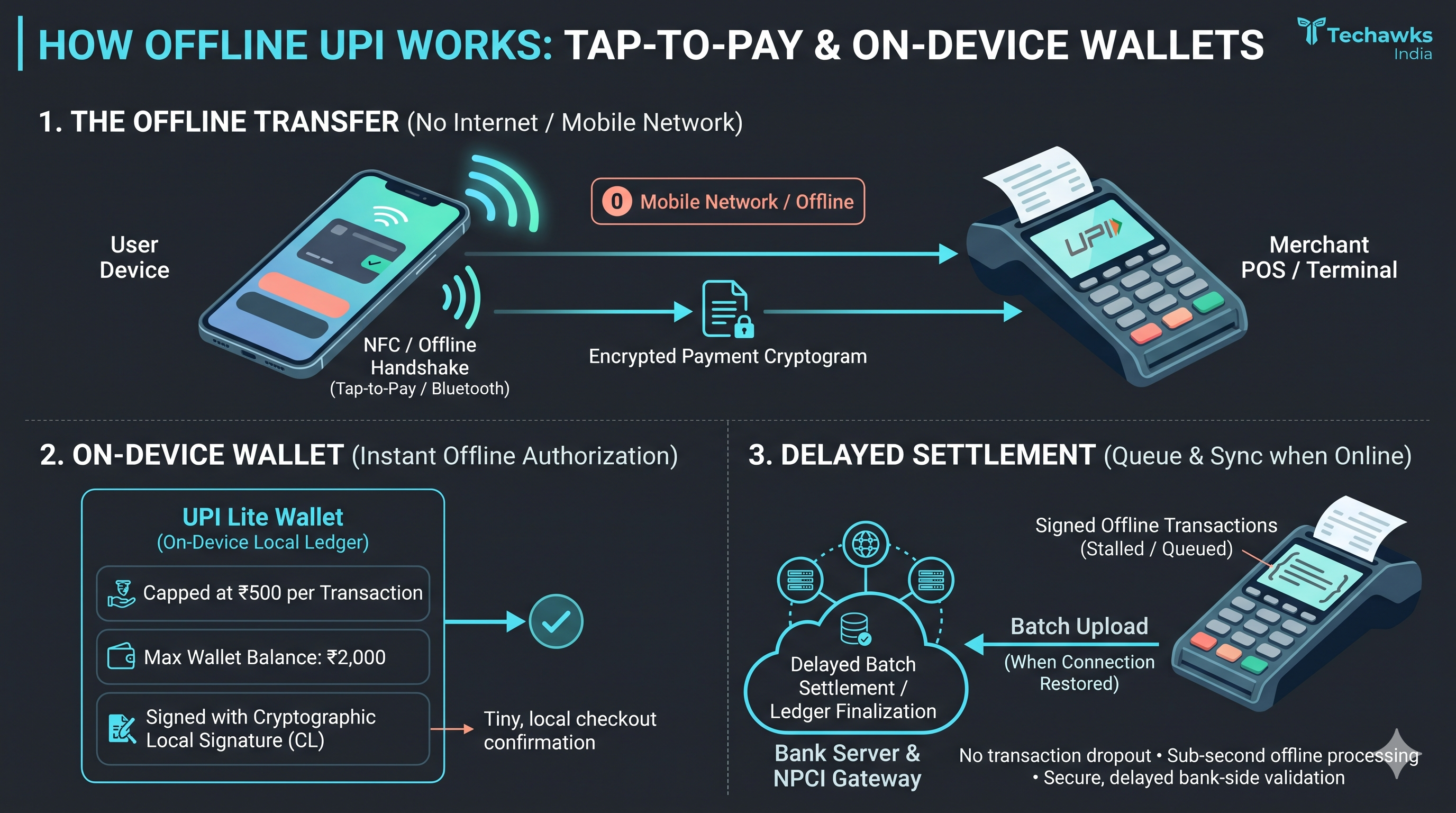 0 التعليقات 0 المشاركات 60 مشاهدة 0 معاينة
-
Architecting for DPDP Compliance: The Engineering Checklist Every Indian Tech Team Needs
For Indian startups and tech enterprises, DPDP compliance mandates shifts in how we design schemas, APIs, and microservice communications. Under the Act, Data Fiduciaries must ensure consent is specific, revocable, and backed by verifiable audit trails—backed by statutory penalties of up to ₹250 crore for significant security lapses.
Compliance cannot be patched with front-end cookie banners. It requires backend re-engineering across data ingestion, retention lifecycles, and identity boundaries.
Here is your production engineering checklist to audit and harden your application stack:
1. Consent State & Event Ingestion
[ ] Decoupled Consent Engine: Treat consent as an immutable event stream rather than a boolean column in your users table. Record timestamp, notice version, specified purpose, and channel (e.g., app, web, SMS).
[ ] Synchronous Revocation Propagation: Build downstream event listeners (e.g., Kafka consumers) that trigger immediate halting of processing pipelines across marketing, analytics, and personalization engines when consent is revoked.
[ ] Unbundled Data Collection: Ensure API contracts reject bundled payload requests where non-essential data collection (e.g., contact book, device telemetry) is forced for core functionality.
2. Data Principal Rights & Storage Architecture
[ ] Automated Deletion & Anonymization Pipelines: Implement automated workflows to execute cascading soft/hard deletes or irreversible tokenization across relational stores, read replicas, and vector databases when retention windows expire.
[ ] Data Principal Request (DPR) Orchestrator: Deploy a self-service endpoint or worker that aggregates personal data across distributed services to generate a machine-readable summary (JSON/PDF) within statutory resolution SLAs.
[ ] Backup Purge Handling: Define a clear policy and tooling (e.g., tombstoning or automated encryption key destruction) to ensure deleted records are not re-ingested during disaster recovery rollbacks.
3. Security, Access & Telemetry
[ ] Column-Level & Field-Level Encryption: Encrypt Personal Identifiable Information (PII) at rest using dedicated KMS keys, segregating direct identifiers (Aadhaar, phone, email) from operational telemetry.
[ ] Zero-Trust Audit Logging: Maintain tamper-evident, append-only access logs for all internal admin queries, customer support lookups, and bulk exports involving PII.
[ ] Downstream Processor Contracts & Telemetry: Audit all outbound webhook and SaaS integrations (CRMs, analytics, payment gateways) to ensure contractual data processing agreements and automated downstream erasure callbacks are enforced.
Discussion Question
What is the hardest technical challenge your engineering team is solving for DPDP readiness: retrofitting cascading erasure across legacy datastores, or orchestrating real-time consent withdrawal across downstream microservices?
CTA
Join Techawks India — Follow us for weekly deep dives, high-scale engineering blueprints, and regulatory tech architectures tailored for the Indian developer ecosystem.Architecting for DPDP Compliance: The Engineering Checklist Every Indian Tech Team Needs For Indian startups and tech enterprises, DPDP compliance mandates shifts in how we design schemas, APIs, and microservice communications. Under the Act, Data Fiduciaries must ensure consent is specific, revocable, and backed by verifiable audit trails—backed by statutory penalties of up to ₹250 crore for significant security lapses. Compliance cannot be patched with front-end cookie banners. It requires backend re-engineering across data ingestion, retention lifecycles, and identity boundaries. Here is your production engineering checklist to audit and harden your application stack: 1. Consent State & Event Ingestion [ ] Decoupled Consent Engine: Treat consent as an immutable event stream rather than a boolean column in your users table. Record timestamp, notice version, specified purpose, and channel (e.g., app, web, SMS). [ ] Synchronous Revocation Propagation: Build downstream event listeners (e.g., Kafka consumers) that trigger immediate halting of processing pipelines across marketing, analytics, and personalization engines when consent is revoked. [ ] Unbundled Data Collection: Ensure API contracts reject bundled payload requests where non-essential data collection (e.g., contact book, device telemetry) is forced for core functionality. 2. Data Principal Rights & Storage Architecture [ ] Automated Deletion & Anonymization Pipelines: Implement automated workflows to execute cascading soft/hard deletes or irreversible tokenization across relational stores, read replicas, and vector databases when retention windows expire. [ ] Data Principal Request (DPR) Orchestrator: Deploy a self-service endpoint or worker that aggregates personal data across distributed services to generate a machine-readable summary (JSON/PDF) within statutory resolution SLAs. [ ] Backup Purge Handling: Define a clear policy and tooling (e.g., tombstoning or automated encryption key destruction) to ensure deleted records are not re-ingested during disaster recovery rollbacks. 3. Security, Access & Telemetry [ ] Column-Level & Field-Level Encryption: Encrypt Personal Identifiable Information (PII) at rest using dedicated KMS keys, segregating direct identifiers (Aadhaar, phone, email) from operational telemetry. [ ] Zero-Trust Audit Logging: Maintain tamper-evident, append-only access logs for all internal admin queries, customer support lookups, and bulk exports involving PII. [ ] Downstream Processor Contracts & Telemetry: Audit all outbound webhook and SaaS integrations (CRMs, analytics, payment gateways) to ensure contractual data processing agreements and automated downstream erasure callbacks are enforced. Discussion Question What is the hardest technical challenge your engineering team is solving for DPDP readiness: retrofitting cascading erasure across legacy datastores, or orchestrating real-time consent withdrawal across downstream microservices? CTA Join Techawks India — Follow us for weekly deep dives, high-scale engineering blueprints, and regulatory tech architectures tailored for the Indian developer ecosystem. 0 التعليقات 0 المشاركات 57 مشاهدة 0 معاينة
-
The API Boundary Crisis: Why Loose Validation on India’s UPI & ONDC Gateways is the Ultimate Breach Target
India’s open-API ecosystem is the gold standard for global DPI, with UPI processing over 21.70 billion transactions in a single month in early 2026, alongside ONDC operating in over 630 cities.
This vast, connected web of APIs enables rapid financial flow, but it also creates a massive, high-stakes threat landscape: Gateway Parameter Manipulation.
In a fast-growing digital economy, developers often assume that simply utilizing NPCI, AA, or ONDC standards guarantees integration security. They overlook a critical boundary reality: The Data Payload Boundary.
Many developer stacks fall into the Boundary Reliance Illusion:
The Trust Fallacy: Expecting that if a transaction request contains a "valid" API signature, the payload values (merchant IDs, amount fields, redirect URIs) are implicitly secure to execute.
Lack of Inline Parameter Isolation: Merely passing parameters directly from customer-facing environments to third-party endpoints, bypassing secondary server-side value check systems.
Inconsistent Signature Verifications: Under-verifying response packets or failover responses from NPCI, banks, and networks, opening the door for validation spoofing.
The Defensive Pivot: Zero-Trust Gateway Integration
Instead of directly forwarding data, adopt a Zero-Trust Validation Gateway for every India Stack API touchpoint:
[ Client Request ]
│
▼
┌───────────────────────────┐
│ 1. Zero-Trust API Gateway │ ──► Terminate outer SSL; inspect headers,
│ (Custom Edge) │ valid payloads, & enforce strict rate-limiting
└───────────────────────────┘
│
▼
┌───────────────────────────┐
│ 2. Isolated Payload │ ──► Re-calculate signature hashes;
│ Verification Service │ verify IDs against secure DB (Not via Client API)
└───────────────────────────┘
│
▼
┌───────────────────────────┐
│ 3. Strictly Signed Egress │ ──► Forward encrypted payloads to UPI / ONDC endpoints
│ to DPI Network │ with 2-way TLS & validated webhook targets
└───────────────────────────┘
Steps to implement secure DPI integrations today:
Adopt Cryptographic mTLS and Validate JWS Signatures: In frameworks like ONDC, every request must be signed at the gateway using JSON Web Signatures (JWS). Do not simplify this by using external libraries without rigorous key management. Use Hardware Security Modules (HSMs) or isolated Key Vaults to fetch validation keys, and ensure JWS signature checks are computed before processing callbacks.
Strictly Implement Fail-Safe Transaction-Id Re-association: Do not trust the payment state (including "SUCCESS" payloads) returned back from a browser or direct client webhook. When verifying transaction statuses via UPI and banking endpoints, regenerate transaction hashes and confirm the payment result directly with your own backend-logged order databases to ensure no redirect tampering has taken place.
Enforce Active Parameter Isolation at Integration Boundaries: Strip inbound client request parameters down to verified inputs. Verify amount, account number, and merchant information on your trusted server before forwarding payloads to bank and UPI SDKs. If you rely on the payload from the application frontend, you’re only a custom POST request away from a financial routing vulnerability.
DPI makes population-scale transactions simple; zero-trust integration is what keeps them secure.
Discussion Question
As your team implements UPI, ONDC, or Account Aggregator APIs in production, do you verify transaction status by calling core provider APIs directly from backend servers, or do you let client responses handle workflow triggers? Let’s talk security down in the comments.
CTA (Join Techawks India)
Join the Techawks India community of builders, developers, and architects who are designing secure, scalable Digital Public Infrastructure. Let's discuss practical ways to build resilient integrations.The API Boundary Crisis: Why Loose Validation on India’s UPI & ONDC Gateways is the Ultimate Breach Target India’s open-API ecosystem is the gold standard for global DPI, with UPI processing over 21.70 billion transactions in a single month in early 2026, alongside ONDC operating in over 630 cities. This vast, connected web of APIs enables rapid financial flow, but it also creates a massive, high-stakes threat landscape: Gateway Parameter Manipulation. In a fast-growing digital economy, developers often assume that simply utilizing NPCI, AA, or ONDC standards guarantees integration security. They overlook a critical boundary reality: The Data Payload Boundary. Many developer stacks fall into the Boundary Reliance Illusion: The Trust Fallacy: Expecting that if a transaction request contains a "valid" API signature, the payload values (merchant IDs, amount fields, redirect URIs) are implicitly secure to execute. Lack of Inline Parameter Isolation: Merely passing parameters directly from customer-facing environments to third-party endpoints, bypassing secondary server-side value check systems. Inconsistent Signature Verifications: Under-verifying response packets or failover responses from NPCI, banks, and networks, opening the door for validation spoofing. The Defensive Pivot: Zero-Trust Gateway Integration Instead of directly forwarding data, adopt a Zero-Trust Validation Gateway for every India Stack API touchpoint: [ Client Request ] │ ▼ ┌───────────────────────────┐ │ 1. Zero-Trust API Gateway │ ──► Terminate outer SSL; inspect headers, │ (Custom Edge) │ valid payloads, & enforce strict rate-limiting └───────────────────────────┘ │ ▼ ┌───────────────────────────┐ │ 2. Isolated Payload │ ──► Re-calculate signature hashes; │ Verification Service │ verify IDs against secure DB (Not via Client API) └───────────────────────────┘ │ ▼ ┌───────────────────────────┐ │ 3. Strictly Signed Egress │ ──► Forward encrypted payloads to UPI / ONDC endpoints │ to DPI Network │ with 2-way TLS & validated webhook targets └───────────────────────────┘ Steps to implement secure DPI integrations today: Adopt Cryptographic mTLS and Validate JWS Signatures: In frameworks like ONDC, every request must be signed at the gateway using JSON Web Signatures (JWS). Do not simplify this by using external libraries without rigorous key management. Use Hardware Security Modules (HSMs) or isolated Key Vaults to fetch validation keys, and ensure JWS signature checks are computed before processing callbacks. Strictly Implement Fail-Safe Transaction-Id Re-association: Do not trust the payment state (including "SUCCESS" payloads) returned back from a browser or direct client webhook. When verifying transaction statuses via UPI and banking endpoints, regenerate transaction hashes and confirm the payment result directly with your own backend-logged order databases to ensure no redirect tampering has taken place. Enforce Active Parameter Isolation at Integration Boundaries: Strip inbound client request parameters down to verified inputs. Verify amount, account number, and merchant information on your trusted server before forwarding payloads to bank and UPI SDKs. If you rely on the payload from the application frontend, you’re only a custom POST request away from a financial routing vulnerability. DPI makes population-scale transactions simple; zero-trust integration is what keeps them secure. Discussion Question As your team implements UPI, ONDC, or Account Aggregator APIs in production, do you verify transaction status by calling core provider APIs directly from backend servers, or do you let client responses handle workflow triggers? Let’s talk security down in the comments. CTA (Join Techawks India) Join the Techawks India community of builders, developers, and architects who are designing secure, scalable Digital Public Infrastructure. Let's discuss practical ways to build resilient integrations.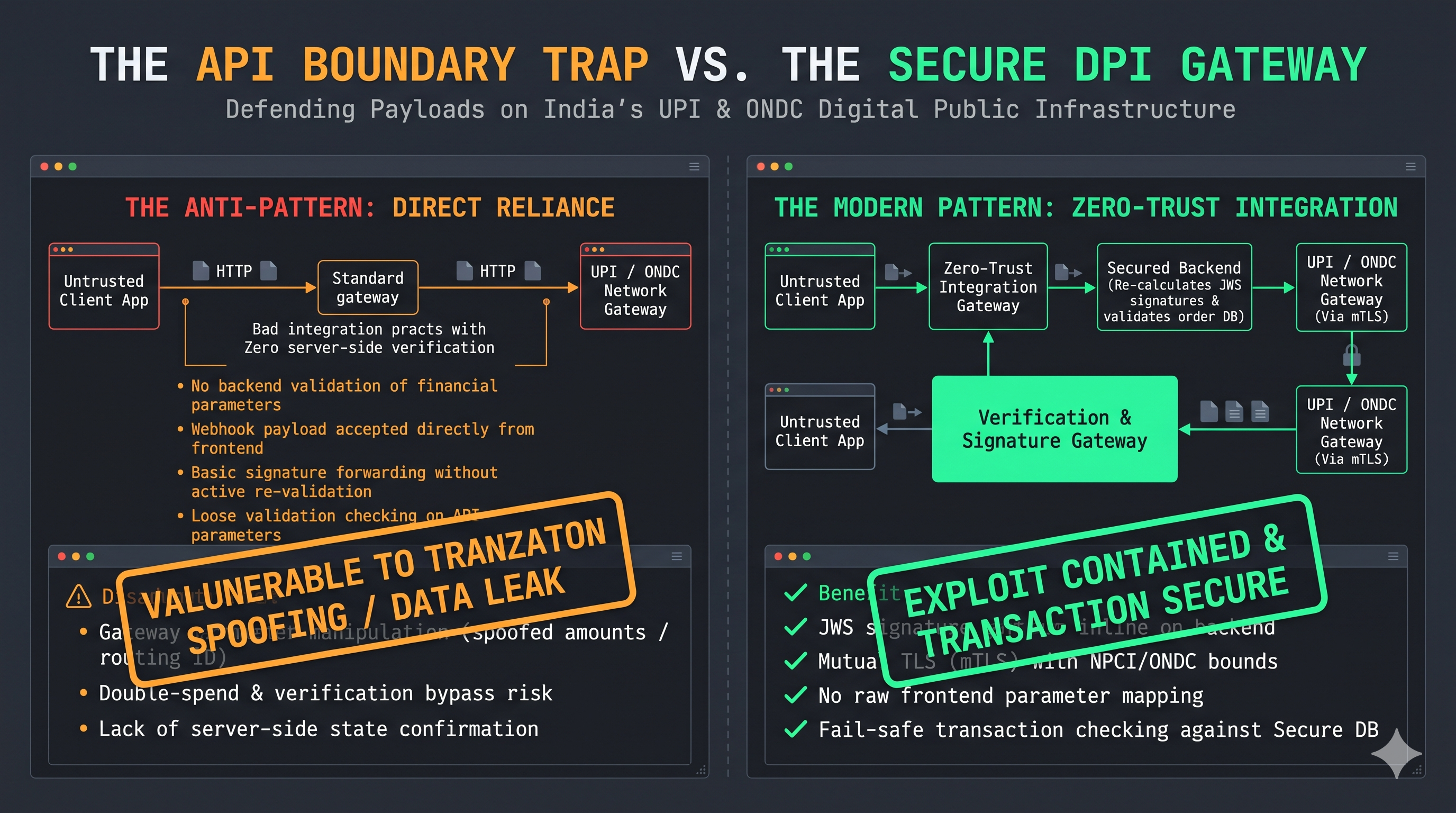 0 التعليقات 0 المشاركات 66 مشاهدة 0 معاينة
-
Scaling UPI & High-Throughput Fintech: Why Synchronous Webhooks Kill Payment Gateways
The Myth:
"When a payment succeeds at the aggregator (NPCI/Bank), synchronously updating the merchant ledger and calling external fulfillment in the same webhook HTTP handler guarantees consistency."
The Fact:
Synchronous webhook consumers create tight temporal coupling with external providers. During flash sales, festive peaks, or bank settlement spikes, downstream latency increases. Your webhook worker pool backs up, incoming requests queue up and time out, and payment aggregators retry aggressively—flooding your edge gateway with redundant webhook storms.
Anti-Pattern vs. Resilient Event-Driven Architecture
Plaintext
[ANTI-PATTERN: SYNCHRONOUS COUPLING]
Aggregator Webhook ---> [ App Server Handler ]
|---> DB Transaction (Row Lock on Wallet)
|---> Downstream Fulfillment API (Latency Spike: 4s)
|---> Retries trigger duplicate fulfillment & DB lock contention
[PRODUCTION RESILIENT PATTERN: OUTBOX & IDEMPOTENT WORKERS]
Aggregator Webhook ---> [ API Gateway / Edge Ingress ]
|
v (Strict Ack: < 50ms)
[ Fast Ingestion Queue (e.g., Kafka / SQS) ]
|
v
[ Idempotent Worker Service ]
|-- 1. Redis Distributed Lock + Idempotency Key (order_id + txn_id)
|-- 2. State Verification: Check Payment State Transition
|-- 3. Transactional Outbox: Ledger Update (Debit/Credit) + Event Emitter
|-- 4. Async Dispatcher to Fulfillment Engine
Production-Grade Architectural Principles for India-Scale FinTech
Deterministic Idempotency Keying at Ingress:
Never process a callback without a compound idempotency key combining pg_transaction_id and merchant order_id. Store deduplication markers in Redis with an atomic SET NX PX before invoking business logic. If a retry arrives while processing is in flight, reply immediately with HTTP 200/202 without reprocessing.
Decouple Ingestion from Ledger State Transitions:
Treat webhook handlers as pure intake buffers. Validate the cryptographic signature (e.g., HMAC-SHA256), push the raw payload to an append-only log or distributed queue, and return HTTP 202 Accepted within 50ms. Never tie webhook HTTP thread pools to database lock acquisitions.
Finite State Machine (FSM) Enforcement:
Payments are not binary (SUCCESS/FAILED); they traverse states (INITIATED, PENDING_NPCI, SETTLEMENT_HOLD, SUCCESS, EXPIRED). Enforce strict FSM validation in code: a transition to SUCCESS can only happen if current state is PENDING or INITIATED. Out-of-order webhooks should be dropped safely.
Transactional Outbox for Multi-System Consistency:
Avoid dual-write bugs across databases and downstream SMS/inventory/fulfillment APIs. Write the ledger balance change and an outbox event in the same atomic SQL transaction. Let a dedicated Change Data Capture (CDC) worker stream the event to fulfill the order.
Discussion Question
When handling transient banking timeouts (e.g., UPI U69 / payment status pending), do you rely on exponential-backoff polling against the aggregator's reconciliation API, or do you leave the session in a passive pending state waiting for the next webhook trigger? What trade-offs have you observed on your infrastructure cost and DB connection pool?
CTA
Ready to dive deeper into system architectures that power India’s digital public infrastructure and top scale-ups?
👉 Join Techawks India — Connect with lead architects, systems engineers, and founders solving high-concurrency challenges.Scaling UPI & High-Throughput Fintech: Why Synchronous Webhooks Kill Payment Gateways The Myth: "When a payment succeeds at the aggregator (NPCI/Bank), synchronously updating the merchant ledger and calling external fulfillment in the same webhook HTTP handler guarantees consistency." The Fact: Synchronous webhook consumers create tight temporal coupling with external providers. During flash sales, festive peaks, or bank settlement spikes, downstream latency increases. Your webhook worker pool backs up, incoming requests queue up and time out, and payment aggregators retry aggressively—flooding your edge gateway with redundant webhook storms. Anti-Pattern vs. Resilient Event-Driven Architecture Plaintext [ANTI-PATTERN: SYNCHRONOUS COUPLING] Aggregator Webhook ---> [ App Server Handler ] |---> DB Transaction (Row Lock on Wallet) |---> Downstream Fulfillment API (Latency Spike: 4s) |---> Retries trigger duplicate fulfillment & DB lock contention [PRODUCTION RESILIENT PATTERN: OUTBOX & IDEMPOTENT WORKERS] Aggregator Webhook ---> [ API Gateway / Edge Ingress ] | v (Strict Ack: < 50ms) [ Fast Ingestion Queue (e.g., Kafka / SQS) ] | v [ Idempotent Worker Service ] |-- 1. Redis Distributed Lock + Idempotency Key (order_id + txn_id) |-- 2. State Verification: Check Payment State Transition |-- 3. Transactional Outbox: Ledger Update (Debit/Credit) + Event Emitter |-- 4. Async Dispatcher to Fulfillment Engine Production-Grade Architectural Principles for India-Scale FinTech Deterministic Idempotency Keying at Ingress: Never process a callback without a compound idempotency key combining pg_transaction_id and merchant order_id. Store deduplication markers in Redis with an atomic SET NX PX before invoking business logic. If a retry arrives while processing is in flight, reply immediately with HTTP 200/202 without reprocessing. Decouple Ingestion from Ledger State Transitions: Treat webhook handlers as pure intake buffers. Validate the cryptographic signature (e.g., HMAC-SHA256), push the raw payload to an append-only log or distributed queue, and return HTTP 202 Accepted within 50ms. Never tie webhook HTTP thread pools to database lock acquisitions. Finite State Machine (FSM) Enforcement: Payments are not binary (SUCCESS/FAILED); they traverse states (INITIATED, PENDING_NPCI, SETTLEMENT_HOLD, SUCCESS, EXPIRED). Enforce strict FSM validation in code: a transition to SUCCESS can only happen if current state is PENDING or INITIATED. Out-of-order webhooks should be dropped safely. Transactional Outbox for Multi-System Consistency: Avoid dual-write bugs across databases and downstream SMS/inventory/fulfillment APIs. Write the ledger balance change and an outbox event in the same atomic SQL transaction. Let a dedicated Change Data Capture (CDC) worker stream the event to fulfill the order. Discussion Question When handling transient banking timeouts (e.g., UPI U69 / payment status pending), do you rely on exponential-backoff polling against the aggregator's reconciliation API, or do you leave the session in a passive pending state waiting for the next webhook trigger? What trade-offs have you observed on your infrastructure cost and DB connection pool? CTA Ready to dive deeper into system architectures that power India’s digital public infrastructure and top scale-ups? 👉 Join Techawks India — Connect with lead architects, systems engineers, and founders solving high-concurrency challenges. 0 التعليقات 0 المشاركات 83 مشاهدة 0 معاينة
-
DPDP Consent Architecture vs. CERT-In 6-Hour Incident Telemetry: Solving India’s Dual Regulatory Pipeline Challenge
Building production-grade cloud backends for Indian users involves balancing two strict, overlapping regulatory frameworks:
The Digital Personal Data Protection (DPDP) Framework: Enforces strict purpose limitation, consent-bound processing, and mandatory deletion upon purpose fulfillment or user dormancy (with financial penalties reaching up to ₹250 crore per violation).
CERT-In Cyber Security Directions: Mandates that all ICT logs be retained for a rolling minimum of 180 days strictly within Indian territorial jurisdiction, alongside a 6-hour reporting window triggered upon the detection of cyber incidents or data breaches.
The core architectural conflict? DPDP demands minimal data retention and time-bound erasure, while CERT-In demands immutable forensic logging and time-synchronized traceability.
Treating application state and audit infrastructure as a unified database leads to compliance dead-ends.
[ ANTI-PATTERN: THE UNIFIED APPLICATION LOGGING TRAP ]
Indian Client Traffic ──► [ Flat Cloud Cluster (ap-south-1) ]
├── PII embedded in stdout / application logs
├── User exercises DPDP Right to Erasure
└── Deleting logs breaks CERT-In 180-day forensic mandate!
(High Risk: ₹250 Cr DPDP exposure vs. CERT-In non-compliance)
[ RESILIENT PATTERN: DUAL-LIFECYCLE DATA & LOG SEGMENTATION ]
Client Request ──► [ Local API Gateway & PII Sanitizer ]
│
┌───────────────┴────────────────────────────────────────┐
▼ (Encrypted Personal Data) ▼ (Sanitized Forensic Telemetry)
[ DPDP Data Engine (ap-south-1 / ap-south-2) ] [ Sovereign CERT-In Log Vault (In-Country) ]
├── Purpose-Bound Consent Metadata ├── NTP Synchronized Clocks (NIC / NPL)
├── Verifiable Parental/Minor Filters ├── Anonymized Transaction Hashes (Zero Raw PII)
└── Automated Dormancy Deletion Pipeline ├── 180-Day WORM Immutable Retention
│ │
▼ (Right to Erasure Handled) ▼ (Continuous SIEM & Breach Triggers)
[ Clean Purge of PII ] [ Automated 6-Hour Alert Dispatch to CERT-In ]
3 Production-Grade Engineering Principles
Separation of Personal Data from Telemetry Pipelines:
Never stream raw personal identifiers (PII, phone numbers, email addresses) into application stdout or access log collectors. Pass all incoming payloads through an edge sanitizer that pseudonymises user IDs into ephemeral hashes before shipping logs to your centralized SIEM, allowing you to delete customer records under DPDP without compromising 180-day forensic telemetry.
Clock Synchronization via National Stratum-1 Servers:
Under CERT-In guidelines, all servers, cloud nodes, and network devices must synchronise system clocks directly with Network Time Protocol (NTP) servers traceable to the National Informatics Centre (NIC) or National Physical Laboratory (NPL). Unaligned timestamps during an incident investigation invalidate log submissions and compound regulatory exposure.
Automated Detection-to-Escalation Playbooks:
Because CERT-In’s 6-hour reporting clock begins the moment an anomaly is detected (not when the post-mortem finishes), configure automated threshold-based alerts inside your SIEM. Detection-to-escalation playbooks must establish an executive reporting decision within two hours, routing standardized pre-approved incident templates directly to CERT-In before deep containment concludes.
Discussion Question
How is your team handling log retention vs. DPDP deletion requests? Have you segregated your logging infrastructure using pseudonymous tokens, or are you storing sanitized forensic telemetry in dedicated India-based storage buckets?
CTA
Connect with regional technology leaders, compare resilient cloud blueprints, and ensure your production pipelines stay audit-ready. Join the official Techawks India community today!DPDP Consent Architecture vs. CERT-In 6-Hour Incident Telemetry: Solving India’s Dual Regulatory Pipeline Challenge Building production-grade cloud backends for Indian users involves balancing two strict, overlapping regulatory frameworks: The Digital Personal Data Protection (DPDP) Framework: Enforces strict purpose limitation, consent-bound processing, and mandatory deletion upon purpose fulfillment or user dormancy (with financial penalties reaching up to ₹250 crore per violation). CERT-In Cyber Security Directions: Mandates that all ICT logs be retained for a rolling minimum of 180 days strictly within Indian territorial jurisdiction, alongside a 6-hour reporting window triggered upon the detection of cyber incidents or data breaches. The core architectural conflict? DPDP demands minimal data retention and time-bound erasure, while CERT-In demands immutable forensic logging and time-synchronized traceability. Treating application state and audit infrastructure as a unified database leads to compliance dead-ends. [ ANTI-PATTERN: THE UNIFIED APPLICATION LOGGING TRAP ] Indian Client Traffic ──► [ Flat Cloud Cluster (ap-south-1) ] ├── PII embedded in stdout / application logs ├── User exercises DPDP Right to Erasure └── Deleting logs breaks CERT-In 180-day forensic mandate! (High Risk: ₹250 Cr DPDP exposure vs. CERT-In non-compliance) [ RESILIENT PATTERN: DUAL-LIFECYCLE DATA & LOG SEGMENTATION ] Client Request ──► [ Local API Gateway & PII Sanitizer ] │ ┌───────────────┴────────────────────────────────────────┐ ▼ (Encrypted Personal Data) ▼ (Sanitized Forensic Telemetry) [ DPDP Data Engine (ap-south-1 / ap-south-2) ] [ Sovereign CERT-In Log Vault (In-Country) ] ├── Purpose-Bound Consent Metadata ├── NTP Synchronized Clocks (NIC / NPL) ├── Verifiable Parental/Minor Filters ├── Anonymized Transaction Hashes (Zero Raw PII) └── Automated Dormancy Deletion Pipeline ├── 180-Day WORM Immutable Retention │ │ ▼ (Right to Erasure Handled) ▼ (Continuous SIEM & Breach Triggers) [ Clean Purge of PII ] [ Automated 6-Hour Alert Dispatch to CERT-In ] 3 Production-Grade Engineering Principles Separation of Personal Data from Telemetry Pipelines: Never stream raw personal identifiers (PII, phone numbers, email addresses) into application stdout or access log collectors. Pass all incoming payloads through an edge sanitizer that pseudonymises user IDs into ephemeral hashes before shipping logs to your centralized SIEM, allowing you to delete customer records under DPDP without compromising 180-day forensic telemetry. Clock Synchronization via National Stratum-1 Servers: Under CERT-In guidelines, all servers, cloud nodes, and network devices must synchronise system clocks directly with Network Time Protocol (NTP) servers traceable to the National Informatics Centre (NIC) or National Physical Laboratory (NPL). Unaligned timestamps during an incident investigation invalidate log submissions and compound regulatory exposure. Automated Detection-to-Escalation Playbooks: Because CERT-In’s 6-hour reporting clock begins the moment an anomaly is detected (not when the post-mortem finishes), configure automated threshold-based alerts inside your SIEM. Detection-to-escalation playbooks must establish an executive reporting decision within two hours, routing standardized pre-approved incident templates directly to CERT-In before deep containment concludes. Discussion Question How is your team handling log retention vs. DPDP deletion requests? Have you segregated your logging infrastructure using pseudonymous tokens, or are you storing sanitized forensic telemetry in dedicated India-based storage buckets? CTA Connect with regional technology leaders, compare resilient cloud blueprints, and ensure your production pipelines stay audit-ready. Join the official Techawks India community today! 0 التعليقات 0 المشاركات 71 مشاهدة 0 معاينة
المزيد من المنشورات