


If your product’s entire AI strategy is just an API call to a monolithic US-hosted model, your unit economics and latency are already on borrowed time.
With India’s national AI infrastructure scaling past 45,000 subsidized shared GPUs and backing over 20 indigenous foundation and multimodal model initiatives, a major architectural shift is taking place across the Indian engineering ecosystem: we are moving from prompt wrapping to domain-specific Small Language Models (SLMs) and fine-tuned edge inference. Here is why this matters for every tech lead and developer building in India today:
1. The Real Cost of Token Latency & Indic Context
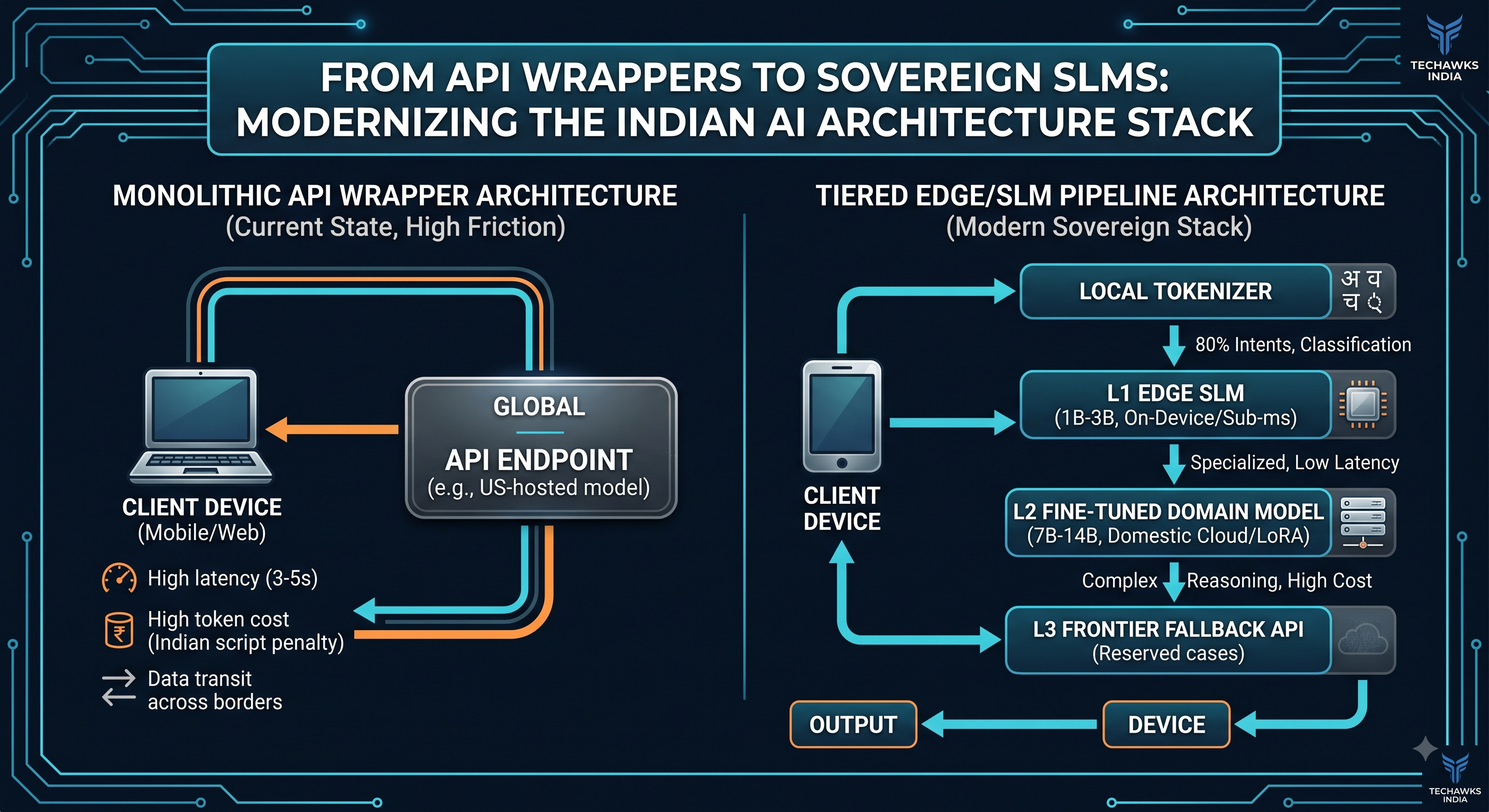
Generic frontier models charge high token taxes on Indic scripts due to sub-optimal tokenization (often splitting a single Hindi or Tamil word into 3–6 tokens).
The fix: Domain-trained SLMs (1B–8B parameters) with native Indic tokenizers reduce token blow-up, cut round-trip latency from seconds to milliseconds, and run at a fraction of cloud inference costs.
2. The Architectural Pattern: Distillation over Brute Force
Instead of throwing massive 70B+ parameter models at every user query, modern architectures in production use a tiered routing pattern:
L1 (Edge / SLM): 1B–3B quantized model (e.g., via ONNX or llama.cpp) running locally or at the nearest domestic edge node to handle 80% of routine domain intents, classification, and validation.
L2 (Specialized Native Model): A medium 7B–14B domain-adapted model fine-tuned on clean task data (via LoRA / QLoRA) for complex domain extraction.
L3 (Frontier Fallback): Expensive API calls reserved strictly for edge-case reasoning.
3. Sovereign Data & Edge Deployment
Running optimized SLMs on domestic cloud compute or directly on-device removes data exfiltration risks and aligns directly with stringent data protection standards while keeping your infrastructure cost predictable.
Building defensibility in 2026 isn't about who wrote the cleverest system prompt—it's about who owns their model distillation pipeline and keeps their compute footprint lean.
Discussion Question
For the engineering leads and founders here:
Are you running SLMs/custom weights in production yet, or are you still relying primarily on commercial closed-source APIs? What is your biggest barrier to self-hosting—GPU availability, pipeline complexity, or inference latency?
Drop your architecture insights below. 👇
CTA (Join Techawks India)
🚀 Level up your engineering stack with Techawks India.
Join our community of over 50,000+ developers, tech architects, and startup builders building India’s next-gen tech ecosystem.
👉 Follow [Techawks India] for daily deep dives, architecture breakdowns, and tech leadership discussions.
With India’s national AI infrastructure scaling past 45,000 subsidized shared GPUs and backing over 20 indigenous foundation and multimodal model initiatives, a major architectural shift is taking place across the Indian engineering ecosystem: we are moving from prompt wrapping to domain-specific Small Language Models (SLMs) and fine-tuned edge inference. Here is why this matters for every tech lead and developer building in India today:
1. The Real Cost of Token Latency & Indic Context
Generic frontier models charge high token taxes on Indic scripts due to sub-optimal tokenization (often splitting a single Hindi or Tamil word into 3–6 tokens).
The fix: Domain-trained SLMs (1B–8B parameters) with native Indic tokenizers reduce token blow-up, cut round-trip latency from seconds to milliseconds, and run at a fraction of cloud inference costs.
2. The Architectural Pattern: Distillation over Brute Force
Instead of throwing massive 70B+ parameter models at every user query, modern architectures in production use a tiered routing pattern:
L1 (Edge / SLM): 1B–3B quantized model (e.g., via ONNX or llama.cpp) running locally or at the nearest domestic edge node to handle 80% of routine domain intents, classification, and validation.
L2 (Specialized Native Model): A medium 7B–14B domain-adapted model fine-tuned on clean task data (via LoRA / QLoRA) for complex domain extraction.
L3 (Frontier Fallback): Expensive API calls reserved strictly for edge-case reasoning.
3. Sovereign Data & Edge Deployment
Running optimized SLMs on domestic cloud compute or directly on-device removes data exfiltration risks and aligns directly with stringent data protection standards while keeping your infrastructure cost predictable.
Building defensibility in 2026 isn't about who wrote the cleverest system prompt—it's about who owns their model distillation pipeline and keeps their compute footprint lean.
Discussion Question
For the engineering leads and founders here:
Are you running SLMs/custom weights in production yet, or are you still relying primarily on commercial closed-source APIs? What is your biggest barrier to self-hosting—GPU availability, pipeline complexity, or inference latency?
Drop your architecture insights below. 👇
CTA (Join Techawks India)
🚀 Level up your engineering stack with Techawks India.
Join our community of over 50,000+ developers, tech architects, and startup builders building India’s next-gen tech ecosystem.
👉 Follow [Techawks India] for daily deep dives, architecture breakdowns, and tech leadership discussions.
If your product’s entire AI strategy is just an API call to a monolithic US-hosted model, your unit economics and latency are already on borrowed time.
With India’s national AI infrastructure scaling past 45,000 subsidized shared GPUs and backing over 20 indigenous foundation and multimodal model initiatives, a major architectural shift is taking place across the Indian engineering ecosystem: we are moving from prompt wrapping to domain-specific Small Language Models (SLMs) and fine-tuned edge inference. Here is why this matters for every tech lead and developer building in India today:
1. The Real Cost of Token Latency & Indic Context
Generic frontier models charge high token taxes on Indic scripts due to sub-optimal tokenization (often splitting a single Hindi or Tamil word into 3–6 tokens).
The fix: Domain-trained SLMs (1B–8B parameters) with native Indic tokenizers reduce token blow-up, cut round-trip latency from seconds to milliseconds, and run at a fraction of cloud inference costs.
2. The Architectural Pattern: Distillation over Brute Force
Instead of throwing massive 70B+ parameter models at every user query, modern architectures in production use a tiered routing pattern:
L1 (Edge / SLM): 1B–3B quantized model (e.g., via ONNX or llama.cpp) running locally or at the nearest domestic edge node to handle 80% of routine domain intents, classification, and validation.
L2 (Specialized Native Model): A medium 7B–14B domain-adapted model fine-tuned on clean task data (via LoRA / QLoRA) for complex domain extraction.
L3 (Frontier Fallback): Expensive API calls reserved strictly for edge-case reasoning.
3. Sovereign Data & Edge Deployment
Running optimized SLMs on domestic cloud compute or directly on-device removes data exfiltration risks and aligns directly with stringent data protection standards while keeping your infrastructure cost predictable.
Building defensibility in 2026 isn't about who wrote the cleverest system prompt—it's about who owns their model distillation pipeline and keeps their compute footprint lean.
Discussion Question
For the engineering leads and founders here:
Are you running SLMs/custom weights in production yet, or are you still relying primarily on commercial closed-source APIs? What is your biggest barrier to self-hosting—GPU availability, pipeline complexity, or inference latency?
Drop your architecture insights below. 👇
CTA (Join Techawks India)
🚀 Level up your engineering stack with Techawks India.
Join our community of over 50,000+ developers, tech architects, and startup builders building India’s next-gen tech ecosystem.
👉 Follow [Techawks India] for daily deep dives, architecture breakdowns, and tech leadership discussions.

 English
 Arabic
 French
 Spanish
 Portuguese
 Turkish
 Dutch
Dutch
 Italiano
 Russian
 Romaian
 Portuguese (Brazil)
 Greek
Greek