


Stop Dumping Raw Tool Schemas into Context: The Shift to Code Execution in Enterprise Agent Design
As the Model Context Protocol (MCP) becomes standard infrastructure across US engineering orgs under the Linux Foundation’s Agentic AI Foundation, teams are hitting a severe production bottleneck: Tool Definition Bloat and Intermediate Token Churn.
When scaling autonomous agents across enterprise systems (Salesforce, GitHub, Snowflake, internal APIs), brute-force tool calling breaks down at scale.
Here is why it matters and the architectural pattern US engineering teams are adopting to solve it:
2. The Architectural Fix: Code Execution with Progressive Tool Discovery
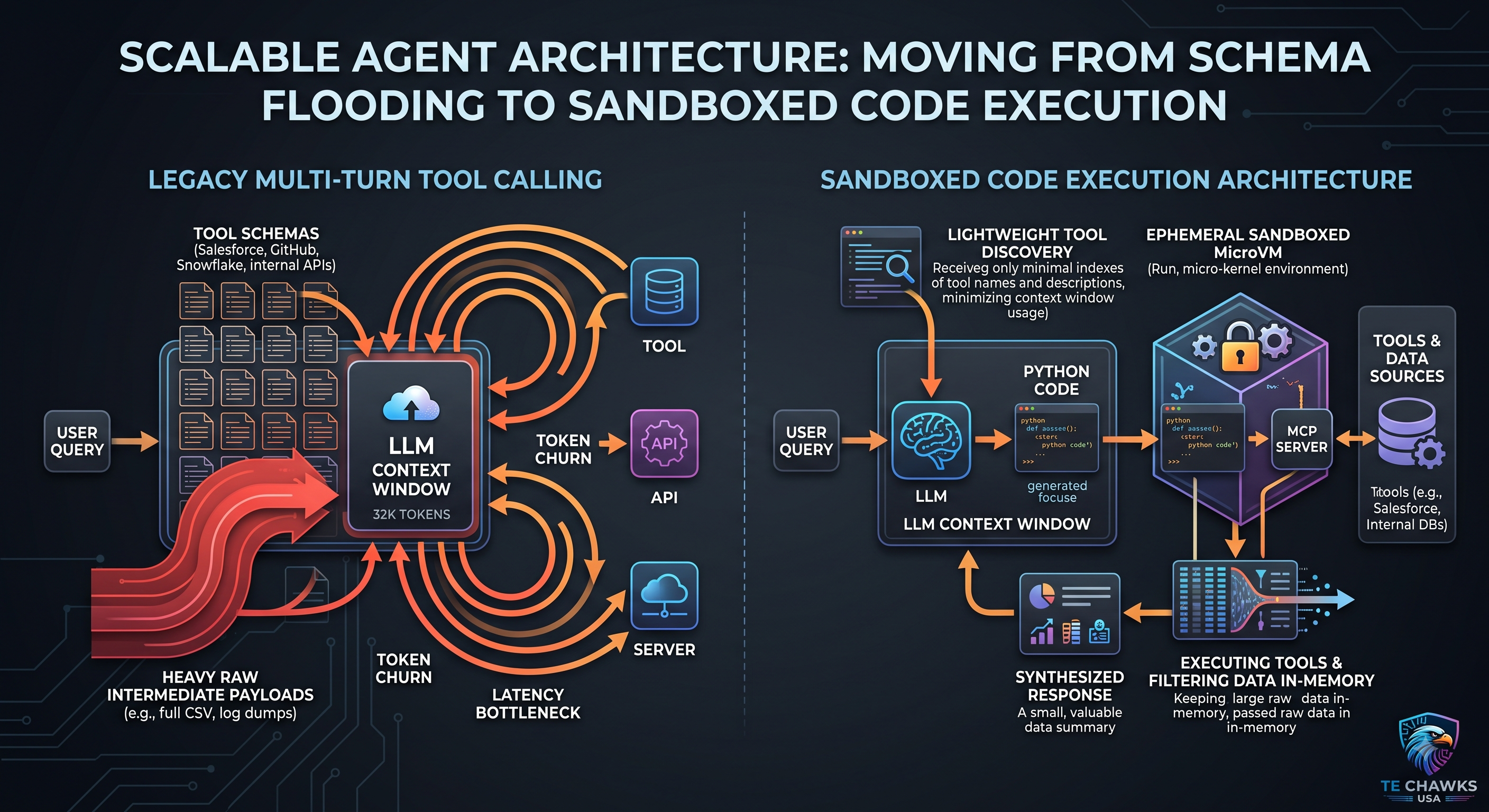
Instead of letting the model blindly call discrete endpoints in an interactive loop, production architectures are moving to a Sandboxed Code Execution Runtime:
Progressive Tool Discovery: The model receives lightweight high-level catalog indexes (names and top-level descriptions). It requests full API signatures dynamically only when needed.
Ephemeral In-Memory Filtering: The agent writes short Python/TypeScript scripts executed inside a secure, ephemeral container (e.g., WebAssembly, gVisor, or Firecracker microVMs).
State Stays in Runtime: If a tool call pulls 50,000 rows, the script filters and aggregates the data inside the execution environment and passes only the summary back to the model context.
3. Security & Determinism
Executing logic via code runtime rather than multi-turn prompt chains allows teams to inject strict static typing, programmatic unit validation, and fine-grained IAM scoping before actions touch production databases.
In 2026, building resilient agentic systems is no longer about writing better instructions—it's about treating tool orchestration as a systems programming problem.
Discussion Question
To the platform engineers and AI architects building agentic pipelines:
How is your team handling tool scale in production? Are you still relying on direct JSON function-calling, or have you migrated to code interpreters and dynamic tool loading?
Share your architectural trade-offs below. 👇
CTA (Join Techawks USA)
🇺🇸 Build what’s next with Techawks USA.
Join thousands of US-based software engineers, platform architects, and tech leaders dissecting the engineering patterns shaping enterprise AI and modern distributed systems.
👉 Follow [Techawks USA] for architecture deep dives, production teardowns, and engineering insights.
As the Model Context Protocol (MCP) becomes standard infrastructure across US engineering orgs under the Linux Foundation’s Agentic AI Foundation, teams are hitting a severe production bottleneck: Tool Definition Bloat and Intermediate Token Churn.
When scaling autonomous agents across enterprise systems (Salesforce, GitHub, Snowflake, internal APIs), brute-force tool calling breaks down at scale.
Here is why it matters and the architectural pattern US engineering teams are adopting to solve it:
2. The Architectural Fix: Code Execution with Progressive Tool Discovery
Instead of letting the model blindly call discrete endpoints in an interactive loop, production architectures are moving to a Sandboxed Code Execution Runtime:
Progressive Tool Discovery: The model receives lightweight high-level catalog indexes (names and top-level descriptions). It requests full API signatures dynamically only when needed.
Ephemeral In-Memory Filtering: The agent writes short Python/TypeScript scripts executed inside a secure, ephemeral container (e.g., WebAssembly, gVisor, or Firecracker microVMs).
State Stays in Runtime: If a tool call pulls 50,000 rows, the script filters and aggregates the data inside the execution environment and passes only the summary back to the model context.
3. Security & Determinism
Executing logic via code runtime rather than multi-turn prompt chains allows teams to inject strict static typing, programmatic unit validation, and fine-grained IAM scoping before actions touch production databases.
In 2026, building resilient agentic systems is no longer about writing better instructions—it's about treating tool orchestration as a systems programming problem.
Discussion Question
To the platform engineers and AI architects building agentic pipelines:
How is your team handling tool scale in production? Are you still relying on direct JSON function-calling, or have you migrated to code interpreters and dynamic tool loading?
Share your architectural trade-offs below. 👇
CTA (Join Techawks USA)
🇺🇸 Build what’s next with Techawks USA.
Join thousands of US-based software engineers, platform architects, and tech leaders dissecting the engineering patterns shaping enterprise AI and modern distributed systems.
👉 Follow [Techawks USA] for architecture deep dives, production teardowns, and engineering insights.
Stop Dumping Raw Tool Schemas into Context: The Shift to Code Execution in Enterprise Agent Design
As the Model Context Protocol (MCP) becomes standard infrastructure across US engineering orgs under the Linux Foundation’s Agentic AI Foundation, teams are hitting a severe production bottleneck: Tool Definition Bloat and Intermediate Token Churn.
When scaling autonomous agents across enterprise systems (Salesforce, GitHub, Snowflake, internal APIs), brute-force tool calling breaks down at scale.
Here is why it matters and the architectural pattern US engineering teams are adopting to solve it:
2. The Architectural Fix: Code Execution with Progressive Tool Discovery
Instead of letting the model blindly call discrete endpoints in an interactive loop, production architectures are moving to a Sandboxed Code Execution Runtime:
Progressive Tool Discovery: The model receives lightweight high-level catalog indexes (names and top-level descriptions). It requests full API signatures dynamically only when needed.
Ephemeral In-Memory Filtering: The agent writes short Python/TypeScript scripts executed inside a secure, ephemeral container (e.g., WebAssembly, gVisor, or Firecracker microVMs).
State Stays in Runtime: If a tool call pulls 50,000 rows, the script filters and aggregates the data inside the execution environment and passes only the summary back to the model context.
3. Security & Determinism
Executing logic via code runtime rather than multi-turn prompt chains allows teams to inject strict static typing, programmatic unit validation, and fine-grained IAM scoping before actions touch production databases.
In 2026, building resilient agentic systems is no longer about writing better instructions—it's about treating tool orchestration as a systems programming problem.
Discussion Question
To the platform engineers and AI architects building agentic pipelines:
How is your team handling tool scale in production? Are you still relying on direct JSON function-calling, or have you migrated to code interpreters and dynamic tool loading?
Share your architectural trade-offs below. 👇
CTA (Join Techawks USA)
🇺🇸 Build what’s next with Techawks USA.
Join thousands of US-based software engineers, platform architects, and tech leaders dissecting the engineering patterns shaping enterprise AI and modern distributed systems.
👉 Follow [Techawks USA] for architecture deep dives, production teardowns, and engineering insights.

 English
 Arabic
 French
 Spanish
 Portuguese
 Deutsch
 Turkish
 Dutch
Dutch
 Italiano
 Romaian
 Portuguese (Brazil)
 Greek
Greek