


The Operational Resilience Reckoning: Why UK Engineering Teams Are Decoupling from Single-Cloud LLM Gateways
With the Bank of England, the Prudential Regulation Authority (PRA), and the Financial Conduct Authority (FCA) enforcing strict oversight regimes on Critical Third Parties (CTPs) and operational resilience, UK tech stacks—especially across London’s FinTech and enterprise sectors—are facing an architectural inflection point.
The days of hardcoding direct dependencies to a single frontier model endpoint are over. UK engineering leads are shifting toward resilient, multi-provider model routing architectures with deterministic fallbacks.
Here is why this matters and how to implement this pattern across your stack:
1. The Single-Point-of-Failure (SPOF) Tax
Relying on a single proprietary AI API creates severe operational vulnerabilities:
Unannounced rate limit throttles or degradation.
Regional routing hops that trigger cross-border data transfer friction under UK-GDPR and the Data (Use and Access) framework.
Non-deterministic outage risks that breach regulatory business continuity objectives (e.g., maximum tolerable downtime).
2. The Architectural Fix:
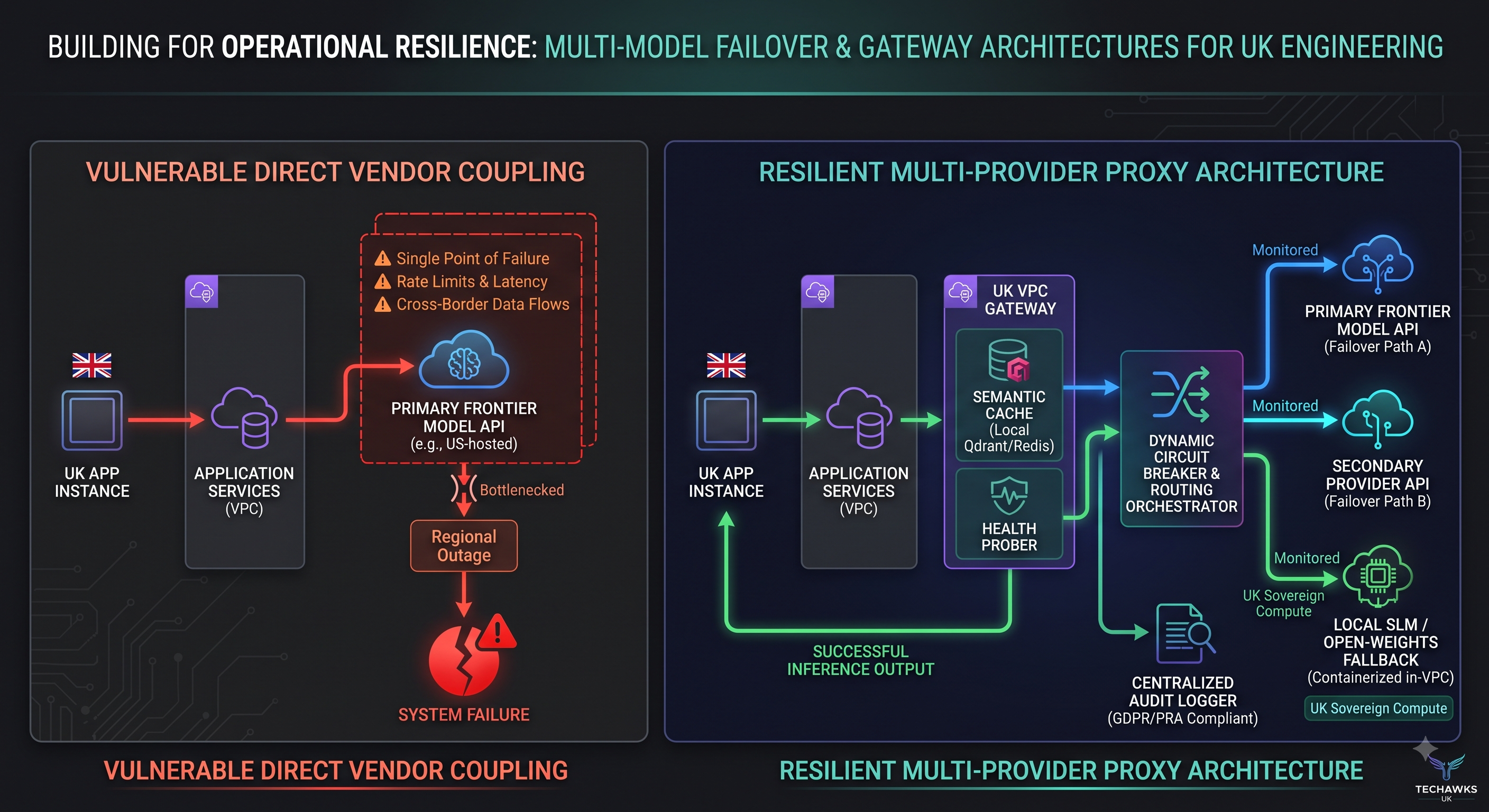
The Resilient Multi-Provider Proxy PatternTo maintain high availability and regulatory compliance, teams are placing an orchestrated abstraction gateway between application services and model providers:
Circuit Breaking & Health Probing: The gateway continuously monitors p99 latency and error rates (5xx codes). If Provider A degrades, the circuit trips automatically, re-routing active traffic to a warm alternative (Provider B or a domestically hosted open-weights endpoint) within milliseconds.
Semantic Caching Layer: Caching high-frequency structured deterministic queries (via Redis or Qdrant) at the edge prevents redundant network hops and ensures key application paths stay up even during total upstream API outages.
Local In-VPC Fallbacks: Critical classification, extraction, and validation workloads fall back to containerised Small Language Models (SLMs) running inside UK-sovereign VPCs when external networks are unreachable.
3. Continuous Auditability & Compliance Observability
A robust gateway enforces structured request/response logging, token budgeting, and cryptographic audit trails at the edge, satisfying FCA/PRA oversight without injecting latency into core application logic.
Engineering leadership in the UK is no longer about testing the newest frontier model first—it is about ensuring your systems remain resilient, compliant, and always available under pressure.
Discussion Question
To UK tech leaders, architects, and engineering managers:
How is your team tackling model redundancy and third-party dependency risks in production? Are you running multi-model fallback gateways, or is your stack still tightly coupled to a single vendor?
Let’s debate resilience trade-offs below. 👇
CTA (Join Techawks UK)
🇬🇧 Stay ahead of the UK engineering landscape with Techawks UK.
Join a premier community of UK software engineers, CTOs, and systems architects building robust, scalable, and compliant enterprise infrastructure.
👉 Follow [Techawks UK] for daily architecture breakdowns, FinTech deep dives, and systems engineering insights.
With the Bank of England, the Prudential Regulation Authority (PRA), and the Financial Conduct Authority (FCA) enforcing strict oversight regimes on Critical Third Parties (CTPs) and operational resilience, UK tech stacks—especially across London’s FinTech and enterprise sectors—are facing an architectural inflection point.
The days of hardcoding direct dependencies to a single frontier model endpoint are over. UK engineering leads are shifting toward resilient, multi-provider model routing architectures with deterministic fallbacks.
Here is why this matters and how to implement this pattern across your stack:
1. The Single-Point-of-Failure (SPOF) Tax
Relying on a single proprietary AI API creates severe operational vulnerabilities:
Unannounced rate limit throttles or degradation.
Regional routing hops that trigger cross-border data transfer friction under UK-GDPR and the Data (Use and Access) framework.
Non-deterministic outage risks that breach regulatory business continuity objectives (e.g., maximum tolerable downtime).
2. The Architectural Fix:
The Resilient Multi-Provider Proxy PatternTo maintain high availability and regulatory compliance, teams are placing an orchestrated abstraction gateway between application services and model providers:
Circuit Breaking & Health Probing: The gateway continuously monitors p99 latency and error rates (5xx codes). If Provider A degrades, the circuit trips automatically, re-routing active traffic to a warm alternative (Provider B or a domestically hosted open-weights endpoint) within milliseconds.
Semantic Caching Layer: Caching high-frequency structured deterministic queries (via Redis or Qdrant) at the edge prevents redundant network hops and ensures key application paths stay up even during total upstream API outages.
Local In-VPC Fallbacks: Critical classification, extraction, and validation workloads fall back to containerised Small Language Models (SLMs) running inside UK-sovereign VPCs when external networks are unreachable.
3. Continuous Auditability & Compliance Observability
A robust gateway enforces structured request/response logging, token budgeting, and cryptographic audit trails at the edge, satisfying FCA/PRA oversight without injecting latency into core application logic.
Engineering leadership in the UK is no longer about testing the newest frontier model first—it is about ensuring your systems remain resilient, compliant, and always available under pressure.
Discussion Question
To UK tech leaders, architects, and engineering managers:
How is your team tackling model redundancy and third-party dependency risks in production? Are you running multi-model fallback gateways, or is your stack still tightly coupled to a single vendor?
Let’s debate resilience trade-offs below. 👇
CTA (Join Techawks UK)
🇬🇧 Stay ahead of the UK engineering landscape with Techawks UK.
Join a premier community of UK software engineers, CTOs, and systems architects building robust, scalable, and compliant enterprise infrastructure.
👉 Follow [Techawks UK] for daily architecture breakdowns, FinTech deep dives, and systems engineering insights.
The Operational Resilience Reckoning: Why UK Engineering Teams Are Decoupling from Single-Cloud LLM Gateways
With the Bank of England, the Prudential Regulation Authority (PRA), and the Financial Conduct Authority (FCA) enforcing strict oversight regimes on Critical Third Parties (CTPs) and operational resilience, UK tech stacks—especially across London’s FinTech and enterprise sectors—are facing an architectural inflection point.
The days of hardcoding direct dependencies to a single frontier model endpoint are over. UK engineering leads are shifting toward resilient, multi-provider model routing architectures with deterministic fallbacks.
Here is why this matters and how to implement this pattern across your stack:
1. The Single-Point-of-Failure (SPOF) Tax
Relying on a single proprietary AI API creates severe operational vulnerabilities:
Unannounced rate limit throttles or degradation.
Regional routing hops that trigger cross-border data transfer friction under UK-GDPR and the Data (Use and Access) framework.
Non-deterministic outage risks that breach regulatory business continuity objectives (e.g., maximum tolerable downtime).
2. The Architectural Fix:
The Resilient Multi-Provider Proxy PatternTo maintain high availability and regulatory compliance, teams are placing an orchestrated abstraction gateway between application services and model providers:
Circuit Breaking & Health Probing: The gateway continuously monitors p99 latency and error rates (5xx codes). If Provider A degrades, the circuit trips automatically, re-routing active traffic to a warm alternative (Provider B or a domestically hosted open-weights endpoint) within milliseconds.
Semantic Caching Layer: Caching high-frequency structured deterministic queries (via Redis or Qdrant) at the edge prevents redundant network hops and ensures key application paths stay up even during total upstream API outages.
Local In-VPC Fallbacks: Critical classification, extraction, and validation workloads fall back to containerised Small Language Models (SLMs) running inside UK-sovereign VPCs when external networks are unreachable.
3. Continuous Auditability & Compliance Observability
A robust gateway enforces structured request/response logging, token budgeting, and cryptographic audit trails at the edge, satisfying FCA/PRA oversight without injecting latency into core application logic.
Engineering leadership in the UK is no longer about testing the newest frontier model first—it is about ensuring your systems remain resilient, compliant, and always available under pressure.
Discussion Question
To UK tech leaders, architects, and engineering managers:
How is your team tackling model redundancy and third-party dependency risks in production? Are you running multi-model fallback gateways, or is your stack still tightly coupled to a single vendor?
Let’s debate resilience trade-offs below. 👇
CTA (Join Techawks UK)
🇬🇧 Stay ahead of the UK engineering landscape with Techawks UK.
Join a premier community of UK software engineers, CTOs, and systems architects building robust, scalable, and compliant enterprise infrastructure.
👉 Follow [Techawks UK] for daily architecture breakdowns, FinTech deep dives, and systems engineering insights.

 English
 Arabic
 French
 Spanish
 Portuguese
 Deutsch
 Turkish
 Dutch
Dutch
 Russian
 Romaian
 Portuguese (Brazil)
 Greek
Greek