


The Sovereign Inference Shift: Why UAE Engineering Teams Are Moving AI Workloads to Local Infrastructure
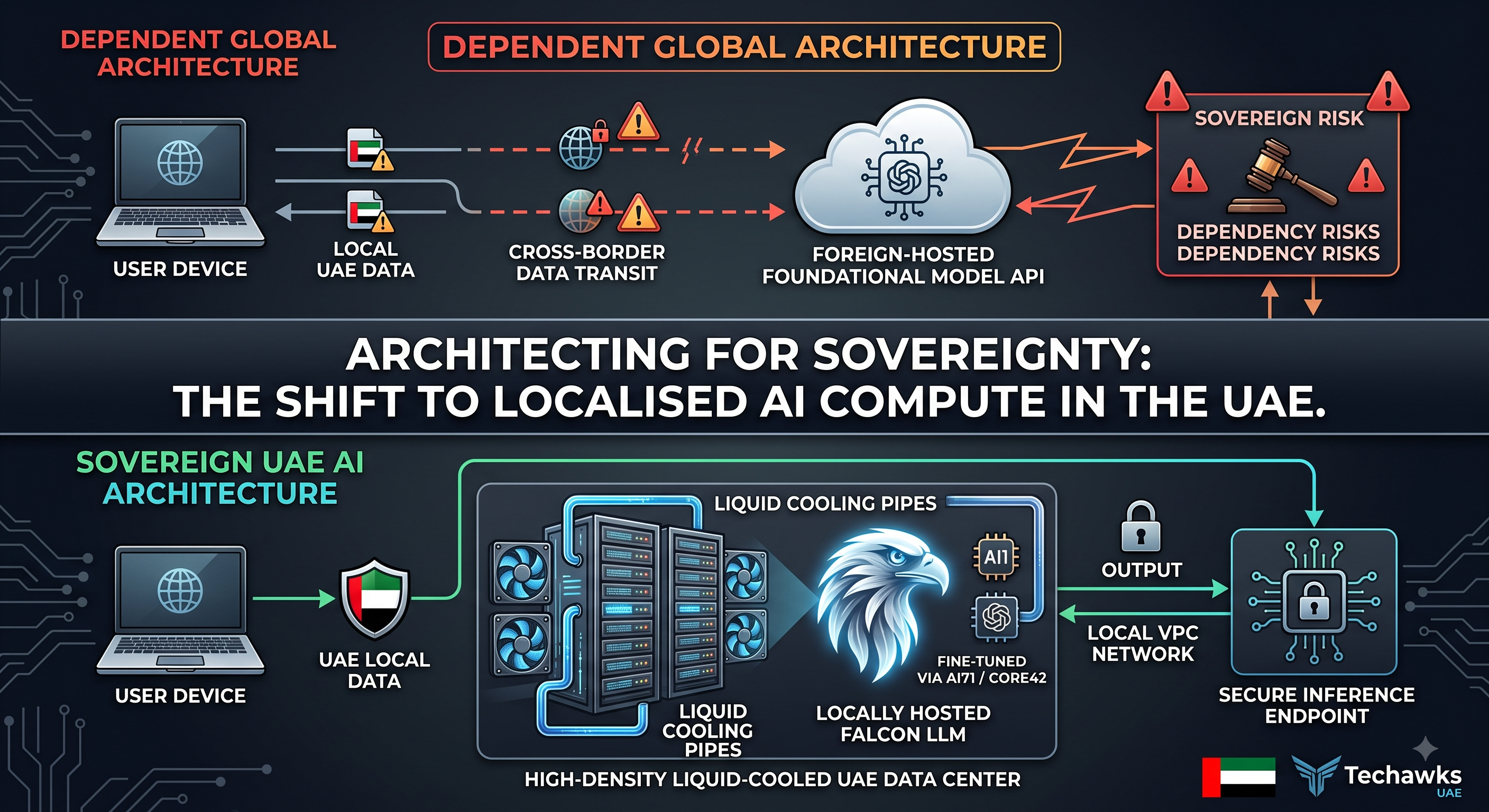
The UAE is fundamentally redefining global AI governance by treating artificial intelligence as a sovereign asset—comparable to national telecommunications or energy—rather than a rented capability. For technical teams building in Dubai and Abu Dhabi, this necessitates a deliberate transition from external API wrappers to indigenous models deployed on local computing environments.
The Pillars of the UAE's Sovereign AI Stack
The Doctrine of Infrastructure Sovereignty: By governing AI within national legal boundaries, the UAE is mitigating long-term dependency risks associated with external platforms, foreign policy shifts, and opaque external data jurisdictions.
Next-Generation Local Compute: The UAE is shifting from a regional data center hub to a dedicated "AI compute destination," supported by hyperscale investments and government-backed AI programs. Accommodating new AI workloads means moving away from traditional 5-10 kW enterprise racks to high-density clusters drawing 40 to over 100 kilowatts per rack. This shift makes direct-to-chip or immersion-based liquid cooling a strict design requirement to handle thermal profiles in the local climate.
Domestically Hosted Models: The Technology Innovation Institute (TII) develops the open-weight Falcon LLM family, providing frontier-scale capabilities. Entities like AI71 are commercialising these models by offering fine-tuned, vertically integrated solutions for the legal, healthcare, and government sectors.
Data Residency and Regulated Deployment: Deploying models locally via infrastructure like G42's Core42 ensures that sensitive commercial and public data remains subject to UAE law. This provides legal certainty and critical data residency for regulated sectors while delivering highly optimised Arabic-language processing capabilities.
Discussion Question
To the platform engineers and AI architects building in the UAE:
Are you already deploying local open-weight models to comply with data residency requirements, or are you currently navigating the transition away from global commercial APIs? How is your team addressing the infrastructure demands of high-density compute?
Share your deployment strategies below. 👇
CTA (Join Techawks UAE)
🇦🇪 Build the future of sovereign tech with Techawks UAE.
Join thousands of engineers, data architects, and tech leaders driving innovation across the Emirates and the wider GCC.
👉 Follow [Techawks UAE] for deep technical breakdowns, infrastructure insights, and exclusive local tech discussions.
The UAE is fundamentally redefining global AI governance by treating artificial intelligence as a sovereign asset—comparable to national telecommunications or energy—rather than a rented capability. For technical teams building in Dubai and Abu Dhabi, this necessitates a deliberate transition from external API wrappers to indigenous models deployed on local computing environments.
The Pillars of the UAE's Sovereign AI Stack
The Doctrine of Infrastructure Sovereignty: By governing AI within national legal boundaries, the UAE is mitigating long-term dependency risks associated with external platforms, foreign policy shifts, and opaque external data jurisdictions.
Next-Generation Local Compute: The UAE is shifting from a regional data center hub to a dedicated "AI compute destination," supported by hyperscale investments and government-backed AI programs. Accommodating new AI workloads means moving away from traditional 5-10 kW enterprise racks to high-density clusters drawing 40 to over 100 kilowatts per rack. This shift makes direct-to-chip or immersion-based liquid cooling a strict design requirement to handle thermal profiles in the local climate.
Domestically Hosted Models: The Technology Innovation Institute (TII) develops the open-weight Falcon LLM family, providing frontier-scale capabilities. Entities like AI71 are commercialising these models by offering fine-tuned, vertically integrated solutions for the legal, healthcare, and government sectors.
Data Residency and Regulated Deployment: Deploying models locally via infrastructure like G42's Core42 ensures that sensitive commercial and public data remains subject to UAE law. This provides legal certainty and critical data residency for regulated sectors while delivering highly optimised Arabic-language processing capabilities.
Discussion Question
To the platform engineers and AI architects building in the UAE:
Are you already deploying local open-weight models to comply with data residency requirements, or are you currently navigating the transition away from global commercial APIs? How is your team addressing the infrastructure demands of high-density compute?
Share your deployment strategies below. 👇
CTA (Join Techawks UAE)
🇦🇪 Build the future of sovereign tech with Techawks UAE.
Join thousands of engineers, data architects, and tech leaders driving innovation across the Emirates and the wider GCC.
👉 Follow [Techawks UAE] for deep technical breakdowns, infrastructure insights, and exclusive local tech discussions.
The Sovereign Inference Shift: Why UAE Engineering Teams Are Moving AI Workloads to Local Infrastructure
The UAE is fundamentally redefining global AI governance by treating artificial intelligence as a sovereign asset—comparable to national telecommunications or energy—rather than a rented capability. For technical teams building in Dubai and Abu Dhabi, this necessitates a deliberate transition from external API wrappers to indigenous models deployed on local computing environments.
The Pillars of the UAE's Sovereign AI Stack
The Doctrine of Infrastructure Sovereignty: By governing AI within national legal boundaries, the UAE is mitigating long-term dependency risks associated with external platforms, foreign policy shifts, and opaque external data jurisdictions.
Next-Generation Local Compute: The UAE is shifting from a regional data center hub to a dedicated "AI compute destination," supported by hyperscale investments and government-backed AI programs. Accommodating new AI workloads means moving away from traditional 5-10 kW enterprise racks to high-density clusters drawing 40 to over 100 kilowatts per rack. This shift makes direct-to-chip or immersion-based liquid cooling a strict design requirement to handle thermal profiles in the local climate.
Domestically Hosted Models: The Technology Innovation Institute (TII) develops the open-weight Falcon LLM family, providing frontier-scale capabilities. Entities like AI71 are commercialising these models by offering fine-tuned, vertically integrated solutions for the legal, healthcare, and government sectors.
Data Residency and Regulated Deployment: Deploying models locally via infrastructure like G42's Core42 ensures that sensitive commercial and public data remains subject to UAE law. This provides legal certainty and critical data residency for regulated sectors while delivering highly optimised Arabic-language processing capabilities.
Discussion Question
To the platform engineers and AI architects building in the UAE:
Are you already deploying local open-weight models to comply with data residency requirements, or are you currently navigating the transition away from global commercial APIs? How is your team addressing the infrastructure demands of high-density compute?
Share your deployment strategies below. 👇
CTA (Join Techawks UAE)
🇦🇪 Build the future of sovereign tech with Techawks UAE.
Join thousands of engineers, data architects, and tech leaders driving innovation across the Emirates and the wider GCC.
👉 Follow [Techawks UAE] for deep technical breakdowns, infrastructure insights, and exclusive local tech discussions.

 Arabic
 French
 Spanish
 Portuguese
 Deutsch
 Turkish
 Dutch
Dutch
 Italiano
 Russian
 Romaian
 Portuguese (Brazil)
 Greek
Greek