


Beyond Data Residency: Why Canadian AI Architecture Requires Pure Data Sovereignty
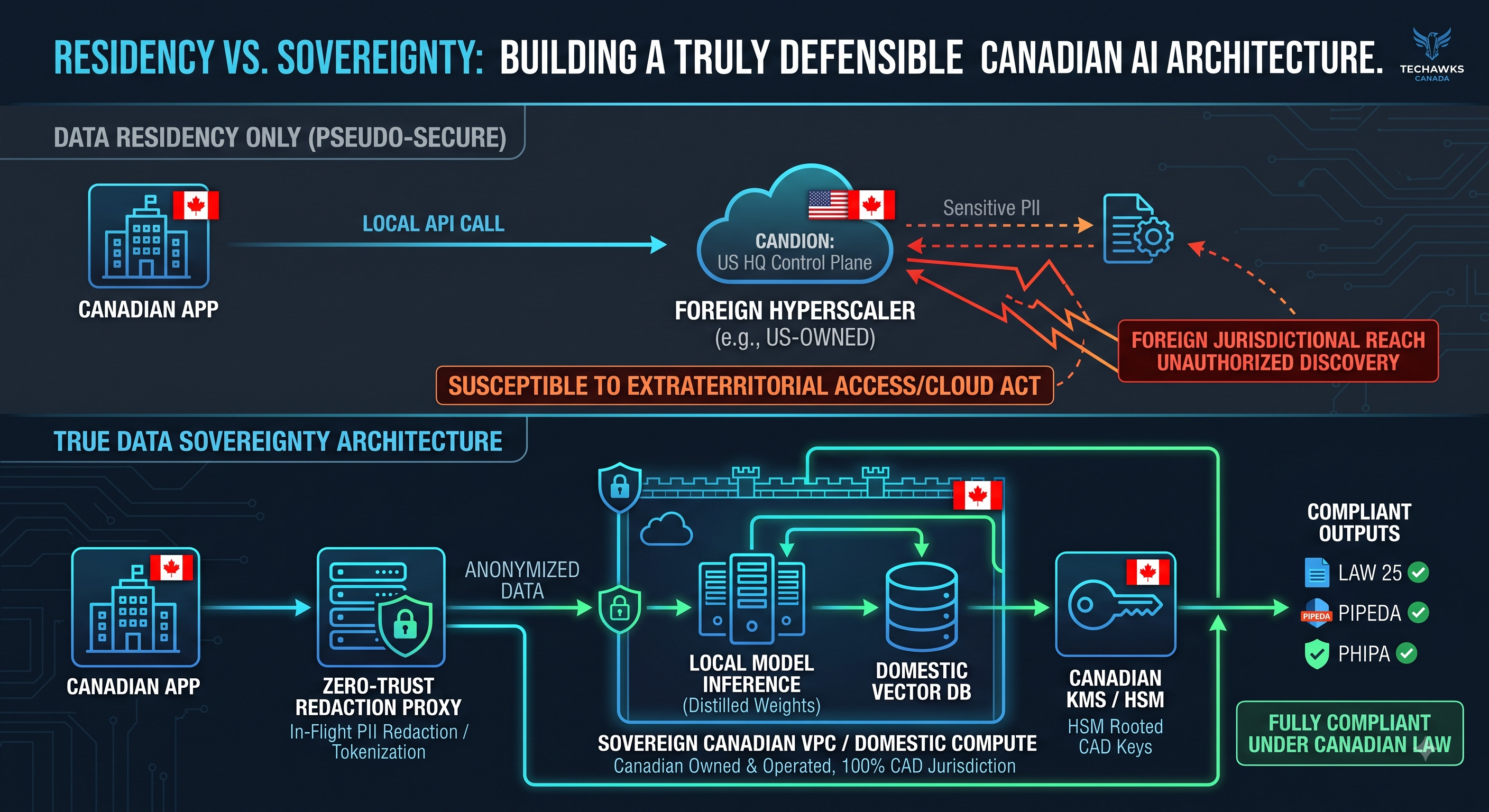
As Canada rolls out its multi-billion-dollar Sovereign AI Compute Strategy and expands domestic compute clusters across Ontario, Quebec, and Alberta, Canadian engineering and infrastructure teams are confronting a critical architectural nuance: The gap between where bits reside geographically (Data Residency) and who legally holds the decryption keys and jurisdiction (Data Sovereignty).
For Canadian financial institutions, healthcare networks, and public-sector tech teams, relying on foreign-governed APIs creates exposure to extraterritorial discovery mandates (such as the US CLOUD Act) regardless of the physical data centre location.
Here is how forward-looking Canadian engineering teams are architecting around this:
1. Decoupling the Model Plane from the Control Plane
The Vulnerability: Routing unredacted enterprise contexts or vector embeddings directly to foreign multi-tenant model APIs breaks provincial privacy compliance (PIPEDA, Quebec’s Law 25, PHIPA).
The Architectural Fix: Implement a zero-trust Tokenization & PII Redaction Proxy before any network egress. Sensitive entities, identifiers, and internal keys are replaced with cryptographic surrogates inside a Canadian-controlled VPC before sending abstracted payloads to external inference engines.
2. Hybrid Sovereign Compute: Deploying Made-in-Canada Weights
Instead of routing every workload out of country, teams are adopting a multi-tier sovereign stack:
Tier 1 (Sovereign In-VPC Inference): Deploying fine-tuned open-weight or domestic foundation models (e.g., Cohere weights or distilled open architectures) directly on Canadian-owned, carrier-neutral infrastructure.
Tier 2 (Client-Side Key Management): Implementing Bring Your Own Key (BYOK) and envelope encryption using domestic Key Management Services (KMS) with HSM modules rooted strictly within Canadian jurisdiction.
3. Cold-Climate Edge Inference
Leveraging regional Canadian data centres with hydro-powered, high-density liquid-cooled racks allows teams to run sustained local batch inference at predictable latency and operational cost without cross-border transit overhead.
Architecting defensible enterprise AI in Canada is no longer just about compliance paperwork—it is about designing zero-trust data topologies where legal sovereignty is enforced at the network and cryptographic layer.
Discussion Question
To Canadian software engineers, CTOs, and cloud architects:
How is your organization navigating the distinction between local cloud regions and true data sovereignty? Are you running self-hosted models in Canadian VPCs, or relying on redaction and proxy layers for global APIs?
Share your architectural perspectives below. 👇
CTA (Join Techawks Canada)
🇨🇦 Build resilient systems with Techawks Canada.
Join a premier community of Canadian developers, cloud architects, and engineering leaders shaping Canada’s next generation of sovereign infrastructure and enterprise AI.
👉 Follow [Techawks Canada] for engineering breakdowns, local architecture patterns, and tech leadership discussions.
As Canada rolls out its multi-billion-dollar Sovereign AI Compute Strategy and expands domestic compute clusters across Ontario, Quebec, and Alberta, Canadian engineering and infrastructure teams are confronting a critical architectural nuance: The gap between where bits reside geographically (Data Residency) and who legally holds the decryption keys and jurisdiction (Data Sovereignty).
For Canadian financial institutions, healthcare networks, and public-sector tech teams, relying on foreign-governed APIs creates exposure to extraterritorial discovery mandates (such as the US CLOUD Act) regardless of the physical data centre location.
Here is how forward-looking Canadian engineering teams are architecting around this:
1. Decoupling the Model Plane from the Control Plane
The Vulnerability: Routing unredacted enterprise contexts or vector embeddings directly to foreign multi-tenant model APIs breaks provincial privacy compliance (PIPEDA, Quebec’s Law 25, PHIPA).
The Architectural Fix: Implement a zero-trust Tokenization & PII Redaction Proxy before any network egress. Sensitive entities, identifiers, and internal keys are replaced with cryptographic surrogates inside a Canadian-controlled VPC before sending abstracted payloads to external inference engines.
2. Hybrid Sovereign Compute: Deploying Made-in-Canada Weights
Instead of routing every workload out of country, teams are adopting a multi-tier sovereign stack:
Tier 1 (Sovereign In-VPC Inference): Deploying fine-tuned open-weight or domestic foundation models (e.g., Cohere weights or distilled open architectures) directly on Canadian-owned, carrier-neutral infrastructure.
Tier 2 (Client-Side Key Management): Implementing Bring Your Own Key (BYOK) and envelope encryption using domestic Key Management Services (KMS) with HSM modules rooted strictly within Canadian jurisdiction.
3. Cold-Climate Edge Inference
Leveraging regional Canadian data centres with hydro-powered, high-density liquid-cooled racks allows teams to run sustained local batch inference at predictable latency and operational cost without cross-border transit overhead.
Architecting defensible enterprise AI in Canada is no longer just about compliance paperwork—it is about designing zero-trust data topologies where legal sovereignty is enforced at the network and cryptographic layer.
Discussion Question
To Canadian software engineers, CTOs, and cloud architects:
How is your organization navigating the distinction between local cloud regions and true data sovereignty? Are you running self-hosted models in Canadian VPCs, or relying on redaction and proxy layers for global APIs?
Share your architectural perspectives below. 👇
CTA (Join Techawks Canada)
🇨🇦 Build resilient systems with Techawks Canada.
Join a premier community of Canadian developers, cloud architects, and engineering leaders shaping Canada’s next generation of sovereign infrastructure and enterprise AI.
👉 Follow [Techawks Canada] for engineering breakdowns, local architecture patterns, and tech leadership discussions.
Beyond Data Residency: Why Canadian AI Architecture Requires Pure Data Sovereignty
As Canada rolls out its multi-billion-dollar Sovereign AI Compute Strategy and expands domestic compute clusters across Ontario, Quebec, and Alberta, Canadian engineering and infrastructure teams are confronting a critical architectural nuance: The gap between where bits reside geographically (Data Residency) and who legally holds the decryption keys and jurisdiction (Data Sovereignty).
For Canadian financial institutions, healthcare networks, and public-sector tech teams, relying on foreign-governed APIs creates exposure to extraterritorial discovery mandates (such as the US CLOUD Act) regardless of the physical data centre location.
Here is how forward-looking Canadian engineering teams are architecting around this:
1. Decoupling the Model Plane from the Control Plane
The Vulnerability: Routing unredacted enterprise contexts or vector embeddings directly to foreign multi-tenant model APIs breaks provincial privacy compliance (PIPEDA, Quebec’s Law 25, PHIPA).
The Architectural Fix: Implement a zero-trust Tokenization & PII Redaction Proxy before any network egress. Sensitive entities, identifiers, and internal keys are replaced with cryptographic surrogates inside a Canadian-controlled VPC before sending abstracted payloads to external inference engines.
2. Hybrid Sovereign Compute: Deploying Made-in-Canada Weights
Instead of routing every workload out of country, teams are adopting a multi-tier sovereign stack:
Tier 1 (Sovereign In-VPC Inference): Deploying fine-tuned open-weight or domestic foundation models (e.g., Cohere weights or distilled open architectures) directly on Canadian-owned, carrier-neutral infrastructure.
Tier 2 (Client-Side Key Management): Implementing Bring Your Own Key (BYOK) and envelope encryption using domestic Key Management Services (KMS) with HSM modules rooted strictly within Canadian jurisdiction.
3. Cold-Climate Edge Inference
Leveraging regional Canadian data centres with hydro-powered, high-density liquid-cooled racks allows teams to run sustained local batch inference at predictable latency and operational cost without cross-border transit overhead.
Architecting defensible enterprise AI in Canada is no longer just about compliance paperwork—it is about designing zero-trust data topologies where legal sovereignty is enforced at the network and cryptographic layer.
Discussion Question
To Canadian software engineers, CTOs, and cloud architects:
How is your organization navigating the distinction between local cloud regions and true data sovereignty? Are you running self-hosted models in Canadian VPCs, or relying on redaction and proxy layers for global APIs?
Share your architectural perspectives below. 👇
CTA (Join Techawks Canada)
🇨🇦 Build resilient systems with Techawks Canada.
Join a premier community of Canadian developers, cloud architects, and engineering leaders shaping Canada’s next generation of sovereign infrastructure and enterprise AI.
👉 Follow [Techawks Canada] for engineering breakdowns, local architecture patterns, and tech leadership discussions.

 English
 Arabic
 French
 Spanish
 Portuguese
 Deutsch
 Dutch
Dutch
 Italiano
 Russian
 Romaian
 Portuguese (Brazil)
 Greek
Greek