


The Ultimate Pre-Interview Tech Checklist: 10 Critical Steps Before Every First Round
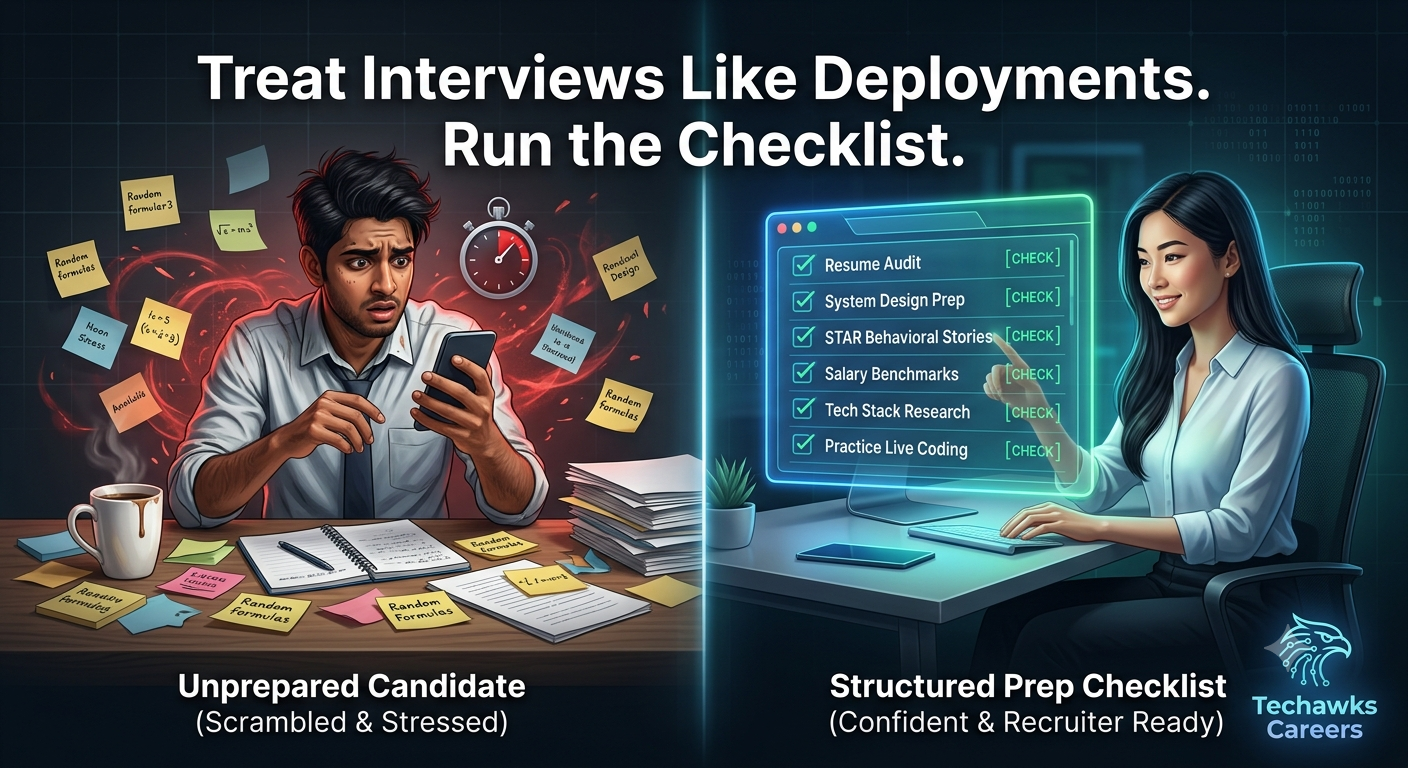
Passing first-round technical and recruiter screens requires more than scanning your resume an hour before the call. To project confidence, competence, and clarity, treat your interview preparation like a deployment checklist.
Work through these 10 actionable steps 24 to 48 hours before every interview:
Phase 1: Company & Product Reconnaissance
1. Test the Core Product: Sign up for the company’s product or app, try its main features, and note two areas of smooth UX and two potential technical improvements.
2. Map the Tech Stack: Review engineering job postings, tech blogs, or GitHub profiles from the company to identify their primary databases, frameworks, and cloud providers.
3. Research Recent Milestones: Identify recent product launches, major feature releases, or technical blog posts to ask informed questions during the interview.
Phase 2: Technical & Behavioral Alignment
4. Audit Your Resume Bullet Points: Be prepared to explain the architectural decisions, trade-offs, and metrics behind every project listed on your resume.
5. Prepare 3 STAR Stories: Prepare concise Situation-Task-Action-Result (STAR) stories highlighting a complex bug fix, a technical trade-off debate, and a cross-functional disagreement.
6. Rehearse Your "Tell Me About Yourself" Pitch: Keep your professional background pitch under 90 seconds, focusing on technical growth, recent impact, and why this specific role fits your trajectory.
Phase 3: System & Live Coding Setup
7. Verify Your Local Environment: Test your IDE, terminal extensions, node/python runtime versions, and local webcams to prevent technical glitches during live coding screens.
8. Bookmark Documentation Quick-Links: Keep language syntax docs, standard library references, and key API specs open in separate browser tabs for quick reference.
Phase 4: Strategic Questions for the Hiring Team
9. Prepare 3 Reverse-Interview Questions: Draft questions focused on engineering culture, deployment frequency, on-call schedules, or tech debt management.
10. Define Your Salary Expectation Range: Research benchmark salary data for the position, level, and location so you can answer compensation questions confidently.
Key Takeaways
Systematize Preparation: Treat every interview prep like a deployment procedure to eliminate missed details.
Understand the Business: Candidates who test the actual product and understand company constraints stand out immediately.
Control the Technical Environment: Eliminate setup friction by auditing your local IDE and testing equipment well ahead of time.
CTA
How do you prepare for high-stakes technical interviews? Join Tech Jobs & Opportunities to access downloadable interview checklists, review salary benchmarks, and practice mock interviews with fellow software engineers.
Passing first-round technical and recruiter screens requires more than scanning your resume an hour before the call. To project confidence, competence, and clarity, treat your interview preparation like a deployment checklist.
Work through these 10 actionable steps 24 to 48 hours before every interview:
Phase 1: Company & Product Reconnaissance
1. Test the Core Product: Sign up for the company’s product or app, try its main features, and note two areas of smooth UX and two potential technical improvements.
2. Map the Tech Stack: Review engineering job postings, tech blogs, or GitHub profiles from the company to identify their primary databases, frameworks, and cloud providers.
3. Research Recent Milestones: Identify recent product launches, major feature releases, or technical blog posts to ask informed questions during the interview.
Phase 2: Technical & Behavioral Alignment
4. Audit Your Resume Bullet Points: Be prepared to explain the architectural decisions, trade-offs, and metrics behind every project listed on your resume.
5. Prepare 3 STAR Stories: Prepare concise Situation-Task-Action-Result (STAR) stories highlighting a complex bug fix, a technical trade-off debate, and a cross-functional disagreement.
6. Rehearse Your "Tell Me About Yourself" Pitch: Keep your professional background pitch under 90 seconds, focusing on technical growth, recent impact, and why this specific role fits your trajectory.
Phase 3: System & Live Coding Setup
7. Verify Your Local Environment: Test your IDE, terminal extensions, node/python runtime versions, and local webcams to prevent technical glitches during live coding screens.
8. Bookmark Documentation Quick-Links: Keep language syntax docs, standard library references, and key API specs open in separate browser tabs for quick reference.
Phase 4: Strategic Questions for the Hiring Team
9. Prepare 3 Reverse-Interview Questions: Draft questions focused on engineering culture, deployment frequency, on-call schedules, or tech debt management.
10. Define Your Salary Expectation Range: Research benchmark salary data for the position, level, and location so you can answer compensation questions confidently.
Key Takeaways
Systematize Preparation: Treat every interview prep like a deployment procedure to eliminate missed details.
Understand the Business: Candidates who test the actual product and understand company constraints stand out immediately.
Control the Technical Environment: Eliminate setup friction by auditing your local IDE and testing equipment well ahead of time.
CTA
How do you prepare for high-stakes technical interviews? Join Tech Jobs & Opportunities to access downloadable interview checklists, review salary benchmarks, and practice mock interviews with fellow software engineers.
The Ultimate Pre-Interview Tech Checklist: 10 Critical Steps Before Every First Round
Passing first-round technical and recruiter screens requires more than scanning your resume an hour before the call. To project confidence, competence, and clarity, treat your interview preparation like a deployment checklist.
Work through these 10 actionable steps 24 to 48 hours before every interview:
Phase 1: Company & Product Reconnaissance
1. Test the Core Product: Sign up for the company’s product or app, try its main features, and note two areas of smooth UX and two potential technical improvements.
2. Map the Tech Stack: Review engineering job postings, tech blogs, or GitHub profiles from the company to identify their primary databases, frameworks, and cloud providers.
3. Research Recent Milestones: Identify recent product launches, major feature releases, or technical blog posts to ask informed questions during the interview.
Phase 2: Technical & Behavioral Alignment
4. Audit Your Resume Bullet Points: Be prepared to explain the architectural decisions, trade-offs, and metrics behind every project listed on your resume.
5. Prepare 3 STAR Stories: Prepare concise Situation-Task-Action-Result (STAR) stories highlighting a complex bug fix, a technical trade-off debate, and a cross-functional disagreement.
6. Rehearse Your "Tell Me About Yourself" Pitch: Keep your professional background pitch under 90 seconds, focusing on technical growth, recent impact, and why this specific role fits your trajectory.
Phase 3: System & Live Coding Setup
7. Verify Your Local Environment: Test your IDE, terminal extensions, node/python runtime versions, and local webcams to prevent technical glitches during live coding screens.
8. Bookmark Documentation Quick-Links: Keep language syntax docs, standard library references, and key API specs open in separate browser tabs for quick reference.
Phase 4: Strategic Questions for the Hiring Team
9. Prepare 3 Reverse-Interview Questions: Draft questions focused on engineering culture, deployment frequency, on-call schedules, or tech debt management.
10. Define Your Salary Expectation Range: Research benchmark salary data for the position, level, and location so you can answer compensation questions confidently.
Key Takeaways
Systematize Preparation: Treat every interview prep like a deployment procedure to eliminate missed details.
Understand the Business: Candidates who test the actual product and understand company constraints stand out immediately.
Control the Technical Environment: Eliminate setup friction by auditing your local IDE and testing equipment well ahead of time.
CTA
How do you prepare for high-stakes technical interviews? Join Tech Jobs & Opportunities to access downloadable interview checklists, review salary benchmarks, and practice mock interviews with fellow software engineers.

 English
 Arabic
 French
 Spanish
 Portuguese
 Turkish
 Dutch
Dutch
 Italiano
 Russian
 Romaian
 Portuguese (Brazil)
 Greek
Greek