


Myth vs Fact: Why Indexing Every Foreign Key Won’t Save Your Database Performance
Database optimization isn't about slapping indexes on every relational column—it’s about understanding execution plans, cardinality, and write amplification.
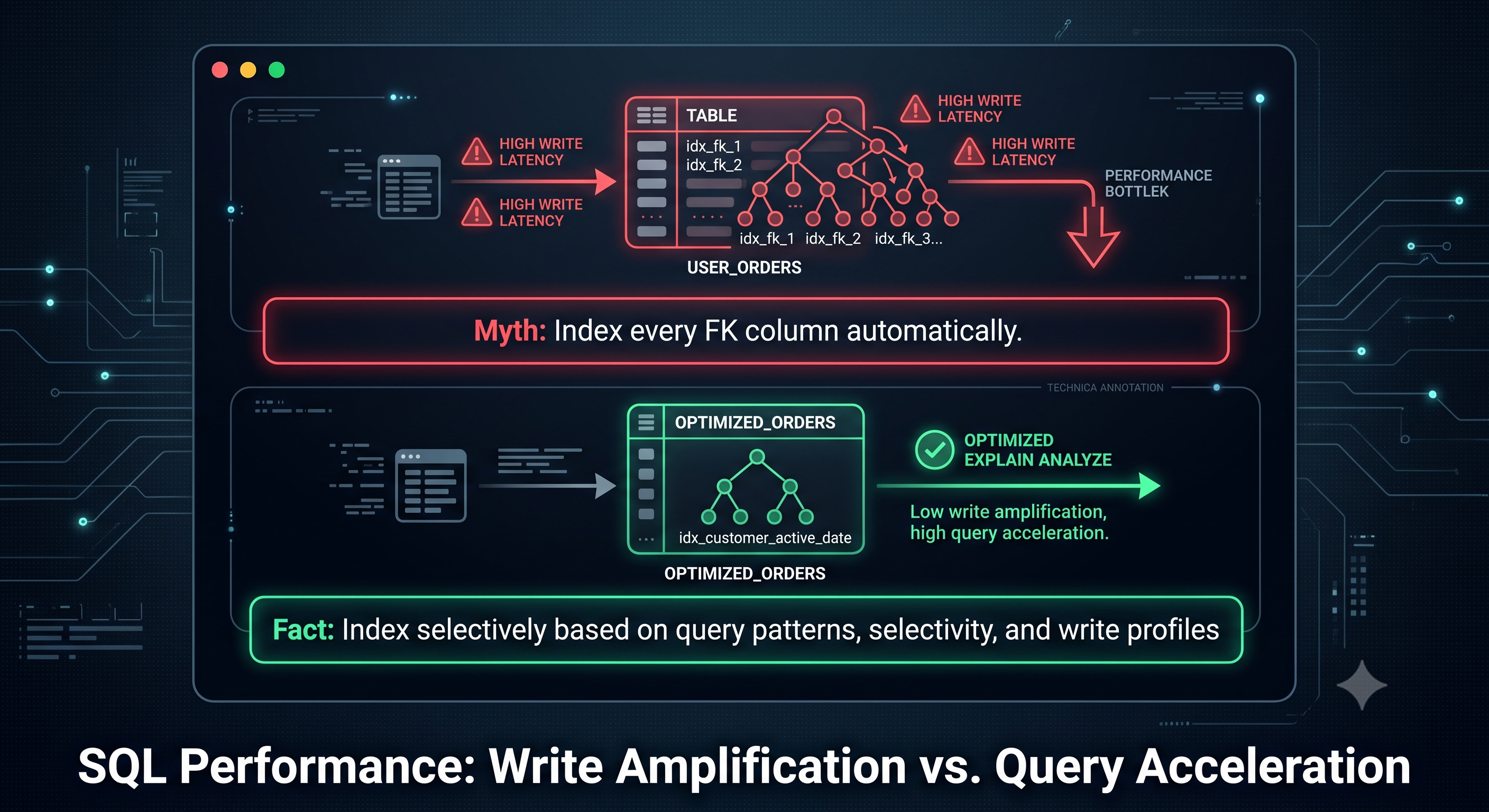
Myth: "Always create an index on every Foreign Key (FK) column to make your relational queries and joins faster."
Fact: An unconsidered index on a low-cardinality or high-write column provides negligible join speedup while degrading insert/update throughput, inflating write-ahead logs (WAL), and bloating memory buffers.
[ Table Write / INSERT / UPDATE ]
│
├──▶ Writes base tuple to Heap Page
├──▶ Updates Index 1 (Primary Key)
├──▶ Updates Index 2 (FK Index A) ──▶ Write Amplification & Buffer Bloat
└──▶ Updates Index 3 (FK Index B)
Why This Matters in Modern Backend Engineering:
The Low-Cardinality Trap: If a foreign key points to an enum-like status table or a boolean flag (e.g., user_type_id with 3 values across 5M rows), the query planner will frequently ignore the index and perform a Sequential Scan anyway.
Write Amplification: Every row mutation (INSERT, UPDATE, DELETE) forces the database engine to synchronously update every associated B-tree index, splitting index pages and trashing shared memory buffers.
HOT (Heap-Only Tuple) Invalidation: In engines like PostgreSQL, updating a row that contains an indexed column prevents HOT optimization, generating excessive table bloat and vacuum pressure.
What You Should Do Instead:
Index for Join Patterns, Not Existence: Index a foreign key only if you regularly query parent-child relationships from the child side (e.g., WHERE child.parent_id = ?) or if parent rows undergo frequent cascades (ON DELETE CASCADE).
Leverage Partial & Composite Indexes: If you only query active records, don't index the whole table:
SQL
-- Bad: Indexes all 10M rows unconditionally
CREATE INDEX idx_orders_customer_id ON orders(customer_id);
-- Better: Partial index targeting active query workloads
CREATE INDEX idx_active_orders_customer
ON orders(customer_id)
WHERE status = 'pending';
Inspect the Planner: Always run EXPLAIN (ANALYZE, BUFFERS) before committing an index to production to confirm index scans are actually chosen over sequential scans.
Discussion Question
What is the worst index-related production bottleneck or write-amplification issue your team has ever had to debug?
CTA (Join Developers & Coding)
💻 Join the Techawks Developers & Coding Community: Connect with software engineers, backend architects, and system developers worldwide to level up your SQL performance, system design patterns, and clean code practices.
👉 [Link to Techawks Developers & Coding Community]
Database optimization isn't about slapping indexes on every relational column—it’s about understanding execution plans, cardinality, and write amplification.
Myth: "Always create an index on every Foreign Key (FK) column to make your relational queries and joins faster."
Fact: An unconsidered index on a low-cardinality or high-write column provides negligible join speedup while degrading insert/update throughput, inflating write-ahead logs (WAL), and bloating memory buffers.
[ Table Write / INSERT / UPDATE ]
│
├──▶ Writes base tuple to Heap Page
├──▶ Updates Index 1 (Primary Key)
├──▶ Updates Index 2 (FK Index A) ──▶ Write Amplification & Buffer Bloat
└──▶ Updates Index 3 (FK Index B)
Why This Matters in Modern Backend Engineering:
The Low-Cardinality Trap: If a foreign key points to an enum-like status table or a boolean flag (e.g., user_type_id with 3 values across 5M rows), the query planner will frequently ignore the index and perform a Sequential Scan anyway.
Write Amplification: Every row mutation (INSERT, UPDATE, DELETE) forces the database engine to synchronously update every associated B-tree index, splitting index pages and trashing shared memory buffers.
HOT (Heap-Only Tuple) Invalidation: In engines like PostgreSQL, updating a row that contains an indexed column prevents HOT optimization, generating excessive table bloat and vacuum pressure.
What You Should Do Instead:
Index for Join Patterns, Not Existence: Index a foreign key only if you regularly query parent-child relationships from the child side (e.g., WHERE child.parent_id = ?) or if parent rows undergo frequent cascades (ON DELETE CASCADE).
Leverage Partial & Composite Indexes: If you only query active records, don't index the whole table:
SQL
-- Bad: Indexes all 10M rows unconditionally
CREATE INDEX idx_orders_customer_id ON orders(customer_id);
-- Better: Partial index targeting active query workloads
CREATE INDEX idx_active_orders_customer
ON orders(customer_id)
WHERE status = 'pending';
Inspect the Planner: Always run EXPLAIN (ANALYZE, BUFFERS) before committing an index to production to confirm index scans are actually chosen over sequential scans.
Discussion Question
What is the worst index-related production bottleneck or write-amplification issue your team has ever had to debug?
CTA (Join Developers & Coding)
💻 Join the Techawks Developers & Coding Community: Connect with software engineers, backend architects, and system developers worldwide to level up your SQL performance, system design patterns, and clean code practices.
👉 [Link to Techawks Developers & Coding Community]
Myth vs Fact: Why Indexing Every Foreign Key Won’t Save Your Database Performance
Database optimization isn't about slapping indexes on every relational column—it’s about understanding execution plans, cardinality, and write amplification.
Myth: "Always create an index on every Foreign Key (FK) column to make your relational queries and joins faster."
Fact: An unconsidered index on a low-cardinality or high-write column provides negligible join speedup while degrading insert/update throughput, inflating write-ahead logs (WAL), and bloating memory buffers.
[ Table Write / INSERT / UPDATE ]
│
├──▶ Writes base tuple to Heap Page
├──▶ Updates Index 1 (Primary Key)
├──▶ Updates Index 2 (FK Index A) ──▶ Write Amplification & Buffer Bloat
└──▶ Updates Index 3 (FK Index B)
Why This Matters in Modern Backend Engineering:
The Low-Cardinality Trap: If a foreign key points to an enum-like status table or a boolean flag (e.g., user_type_id with 3 values across 5M rows), the query planner will frequently ignore the index and perform a Sequential Scan anyway.
Write Amplification: Every row mutation (INSERT, UPDATE, DELETE) forces the database engine to synchronously update every associated B-tree index, splitting index pages and trashing shared memory buffers.
HOT (Heap-Only Tuple) Invalidation: In engines like PostgreSQL, updating a row that contains an indexed column prevents HOT optimization, generating excessive table bloat and vacuum pressure.
What You Should Do Instead:
Index for Join Patterns, Not Existence: Index a foreign key only if you regularly query parent-child relationships from the child side (e.g., WHERE child.parent_id = ?) or if parent rows undergo frequent cascades (ON DELETE CASCADE).
Leverage Partial & Composite Indexes: If you only query active records, don't index the whole table:
SQL
-- Bad: Indexes all 10M rows unconditionally
CREATE INDEX idx_orders_customer_id ON orders(customer_id);
-- Better: Partial index targeting active query workloads
CREATE INDEX idx_active_orders_customer
ON orders(customer_id)
WHERE status = 'pending';
Inspect the Planner: Always run EXPLAIN (ANALYZE, BUFFERS) before committing an index to production to confirm index scans are actually chosen over sequential scans.
Discussion Question
What is the worst index-related production bottleneck or write-amplification issue your team has ever had to debug?
CTA (Join Developers & Coding)
💻 Join the Techawks Developers & Coding Community: Connect with software engineers, backend architects, and system developers worldwide to level up your SQL performance, system design patterns, and clean code practices.
👉 [Link to Techawks Developers & Coding Community]

 English
 Arabic
 French
 Spanish
 Portuguese
 Deutsch
 Turkish
 Dutch
Dutch
 Italiano
 Romaian
 Portuguese (Brazil)
 Greek
Greek