


Scale, Security, and Compliance: 4 Architectural Pillars for US-Based Enterprise Engineering
Building and scaling engineering platforms for US enterprises requires far more than just writing clean code. Between rigid regulatory frameworks, SOC 2 compliance audits, and multi-region failover demands, architectural choices made in early development phases can either unlock frictionless growth or trap your team in expensive technical debt.
Whether you're an engineering leader, platform architect, or CTO operating in the US tech ecosystem, here are four non-negotiable architectural pillars to design into your infrastructure:
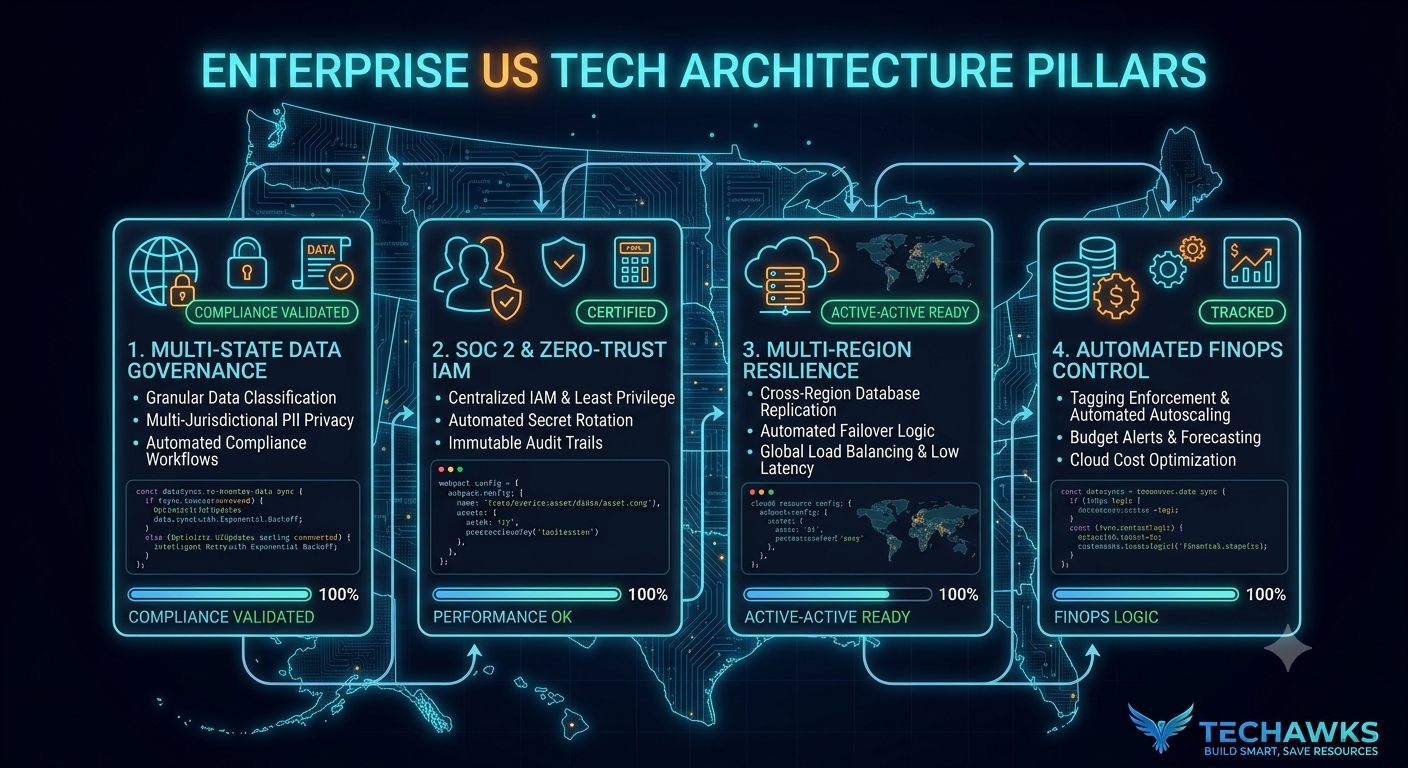
1. Granular Data Residency & Multi-State Compliance
With regulations like CCPA/CPRA in California and expanding state-level privacy laws across the country, handling user data requires strict governance. Implement granular data classification tags, automated data lifecycle policies (TTL and deletion pipelines), and localized storage encryption to ensure compliance without re-architecting your databases for every new state law.
2. SOC 2 Type II Compliance by Design
Enterprise US buyers expect zero-trust access controls and auditable security posture. Build with centralized Identity and Access Management (IAM), Least Privilege access policies, automated secret rotation, and immutable audit logging (via CloudTrail or SIEM integrations) right from day one.
3. Multi-Region Active-Passive (or Active-Active) Resiliency
High-availability SLAs in North America demand minimal downtime during AWS, GCP, or Azure regional outages. Design stateless microservices, automated cross-region database replication, and DNS failovers with low TTLs to guarantee low Latency and 99.99% uptime for cross-country users.
4. FinOps & Automated Cloud Cost Guardrails
Unchecked cloud spending across multi-cloud environments can rapidly erode margins. Implement resource tagging enforcement, automated autoscaling triggers, ephemeral staging environments, and budget alerts using modern FinOps frameworks to keep compute costs predictable as query volume scales.
Key Take Aways
Bake compliance into code: Automate data privacy policies and audit logs at the infrastructure layer rather than treating SOC 2 or CCPA as a manual checklist.
Design for zero-trust: Enforce strict IAM policies and immutable audit trails to satisfy security reviews for enterprise buyers.
Cost efficiency is a design feature: Proactive FinOps and auto-scaling prevent unexpected cloud bill spikes as US user concurrency scales.
CTA
Are you building, scaling, or managing enterprise-grade infrastructure in the US? Join Techawks USA today!
Building and scaling engineering platforms for US enterprises requires far more than just writing clean code. Between rigid regulatory frameworks, SOC 2 compliance audits, and multi-region failover demands, architectural choices made in early development phases can either unlock frictionless growth or trap your team in expensive technical debt.
Whether you're an engineering leader, platform architect, or CTO operating in the US tech ecosystem, here are four non-negotiable architectural pillars to design into your infrastructure:
1. Granular Data Residency & Multi-State Compliance
With regulations like CCPA/CPRA in California and expanding state-level privacy laws across the country, handling user data requires strict governance. Implement granular data classification tags, automated data lifecycle policies (TTL and deletion pipelines), and localized storage encryption to ensure compliance without re-architecting your databases for every new state law.
2. SOC 2 Type II Compliance by Design
Enterprise US buyers expect zero-trust access controls and auditable security posture. Build with centralized Identity and Access Management (IAM), Least Privilege access policies, automated secret rotation, and immutable audit logging (via CloudTrail or SIEM integrations) right from day one.
3. Multi-Region Active-Passive (or Active-Active) Resiliency
High-availability SLAs in North America demand minimal downtime during AWS, GCP, or Azure regional outages. Design stateless microservices, automated cross-region database replication, and DNS failovers with low TTLs to guarantee low Latency and 99.99% uptime for cross-country users.
4. FinOps & Automated Cloud Cost Guardrails
Unchecked cloud spending across multi-cloud environments can rapidly erode margins. Implement resource tagging enforcement, automated autoscaling triggers, ephemeral staging environments, and budget alerts using modern FinOps frameworks to keep compute costs predictable as query volume scales.
Key Take Aways
Bake compliance into code: Automate data privacy policies and audit logs at the infrastructure layer rather than treating SOC 2 or CCPA as a manual checklist.
Design for zero-trust: Enforce strict IAM policies and immutable audit trails to satisfy security reviews for enterprise buyers.
Cost efficiency is a design feature: Proactive FinOps and auto-scaling prevent unexpected cloud bill spikes as US user concurrency scales.
CTA
Are you building, scaling, or managing enterprise-grade infrastructure in the US? Join Techawks USA today!
Scale, Security, and Compliance: 4 Architectural Pillars for US-Based Enterprise Engineering
Building and scaling engineering platforms for US enterprises requires far more than just writing clean code. Between rigid regulatory frameworks, SOC 2 compliance audits, and multi-region failover demands, architectural choices made in early development phases can either unlock frictionless growth or trap your team in expensive technical debt.
Whether you're an engineering leader, platform architect, or CTO operating in the US tech ecosystem, here are four non-negotiable architectural pillars to design into your infrastructure:
1. Granular Data Residency & Multi-State Compliance
With regulations like CCPA/CPRA in California and expanding state-level privacy laws across the country, handling user data requires strict governance. Implement granular data classification tags, automated data lifecycle policies (TTL and deletion pipelines), and localized storage encryption to ensure compliance without re-architecting your databases for every new state law.
2. SOC 2 Type II Compliance by Design
Enterprise US buyers expect zero-trust access controls and auditable security posture. Build with centralized Identity and Access Management (IAM), Least Privilege access policies, automated secret rotation, and immutable audit logging (via CloudTrail or SIEM integrations) right from day one.
3. Multi-Region Active-Passive (or Active-Active) Resiliency
High-availability SLAs in North America demand minimal downtime during AWS, GCP, or Azure regional outages. Design stateless microservices, automated cross-region database replication, and DNS failovers with low TTLs to guarantee low Latency and 99.99% uptime for cross-country users.
4. FinOps & Automated Cloud Cost Guardrails
Unchecked cloud spending across multi-cloud environments can rapidly erode margins. Implement resource tagging enforcement, automated autoscaling triggers, ephemeral staging environments, and budget alerts using modern FinOps frameworks to keep compute costs predictable as query volume scales.
Key Take Aways
Bake compliance into code: Automate data privacy policies and audit logs at the infrastructure layer rather than treating SOC 2 or CCPA as a manual checklist.
Design for zero-trust: Enforce strict IAM policies and immutable audit trails to satisfy security reviews for enterprise buyers.
Cost efficiency is a design feature: Proactive FinOps and auto-scaling prevent unexpected cloud bill spikes as US user concurrency scales.
CTA
Are you building, scaling, or managing enterprise-grade infrastructure in the US? Join Techawks USA today!

 English
 Arabic
 French
 Spanish
 Deutsch
 Turkish
 Dutch
Dutch
 Italiano
 Russian
 Romaian
 Portuguese (Brazil)
 Greek
Greek