


vLLM vs. SGLang in Production: Picking the Right High-Throughput Inference Engine for Multi-Agent Architectures
As LLM workloads transition from single-turn chat completion to multi-step autonomous agents, the performance bottleneck shifts from raw token generation speed to KV cache reuse efficiency.
If your backend coordinates dozens of autonomous agent loops or complex Model Context Protocol (MCP) servers, choosing between vLLM and SGLang dictates both your monthly cloud GPU compute spend and Time-to-First-Token (TTFT) latency.
1. Why Prefix Caching Dictates Agent Performance
In agentic pipelines, 70% to 90% of prompt tokens—such as tool schemas, MCP definitions, and recurring system instructions—are reused across consecutive turns.
vLLM (PagedAttention): Allocates memory using fixed-size memory pages to eliminate KV-cache fragmentation. Excellent for continuous batching and linear, high-throughput API endpoints.
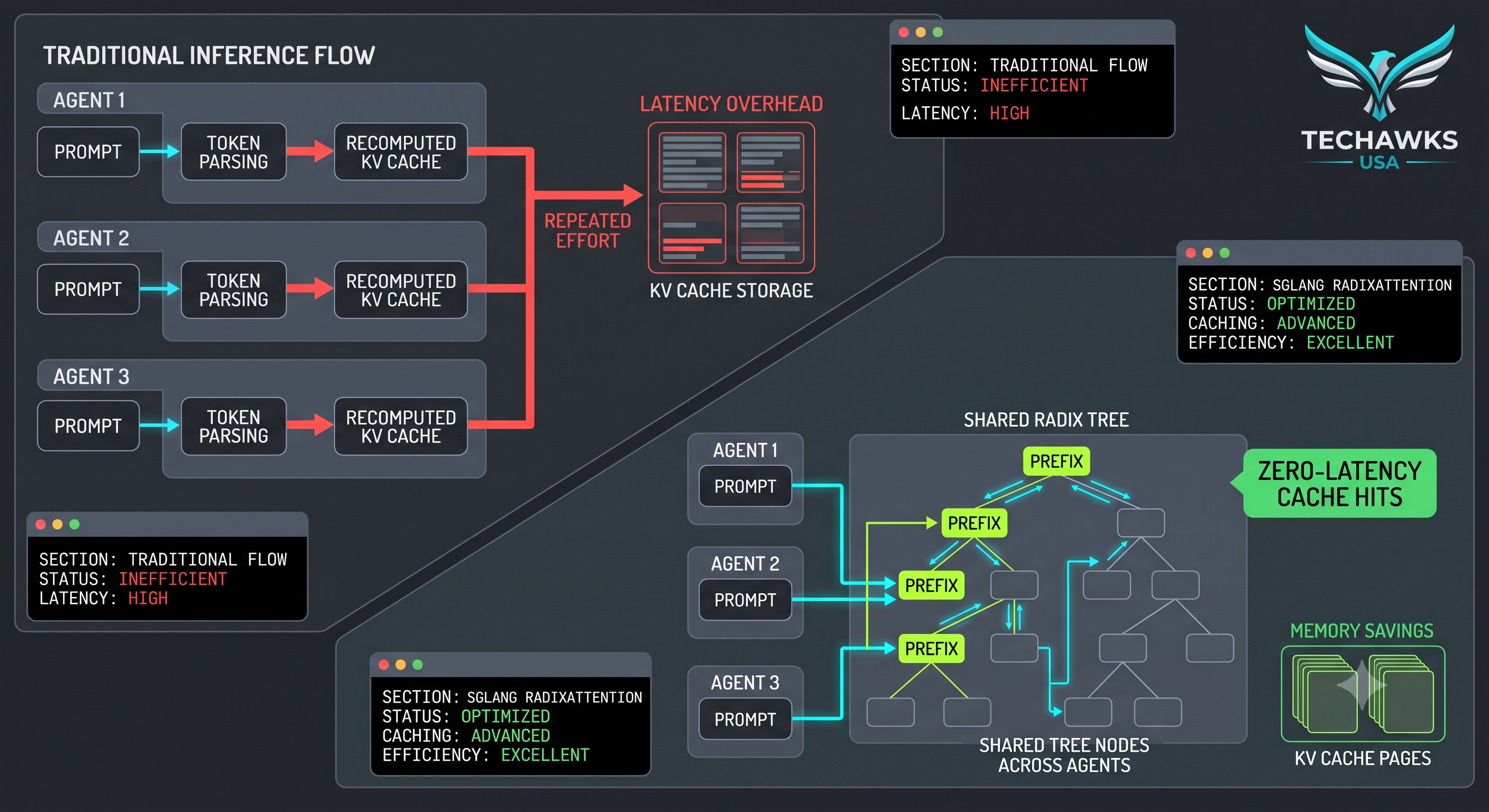
SGLang (RadixAttention): Organizes KV cache along a hierarchical Radix tree. When multiple agents share identical tool descriptions or conversational branches, SGLang reuses the cached KV tree directly, bypassing prompt reprocessing.
2. Head-to-Head Architecture Breakdown
Architectural Dimension, vLLM (v0.6+), SGLang (PyTorch Ecosystem)
Core Memory Mechanism, PagedAttention (Page-level granularity), RadixAttention (Radix-tree KV matching)
Best-Fit Workload, "High-concurrency chat, bulk batching, unique queries", "Multi-turn agent loops, code execution, structured JSON"
Tool / Grammar Execution, Standard Outlines / Regex guided generation, Native frontend compiler with sub-graph execution
Ecosystem & Deployment, "Broadest hardware support (AWS, GCP, RunPod, Ray)", Tight PyTorch integration; optimized for dynamic branching
3. Engineering Recommendations for US Tech Stacks
Choose vLLM if your service handles user-facing RAG applications with distinct query contexts or large-scale batch embeddings where shared context reuse across concurrent users is minimal.
Choose SGLang if you are building tool-calling loops, multi-agent evaluation frameworks, or systems using large context schemas (e.g., Anthropic MCP setups) where Radix tree caching slashes TTFT by 3x–5x.
Discussion Question
For teams managing self-hosted agent pipelines: Are you running RadixAttention-based engines like SGLang in production, or are managed inference routers handling prefix caching for your clusters?
Call to Action (CTA)
Join Techawks USA — Engage with senior US software architects, AI engineers, and DevOps leads exploring scalable cloud infrastructure, AI runtime optimizations, and next-gen DevTools.
As LLM workloads transition from single-turn chat completion to multi-step autonomous agents, the performance bottleneck shifts from raw token generation speed to KV cache reuse efficiency.
If your backend coordinates dozens of autonomous agent loops or complex Model Context Protocol (MCP) servers, choosing between vLLM and SGLang dictates both your monthly cloud GPU compute spend and Time-to-First-Token (TTFT) latency.
1. Why Prefix Caching Dictates Agent Performance
In agentic pipelines, 70% to 90% of prompt tokens—such as tool schemas, MCP definitions, and recurring system instructions—are reused across consecutive turns.
vLLM (PagedAttention): Allocates memory using fixed-size memory pages to eliminate KV-cache fragmentation. Excellent for continuous batching and linear, high-throughput API endpoints.
SGLang (RadixAttention): Organizes KV cache along a hierarchical Radix tree. When multiple agents share identical tool descriptions or conversational branches, SGLang reuses the cached KV tree directly, bypassing prompt reprocessing.
2. Head-to-Head Architecture Breakdown
Architectural Dimension, vLLM (v0.6+), SGLang (PyTorch Ecosystem)
Core Memory Mechanism, PagedAttention (Page-level granularity), RadixAttention (Radix-tree KV matching)
Best-Fit Workload, "High-concurrency chat, bulk batching, unique queries", "Multi-turn agent loops, code execution, structured JSON"
Tool / Grammar Execution, Standard Outlines / Regex guided generation, Native frontend compiler with sub-graph execution
Ecosystem & Deployment, "Broadest hardware support (AWS, GCP, RunPod, Ray)", Tight PyTorch integration; optimized for dynamic branching
3. Engineering Recommendations for US Tech Stacks
Choose vLLM if your service handles user-facing RAG applications with distinct query contexts or large-scale batch embeddings where shared context reuse across concurrent users is minimal.
Choose SGLang if you are building tool-calling loops, multi-agent evaluation frameworks, or systems using large context schemas (e.g., Anthropic MCP setups) where Radix tree caching slashes TTFT by 3x–5x.
Discussion Question
For teams managing self-hosted agent pipelines: Are you running RadixAttention-based engines like SGLang in production, or are managed inference routers handling prefix caching for your clusters?
Call to Action (CTA)
Join Techawks USA — Engage with senior US software architects, AI engineers, and DevOps leads exploring scalable cloud infrastructure, AI runtime optimizations, and next-gen DevTools.
vLLM vs. SGLang in Production: Picking the Right High-Throughput Inference Engine for Multi-Agent Architectures
As LLM workloads transition from single-turn chat completion to multi-step autonomous agents, the performance bottleneck shifts from raw token generation speed to KV cache reuse efficiency.
If your backend coordinates dozens of autonomous agent loops or complex Model Context Protocol (MCP) servers, choosing between vLLM and SGLang dictates both your monthly cloud GPU compute spend and Time-to-First-Token (TTFT) latency.
1. Why Prefix Caching Dictates Agent Performance
In agentic pipelines, 70% to 90% of prompt tokens—such as tool schemas, MCP definitions, and recurring system instructions—are reused across consecutive turns.
vLLM (PagedAttention): Allocates memory using fixed-size memory pages to eliminate KV-cache fragmentation. Excellent for continuous batching and linear, high-throughput API endpoints.
SGLang (RadixAttention): Organizes KV cache along a hierarchical Radix tree. When multiple agents share identical tool descriptions or conversational branches, SGLang reuses the cached KV tree directly, bypassing prompt reprocessing.
2. Head-to-Head Architecture Breakdown
Architectural Dimension, vLLM (v0.6+), SGLang (PyTorch Ecosystem)
Core Memory Mechanism, PagedAttention (Page-level granularity), RadixAttention (Radix-tree KV matching)
Best-Fit Workload, "High-concurrency chat, bulk batching, unique queries", "Multi-turn agent loops, code execution, structured JSON"
Tool / Grammar Execution, Standard Outlines / Regex guided generation, Native frontend compiler with sub-graph execution
Ecosystem & Deployment, "Broadest hardware support (AWS, GCP, RunPod, Ray)", Tight PyTorch integration; optimized for dynamic branching
3. Engineering Recommendations for US Tech Stacks
Choose vLLM if your service handles user-facing RAG applications with distinct query contexts or large-scale batch embeddings where shared context reuse across concurrent users is minimal.
Choose SGLang if you are building tool-calling loops, multi-agent evaluation frameworks, or systems using large context schemas (e.g., Anthropic MCP setups) where Radix tree caching slashes TTFT by 3x–5x.
Discussion Question
For teams managing self-hosted agent pipelines: Are you running RadixAttention-based engines like SGLang in production, or are managed inference routers handling prefix caching for your clusters?
Call to Action (CTA)
Join Techawks USA — Engage with senior US software architects, AI engineers, and DevOps leads exploring scalable cloud infrastructure, AI runtime optimizations, and next-gen DevTools.

 English
 Arabic
 French
 Spanish
 Deutsch
 Turkish
 Dutch
Dutch
 Italiano
 Russian
 Romaian
 Portuguese (Brazil)
 Greek
Greek