


The Canadian Tech Stack Challenge: Can Your Architecture Pass the PIPEDA & Coast-to-Coast Latency Test?
Canadian engineering teams often face a distinct dual constraint: geographic distance causing cross-country network latency, alongside strict provincial and national compliance standards. Software that runs smoothly in a single metro region often hits speed bumps when scaled across Canadian provinces.
Take The Canadian Tech Stack Challenge and audit your production architecture against these three practical scenarios:
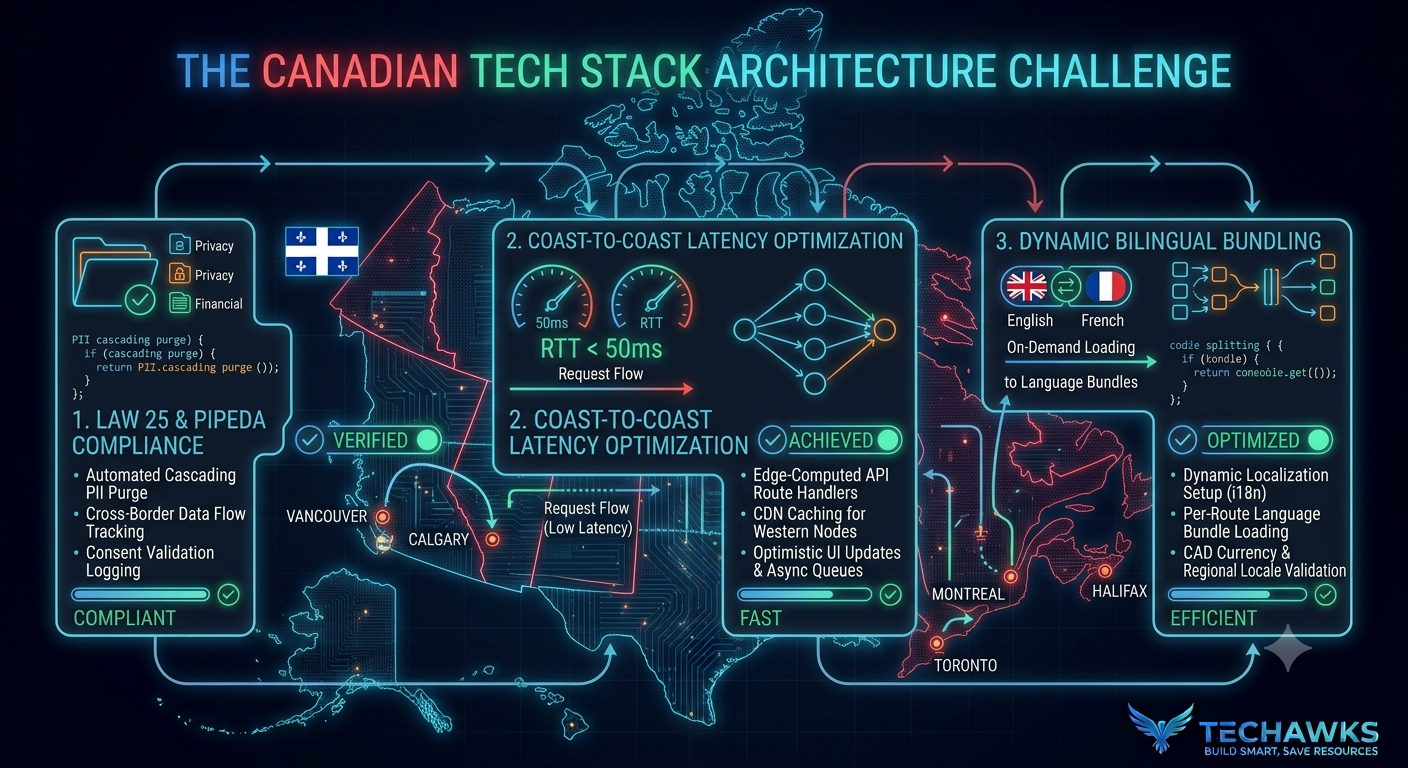
1: The Law 25 & PIPEDA Data Audit
The Scenario: A user in Quebec requests complete deletion of their account while exercising their rights under Quebec’s Law 25, while your primary data store resides in ca-central-1 (Central Canada).
The Test:
Can your database trigger an automated, cascading purge of PII across primary databases, cold storage backups, and third-party SaaS vendors within required timeframes?
Are cross-border or cross-provincial data flows explicitly tracked and logged with consent validation attached?
2: The Trans-Canada Latency Optimization
The Scenario: Your core API server is hosted in Montreal/Toronto, but thousands of concurrent users in Vancouver or Calgary are executing write-heavy transactions.
The Test:
Do you use edge-computed API route handlers and CDN caching for static assets in Western Canada nodes to keep Round Trip Time (RTT) under 50ms?
Are write requests handled via optimistic UI updates and async message queues (e.g., Kafka or SQS) to prevent UI blocking over high-latency connections?
3: Modern Bilingual Asset Splitting
The Scenario: Your application requires full English and French language parity to comply with provincial guidelines without sacrificing page speed performance.
The Test:
Is your localization (i18n) setup dynamic—loading language bundles on demand per route rather than shipping a bloated dual-language JSON payload on initial page load?
Are date, currency (CAD), and address formats dynamically validated based on regional locale settings?
Key Takeaways
Compliance at the data layer: Design database schemas with PII tagging and automated retention rules from day one rather than retrofitting privacy scripts later.
Edge strategy for vast geography: Leverage edge caching and regional API gateways in both Western and Eastern Canadian nodes to mitigate cross-country network latency.
Conditional asset loading: Keep client bundle sizes minimal by dynamically serving localized text and regional feature flags.
CTA
Are you an engineer, developer, or tech leader building for the Canadian ecosystem? Join Techawks Canada today!
Canadian engineering teams often face a distinct dual constraint: geographic distance causing cross-country network latency, alongside strict provincial and national compliance standards. Software that runs smoothly in a single metro region often hits speed bumps when scaled across Canadian provinces.
Take The Canadian Tech Stack Challenge and audit your production architecture against these three practical scenarios:
1: The Law 25 & PIPEDA Data Audit
The Scenario: A user in Quebec requests complete deletion of their account while exercising their rights under Quebec’s Law 25, while your primary data store resides in ca-central-1 (Central Canada).
The Test:
Can your database trigger an automated, cascading purge of PII across primary databases, cold storage backups, and third-party SaaS vendors within required timeframes?
Are cross-border or cross-provincial data flows explicitly tracked and logged with consent validation attached?
2: The Trans-Canada Latency Optimization
The Scenario: Your core API server is hosted in Montreal/Toronto, but thousands of concurrent users in Vancouver or Calgary are executing write-heavy transactions.
The Test:
Do you use edge-computed API route handlers and CDN caching for static assets in Western Canada nodes to keep Round Trip Time (RTT) under 50ms?
Are write requests handled via optimistic UI updates and async message queues (e.g., Kafka or SQS) to prevent UI blocking over high-latency connections?
3: Modern Bilingual Asset Splitting
The Scenario: Your application requires full English and French language parity to comply with provincial guidelines without sacrificing page speed performance.
The Test:
Is your localization (i18n) setup dynamic—loading language bundles on demand per route rather than shipping a bloated dual-language JSON payload on initial page load?
Are date, currency (CAD), and address formats dynamically validated based on regional locale settings?
Key Takeaways
Compliance at the data layer: Design database schemas with PII tagging and automated retention rules from day one rather than retrofitting privacy scripts later.
Edge strategy for vast geography: Leverage edge caching and regional API gateways in both Western and Eastern Canadian nodes to mitigate cross-country network latency.
Conditional asset loading: Keep client bundle sizes minimal by dynamically serving localized text and regional feature flags.
CTA
Are you an engineer, developer, or tech leader building for the Canadian ecosystem? Join Techawks Canada today!
The Canadian Tech Stack Challenge: Can Your Architecture Pass the PIPEDA & Coast-to-Coast Latency Test?
Canadian engineering teams often face a distinct dual constraint: geographic distance causing cross-country network latency, alongside strict provincial and national compliance standards. Software that runs smoothly in a single metro region often hits speed bumps when scaled across Canadian provinces.
Take The Canadian Tech Stack Challenge and audit your production architecture against these three practical scenarios:
1: The Law 25 & PIPEDA Data Audit
The Scenario: A user in Quebec requests complete deletion of their account while exercising their rights under Quebec’s Law 25, while your primary data store resides in ca-central-1 (Central Canada).
The Test:
Can your database trigger an automated, cascading purge of PII across primary databases, cold storage backups, and third-party SaaS vendors within required timeframes?
Are cross-border or cross-provincial data flows explicitly tracked and logged with consent validation attached?
2: The Trans-Canada Latency Optimization
The Scenario: Your core API server is hosted in Montreal/Toronto, but thousands of concurrent users in Vancouver or Calgary are executing write-heavy transactions.
The Test:
Do you use edge-computed API route handlers and CDN caching for static assets in Western Canada nodes to keep Round Trip Time (RTT) under 50ms?
Are write requests handled via optimistic UI updates and async message queues (e.g., Kafka or SQS) to prevent UI blocking over high-latency connections?
3: Modern Bilingual Asset Splitting
The Scenario: Your application requires full English and French language parity to comply with provincial guidelines without sacrificing page speed performance.
The Test:
Is your localization (i18n) setup dynamic—loading language bundles on demand per route rather than shipping a bloated dual-language JSON payload on initial page load?
Are date, currency (CAD), and address formats dynamically validated based on regional locale settings?
Key Takeaways
Compliance at the data layer: Design database schemas with PII tagging and automated retention rules from day one rather than retrofitting privacy scripts later.
Edge strategy for vast geography: Leverage edge caching and regional API gateways in both Western and Eastern Canadian nodes to mitigate cross-country network latency.
Conditional asset loading: Keep client bundle sizes minimal by dynamically serving localized text and regional feature flags.
CTA
Are you an engineer, developer, or tech leader building for the Canadian ecosystem? Join Techawks Canada today!

 English
 Arabic
 French
 Spanish
 Portuguese
 Deutsch
 Turkish
 Dutch
Dutch
 Italiano
 Romaian
 Portuguese (Brazil)
 Greek
Greek