 English
 Arabic
 French
 Spanish
 Portuguese
 Deutsch
 Turkish
 Dutch
Dutch
 Italiano
 Russian
 Romaian
 Portuguese (Brazil)
 Greek
Greek
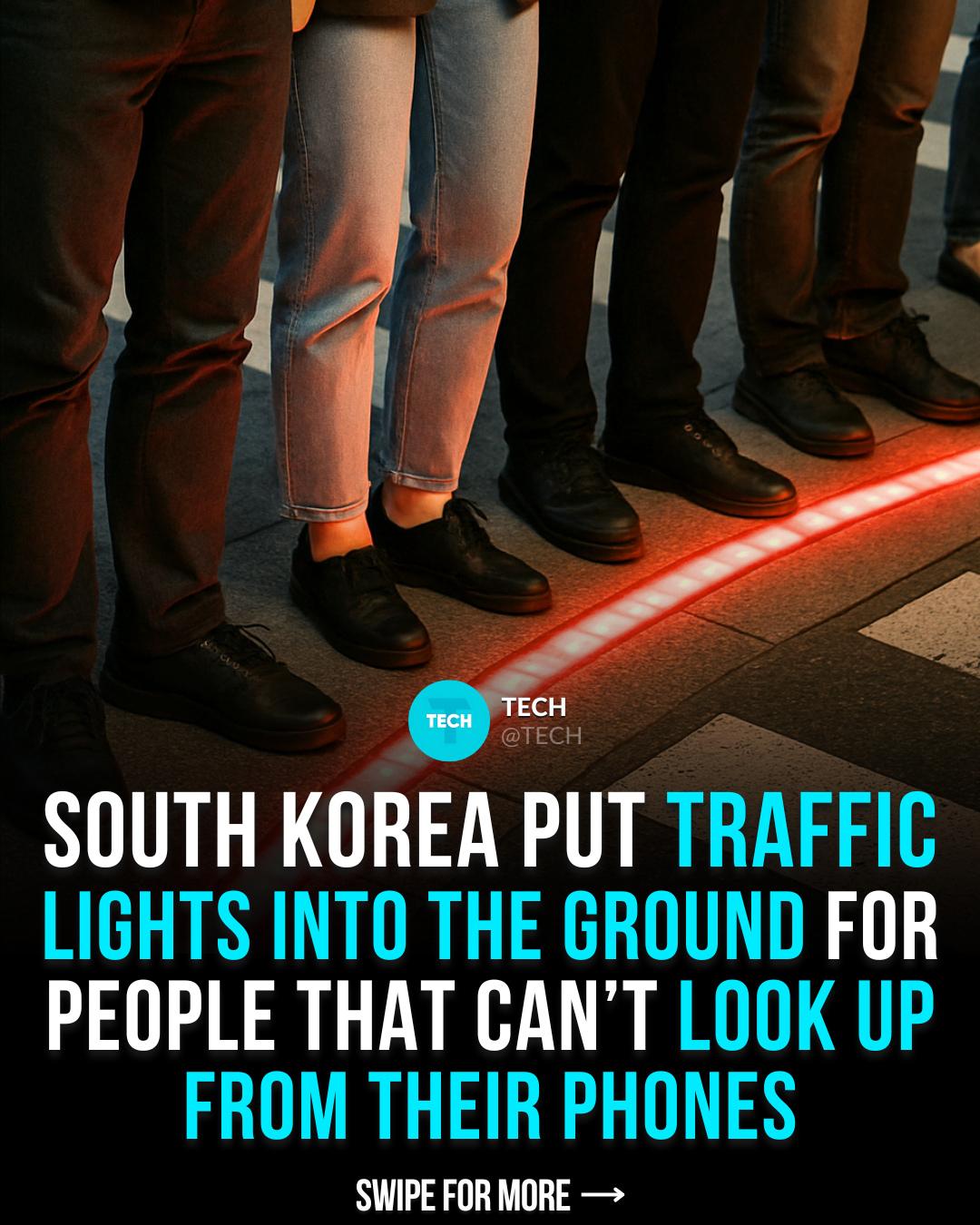
In the heart of Seoul, South Korea, is reshaping how cities think about pedestrian safety. Instead of scolding people for staring at their phones while crossing the street, city officials are building infrastructure that accommodates it. At nearly 1,200 intersections across Seoul, including 138 in Gangnam alone, glowing LED traffic lights have been embedded directly into the pavement—right at the edge of the sidewalk. Their purpose is to catch the attention of people looking down at their screens.
These in-ground lights glow red or green, synchronized with traditional signal poles. When the light is red, a band of illuminated warning pulses at their feet. When green, the path clears. The initiative began as a pilot program in 2019, prompted by a spike in accidents involving so-called “smombies”—a mashup of “smartphone” and “zombie,” describing pedestrians too distracted to look up. South Korea’s staggering smartphone penetration rate—over 94% as of 2017—has only compounded the issue.
But the glowing pavement is just one layer of Seoul’s multi-tiered “smart crossing” initiative. In more advanced intersections, sensors detect approaching pedestrians and trigger a range of safety measures: visual ground projections, alerts sent to nearby smartphones, and flashing signals aimed at oncoming drivers. Some crossings even use thermal and radar cameras to monitor foot traffic and adjust signals dynamically.
Unexpectedly, the benefits go beyond smartphone users. City officials have noted improvements in school zones, where the lights help young children stay farther from the curb. With over half of all traffic deaths in Seoul involving pedestrians as of 2020, these targeted interventions are already saving lives.
By embracing behavioral realities rather than resisting them, Seoul offers a compelling model for cities everywhere. When the future refuses to look up, the answer might just lie at our feet.
These in-ground lights glow red or green, synchronized with traditional signal poles. When the light is red, a band of illuminated warning pulses at their feet. When green, the path clears. The initiative began as a pilot program in 2019, prompted by a spike in accidents involving so-called “smombies”—a mashup of “smartphone” and “zombie,” describing pedestrians too distracted to look up. South Korea’s staggering smartphone penetration rate—over 94% as of 2017—has only compounded the issue.
But the glowing pavement is just one layer of Seoul’s multi-tiered “smart crossing” initiative. In more advanced intersections, sensors detect approaching pedestrians and trigger a range of safety measures: visual ground projections, alerts sent to nearby smartphones, and flashing signals aimed at oncoming drivers. Some crossings even use thermal and radar cameras to monitor foot traffic and adjust signals dynamically.
Unexpectedly, the benefits go beyond smartphone users. City officials have noted improvements in school zones, where the lights help young children stay farther from the curb. With over half of all traffic deaths in Seoul involving pedestrians as of 2020, these targeted interventions are already saving lives.
By embracing behavioral realities rather than resisting them, Seoul offers a compelling model for cities everywhere. When the future refuses to look up, the answer might just lie at our feet.
In the heart of Seoul, South Korea, is reshaping how cities think about pedestrian safety. Instead of scolding people for staring at their phones while crossing the street, city officials are building infrastructure that accommodates it. At nearly 1,200 intersections across Seoul, including 138 in Gangnam alone, glowing LED traffic lights have been embedded directly into the pavement—right at the edge of the sidewalk. Their purpose is to catch the attention of people looking down at their screens.
These in-ground lights glow red or green, synchronized with traditional signal poles. When the light is red, a band of illuminated warning pulses at their feet. When green, the path clears. The initiative began as a pilot program in 2019, prompted by a spike in accidents involving so-called “smombies”—a mashup of “smartphone” and “zombie,” describing pedestrians too distracted to look up. South Korea’s staggering smartphone penetration rate—over 94% as of 2017—has only compounded the issue.
But the glowing pavement is just one layer of Seoul’s multi-tiered “smart crossing” initiative. In more advanced intersections, sensors detect approaching pedestrians and trigger a range of safety measures: visual ground projections, alerts sent to nearby smartphones, and flashing signals aimed at oncoming drivers. Some crossings even use thermal and radar cameras to monitor foot traffic and adjust signals dynamically.
Unexpectedly, the benefits go beyond smartphone users. City officials have noted improvements in school zones, where the lights help young children stay farther from the curb. With over half of all traffic deaths in Seoul involving pedestrians as of 2020, these targeted interventions are already saving lives.
By embracing behavioral realities rather than resisting them, Seoul offers a compelling model for cities everywhere. When the future refuses to look up, the answer might just lie at our feet.
·177 Views
·0 Reviews
