


The 2026 AI Career Pivot: Why Evaluation Engineering (Evals) Is the Ultimate High-Leverage Skill
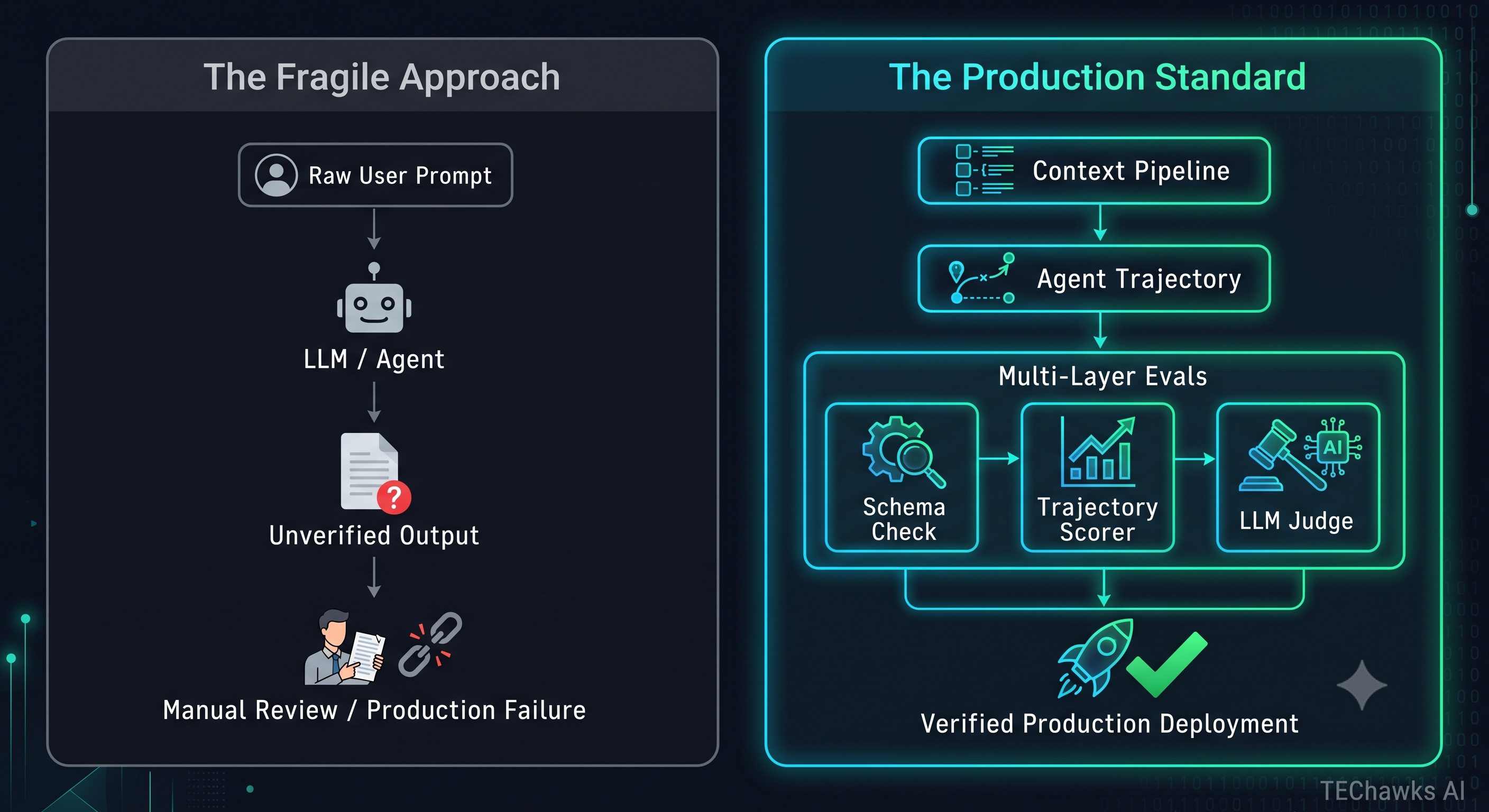
When raw model capability increases, prompt tweaks offer diminishing returns. In production-grade agentic applications, non-deterministic reasoning chains, dynamic tool calling, and multi-step execution introduce real system fragility.
If you want to future-proof your career as an AI builder, transition from Prompt Tweaker to Evaluation & System Engineer:
Move from Single-Turn Assertions to Trajectory Evals
Autonomous agents don’t just fail on the final output; they fail during intermediate steps. Build evaluations that score the entire reasoning trajectory: Did the agent select the right tool? Did it parse parameters correctly? Did it handle an API failure gracefully?
Curate Synthetic "Golden Datasets" and Failure Modes
High-performing teams don't rely on vibes or subjective manual spot-checks. Capture production edge cases, convert real-world user feedback into labeled test suites, and run continuous regression testing before shipping any workflow update.
Master Model-Graded Evaluators with Tight Heuristic Guardrails
Combine LLM-as-a-judge scoring with deterministic code checks (schema validation, latency ceilings, and static safety rules). This hybrid pattern eliminates evaluation drift and gives enterprise stakeholders verifiable proof of system reliability.
The takeaway: Anyone can make a demo work once with a clever prompt. The engineers commanding top roles are the ones who can guarantee an agent works 10,000 times in production without silent degradation.
Discussion Question
What is your primary method for testing agent reliability before deploying to production—heuristic unit tests, synthetic LLM evaluators, or production shadow-traffic monitoring?
CTA
Ready to move past basic prompting and master the architecture behind reliable AI agents?
👉 [Join AI Builders & Enthusiasts] to access real-world evaluation templates, architecture breakdowns, and collaborate with top practitioners.
When raw model capability increases, prompt tweaks offer diminishing returns. In production-grade agentic applications, non-deterministic reasoning chains, dynamic tool calling, and multi-step execution introduce real system fragility.
If you want to future-proof your career as an AI builder, transition from Prompt Tweaker to Evaluation & System Engineer:
Move from Single-Turn Assertions to Trajectory Evals
Autonomous agents don’t just fail on the final output; they fail during intermediate steps. Build evaluations that score the entire reasoning trajectory: Did the agent select the right tool? Did it parse parameters correctly? Did it handle an API failure gracefully?
Curate Synthetic "Golden Datasets" and Failure Modes
High-performing teams don't rely on vibes or subjective manual spot-checks. Capture production edge cases, convert real-world user feedback into labeled test suites, and run continuous regression testing before shipping any workflow update.
Master Model-Graded Evaluators with Tight Heuristic Guardrails
Combine LLM-as-a-judge scoring with deterministic code checks (schema validation, latency ceilings, and static safety rules). This hybrid pattern eliminates evaluation drift and gives enterprise stakeholders verifiable proof of system reliability.
The takeaway: Anyone can make a demo work once with a clever prompt. The engineers commanding top roles are the ones who can guarantee an agent works 10,000 times in production without silent degradation.
Discussion Question
What is your primary method for testing agent reliability before deploying to production—heuristic unit tests, synthetic LLM evaluators, or production shadow-traffic monitoring?
CTA
Ready to move past basic prompting and master the architecture behind reliable AI agents?
👉 [Join AI Builders & Enthusiasts] to access real-world evaluation templates, architecture breakdowns, and collaborate with top practitioners.
The 2026 AI Career Pivot: Why Evaluation Engineering (Evals) Is the Ultimate High-Leverage Skill
When raw model capability increases, prompt tweaks offer diminishing returns. In production-grade agentic applications, non-deterministic reasoning chains, dynamic tool calling, and multi-step execution introduce real system fragility.
If you want to future-proof your career as an AI builder, transition from Prompt Tweaker to Evaluation & System Engineer:
Move from Single-Turn Assertions to Trajectory Evals
Autonomous agents don’t just fail on the final output; they fail during intermediate steps. Build evaluations that score the entire reasoning trajectory: Did the agent select the right tool? Did it parse parameters correctly? Did it handle an API failure gracefully?
Curate Synthetic "Golden Datasets" and Failure Modes
High-performing teams don't rely on vibes or subjective manual spot-checks. Capture production edge cases, convert real-world user feedback into labeled test suites, and run continuous regression testing before shipping any workflow update.
Master Model-Graded Evaluators with Tight Heuristic Guardrails
Combine LLM-as-a-judge scoring with deterministic code checks (schema validation, latency ceilings, and static safety rules). This hybrid pattern eliminates evaluation drift and gives enterprise stakeholders verifiable proof of system reliability.
The takeaway: Anyone can make a demo work once with a clever prompt. The engineers commanding top roles are the ones who can guarantee an agent works 10,000 times in production without silent degradation.
Discussion Question
What is your primary method for testing agent reliability before deploying to production—heuristic unit tests, synthetic LLM evaluators, or production shadow-traffic monitoring?
CTA
Ready to move past basic prompting and master the architecture behind reliable AI agents?
👉 [Join AI Builders & Enthusiasts] to access real-world evaluation templates, architecture breakdowns, and collaborate with top practitioners.

 English
 Arabic
 French
 Spanish
 Portuguese
 Deutsch
 Turkish
 Italiano
 Russian
 Romaian
 Portuguese (Brazil)
 Greek
Greek