 English
 Arabic
 French
 Spanish
 Portuguese
 Deutsch
 Turkish
 Dutch
Dutch
 Italiano
 Russian
 Romaian
 Portuguese (Brazil)
 Greek
Greek
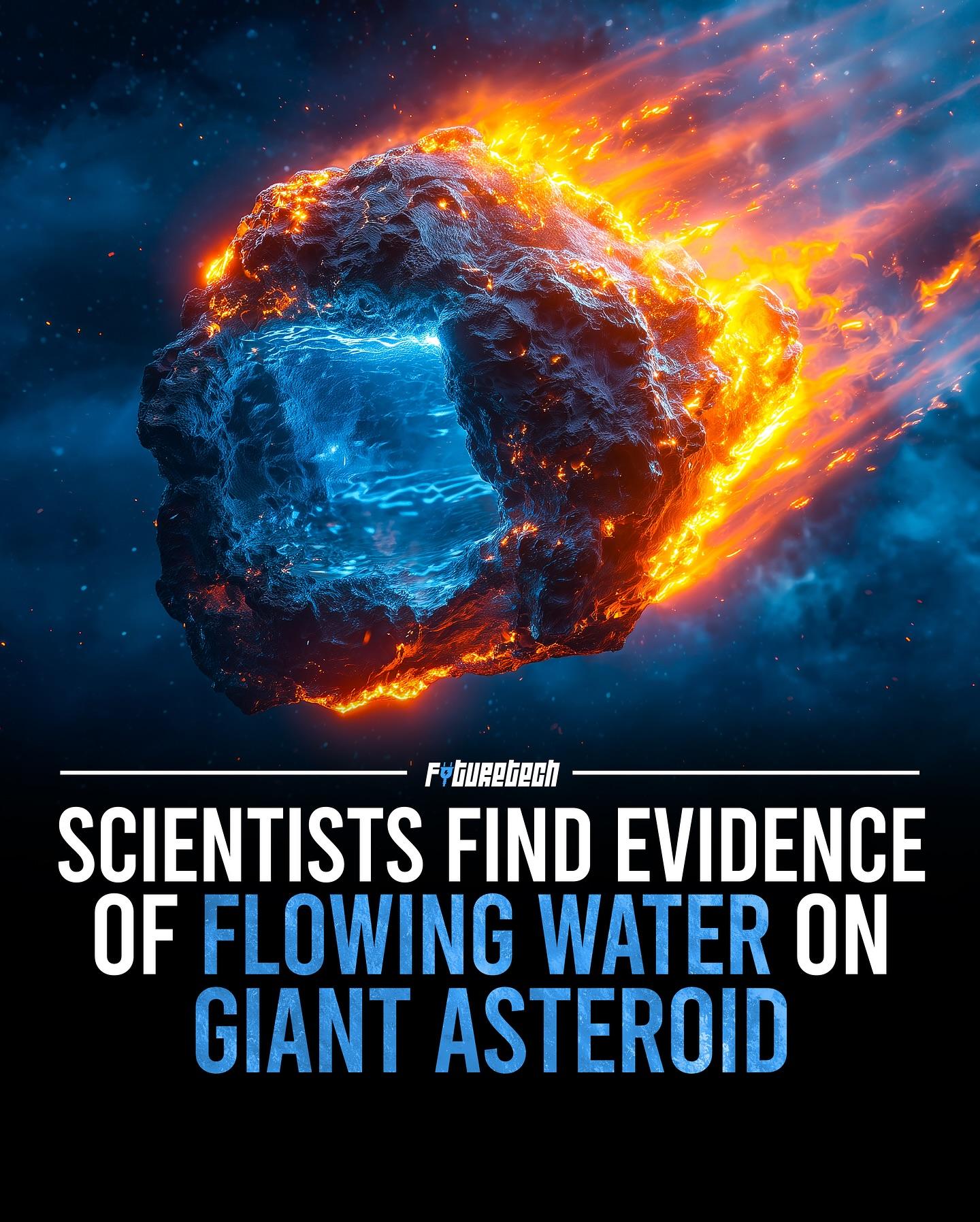
A new study in Nature suggests that the near-Earth asteroid Ryugu, now completely dry, may once have contained flowing liquid water far later in the solar system’s history than previously believed. Researchers analyzing samples collected by Japan’s Hayabusa2 mission discovered isotope signatures that indicate water activity roughly a billion years after Ryugu’s formation.
This finding challenges the long-held view that asteroid water vanished quickly after the solar system’s early days. Instead, it points to icy asteroids retaining water far longer, potentially thawed by impacts. If true, it widens the window during which water-rich asteroids could have delivered Earth’s oceans.
“The idea that Ryugu-like objects held on to ice for so long is remarkable,” said study lead Tsuyoshi Iizuka of the University of Tokyo. “It suggests the building blocks of Earth were far wetter than we imagined.”
#FutureTech
This finding challenges the long-held view that asteroid water vanished quickly after the solar system’s early days. Instead, it points to icy asteroids retaining water far longer, potentially thawed by impacts. If true, it widens the window during which water-rich asteroids could have delivered Earth’s oceans.
“The idea that Ryugu-like objects held on to ice for so long is remarkable,” said study lead Tsuyoshi Iizuka of the University of Tokyo. “It suggests the building blocks of Earth were far wetter than we imagined.”
#FutureTech
A new study in Nature suggests that the near-Earth asteroid Ryugu, now completely dry, may once have contained flowing liquid water far later in the solar system’s history than previously believed. Researchers analyzing samples collected by Japan’s Hayabusa2 mission discovered isotope signatures that indicate water activity roughly a billion years after Ryugu’s formation.
This finding challenges the long-held view that asteroid water vanished quickly after the solar system’s early days. Instead, it points to icy asteroids retaining water far longer, potentially thawed by impacts. If true, it widens the window during which water-rich asteroids could have delivered Earth’s oceans.
“The idea that Ryugu-like objects held on to ice for so long is remarkable,” said study lead Tsuyoshi Iizuka of the University of Tokyo. “It suggests the building blocks of Earth were far wetter than we imagined.”
#FutureTech 🔌
·184 Views
·0 Reviews
