


Why Most AI Agents Fail in Production (And the Dynamic Context Architecture That Fixes Them)
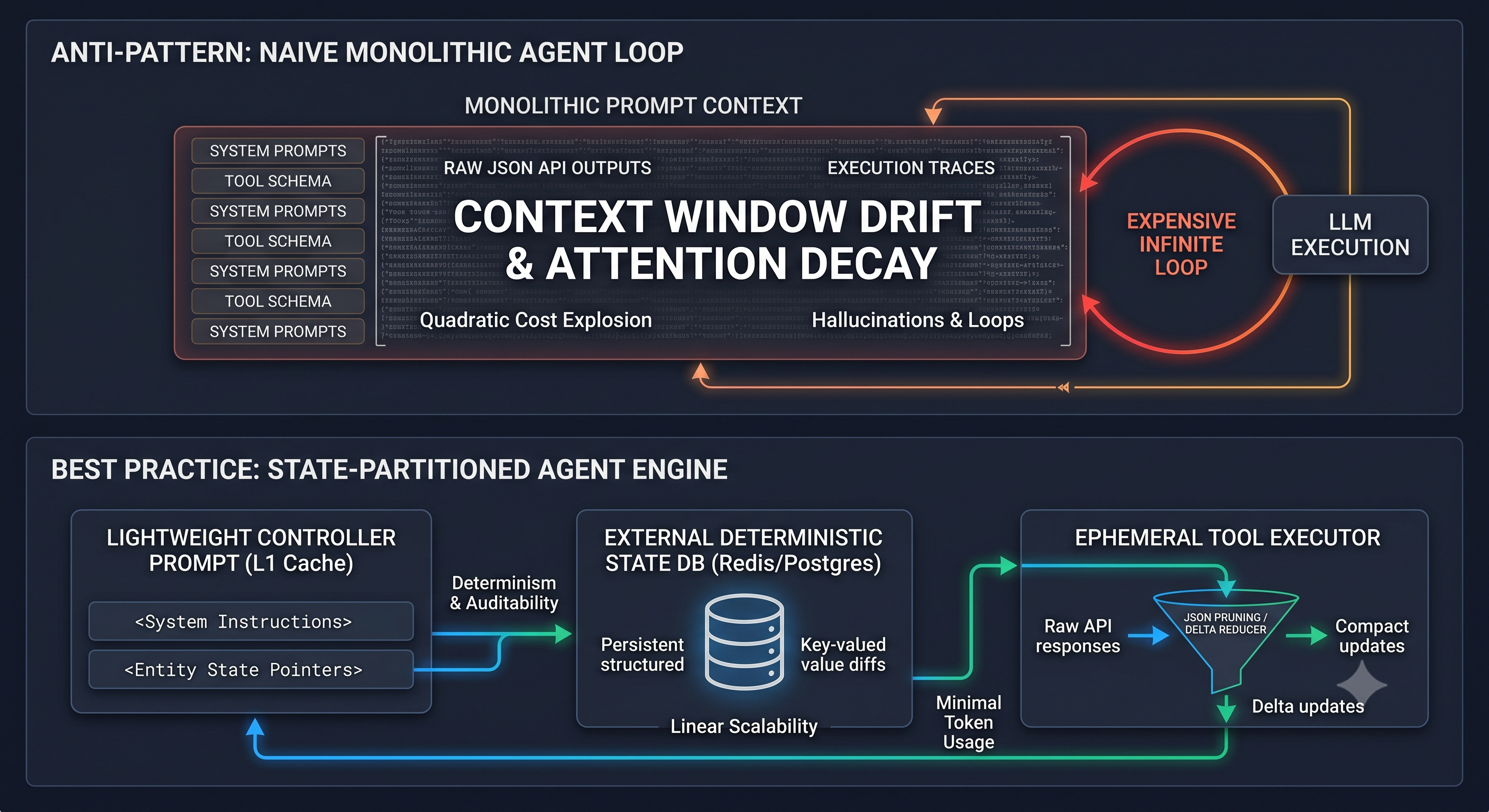
When building autonomous multi-step agents, naive implementations stuff every thought, raw API response, and observation directly into the conversational history.
By step 5 or 6, three critical failures occur:
Massive unstructured payload dumps dilute the model's self-attention across crucial system instructions.
Quadratic Cost Explosion: KV-cache storage and input token pricing scale rapidly as repetitive tool schema data is re-processed.
Loss of Determinism: The agent begins hallucinating parameters or enters infinite loops trying to reconcile contradictory intermediate states.
The Solution: State-Partitioned Architecture
Instead of maintaining a monolithic sliding context window, architect your agents into three isolated memory tiers:
Ephemeral Execution Sandbox: Tool calls and raw API responses run in an isolated memory buffer. The agent extracts structured key-value diffs, then discards the raw JSON payload.
Deterministic State Graph: Keep a structured external state outside the prompt (e.g., in a Redis or SQLite entity store). The LLM acts purely as a deterministic state-transition evaluator.
Structured Working Scratchpad: Compress intermediate observations into a concise semantic recap before triggering subsequent planning phases.
The Builder Takeaway:
Treat LLM prompts like CPU L1 cache—scarce and reserved strictly for execution-critical data. Keep persistent data and historical breadcrumbs in dedicated external state stores, feeding only synthesized delta updates to the model.
Discussion Question & Pol
lWhat is your primary architectural strategy to manage state and memory in multi-step AI agents?
📊 A) Dynamic Summary/Scratchpad compression (summarizing past tool steps)
📊 B) External State Stores & Graphs (e.g., LangGraph, custom state machines)
📊 C) Hierarchical Multi-Agent Systems (Planner $\rightarrow$ Sub-agent delegation)
📊 D) Large Context Window Ingestion (stuffing full execution traces)What framework or custom stack are you running to manage agent state in production? Let's discuss in the comments!
Call to Action (CTA)
Ready to build resilient, production-grade AI applications and master advanced agentic workflows?
👉 Join AI Builders & Enthusiasts to collaborate with engineers pushing the boundaries of applied artificial intelligence.
When building autonomous multi-step agents, naive implementations stuff every thought, raw API response, and observation directly into the conversational history.
By step 5 or 6, three critical failures occur:
Massive unstructured payload dumps dilute the model's self-attention across crucial system instructions.
Quadratic Cost Explosion: KV-cache storage and input token pricing scale rapidly as repetitive tool schema data is re-processed.
Loss of Determinism: The agent begins hallucinating parameters or enters infinite loops trying to reconcile contradictory intermediate states.
The Solution: State-Partitioned Architecture
Instead of maintaining a monolithic sliding context window, architect your agents into three isolated memory tiers:
Ephemeral Execution Sandbox: Tool calls and raw API responses run in an isolated memory buffer. The agent extracts structured key-value diffs, then discards the raw JSON payload.
Deterministic State Graph: Keep a structured external state outside the prompt (e.g., in a Redis or SQLite entity store). The LLM acts purely as a deterministic state-transition evaluator.
Structured Working Scratchpad: Compress intermediate observations into a concise semantic recap before triggering subsequent planning phases.
The Builder Takeaway:
Treat LLM prompts like CPU L1 cache—scarce and reserved strictly for execution-critical data. Keep persistent data and historical breadcrumbs in dedicated external state stores, feeding only synthesized delta updates to the model.
Discussion Question & Pol
lWhat is your primary architectural strategy to manage state and memory in multi-step AI agents?
📊 A) Dynamic Summary/Scratchpad compression (summarizing past tool steps)
📊 B) External State Stores & Graphs (e.g., LangGraph, custom state machines)
📊 C) Hierarchical Multi-Agent Systems (Planner $\rightarrow$ Sub-agent delegation)
📊 D) Large Context Window Ingestion (stuffing full execution traces)What framework or custom stack are you running to manage agent state in production? Let's discuss in the comments!
Call to Action (CTA)
Ready to build resilient, production-grade AI applications and master advanced agentic workflows?
👉 Join AI Builders & Enthusiasts to collaborate with engineers pushing the boundaries of applied artificial intelligence.
Why Most AI Agents Fail in Production (And the Dynamic Context Architecture That Fixes Them)
When building autonomous multi-step agents, naive implementations stuff every thought, raw API response, and observation directly into the conversational history.
By step 5 or 6, three critical failures occur:
Massive unstructured payload dumps dilute the model's self-attention across crucial system instructions.
Quadratic Cost Explosion: KV-cache storage and input token pricing scale rapidly as repetitive tool schema data is re-processed.
Loss of Determinism: The agent begins hallucinating parameters or enters infinite loops trying to reconcile contradictory intermediate states.
The Solution: State-Partitioned Architecture
Instead of maintaining a monolithic sliding context window, architect your agents into three isolated memory tiers:
Ephemeral Execution Sandbox: Tool calls and raw API responses run in an isolated memory buffer. The agent extracts structured key-value diffs, then discards the raw JSON payload.
Deterministic State Graph: Keep a structured external state outside the prompt (e.g., in a Redis or SQLite entity store). The LLM acts purely as a deterministic state-transition evaluator.
Structured Working Scratchpad: Compress intermediate observations into a concise semantic recap before triggering subsequent planning phases.
The Builder Takeaway:
Treat LLM prompts like CPU L1 cache—scarce and reserved strictly for execution-critical data. Keep persistent data and historical breadcrumbs in dedicated external state stores, feeding only synthesized delta updates to the model.
Discussion Question & Pol
lWhat is your primary architectural strategy to manage state and memory in multi-step AI agents?
📊 A) Dynamic Summary/Scratchpad compression (summarizing past tool steps)
📊 B) External State Stores & Graphs (e.g., LangGraph, custom state machines)
📊 C) Hierarchical Multi-Agent Systems (Planner $\rightarrow$ Sub-agent delegation)
📊 D) Large Context Window Ingestion (stuffing full execution traces)What framework or custom stack are you running to manage agent state in production? Let's discuss in the comments!
Call to Action (CTA)
Ready to build resilient, production-grade AI applications and master advanced agentic workflows?
👉 Join AI Builders & Enthusiasts to collaborate with engineers pushing the boundaries of applied artificial intelligence.

 English
 French
 Spanish
 Portuguese
 Deutsch
 Turkish
 Dutch
Dutch
 Italiano
 Russian
 Romaian
 Portuguese (Brazil)
 Greek
Greek