


Structured Concurrency: The Pattern That Prevents 3 AM Goroutine and Thread Leaks
In the early days of programming, languages used unstructured goto statements. We replaced them with structured control flow: if/else, loops, and explicit scopes.
Yet in modern backend development, many developers still write unstructured concurrency:
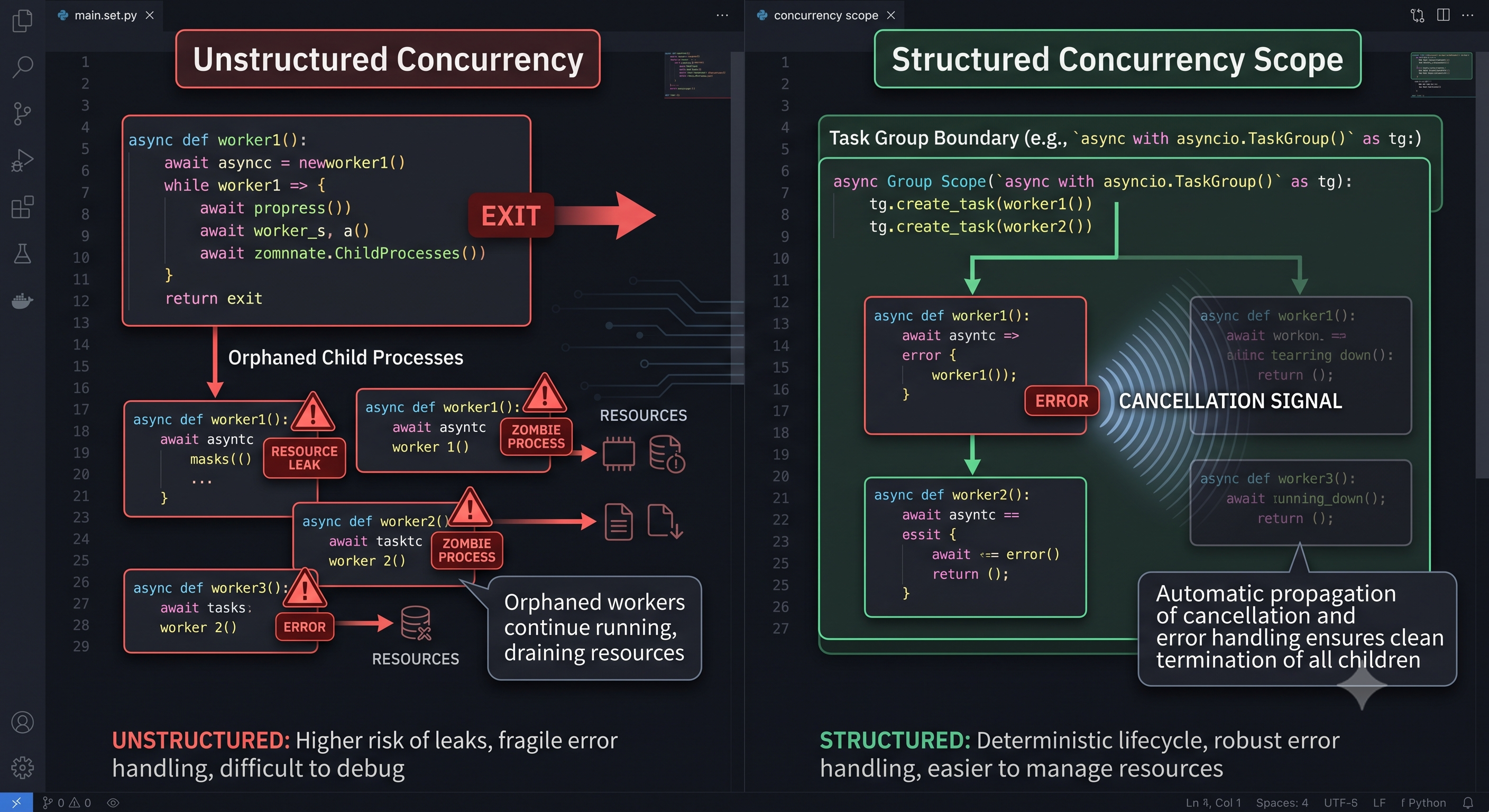
The "Goto" of Concurrency: Launching threads or coroutines (go func(), tokio::spawn, Thread.start()) with no parent-child lifecycle guarantees. If the parent function exits or throws an error, the spawned worker keeps running in the background as a zombie routine.
Structured concurrency enforces one foundational rule: A concurrent block of work cannot complete until all its child tasks have completed or cancelled.
The Bad Pattern vs. The Structured Pattern
Unstructured (Orphan Risk):
[ Parent Function ] ── spawns ──► [ Detached Task 1 ] (Runs forever if Parent fails)
│
Exits ──► Task 1 is now a zombie eating memory & DB connections.
Structured (Scoped Lifecycle):
┌── Structured Task Scope ────────────────────┐
│ [ Parent Scope ] │
│ ├── Task A (Fetch User) ──► [ Success ] │
│ └── Task B (Fetch Orders) ──► [ FAILS / Timeout] │
│ │
│ * Action: Automatic cancel signal propagated to A │
│ * Result: Scope cleans up before returning error │
└─────────────────────────────────────┘
3 Core Principles to Apply in Your Codebase
Explicit Cancellation Propagation:
Always bind child tasks to a parent cancellation token or context (context.Context in Go, CancellationToken in C#, or structured task groups in Python/Kotlin/Java). When the parent fails, children cancel immediately.
Error Short-Circuiting:
If Task B in a scatter-gather operation throws an unrecoverable exception, do not wait for Task A to spend 5 seconds timing out. The scope should abort sibling operations and surface the root cause instantly.
Bounded Lifetime Guarantees:
Ensure the stack frame that initiated the concurrent work is strictly responsible for joining and collecting errors before returning.
Discussion Question (Poll)
What is the most common cause of concurrency bugs in your team's production services?
A) Deadlocks / Mutex contention
B) Unbounded task spawning / Goroutine & thread leaks
C) Race conditions / Unsynchronized shared state
D) Unhandled cancellation & context timeouts
(Drop your war stories and preferred concurrency patterns in the comments!)
CTA
Master clean architecture and modern backend engineering with Techawks Developers.
Join thousands of developers writing resilient, scalable code across Go, Rust, Java, Python, and TypeScript.
🔗 Join the Developers & Coding Community
In the early days of programming, languages used unstructured goto statements. We replaced them with structured control flow: if/else, loops, and explicit scopes.
Yet in modern backend development, many developers still write unstructured concurrency:
The "Goto" of Concurrency: Launching threads or coroutines (go func(), tokio::spawn, Thread.start()) with no parent-child lifecycle guarantees. If the parent function exits or throws an error, the spawned worker keeps running in the background as a zombie routine.
Structured concurrency enforces one foundational rule: A concurrent block of work cannot complete until all its child tasks have completed or cancelled.
The Bad Pattern vs. The Structured Pattern
Unstructured (Orphan Risk):
[ Parent Function ] ── spawns ──► [ Detached Task 1 ] (Runs forever if Parent fails)
│
Exits ──► Task 1 is now a zombie eating memory & DB connections.
Structured (Scoped Lifecycle):
┌── Structured Task Scope ────────────────────┐
│ [ Parent Scope ] │
│ ├── Task A (Fetch User) ──► [ Success ] │
│ └── Task B (Fetch Orders) ──► [ FAILS / Timeout] │
│ │
│ * Action: Automatic cancel signal propagated to A │
│ * Result: Scope cleans up before returning error │
└─────────────────────────────────────┘
3 Core Principles to Apply in Your Codebase
Explicit Cancellation Propagation:
Always bind child tasks to a parent cancellation token or context (context.Context in Go, CancellationToken in C#, or structured task groups in Python/Kotlin/Java). When the parent fails, children cancel immediately.
Error Short-Circuiting:
If Task B in a scatter-gather operation throws an unrecoverable exception, do not wait for Task A to spend 5 seconds timing out. The scope should abort sibling operations and surface the root cause instantly.
Bounded Lifetime Guarantees:
Ensure the stack frame that initiated the concurrent work is strictly responsible for joining and collecting errors before returning.
Discussion Question (Poll)
What is the most common cause of concurrency bugs in your team's production services?
A) Deadlocks / Mutex contention
B) Unbounded task spawning / Goroutine & thread leaks
C) Race conditions / Unsynchronized shared state
D) Unhandled cancellation & context timeouts
(Drop your war stories and preferred concurrency patterns in the comments!)
CTA
Master clean architecture and modern backend engineering with Techawks Developers.
Join thousands of developers writing resilient, scalable code across Go, Rust, Java, Python, and TypeScript.
🔗 Join the Developers & Coding Community
Structured Concurrency: The Pattern That Prevents 3 AM Goroutine and Thread Leaks
In the early days of programming, languages used unstructured goto statements. We replaced them with structured control flow: if/else, loops, and explicit scopes.
Yet in modern backend development, many developers still write unstructured concurrency:
The "Goto" of Concurrency: Launching threads or coroutines (go func(), tokio::spawn, Thread.start()) with no parent-child lifecycle guarantees. If the parent function exits or throws an error, the spawned worker keeps running in the background as a zombie routine.
Structured concurrency enforces one foundational rule: A concurrent block of work cannot complete until all its child tasks have completed or cancelled.
The Bad Pattern vs. The Structured Pattern
Unstructured (Orphan Risk):
[ Parent Function ] ── spawns ──► [ Detached Task 1 ] (Runs forever if Parent fails)
│
Exits ──► Task 1 is now a zombie eating memory & DB connections.
Structured (Scoped Lifecycle):
┌── Structured Task Scope ────────────────────┐
│ [ Parent Scope ] │
│ ├── Task A (Fetch User) ──► [ Success ] │
│ └── Task B (Fetch Orders) ──► [ FAILS / Timeout] │
│ │
│ * Action: Automatic cancel signal propagated to A │
│ * Result: Scope cleans up before returning error │
└─────────────────────────────────────┘
3 Core Principles to Apply in Your Codebase
Explicit Cancellation Propagation:
Always bind child tasks to a parent cancellation token or context (context.Context in Go, CancellationToken in C#, or structured task groups in Python/Kotlin/Java). When the parent fails, children cancel immediately.
Error Short-Circuiting:
If Task B in a scatter-gather operation throws an unrecoverable exception, do not wait for Task A to spend 5 seconds timing out. The scope should abort sibling operations and surface the root cause instantly.
Bounded Lifetime Guarantees:
Ensure the stack frame that initiated the concurrent work is strictly responsible for joining and collecting errors before returning.
Discussion Question (Poll)
What is the most common cause of concurrency bugs in your team's production services?
A) Deadlocks / Mutex contention
B) Unbounded task spawning / Goroutine & thread leaks
C) Race conditions / Unsynchronized shared state
D) Unhandled cancellation & context timeouts
(Drop your war stories and preferred concurrency patterns in the comments!)
CTA
Master clean architecture and modern backend engineering with Techawks Developers.
Join thousands of developers writing resilient, scalable code across Go, Rust, Java, Python, and TypeScript.
🔗 Join the Developers & Coding Community

 English
 Arabic
 French
 Spanish
 Portuguese
 Deutsch
 Dutch
Dutch
 Italiano
 Russian
 Romaian
 Portuguese (Brazil)
 Greek
Greek