


Designing for Intent, Not Layouts: Why "Generative UI" Kills the Static Wireframe
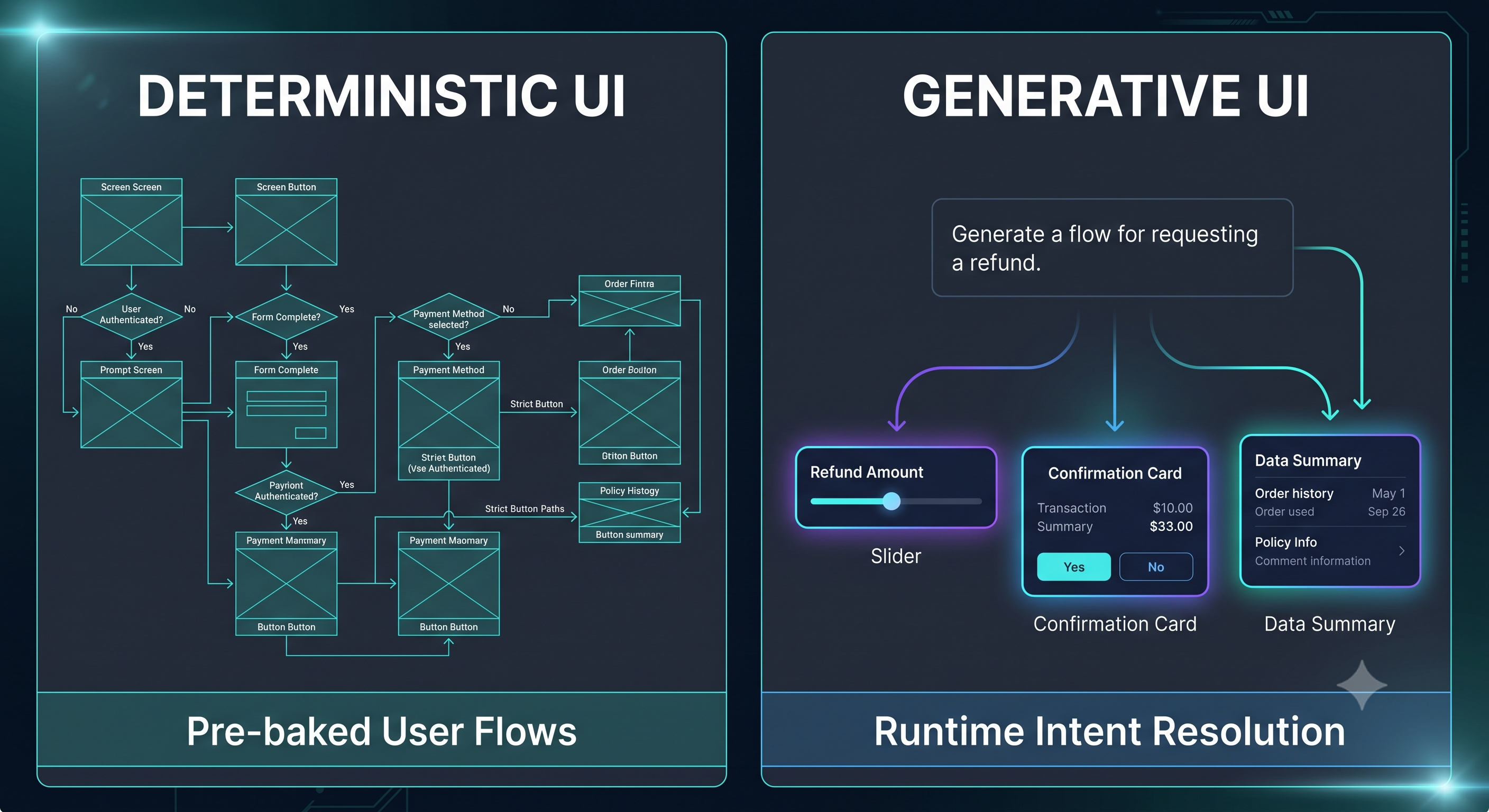
With modern AI models and local on-device neural runtimes capable of parsing complex user context in milliseconds, product development is undergoing its biggest paradigm shift since mobile-first design: the move from Deterministic UI to Generative UI.
In a deterministic workflow, product managers map out every edge case, and designers create rigid wireframes for each view. But as autonomous agents and multimodal interfaces handle end-to-end user intent, rendering static UI trees creates needless cognitive friction.
Instead of designing static screens, product teams must start designing component boundaries and intent resolvers:
From Screen States to Dynamic Micro-Components: The system renders ephemeral, intent-driven UI components on the fly (e.g., an instant checkout approval card or a contextual parameter slider instead of an entire checkout funnel).
Design Systems as Constraints, Not Canvases: Your design system tokens and accessibility rules become guardrails that models compose within, preventing layout hallucination and maintaining brand coherence.
Optimizing for Reversibility, Not Step-by-Step Flow: When an agent takes an action, the primary UX challenge is no longer input collection—it is visual confirmation, high-confidence feedback, and 1-click reversibility.
Product thinking in 2026 isn't about predicting every screen a user will click; it’s about establishing the constraints and confidence thresholds within which the interface dynamically generates itself.
Discussion Question (Poll)Where is your product team spending the majority of its design and discovery effort this quarter?
🔘 A: Refining classic static user flows and multi-step funnels
🔘 B: Building generative/adaptive UI components triggered by AI agents
🔘 C: Hardening design system tokens to support dynamic runtime layouts
🔘 D: Evaluating user trust and reversibility patterns for agentic actions
CTA
Join Product, UX & Design by Techawks to get daily frameworks, deep dives, and teardowns on building the next generation of intelligent software products.
With modern AI models and local on-device neural runtimes capable of parsing complex user context in milliseconds, product development is undergoing its biggest paradigm shift since mobile-first design: the move from Deterministic UI to Generative UI.
In a deterministic workflow, product managers map out every edge case, and designers create rigid wireframes for each view. But as autonomous agents and multimodal interfaces handle end-to-end user intent, rendering static UI trees creates needless cognitive friction.
Instead of designing static screens, product teams must start designing component boundaries and intent resolvers:
From Screen States to Dynamic Micro-Components: The system renders ephemeral, intent-driven UI components on the fly (e.g., an instant checkout approval card or a contextual parameter slider instead of an entire checkout funnel).
Design Systems as Constraints, Not Canvases: Your design system tokens and accessibility rules become guardrails that models compose within, preventing layout hallucination and maintaining brand coherence.
Optimizing for Reversibility, Not Step-by-Step Flow: When an agent takes an action, the primary UX challenge is no longer input collection—it is visual confirmation, high-confidence feedback, and 1-click reversibility.
Product thinking in 2026 isn't about predicting every screen a user will click; it’s about establishing the constraints and confidence thresholds within which the interface dynamically generates itself.
Discussion Question (Poll)Where is your product team spending the majority of its design and discovery effort this quarter?
🔘 A: Refining classic static user flows and multi-step funnels
🔘 B: Building generative/adaptive UI components triggered by AI agents
🔘 C: Hardening design system tokens to support dynamic runtime layouts
🔘 D: Evaluating user trust and reversibility patterns for agentic actions
CTA
Join Product, UX & Design by Techawks to get daily frameworks, deep dives, and teardowns on building the next generation of intelligent software products.
Designing for Intent, Not Layouts: Why "Generative UI" Kills the Static Wireframe
With modern AI models and local on-device neural runtimes capable of parsing complex user context in milliseconds, product development is undergoing its biggest paradigm shift since mobile-first design: the move from Deterministic UI to Generative UI.
In a deterministic workflow, product managers map out every edge case, and designers create rigid wireframes for each view. But as autonomous agents and multimodal interfaces handle end-to-end user intent, rendering static UI trees creates needless cognitive friction.
Instead of designing static screens, product teams must start designing component boundaries and intent resolvers:
From Screen States to Dynamic Micro-Components: The system renders ephemeral, intent-driven UI components on the fly (e.g., an instant checkout approval card or a contextual parameter slider instead of an entire checkout funnel).
Design Systems as Constraints, Not Canvases: Your design system tokens and accessibility rules become guardrails that models compose within, preventing layout hallucination and maintaining brand coherence.
Optimizing for Reversibility, Not Step-by-Step Flow: When an agent takes an action, the primary UX challenge is no longer input collection—it is visual confirmation, high-confidence feedback, and 1-click reversibility.
Product thinking in 2026 isn't about predicting every screen a user will click; it’s about establishing the constraints and confidence thresholds within which the interface dynamically generates itself.
Discussion Question (Poll)Where is your product team spending the majority of its design and discovery effort this quarter?
🔘 A: Refining classic static user flows and multi-step funnels
🔘 B: Building generative/adaptive UI components triggered by AI agents
🔘 C: Hardening design system tokens to support dynamic runtime layouts
🔘 D: Evaluating user trust and reversibility patterns for agentic actions
CTA
Join Product, UX & Design by Techawks to get daily frameworks, deep dives, and teardowns on building the next generation of intelligent software products.

 English
 Arabic
 Spanish
 Portuguese
 Deutsch
 Turkish
 Dutch
Dutch
 Italiano
 Russian
 Romaian
 Portuguese (Brazil)
 Greek
Greek