


Why India’s DPDP Consent Manager Architecture Changes Backend Engineering Forever
As India's Digital Personal Data Protection (DPDP) Act moves deeper into its phased rollout—introducing interoperable Consent Managers and stringent purpose-limitation rules—compliance is no longer just a legal task. It is a fundamental database and API architectural challenge.
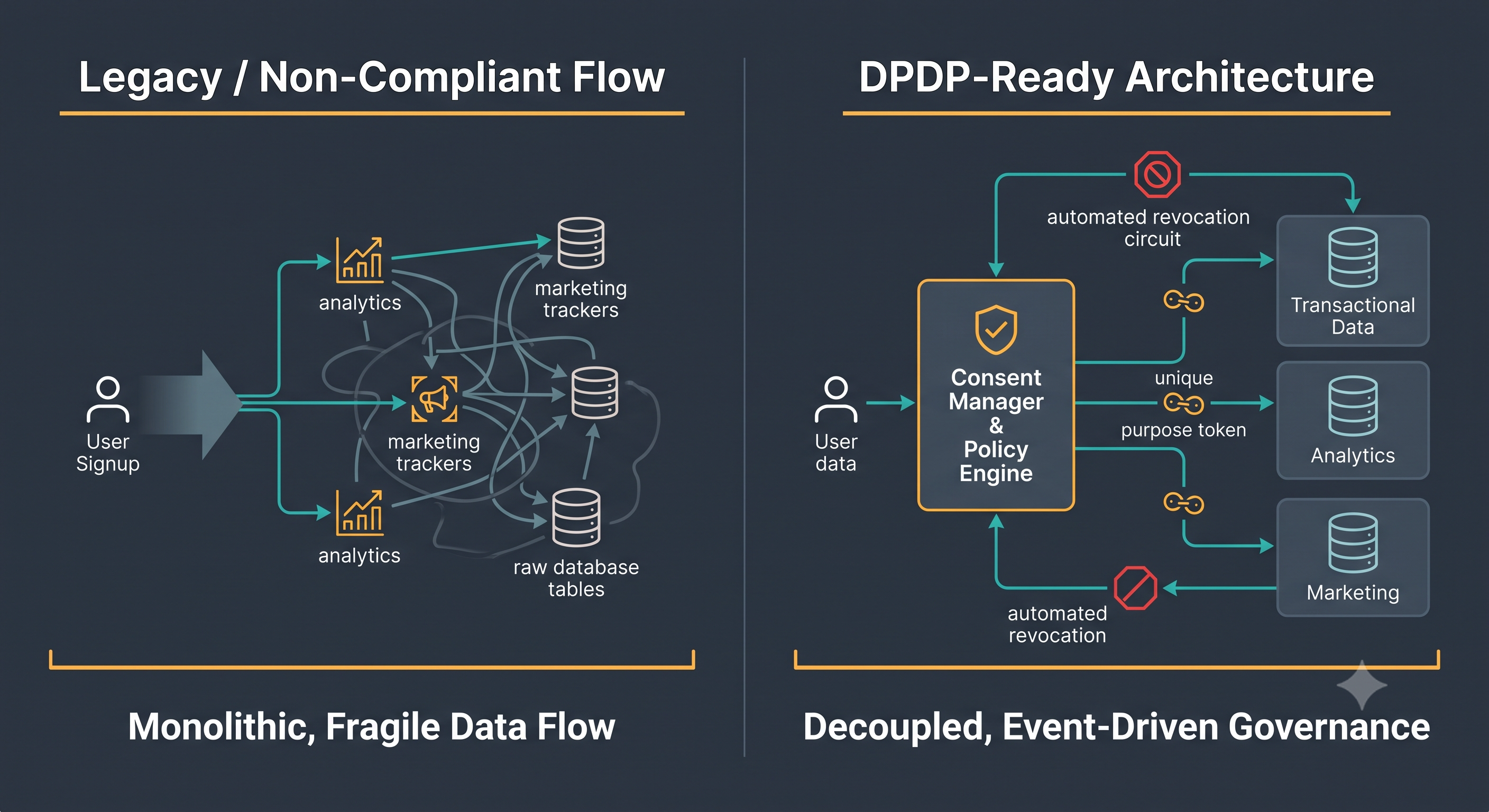
In standard architectures, user data lands in data lakes, analytics pipelines, and third-party SaaS integrations with blanket persistence. Under the DPDP framework, handling user data requires deterministic, programmable governance:
Consent as a First-Class Data Entity: Consent cannot be a static boolean flag in a user table. It must be a versioned, queryable artifact tied to explicit purpose boundaries (e.g., separating core transactional processing from behavioral profiling).
Event-Driven Cascading Erasure: When a user revokes consent or triggers an erasure request through a registered Consent Manager, your backend needs automated event buses (Kafka/RabbitMQ) to propagate deletions across microservices, read replicas, and downstream analytics sinks in real time.
Decoupled Identity & Data Minimization: Telemetry, logs, and staging databases must enforce automated pseudonymization, ensuring that operational monitoring never retains identifiable personal records beyond justified lifecycles.
Indian software architectures must evolve: compliance is no longer a wrapper around your code; it is baked directly into your schema design and distributed workflows.
Discussion Question (Poll)
How prepared is your tech stack to handle dynamic, real-time consent revocations and automated user data deletion?
🔘 A: Fully automated across all primary databases and downstream pipelines
🔘 B: Semi-automated (manual scripts or batch-processed deletion jobs)
🔘 C: Currently redesigning schemas and event workflows for DPDP alignment
🔘 D: Still relying on static privacy notices and legal reviews
CTA
Join Techawks India to connect with local architects, CTOs, and builders designing resilient, high-scale, and compliant software for the Indian tech ecosystem.
As India's Digital Personal Data Protection (DPDP) Act moves deeper into its phased rollout—introducing interoperable Consent Managers and stringent purpose-limitation rules—compliance is no longer just a legal task. It is a fundamental database and API architectural challenge.
In standard architectures, user data lands in data lakes, analytics pipelines, and third-party SaaS integrations with blanket persistence. Under the DPDP framework, handling user data requires deterministic, programmable governance:
Consent as a First-Class Data Entity: Consent cannot be a static boolean flag in a user table. It must be a versioned, queryable artifact tied to explicit purpose boundaries (e.g., separating core transactional processing from behavioral profiling).
Event-Driven Cascading Erasure: When a user revokes consent or triggers an erasure request through a registered Consent Manager, your backend needs automated event buses (Kafka/RabbitMQ) to propagate deletions across microservices, read replicas, and downstream analytics sinks in real time.
Decoupled Identity & Data Minimization: Telemetry, logs, and staging databases must enforce automated pseudonymization, ensuring that operational monitoring never retains identifiable personal records beyond justified lifecycles.
Indian software architectures must evolve: compliance is no longer a wrapper around your code; it is baked directly into your schema design and distributed workflows.
Discussion Question (Poll)
How prepared is your tech stack to handle dynamic, real-time consent revocations and automated user data deletion?
🔘 A: Fully automated across all primary databases and downstream pipelines
🔘 B: Semi-automated (manual scripts or batch-processed deletion jobs)
🔘 C: Currently redesigning schemas and event workflows for DPDP alignment
🔘 D: Still relying on static privacy notices and legal reviews
CTA
Join Techawks India to connect with local architects, CTOs, and builders designing resilient, high-scale, and compliant software for the Indian tech ecosystem.
Why India’s DPDP Consent Manager Architecture Changes Backend Engineering Forever
As India's Digital Personal Data Protection (DPDP) Act moves deeper into its phased rollout—introducing interoperable Consent Managers and stringent purpose-limitation rules—compliance is no longer just a legal task. It is a fundamental database and API architectural challenge.
In standard architectures, user data lands in data lakes, analytics pipelines, and third-party SaaS integrations with blanket persistence. Under the DPDP framework, handling user data requires deterministic, programmable governance:
Consent as a First-Class Data Entity: Consent cannot be a static boolean flag in a user table. It must be a versioned, queryable artifact tied to explicit purpose boundaries (e.g., separating core transactional processing from behavioral profiling).
Event-Driven Cascading Erasure: When a user revokes consent or triggers an erasure request through a registered Consent Manager, your backend needs automated event buses (Kafka/RabbitMQ) to propagate deletions across microservices, read replicas, and downstream analytics sinks in real time.
Decoupled Identity & Data Minimization: Telemetry, logs, and staging databases must enforce automated pseudonymization, ensuring that operational monitoring never retains identifiable personal records beyond justified lifecycles.
Indian software architectures must evolve: compliance is no longer a wrapper around your code; it is baked directly into your schema design and distributed workflows.
Discussion Question (Poll)
How prepared is your tech stack to handle dynamic, real-time consent revocations and automated user data deletion?
🔘 A: Fully automated across all primary databases and downstream pipelines
🔘 B: Semi-automated (manual scripts or batch-processed deletion jobs)
🔘 C: Currently redesigning schemas and event workflows for DPDP alignment
🔘 D: Still relying on static privacy notices and legal reviews
CTA
Join Techawks India to connect with local architects, CTOs, and builders designing resilient, high-scale, and compliant software for the Indian tech ecosystem.

 Arabic
 French
 Spanish
 Portuguese
 Deutsch
 Turkish
 Dutch
Dutch
 Italiano
 Russian
 Romaian
 Portuguese (Brazil)
 Greek
Greek