


The Provenance Pipeline: How California’s AI Transparency Mandates Turn Metadata into Core Infrastructure
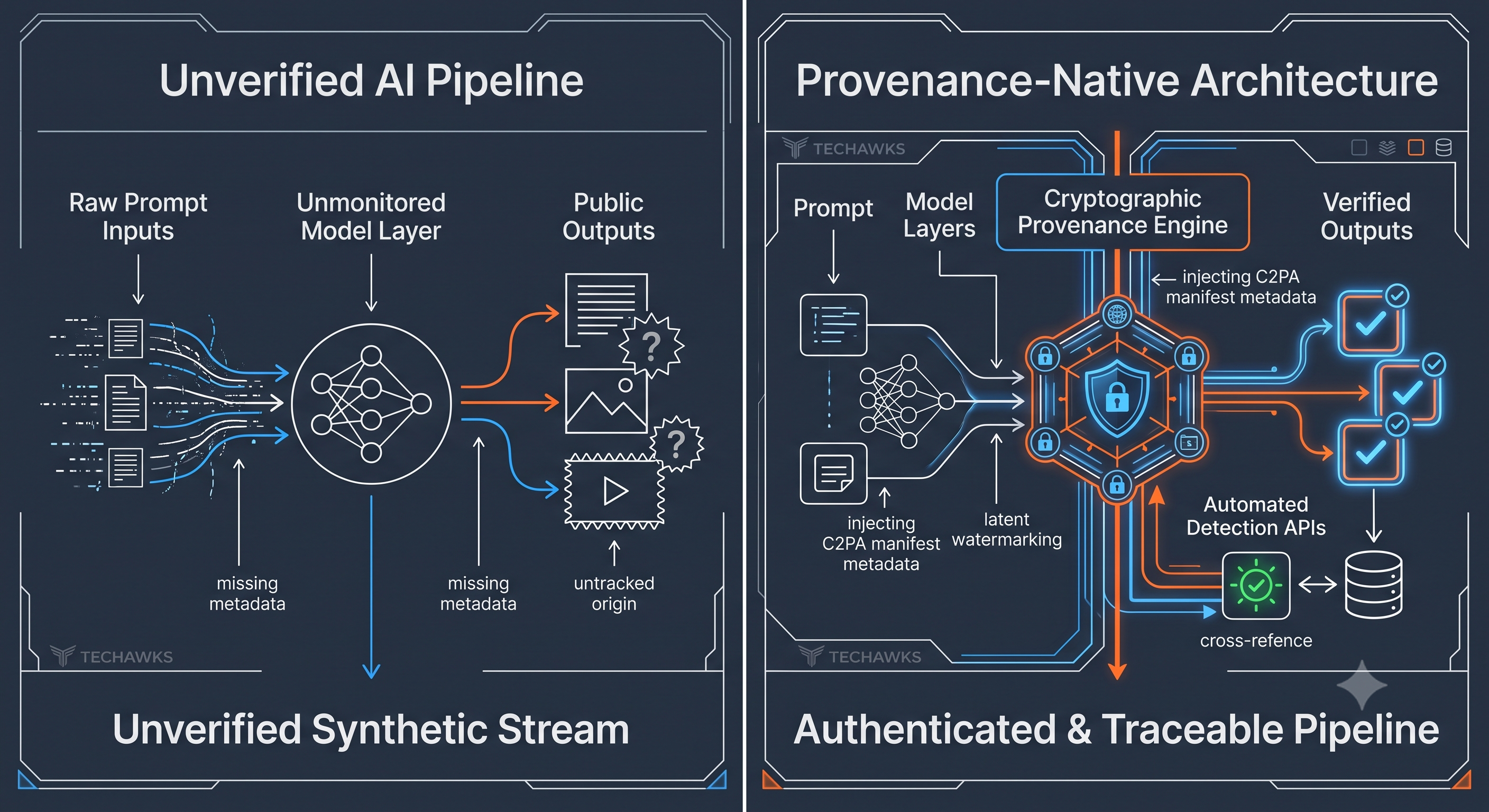
As California's AI transparency frameworks (including AB 2013 and SB 942/AB 853) establish operational baselines across the US tech market, shipping generative AI features requires more than raw model inference. It demands an end-to-end Content Provenance & Verification Architecture.
When generative models create text, image, audio, or synthetic code at enterprise scale, compliance and trust cannot be handled retroactively. US tech teams must engineer cryptographic traceability directly into their generation lifecycles:
Dual-Layer Provenance (Manifest + Latent): User-facing disclosures (manifest UI indicators) must be paired with tamper-evident, machine-readable metadata (latent watermarking via C2PA standards) embedded directly into payload bytes at generation time.
API-First Verification & Detection Endpoints: Systems must expose automated verification endpoints and detection tools that allow downstream consumers to parse origin metadata without leaking underlying personal training data.
Lineage Tracking for Fine-Tuned Open Weights: If your platform substantially modifies or fine-tunes open-source models in-house, training dataset documentation and transformation pipelines become audited software artifacts rather than internal notes.
In 2026, compliance is an engineering primitive: the systems that win enterprise trust will be the ones that treat authenticity, provenance, and data lineage as low-latency runtime services.
Discussion Question (Poll)
How is your engineering organization handling AI content provenance and regulatory transparency for user-facing models?
🔘 A: Automated latent watermarking & C2PA metadata embedding in production pipelines
🔘 B: Basic UI disclosure tags and terms-of-service notices only
🔘 C: Currently re-architecting inference pipelines for cryptographic provenance
🔘 D: Using third-party model APIs that manage verification natively
CTA
Join Techawks USA to connect with top US founders, engineering leaders, and product architects navigating enterprise AI architecture, governance, and scale.
As California's AI transparency frameworks (including AB 2013 and SB 942/AB 853) establish operational baselines across the US tech market, shipping generative AI features requires more than raw model inference. It demands an end-to-end Content Provenance & Verification Architecture.
When generative models create text, image, audio, or synthetic code at enterprise scale, compliance and trust cannot be handled retroactively. US tech teams must engineer cryptographic traceability directly into their generation lifecycles:
Dual-Layer Provenance (Manifest + Latent): User-facing disclosures (manifest UI indicators) must be paired with tamper-evident, machine-readable metadata (latent watermarking via C2PA standards) embedded directly into payload bytes at generation time.
API-First Verification & Detection Endpoints: Systems must expose automated verification endpoints and detection tools that allow downstream consumers to parse origin metadata without leaking underlying personal training data.
Lineage Tracking for Fine-Tuned Open Weights: If your platform substantially modifies or fine-tunes open-source models in-house, training dataset documentation and transformation pipelines become audited software artifacts rather than internal notes.
In 2026, compliance is an engineering primitive: the systems that win enterprise trust will be the ones that treat authenticity, provenance, and data lineage as low-latency runtime services.
Discussion Question (Poll)
How is your engineering organization handling AI content provenance and regulatory transparency for user-facing models?
🔘 A: Automated latent watermarking & C2PA metadata embedding in production pipelines
🔘 B: Basic UI disclosure tags and terms-of-service notices only
🔘 C: Currently re-architecting inference pipelines for cryptographic provenance
🔘 D: Using third-party model APIs that manage verification natively
CTA
Join Techawks USA to connect with top US founders, engineering leaders, and product architects navigating enterprise AI architecture, governance, and scale.
The Provenance Pipeline: How California’s AI Transparency Mandates Turn Metadata into Core Infrastructure
As California's AI transparency frameworks (including AB 2013 and SB 942/AB 853) establish operational baselines across the US tech market, shipping generative AI features requires more than raw model inference. It demands an end-to-end Content Provenance & Verification Architecture.
When generative models create text, image, audio, or synthetic code at enterprise scale, compliance and trust cannot be handled retroactively. US tech teams must engineer cryptographic traceability directly into their generation lifecycles:
Dual-Layer Provenance (Manifest + Latent): User-facing disclosures (manifest UI indicators) must be paired with tamper-evident, machine-readable metadata (latent watermarking via C2PA standards) embedded directly into payload bytes at generation time.
API-First Verification & Detection Endpoints: Systems must expose automated verification endpoints and detection tools that allow downstream consumers to parse origin metadata without leaking underlying personal training data.
Lineage Tracking for Fine-Tuned Open Weights: If your platform substantially modifies or fine-tunes open-source models in-house, training dataset documentation and transformation pipelines become audited software artifacts rather than internal notes.
In 2026, compliance is an engineering primitive: the systems that win enterprise trust will be the ones that treat authenticity, provenance, and data lineage as low-latency runtime services.
Discussion Question (Poll)
How is your engineering organization handling AI content provenance and regulatory transparency for user-facing models?
🔘 A: Automated latent watermarking & C2PA metadata embedding in production pipelines
🔘 B: Basic UI disclosure tags and terms-of-service notices only
🔘 C: Currently re-architecting inference pipelines for cryptographic provenance
🔘 D: Using third-party model APIs that manage verification natively
CTA
Join Techawks USA to connect with top US founders, engineering leaders, and product architects navigating enterprise AI architecture, governance, and scale.

 English
 Arabic
 French
 Spanish
 Portuguese
 Deutsch
 Turkish
 Dutch
Dutch
 Russian
 Romaian
 Portuguese (Brazil)
 Greek
Greek