


Designing for Strategic Market Status: How the UK’s DMCCA Reshapes App & API Interoperability
As the UK Competition and Markets Authority (CMA) enforces its Strategic Market Status (SMS) designations and new conduct requirements, the British tech sector is navigating a major shift in how platforms interact. Compliance under the DMCCA is no longer just a legal issue—it directly impacts system architecture, API design, and data portability.
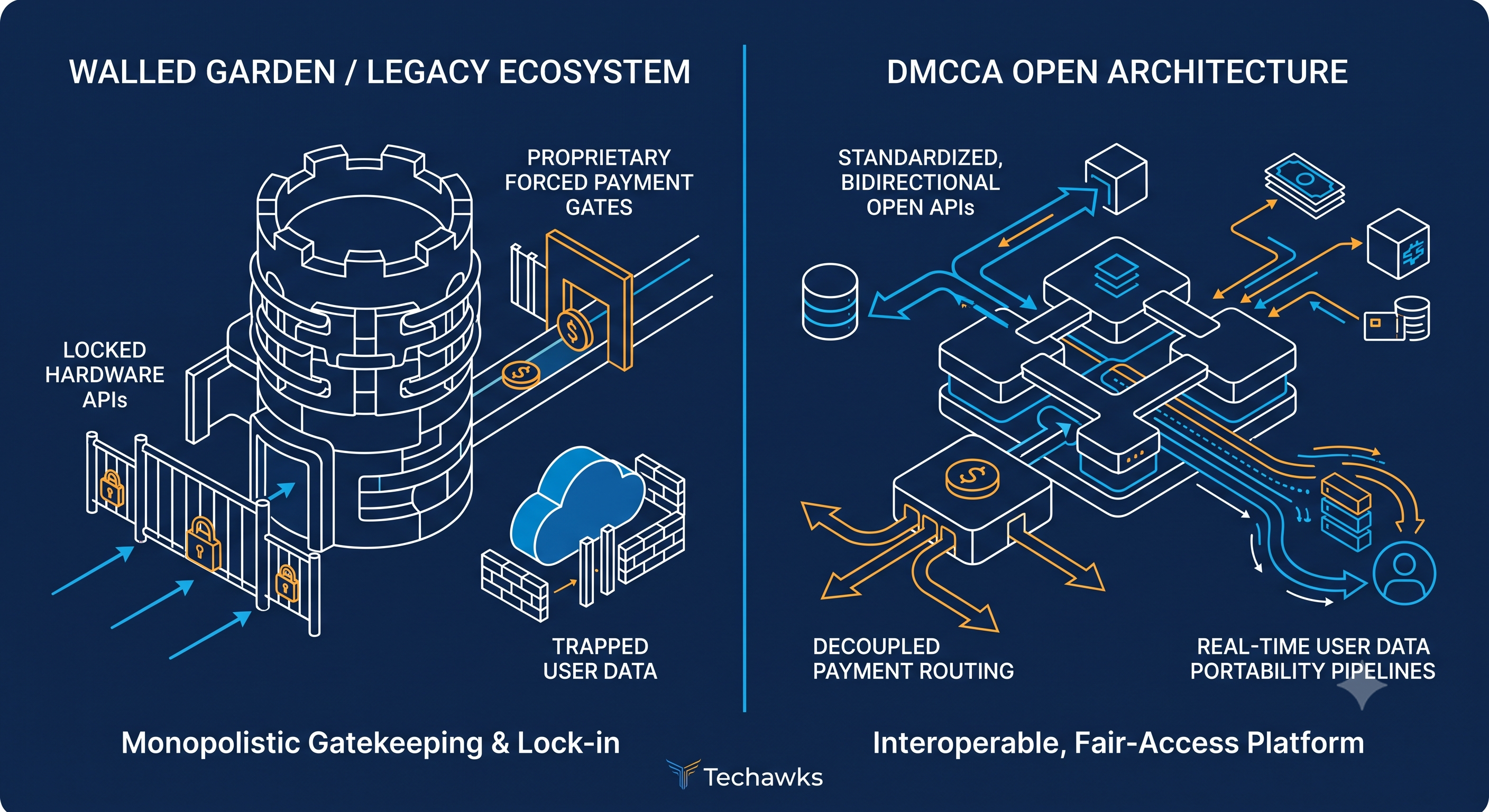
For UK engineering leads and product builders, the days of proprietary walled gardens and restrictive gatekeeping are shifting toward mandated open interoperability:
Unbundled Gateways & Fair API Access: Platforms designated with SMS must provide equitable, non-discriminatory API access to core OS and hardware primitives (such as NFC chips, default browser engines, and background execution loops) without self-preferencing their internal apps.
Standardized Data Portability Pipelines: Systems must support real-time, low-friction data export interfaces rather than bulk batch exports, enabling users and competing apps to migrate state, telemetry, and identity seamlessly.
Decoupled Billing & Direct Checkout Workflows: Mobile and platform applications must be architected to support alternative payment processors and direct out-of-app customer routing, requiring modular payment orchestration layers at the backend.
In 2026, designing for the UK market means building open, modular, and unbundled systems from day one.
Discussion Question (Poll)
How is your product or engineering team approaching the UK's platform interoperability and open access mandates?
🔘 A: Actively integrating direct-to-consumer and alternative payment flows
🔘 B: Building open APIs and modular data export endpoints for portability
🔘 C: Auditing current platform dependencies (app stores, proprietary cloud locks)
🔘 D: Waiting for formal CMA conduct remedies to roll out further
CTA
Join Techawks UK to collaborate with local tech leads, architects, and engineering executives building scalable, open-ecosystem software across Britain.
As the UK Competition and Markets Authority (CMA) enforces its Strategic Market Status (SMS) designations and new conduct requirements, the British tech sector is navigating a major shift in how platforms interact. Compliance under the DMCCA is no longer just a legal issue—it directly impacts system architecture, API design, and data portability.
For UK engineering leads and product builders, the days of proprietary walled gardens and restrictive gatekeeping are shifting toward mandated open interoperability:
Unbundled Gateways & Fair API Access: Platforms designated with SMS must provide equitable, non-discriminatory API access to core OS and hardware primitives (such as NFC chips, default browser engines, and background execution loops) without self-preferencing their internal apps.
Standardized Data Portability Pipelines: Systems must support real-time, low-friction data export interfaces rather than bulk batch exports, enabling users and competing apps to migrate state, telemetry, and identity seamlessly.
Decoupled Billing & Direct Checkout Workflows: Mobile and platform applications must be architected to support alternative payment processors and direct out-of-app customer routing, requiring modular payment orchestration layers at the backend.
In 2026, designing for the UK market means building open, modular, and unbundled systems from day one.
Discussion Question (Poll)
How is your product or engineering team approaching the UK's platform interoperability and open access mandates?
🔘 A: Actively integrating direct-to-consumer and alternative payment flows
🔘 B: Building open APIs and modular data export endpoints for portability
🔘 C: Auditing current platform dependencies (app stores, proprietary cloud locks)
🔘 D: Waiting for formal CMA conduct remedies to roll out further
CTA
Join Techawks UK to collaborate with local tech leads, architects, and engineering executives building scalable, open-ecosystem software across Britain.
Designing for Strategic Market Status: How the UK’s DMCCA Reshapes App & API Interoperability
As the UK Competition and Markets Authority (CMA) enforces its Strategic Market Status (SMS) designations and new conduct requirements, the British tech sector is navigating a major shift in how platforms interact. Compliance under the DMCCA is no longer just a legal issue—it directly impacts system architecture, API design, and data portability.
For UK engineering leads and product builders, the days of proprietary walled gardens and restrictive gatekeeping are shifting toward mandated open interoperability:
Unbundled Gateways & Fair API Access: Platforms designated with SMS must provide equitable, non-discriminatory API access to core OS and hardware primitives (such as NFC chips, default browser engines, and background execution loops) without self-preferencing their internal apps.
Standardized Data Portability Pipelines: Systems must support real-time, low-friction data export interfaces rather than bulk batch exports, enabling users and competing apps to migrate state, telemetry, and identity seamlessly.
Decoupled Billing & Direct Checkout Workflows: Mobile and platform applications must be architected to support alternative payment processors and direct out-of-app customer routing, requiring modular payment orchestration layers at the backend.
In 2026, designing for the UK market means building open, modular, and unbundled systems from day one.
Discussion Question (Poll)
How is your product or engineering team approaching the UK's platform interoperability and open access mandates?
🔘 A: Actively integrating direct-to-consumer and alternative payment flows
🔘 B: Building open APIs and modular data export endpoints for portability
🔘 C: Auditing current platform dependencies (app stores, proprietary cloud locks)
🔘 D: Waiting for formal CMA conduct remedies to roll out further
CTA
Join Techawks UK to collaborate with local tech leads, architects, and engineering executives building scalable, open-ecosystem software across Britain.

 English
 Arabic
 French
 Portuguese
 Deutsch
 Turkish
 Dutch
Dutch
 Italiano
 Russian
 Romaian
 Portuguese (Brazil)
 Greek
Greek