


Engineering for DPDP Act: Why India’s New Privacy Architecture Changes Backend Design
India's Digital Personal Data Protection (DPDP) Act introduces technical constraints that directly impact software architecture and database design.
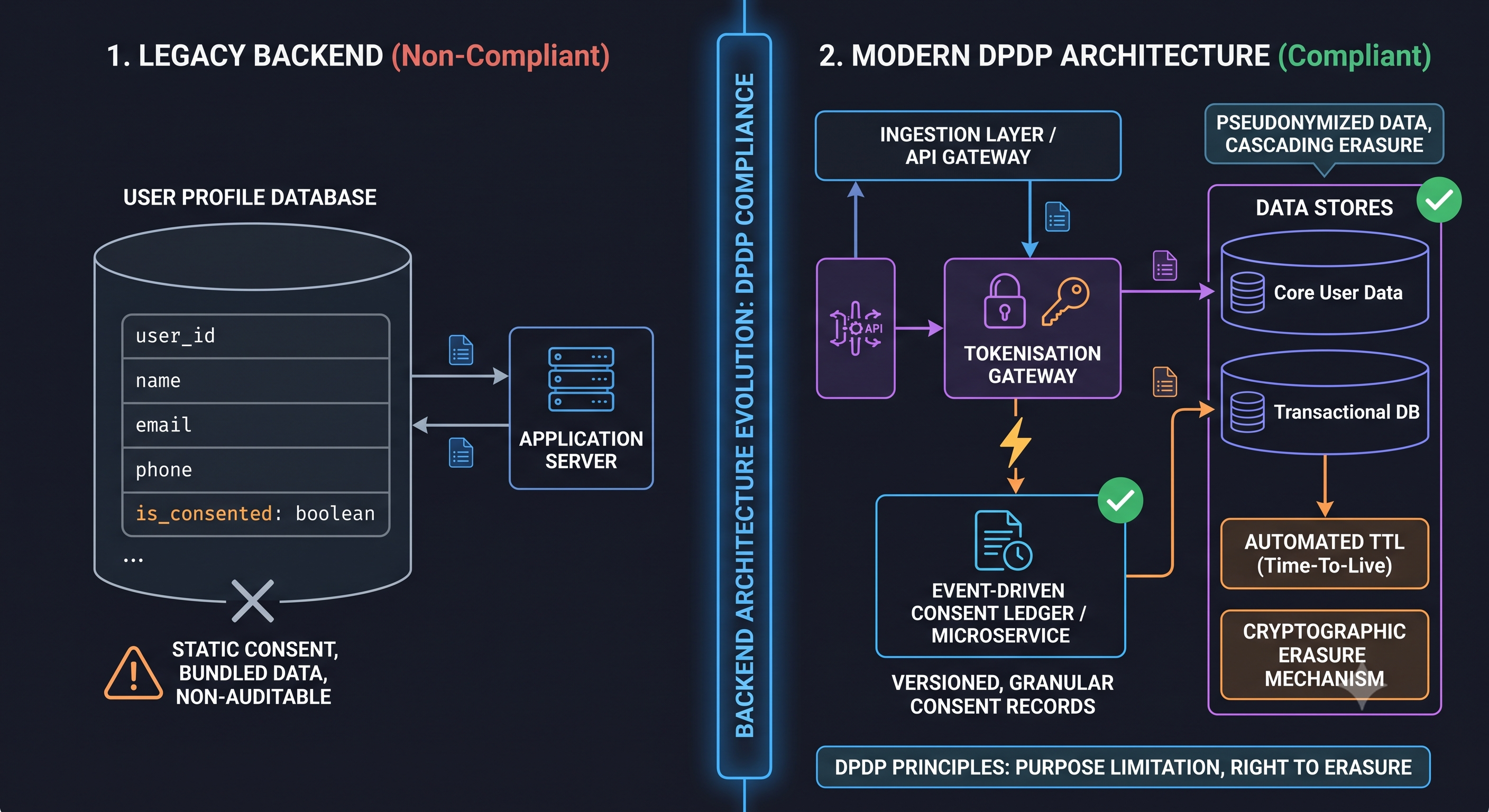
Unlike traditional setups where consent is simply stored as a true/false boolean in a user profile, DPDP requires compliance to be treated as a distributed systems challenge.
Here is what Indian tech teams need to refactor across their stack:
1. Decoupled Consent Architecture (Itemized vs. Bundled)
The Rule: Consent must be specific, unbundled, and revocable per purpose.
The Engineering Shift: Avoid static database flags. Build a standalone Consent Ledger / Microservice where each consent event is versioned (purpose_id, notice_version, timestamp, scope_id). If an end-user revokes permission for marketing analytics, it should revoke data processing without breaking core authentication or order workflows.
2. Automated Right to Erasure & Cascading Deletions
The Rule: Data Principals can request erasure of their personal data when the original processing purpose is complete.
The Engineering Shift: Personal Identifiable Information (PII) scattered across data lakes, read replicas, vector stores, and backup logs creates high operational risk. Implement pseudonymisation / tokenisation layers at ingestion. When erasure is triggered, deleting the cryptographic key renders the associated data mathematically anonymous across downstream analytical storage.
3. Log Retention vs. Erasure Conflicts
The Rule: Security and statutory audit logs require a minimum 1-year forensic retention window, even when an erasure request is executed.
The Engineering Shift: Separate application telemetry and transaction logs from plain-text PII. Never log raw payloads (e.g., Aadhaar numbers, phone numbers, raw emails) in debug or application log aggregators (ELK, Datadog).
Discussion Question
How is your engineering team decoupling consent logs from core user tables—are you building an in-house consent microservice or integrating with registered Consent Managers?
CTA (Join Techawks India)Building scalable tech for India's digital ecosystem?
Join Techawks India to connect with senior architects, backend engineers, and tech leaders solving population-scale engineering challenges. Link in comments / bio!
India's Digital Personal Data Protection (DPDP) Act introduces technical constraints that directly impact software architecture and database design.
Unlike traditional setups where consent is simply stored as a true/false boolean in a user profile, DPDP requires compliance to be treated as a distributed systems challenge.
Here is what Indian tech teams need to refactor across their stack:
1. Decoupled Consent Architecture (Itemized vs. Bundled)
The Rule: Consent must be specific, unbundled, and revocable per purpose.
The Engineering Shift: Avoid static database flags. Build a standalone Consent Ledger / Microservice where each consent event is versioned (purpose_id, notice_version, timestamp, scope_id). If an end-user revokes permission for marketing analytics, it should revoke data processing without breaking core authentication or order workflows.
2. Automated Right to Erasure & Cascading Deletions
The Rule: Data Principals can request erasure of their personal data when the original processing purpose is complete.
The Engineering Shift: Personal Identifiable Information (PII) scattered across data lakes, read replicas, vector stores, and backup logs creates high operational risk. Implement pseudonymisation / tokenisation layers at ingestion. When erasure is triggered, deleting the cryptographic key renders the associated data mathematically anonymous across downstream analytical storage.
3. Log Retention vs. Erasure Conflicts
The Rule: Security and statutory audit logs require a minimum 1-year forensic retention window, even when an erasure request is executed.
The Engineering Shift: Separate application telemetry and transaction logs from plain-text PII. Never log raw payloads (e.g., Aadhaar numbers, phone numbers, raw emails) in debug or application log aggregators (ELK, Datadog).
Discussion Question
How is your engineering team decoupling consent logs from core user tables—are you building an in-house consent microservice or integrating with registered Consent Managers?
CTA (Join Techawks India)Building scalable tech for India's digital ecosystem?
Join Techawks India to connect with senior architects, backend engineers, and tech leaders solving population-scale engineering challenges. Link in comments / bio!
Engineering for DPDP Act: Why India’s New Privacy Architecture Changes Backend Design
India's Digital Personal Data Protection (DPDP) Act introduces technical constraints that directly impact software architecture and database design.
Unlike traditional setups where consent is simply stored as a true/false boolean in a user profile, DPDP requires compliance to be treated as a distributed systems challenge.
Here is what Indian tech teams need to refactor across their stack:
1. Decoupled Consent Architecture (Itemized vs. Bundled)
The Rule: Consent must be specific, unbundled, and revocable per purpose.
The Engineering Shift: Avoid static database flags. Build a standalone Consent Ledger / Microservice where each consent event is versioned (purpose_id, notice_version, timestamp, scope_id). If an end-user revokes permission for marketing analytics, it should revoke data processing without breaking core authentication or order workflows.
2. Automated Right to Erasure & Cascading Deletions
The Rule: Data Principals can request erasure of their personal data when the original processing purpose is complete.
The Engineering Shift: Personal Identifiable Information (PII) scattered across data lakes, read replicas, vector stores, and backup logs creates high operational risk. Implement pseudonymisation / tokenisation layers at ingestion. When erasure is triggered, deleting the cryptographic key renders the associated data mathematically anonymous across downstream analytical storage.
3. Log Retention vs. Erasure Conflicts
The Rule: Security and statutory audit logs require a minimum 1-year forensic retention window, even when an erasure request is executed.
The Engineering Shift: Separate application telemetry and transaction logs from plain-text PII. Never log raw payloads (e.g., Aadhaar numbers, phone numbers, raw emails) in debug or application log aggregators (ELK, Datadog).
Discussion Question
How is your engineering team decoupling consent logs from core user tables—are you building an in-house consent microservice or integrating with registered Consent Managers?
CTA (Join Techawks India)Building scalable tech for India's digital ecosystem?
Join Techawks India to connect with senior architects, backend engineers, and tech leaders solving population-scale engineering challenges. Link in comments / bio!

 English
 Arabic
 French
 Spanish
 Portuguese
 Deutsch
 Turkish
 Dutch
Dutch
 Russian
 Romaian
 Portuguese (Brazil)
 Greek
Greek