


Beyond the ReAct Loop: Designing Deterministic State Machines for Production AI Agents
As US engineering teams move from generative prototypes to agentic workflows, the core architectural challenge is no longer prompt tuning—it is state boundary management.
When an autonomous agent dynamically plans its execution graph, non-deterministic branching makes traditional idempotency, circuit breaking, and distributed tracing break down.
Here is how senior backend and platform engineers are structuring reliable agentic execution layers:
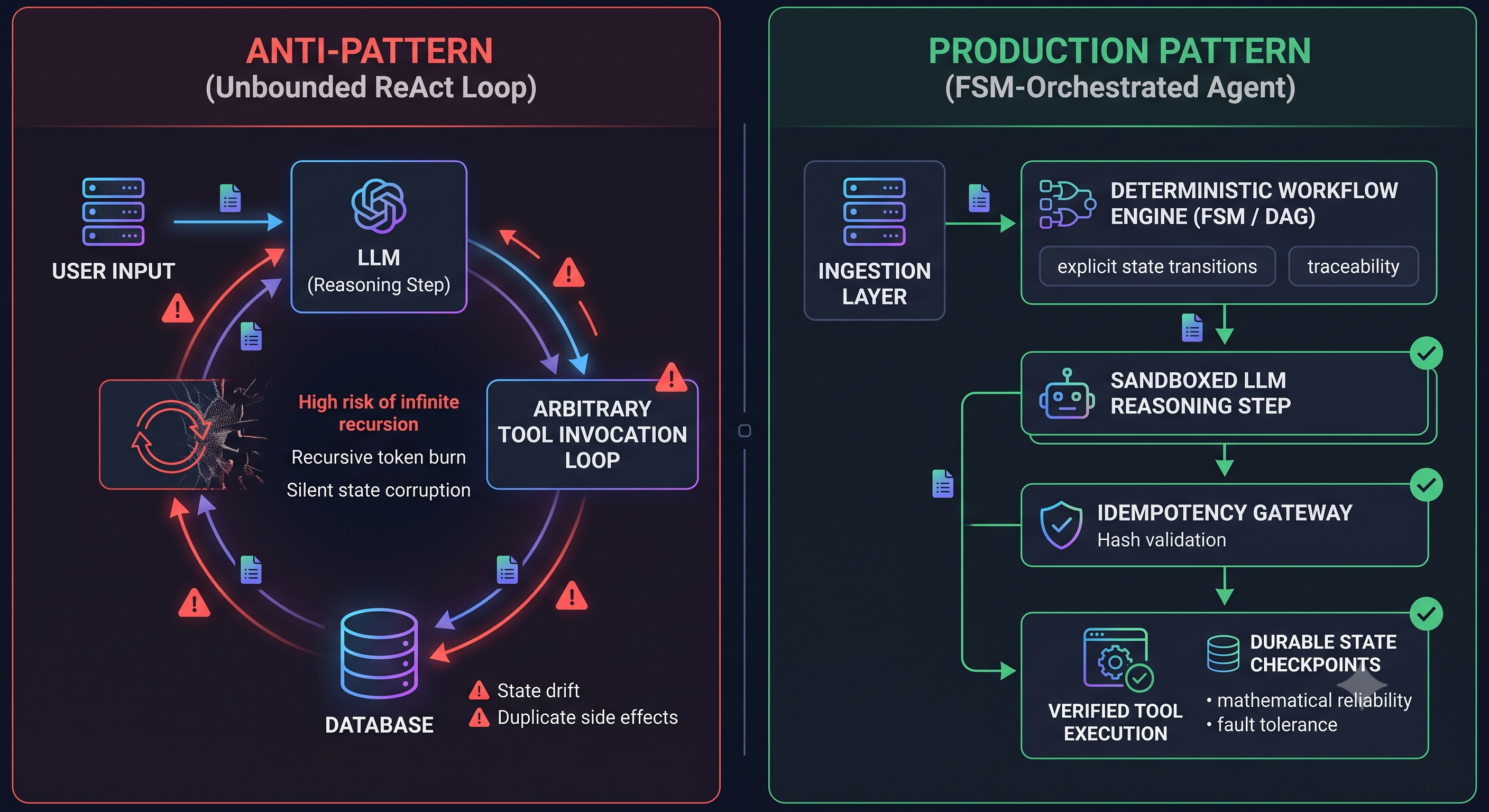
1. Transition from Dynamic ReAct Loops to Constrained State Machines
The Pitfall: Letting a reasoning model decide both what action to take and which state to transition to next without boundaries. A 3% reasoning error on step 2 cascades into a 40%+ failure rate across a 5-step transaction.
The Engineering Fix: Use structured workflow orchestrators (e.g., Temporal, LangGraph, or custom DAG engines). The LLM is restricted to deciding arguments for localized, state-bound tasks, while the state transitions themselves follow an explicit, deterministic finite-state machine (FSM).
2. Idempotency Keys at the Tool-Calling Gateway
The Pitfall: Network timeouts or retry loops causing duplicate tool calls (e.g., initiating duplicate Stripe charges or re-triggering webhook dispatches).
The Engineering Fix: Treat every tool call emitted by an LLM as an unverified I/O event. Require every tool invocation to generate a deterministic idempotency key computed from:
Hash Session ID+ Agent Step ID + Tool Name +Canonicalized Input Payload
Downstream service endpoints validate this hash against an in-memory cache (e.g., Redis) before executing any state-mutating operation.
3. Semantic Fallbacks vs. Raw Retries
The Pitfall: Repeatedly sending the exact same payload back to a model after a parsing error or tool invocation failure.
The Engineering Fix: Implement a structured recovery hierarchy:
Schema Correction Layer: Fix malformed JSON outputs locally using schema validators (Pydantic/Zod) before pinging the model again.
Model Downgrade / Switch: Route validation retries to a faster, structured-output-specialized endpoint or fallback reasoning model.
Human-in-the-Loop (HITL) Interruption: Persist execution state to durable storage and emit an asynchronous approval ticket if recovery fails twice.
Discussion Question
How is your engineering team handling multi-step agent failures—are you enforcing hard-coded workflow DAGs with localized LLM reasoning, or relying on runtime model-directed planning with guardrails?
CTA (Join Techawks USA)
Architecting and scaling production-grade systems in the US tech ecosystem? Join Techawks USA to connect with lead architects, systems engineers, and founders engineering next-generation infrastructure. Follow our page and join our community today!
As US engineering teams move from generative prototypes to agentic workflows, the core architectural challenge is no longer prompt tuning—it is state boundary management.
When an autonomous agent dynamically plans its execution graph, non-deterministic branching makes traditional idempotency, circuit breaking, and distributed tracing break down.
Here is how senior backend and platform engineers are structuring reliable agentic execution layers:
1. Transition from Dynamic ReAct Loops to Constrained State Machines
The Pitfall: Letting a reasoning model decide both what action to take and which state to transition to next without boundaries. A 3% reasoning error on step 2 cascades into a 40%+ failure rate across a 5-step transaction.
The Engineering Fix: Use structured workflow orchestrators (e.g., Temporal, LangGraph, or custom DAG engines). The LLM is restricted to deciding arguments for localized, state-bound tasks, while the state transitions themselves follow an explicit, deterministic finite-state machine (FSM).
2. Idempotency Keys at the Tool-Calling Gateway
The Pitfall: Network timeouts or retry loops causing duplicate tool calls (e.g., initiating duplicate Stripe charges or re-triggering webhook dispatches).
The Engineering Fix: Treat every tool call emitted by an LLM as an unverified I/O event. Require every tool invocation to generate a deterministic idempotency key computed from:
Hash Session ID+ Agent Step ID + Tool Name +Canonicalized Input Payload
Downstream service endpoints validate this hash against an in-memory cache (e.g., Redis) before executing any state-mutating operation.
3. Semantic Fallbacks vs. Raw Retries
The Pitfall: Repeatedly sending the exact same payload back to a model after a parsing error or tool invocation failure.
The Engineering Fix: Implement a structured recovery hierarchy:
Schema Correction Layer: Fix malformed JSON outputs locally using schema validators (Pydantic/Zod) before pinging the model again.
Model Downgrade / Switch: Route validation retries to a faster, structured-output-specialized endpoint or fallback reasoning model.
Human-in-the-Loop (HITL) Interruption: Persist execution state to durable storage and emit an asynchronous approval ticket if recovery fails twice.
Discussion Question
How is your engineering team handling multi-step agent failures—are you enforcing hard-coded workflow DAGs with localized LLM reasoning, or relying on runtime model-directed planning with guardrails?
CTA (Join Techawks USA)
Architecting and scaling production-grade systems in the US tech ecosystem? Join Techawks USA to connect with lead architects, systems engineers, and founders engineering next-generation infrastructure. Follow our page and join our community today!
Beyond the ReAct Loop: Designing Deterministic State Machines for Production AI Agents
As US engineering teams move from generative prototypes to agentic workflows, the core architectural challenge is no longer prompt tuning—it is state boundary management.
When an autonomous agent dynamically plans its execution graph, non-deterministic branching makes traditional idempotency, circuit breaking, and distributed tracing break down.
Here is how senior backend and platform engineers are structuring reliable agentic execution layers:
1. Transition from Dynamic ReAct Loops to Constrained State Machines
The Pitfall: Letting a reasoning model decide both what action to take and which state to transition to next without boundaries. A 3% reasoning error on step 2 cascades into a 40%+ failure rate across a 5-step transaction.
The Engineering Fix: Use structured workflow orchestrators (e.g., Temporal, LangGraph, or custom DAG engines). The LLM is restricted to deciding arguments for localized, state-bound tasks, while the state transitions themselves follow an explicit, deterministic finite-state machine (FSM).
2. Idempotency Keys at the Tool-Calling Gateway
The Pitfall: Network timeouts or retry loops causing duplicate tool calls (e.g., initiating duplicate Stripe charges or re-triggering webhook dispatches).
The Engineering Fix: Treat every tool call emitted by an LLM as an unverified I/O event. Require every tool invocation to generate a deterministic idempotency key computed from:
Hash Session ID+ Agent Step ID + Tool Name +Canonicalized Input Payload
Downstream service endpoints validate this hash against an in-memory cache (e.g., Redis) before executing any state-mutating operation.
3. Semantic Fallbacks vs. Raw Retries
The Pitfall: Repeatedly sending the exact same payload back to a model after a parsing error or tool invocation failure.
The Engineering Fix: Implement a structured recovery hierarchy:
Schema Correction Layer: Fix malformed JSON outputs locally using schema validators (Pydantic/Zod) before pinging the model again.
Model Downgrade / Switch: Route validation retries to a faster, structured-output-specialized endpoint or fallback reasoning model.
Human-in-the-Loop (HITL) Interruption: Persist execution state to durable storage and emit an asynchronous approval ticket if recovery fails twice.
Discussion Question
How is your engineering team handling multi-step agent failures—are you enforcing hard-coded workflow DAGs with localized LLM reasoning, or relying on runtime model-directed planning with guardrails?
CTA (Join Techawks USA)
Architecting and scaling production-grade systems in the US tech ecosystem? Join Techawks USA to connect with lead architects, systems engineers, and founders engineering next-generation infrastructure. Follow our page and join our community today!

 Arabic
 French
 Spanish
 Portuguese
 Deutsch
 Turkish
 Dutch
Dutch
 Italiano
 Russian
 Romaian
 Portuguese (Brazil)
 Greek
Greek