


Why Reference Free Alignment With SimPO Is Replacing DPO in Production Fine Tuning
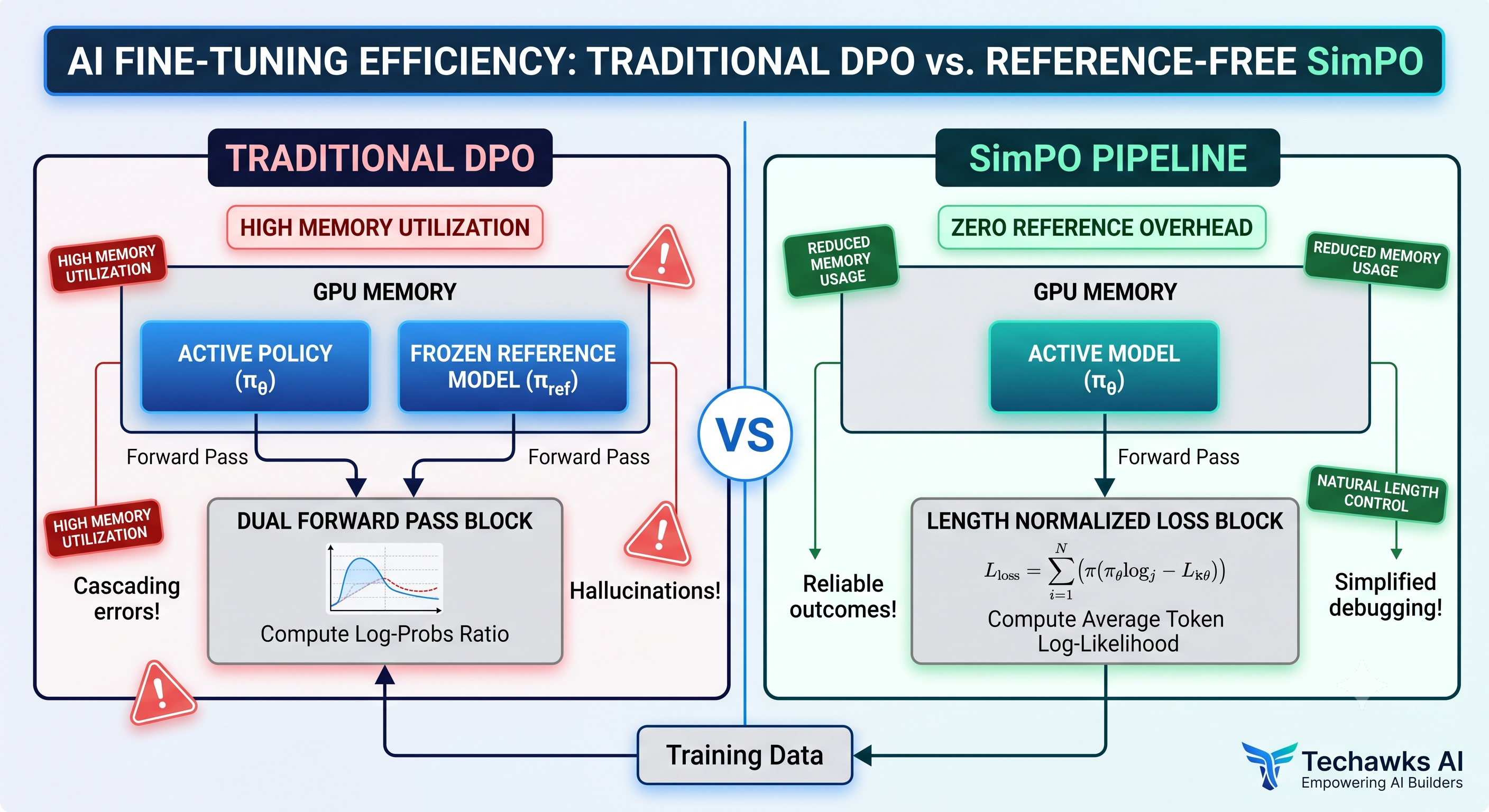
When aligning open weight language models, standard Direct Preference Optimization optimizes an active policy by measuring its outputs against a duplicate, frozen reference model.
While effective, this introduces two major bottlenecks in production engineering pipelines:
Memory and Compute Overhead: You must store a static clone of your base model in GPU memory and run two forward passes per sample, one for the active model and one for the reference model.
Length Exploitation Bias: Standard preference methods often favor longer answers because unnormalized probabilities decline with sequence length, causing the model to generate unnecessarily verbose responses to maximize reward scores.
The Architectural Shift: Simple Preference Optimization
Simple Preference Optimization aligns models directly by using average token log likelihood as the core reward metric, removing the reference model from memory.
Reference Free Target: The reward score is derived entirely from the active model by calculating its average probability per token.
Length Normalization: Dividing the score by the total token length ensures that concise and direct answers compete fairly with longer responses.
Explicit Target Reward Margin: A fixed numerical separation margin is enforced between winning and losing responses to prevent reward collapse and guarantee distinct decision boundaries.
Key Engineering Takeaways for Builders
Lower Memory Footprint: Removing the reference model frees up roughly forty to fifty percent of GPU memory, allowing teams to double training batch sizes or fine tune larger architectures on single node setups.
Natural Length Control: Built in sequence length normalization prevents the model from artificially padding responses to exploit loss functions.
Practical Deployment: Engineers can achieve competitive alignment benchmarks with simpler loss computation and faster iteration cycles.
Discussion Question
For teams actively fine tuning open weight models, are you still using traditional reference based pipelines, or have you tested reference free alignment methods? What trade offs have you observed in downstream benchmark accuracy?
CTA
Ready to dive deep into cutting edge AI architecture, fine tuning frameworks, and inference optimization?
Join the AI Builders and Enthusiasts Community
When aligning open weight language models, standard Direct Preference Optimization optimizes an active policy by measuring its outputs against a duplicate, frozen reference model.
While effective, this introduces two major bottlenecks in production engineering pipelines:
Memory and Compute Overhead: You must store a static clone of your base model in GPU memory and run two forward passes per sample, one for the active model and one for the reference model.
Length Exploitation Bias: Standard preference methods often favor longer answers because unnormalized probabilities decline with sequence length, causing the model to generate unnecessarily verbose responses to maximize reward scores.
The Architectural Shift: Simple Preference Optimization
Simple Preference Optimization aligns models directly by using average token log likelihood as the core reward metric, removing the reference model from memory.
Reference Free Target: The reward score is derived entirely from the active model by calculating its average probability per token.
Length Normalization: Dividing the score by the total token length ensures that concise and direct answers compete fairly with longer responses.
Explicit Target Reward Margin: A fixed numerical separation margin is enforced between winning and losing responses to prevent reward collapse and guarantee distinct decision boundaries.
Key Engineering Takeaways for Builders
Lower Memory Footprint: Removing the reference model frees up roughly forty to fifty percent of GPU memory, allowing teams to double training batch sizes or fine tune larger architectures on single node setups.
Natural Length Control: Built in sequence length normalization prevents the model from artificially padding responses to exploit loss functions.
Practical Deployment: Engineers can achieve competitive alignment benchmarks with simpler loss computation and faster iteration cycles.
Discussion Question
For teams actively fine tuning open weight models, are you still using traditional reference based pipelines, or have you tested reference free alignment methods? What trade offs have you observed in downstream benchmark accuracy?
CTA
Ready to dive deep into cutting edge AI architecture, fine tuning frameworks, and inference optimization?
Join the AI Builders and Enthusiasts Community
Why Reference Free Alignment With SimPO Is Replacing DPO in Production Fine Tuning
When aligning open weight language models, standard Direct Preference Optimization optimizes an active policy by measuring its outputs against a duplicate, frozen reference model.
While effective, this introduces two major bottlenecks in production engineering pipelines:
Memory and Compute Overhead: You must store a static clone of your base model in GPU memory and run two forward passes per sample, one for the active model and one for the reference model.
Length Exploitation Bias: Standard preference methods often favor longer answers because unnormalized probabilities decline with sequence length, causing the model to generate unnecessarily verbose responses to maximize reward scores.
The Architectural Shift: Simple Preference Optimization
Simple Preference Optimization aligns models directly by using average token log likelihood as the core reward metric, removing the reference model from memory.
Reference Free Target: The reward score is derived entirely from the active model by calculating its average probability per token.
Length Normalization: Dividing the score by the total token length ensures that concise and direct answers compete fairly with longer responses.
Explicit Target Reward Margin: A fixed numerical separation margin is enforced between winning and losing responses to prevent reward collapse and guarantee distinct decision boundaries.
Key Engineering Takeaways for Builders
Lower Memory Footprint: Removing the reference model frees up roughly forty to fifty percent of GPU memory, allowing teams to double training batch sizes or fine tune larger architectures on single node setups.
Natural Length Control: Built in sequence length normalization prevents the model from artificially padding responses to exploit loss functions.
Practical Deployment: Engineers can achieve competitive alignment benchmarks with simpler loss computation and faster iteration cycles.
Discussion Question
For teams actively fine tuning open weight models, are you still using traditional reference based pipelines, or have you tested reference free alignment methods? What trade offs have you observed in downstream benchmark accuracy?
CTA
Ready to dive deep into cutting edge AI architecture, fine tuning frameworks, and inference optimization?
Join the AI Builders and Enthusiasts Community

 Arabic
 French
 Spanish
 Portuguese
 Deutsch
 Turkish
 Dutch
Dutch
 Italiano
 Russian
 Romaian
 Portuguese (Brazil)
 Greek
Greek