


The LeetCode Era Is Shifting: How to Pass Modern AI-Assisted Technical Interviews
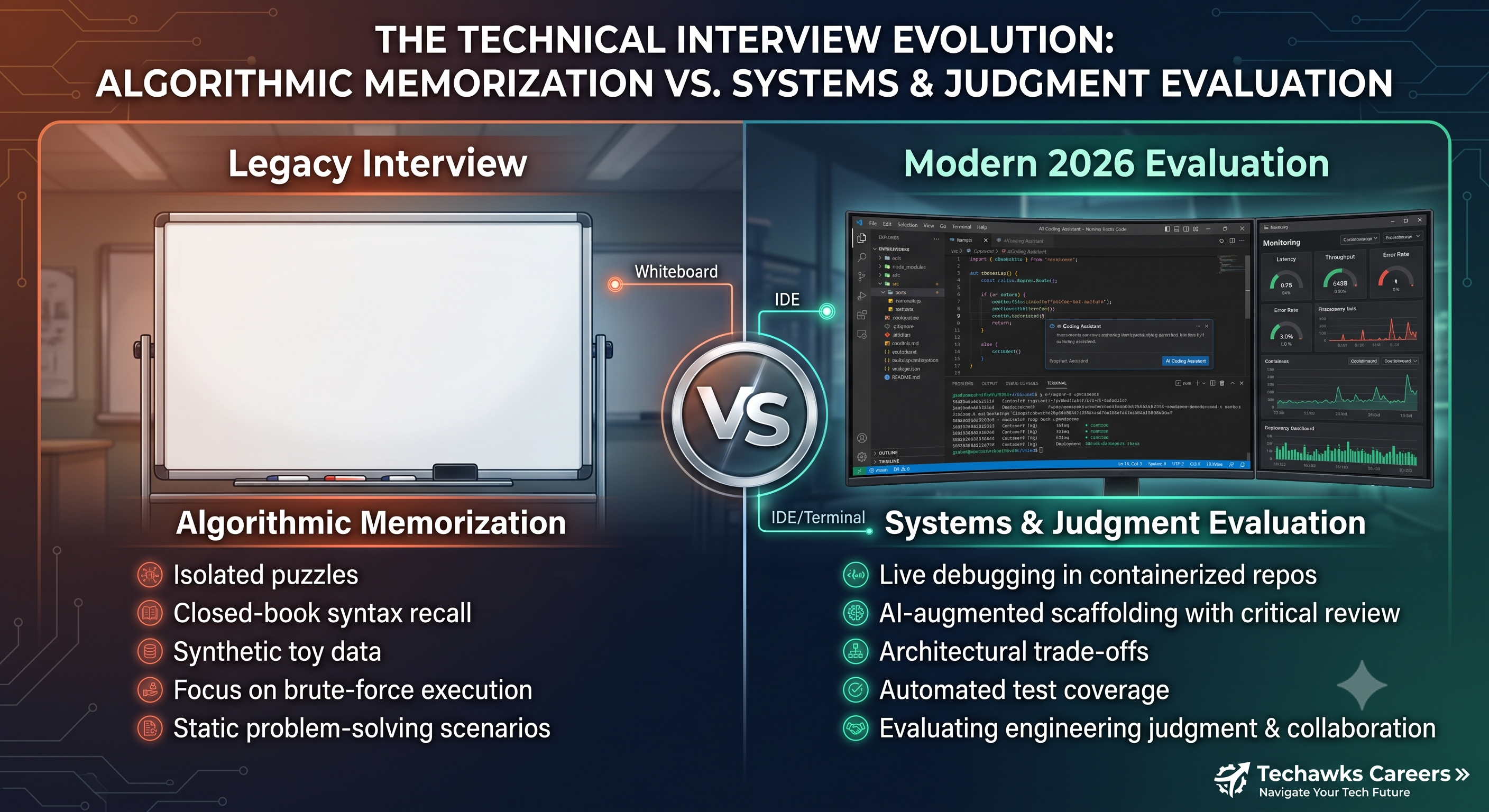
In the current hiring market, boilerplate syntax and memorized sorting algorithms are commoditized. Top engineering teams no longer evaluate how fast you can type from memory—they test your engineering judgment, code review rigor, and systems comprehension.
In a modern 60-minute technical evaluation, candidates are increasingly given a pre-existing, containerized repo with an active AI coding assistant and asked to debug a realistic production issue or implement a complex feature.
The 4 Signals That Get Candidates Hired Now:
Prompt & Critique Over Pure Typing:
Old way: Manually scaffolding boilerplate data structures.
New expectation: Using AI to scaffold, but immediately spotting subtle edge-case bugs, security vulnerabilities, or off-by-one errors in generated code before accepting it.
Root-Cause Debugging & Observability:
Can you read unfamiliar service logs, trace an API bottleneck with a debugger, and reproduce a bug under specific network constraints?
Demonstrating command over terminal tooling and runtime diagnostics signals production readiness faster than raw syntax speed.
System Boundary & Trade-off Articulation:
Senior compensation packages hinge on answering why, not just how.
You must clearly communicate the latency, memory, cost, and eventual consistency trade-offs of architectural decisions during the live session.
Testing & Defensive Engineering:
Submitting code without automated regression tests is an immediate red flag.
Writing targeted integration tests and handling error envelopes proves you write maintainable software for teams, not throwaway demo scripts.
Career Takeaway: Stop treating interview prep as algorithmic memorization. Treat it as simulated production engineering: navigate unfamiliar open-source repos, refactor legacy code, and practice defending architectural choices out loud.
Discussion Question
Have you experienced the shift toward open-IDE or AI-assisted interviews in your recent job hunt? Which format do you believe provides a fairer assessment of real engineering capability?
CTA
Looking to level up your interview preparation, land high-impact tech roles, and access vetted engineering openings?
👉 Join Tech Jobs & Opportunities at Techawks:
In the current hiring market, boilerplate syntax and memorized sorting algorithms are commoditized. Top engineering teams no longer evaluate how fast you can type from memory—they test your engineering judgment, code review rigor, and systems comprehension.
In a modern 60-minute technical evaluation, candidates are increasingly given a pre-existing, containerized repo with an active AI coding assistant and asked to debug a realistic production issue or implement a complex feature.
The 4 Signals That Get Candidates Hired Now:
Prompt & Critique Over Pure Typing:
Old way: Manually scaffolding boilerplate data structures.
New expectation: Using AI to scaffold, but immediately spotting subtle edge-case bugs, security vulnerabilities, or off-by-one errors in generated code before accepting it.
Root-Cause Debugging & Observability:
Can you read unfamiliar service logs, trace an API bottleneck with a debugger, and reproduce a bug under specific network constraints?
Demonstrating command over terminal tooling and runtime diagnostics signals production readiness faster than raw syntax speed.
System Boundary & Trade-off Articulation:
Senior compensation packages hinge on answering why, not just how.
You must clearly communicate the latency, memory, cost, and eventual consistency trade-offs of architectural decisions during the live session.
Testing & Defensive Engineering:
Submitting code without automated regression tests is an immediate red flag.
Writing targeted integration tests and handling error envelopes proves you write maintainable software for teams, not throwaway demo scripts.
Career Takeaway: Stop treating interview prep as algorithmic memorization. Treat it as simulated production engineering: navigate unfamiliar open-source repos, refactor legacy code, and practice defending architectural choices out loud.
Discussion Question
Have you experienced the shift toward open-IDE or AI-assisted interviews in your recent job hunt? Which format do you believe provides a fairer assessment of real engineering capability?
CTA
Looking to level up your interview preparation, land high-impact tech roles, and access vetted engineering openings?
👉 Join Tech Jobs & Opportunities at Techawks:
The LeetCode Era Is Shifting: How to Pass Modern AI-Assisted Technical Interviews
In the current hiring market, boilerplate syntax and memorized sorting algorithms are commoditized. Top engineering teams no longer evaluate how fast you can type from memory—they test your engineering judgment, code review rigor, and systems comprehension.
In a modern 60-minute technical evaluation, candidates are increasingly given a pre-existing, containerized repo with an active AI coding assistant and asked to debug a realistic production issue or implement a complex feature.
The 4 Signals That Get Candidates Hired Now:
Prompt & Critique Over Pure Typing:
Old way: Manually scaffolding boilerplate data structures.
New expectation: Using AI to scaffold, but immediately spotting subtle edge-case bugs, security vulnerabilities, or off-by-one errors in generated code before accepting it.
Root-Cause Debugging & Observability:
Can you read unfamiliar service logs, trace an API bottleneck with a debugger, and reproduce a bug under specific network constraints?
Demonstrating command over terminal tooling and runtime diagnostics signals production readiness faster than raw syntax speed.
System Boundary & Trade-off Articulation:
Senior compensation packages hinge on answering why, not just how.
You must clearly communicate the latency, memory, cost, and eventual consistency trade-offs of architectural decisions during the live session.
Testing & Defensive Engineering:
Submitting code without automated regression tests is an immediate red flag.
Writing targeted integration tests and handling error envelopes proves you write maintainable software for teams, not throwaway demo scripts.
Career Takeaway: Stop treating interview prep as algorithmic memorization. Treat it as simulated production engineering: navigate unfamiliar open-source repos, refactor legacy code, and practice defending architectural choices out loud.
Discussion Question
Have you experienced the shift toward open-IDE or AI-assisted interviews in your recent job hunt? Which format do you believe provides a fairer assessment of real engineering capability?
CTA
Looking to level up your interview preparation, land high-impact tech roles, and access vetted engineering openings?
👉 Join Tech Jobs & Opportunities at Techawks:

 Arabic
 French
 Spanish
 Portuguese
 Deutsch
 Turkish
 Dutch
Dutch
 Italiano
 Russian
 Romaian
 Portuguese (Brazil)
 Greek
Greek