


Monolith vs. Microservices in 2026: What’s the Right Choice for Indian Startups?
Over the last few years, microservices became the default answer for backend design. But as many Indian engineering teams scale from early stage to series A and beyond, they are discovering that breaking a system into dozens of independent services too early introduces massive operational overhead, complex distributed tracing, and inflated cloud bills.
Choosing the right architectural strategy isn't about following tech trends; it's about matching your system design to your team's size, domain clarity, and operational maturity. Here is how to evaluate where your team stands:
The Modular Monolith Advantage
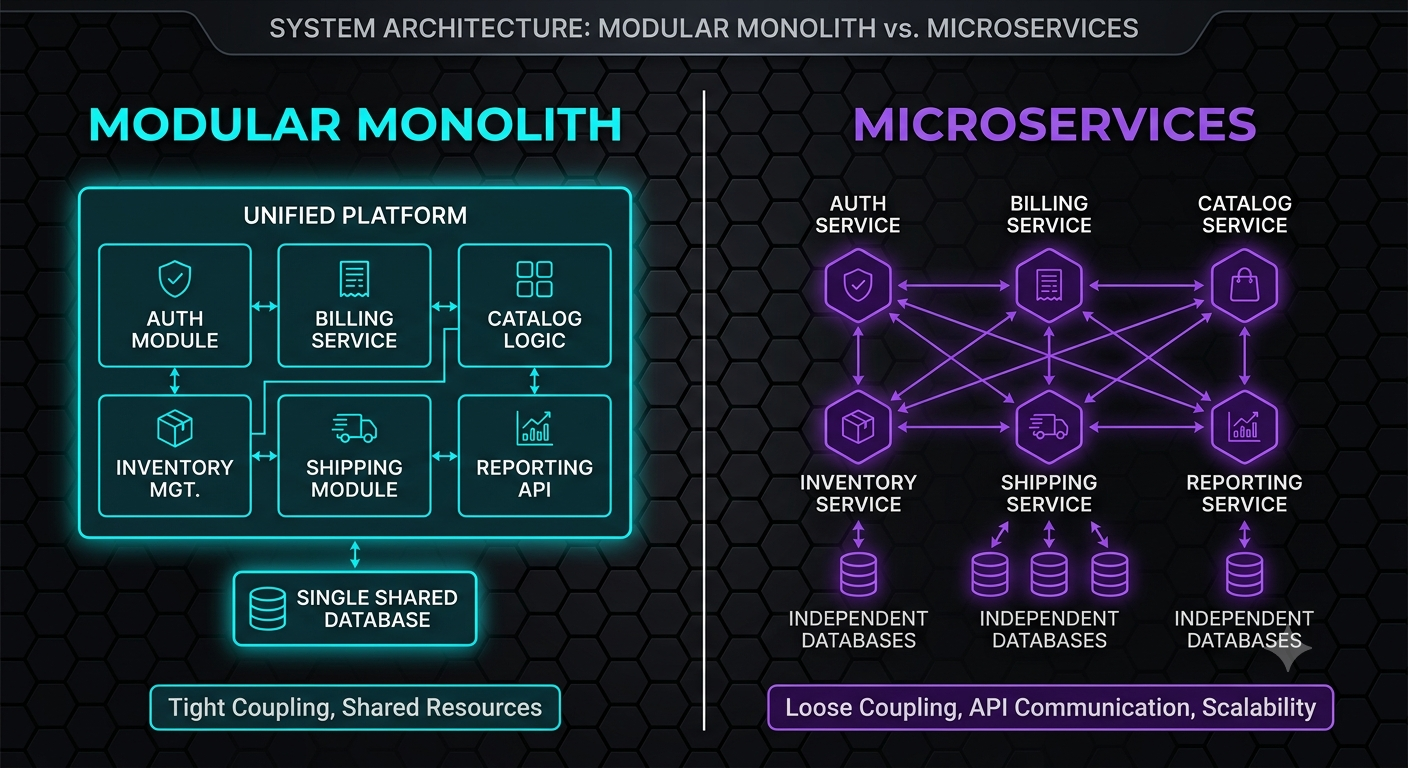
If your engineering team is under 20 developers or your product domain is still evolving, a well-structured "Modular Monolith" is often the most practical path. You get fast deployment cycles, simple single-database transactions, and straightforward debugging while keeping code boundaries clean for future extraction.
When to Transition to Microservices
Microservices shine when different parts of your system have vastly different scaling requirements (e.g., high-throughput payment processing vs. low-traffic admin dashboards) or when separate domain teams need to deploy independently without blocking each other.
The Hidden Cost of premature Abstraction
Splitting services prematurely forces you to handle network latency, distributed transactions (Saga pattern), complex API versioning, and service mesh management before you even hit product-market fit.
Instead of asking "Should we use microservices?", ask "What exact operational bottleneck are we solving by splitting this service right now?"
Key Takeaways
Start with a Modular Monolith unless clear organizational or scaling boundaries force a split.
Microservices solve team autonomy and selective scaling challenges, not code quality issues.
Distributed complexity should only be introduced when the cost of a monolithic deployment outweighs the operational cost of managing microservices.
CTA (Join Techawks India)
Where does your team stand on this debate? Have you recently migrated to microservices—or moved back to a monolith? Drop your thoughts in the comments below, and Join Techawks India to connect with senior engineers and tech leaders shaping backend architecture across the country.
Over the last few years, microservices became the default answer for backend design. But as many Indian engineering teams scale from early stage to series A and beyond, they are discovering that breaking a system into dozens of independent services too early introduces massive operational overhead, complex distributed tracing, and inflated cloud bills.
Choosing the right architectural strategy isn't about following tech trends; it's about matching your system design to your team's size, domain clarity, and operational maturity. Here is how to evaluate where your team stands:
The Modular Monolith Advantage
If your engineering team is under 20 developers or your product domain is still evolving, a well-structured "Modular Monolith" is often the most practical path. You get fast deployment cycles, simple single-database transactions, and straightforward debugging while keeping code boundaries clean for future extraction.
When to Transition to Microservices
Microservices shine when different parts of your system have vastly different scaling requirements (e.g., high-throughput payment processing vs. low-traffic admin dashboards) or when separate domain teams need to deploy independently without blocking each other.
The Hidden Cost of premature Abstraction
Splitting services prematurely forces you to handle network latency, distributed transactions (Saga pattern), complex API versioning, and service mesh management before you even hit product-market fit.
Instead of asking "Should we use microservices?", ask "What exact operational bottleneck are we solving by splitting this service right now?"
Key Takeaways
Start with a Modular Monolith unless clear organizational or scaling boundaries force a split.
Microservices solve team autonomy and selective scaling challenges, not code quality issues.
Distributed complexity should only be introduced when the cost of a monolithic deployment outweighs the operational cost of managing microservices.
CTA (Join Techawks India)
Where does your team stand on this debate? Have you recently migrated to microservices—or moved back to a monolith? Drop your thoughts in the comments below, and Join Techawks India to connect with senior engineers and tech leaders shaping backend architecture across the country.
Monolith vs. Microservices in 2026: What’s the Right Choice for Indian Startups?
Over the last few years, microservices became the default answer for backend design. But as many Indian engineering teams scale from early stage to series A and beyond, they are discovering that breaking a system into dozens of independent services too early introduces massive operational overhead, complex distributed tracing, and inflated cloud bills.
Choosing the right architectural strategy isn't about following tech trends; it's about matching your system design to your team's size, domain clarity, and operational maturity. Here is how to evaluate where your team stands:
The Modular Monolith Advantage
If your engineering team is under 20 developers or your product domain is still evolving, a well-structured "Modular Monolith" is often the most practical path. You get fast deployment cycles, simple single-database transactions, and straightforward debugging while keeping code boundaries clean for future extraction.
When to Transition to Microservices
Microservices shine when different parts of your system have vastly different scaling requirements (e.g., high-throughput payment processing vs. low-traffic admin dashboards) or when separate domain teams need to deploy independently without blocking each other.
The Hidden Cost of premature Abstraction
Splitting services prematurely forces you to handle network latency, distributed transactions (Saga pattern), complex API versioning, and service mesh management before you even hit product-market fit.
Instead of asking "Should we use microservices?", ask "What exact operational bottleneck are we solving by splitting this service right now?"
Key Takeaways
Start with a Modular Monolith unless clear organizational or scaling boundaries force a split.
Microservices solve team autonomy and selective scaling challenges, not code quality issues.
Distributed complexity should only be introduced when the cost of a monolithic deployment outweighs the operational cost of managing microservices.
CTA (Join Techawks India)
Where does your team stand on this debate? Have you recently migrated to microservices—or moved back to a monolith? Drop your thoughts in the comments below, and Join Techawks India to connect with senior engineers and tech leaders shaping backend architecture across the country.

 English
 Arabic
 French
 Spanish
 Portuguese
 Deutsch
 Turkish
 Dutch
Dutch
 Italiano
 Russian
 Portuguese (Brazil)
 Greek
Greek